
GDPR and AI customer support: what the regulation asks of you
 Communicate.so
GDPR and AI customer support explained: lawful basis, retention, subprocessors, and the right to erasure when data lives inside a retrieval index.
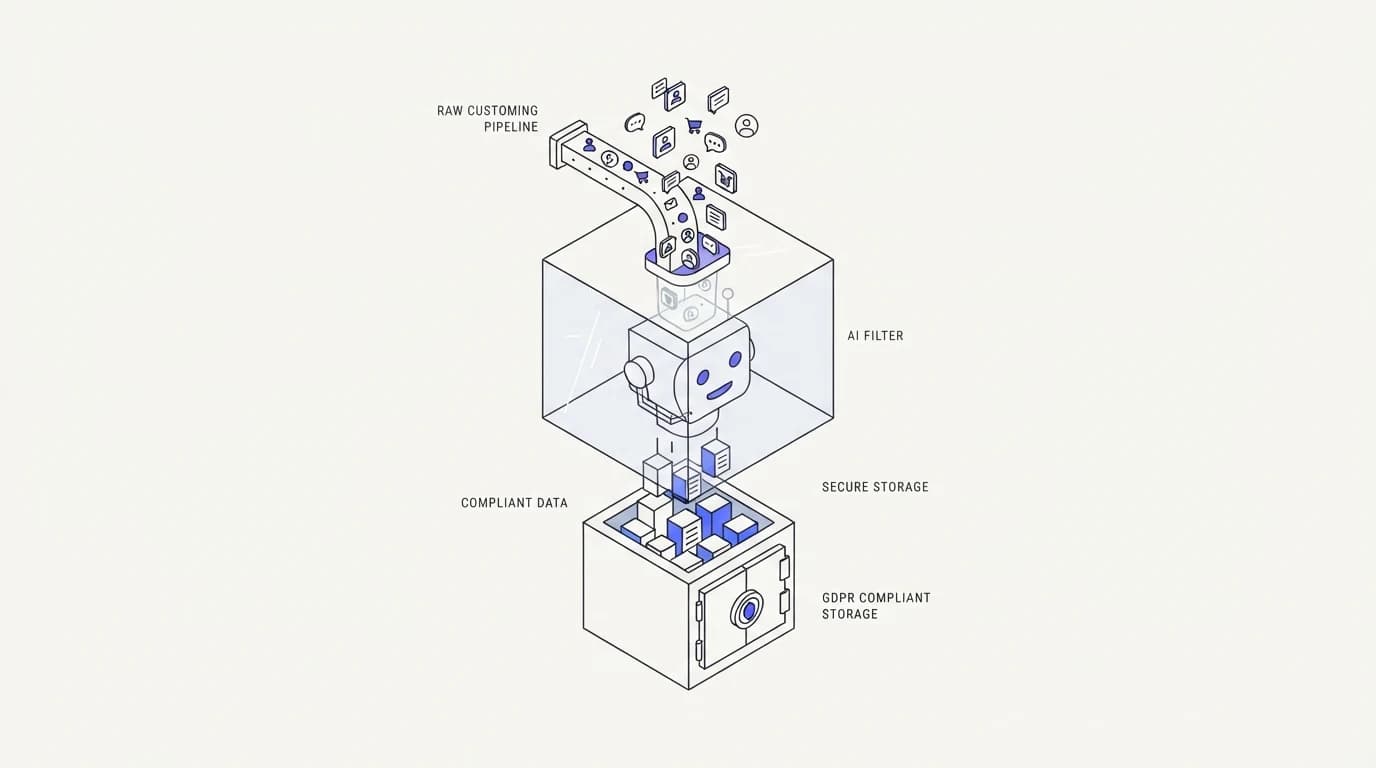
TL;DR: The General Data Protection Regulation governs how a business collects, uses, and retains personal data for anyone in the European Union, and an AI support agent processing customer conversations sits squarely inside its scope. This guide is an educational explainer, not legal advice, walking through four practical questions an AI support deployment has to answer: what lawful basis justifies processing the conversation, how long the data is kept, what a subprocessor is and why your AI vendor is probably one, and what erasure means when a customer's data has been embedded into a retrieval index rather than stored as a plain record. None of these questions are unique to AI, but AI support raises them in a sharper form, because a retrieval pipeline can make a customer's words harder to locate and delete than a row in a database. The regulation does not forbid AI support. It asks you to be able to answer these four questions plainly, and building that ability in from the start is far cheaper than retrofitting it after a request arrives. Confirm every specific obligation that applies to your business with qualified counsel.
Any business selling to customers in the European Union that runs an AI agent in support is processing personal data under the GDPR, whether or not anyone on the team has read the regulation. A support conversation is personal data almost by definition: it identifies a person, and it often includes an email, an order, or an account detail alongside it.
This guide is written for the person configuring that agent: a founder, a support lead, or an engineer who needs to understand what the regulation actually asks for, in plain terms, before talking to a lawyer about the specifics that apply to their business. It focuses on four practical questions that come up directly in an AI support deployment: lawful basis, retention, subprocessors, and erasure inside a retrieval system.
This is an educational explainer, not legal advice, and none of it substitutes for a qualified professional who understands your data, your customers, and your obligations. The goal is to help you ask the right questions and build a system that is already close to compliant, so that a real legal review confirms details rather than starting from nothing, a companion piece to the EU AI Act overview of AI-specific obligations.
What GDPR actually covers in an AI support context
The GDPR, formally Regulation (EU) 2016/679, sets rules for how personal data about people in the European Union is collected, used, stored, and shared. It applies based on whose data is processed, not where your company is based, so a business outside the EU serving EU customers is still in scope.
A support conversation handled by an AI agent typically contains personal data: the customer's name, email, and often account or order details volunteered mid-conversation. Once that conversation is stored, retrieved for context in a future session, or used to improve the system, it is being processed under the regulation's definition, a scope confirmed by the official text on EUR-Lex.
None of this means AI support is prohibited or unusually risky compared to any other system that stores customer conversations. A traditional helpdesk holding the same conversations is under the same obligations. What changes with AI is where the data ends up and how hard it can be to locate later, particularly once it has been chunked and embedded into a retrieval index rather than kept as a single readable record.
The four questions this guide answers, lawful basis, retention, subprocessors, and erasure, are the ones that come up first and most concretely when a team actually sits down to configure an AI support system, rather than the full breadth of the regulation. For the wider set of principles behind these four, the European Commission and the EUR-Lex text remain the primary sources to consult directly.
Lawful basis: what justifies processing a support conversation
 Communicate.so
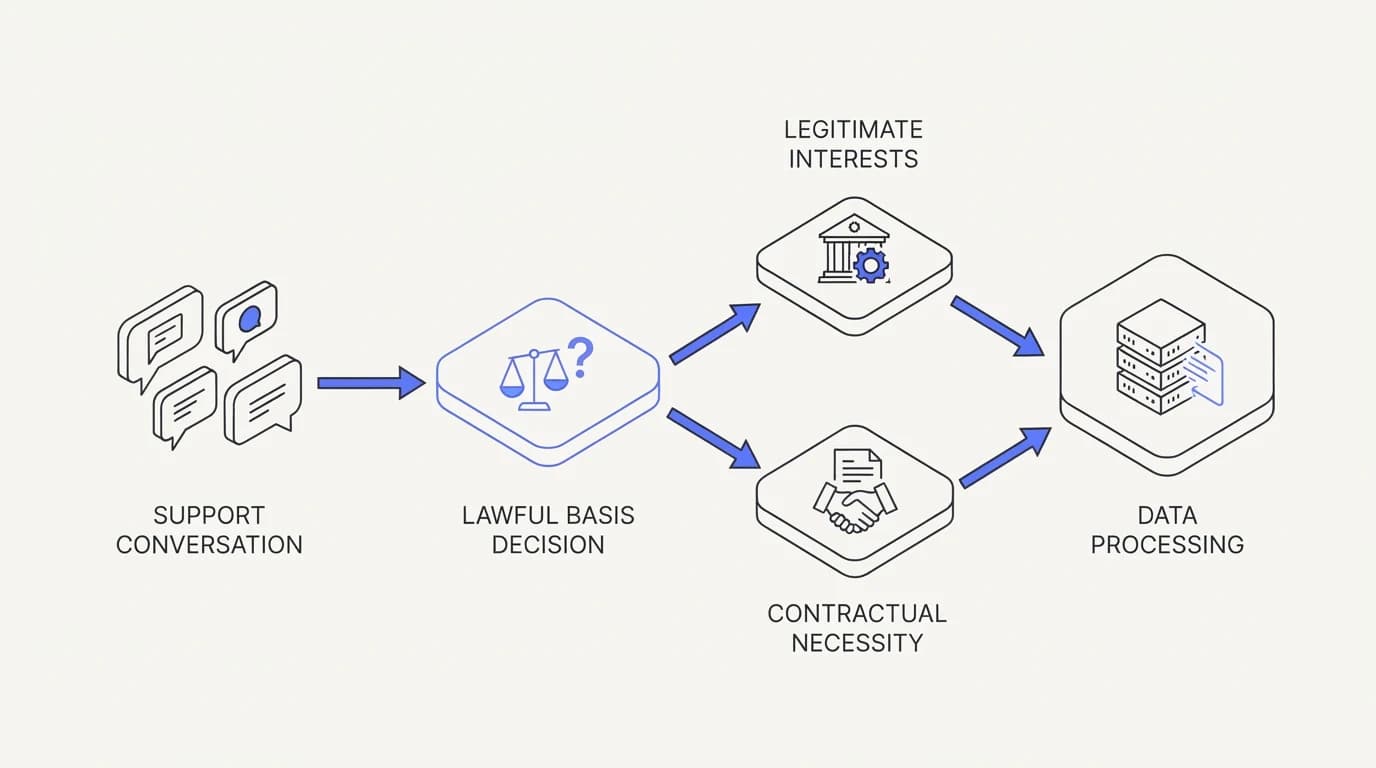
Article 6 of the GDPR requires a lawful basis before personal data can be processed at all, and it names six: consent, contract, legal obligation, vital interests, public task, and legitimate interests, per the official text on EUR-Lex. None of the six is ranked above the others; the right one depends on why the processing is happening.
For most AI support conversations, the relevant basis is either contract or legitimate interests. Contract applies when responding to a customer's support request is necessary to deliver a service they have already signed up for. Legitimate interests can apply when the processing is reasonably expected by the customer and proportionate to the purpose, such as answering their question and keeping a record to resolve it properly.
Consent is a separate path and a narrower one than teams often assume. It has to be freely given, specific, informed, and unambiguous, and it is easy to invalidate by bundling it with unrelated terms or by making it hard to withdraw. Relying on consent for basic support processing, when contract or legitimate interests already covers it more cleanly, tends to create more obligation than it removes, since withdrawn consent can require stopping the very processing needed to help the customer, a nuance worth confirming with the European Commission guidance or counsel before choosing.
The practical takeaway is to identify, in writing, which basis applies to each purpose your AI agent serves: answering the immediate question, improving the system over time, and any marketing use of support data, which is a different purpose requiring its own basis. Treating support and marketing as one undifferentiated pool of data is a common and avoidable source of confusion.
Documenting the basis also has a practical benefit beyond compliance. When a customer or a colleague asks why the agent retained a piece of information, a written answer tied to a named basis is far easier to give than reconstructing the reasoning after the fact, and it keeps the team consistent as new people join and configure new features on top of the same agent.
Retention: how long conversation data should be kept
 Communicate.so
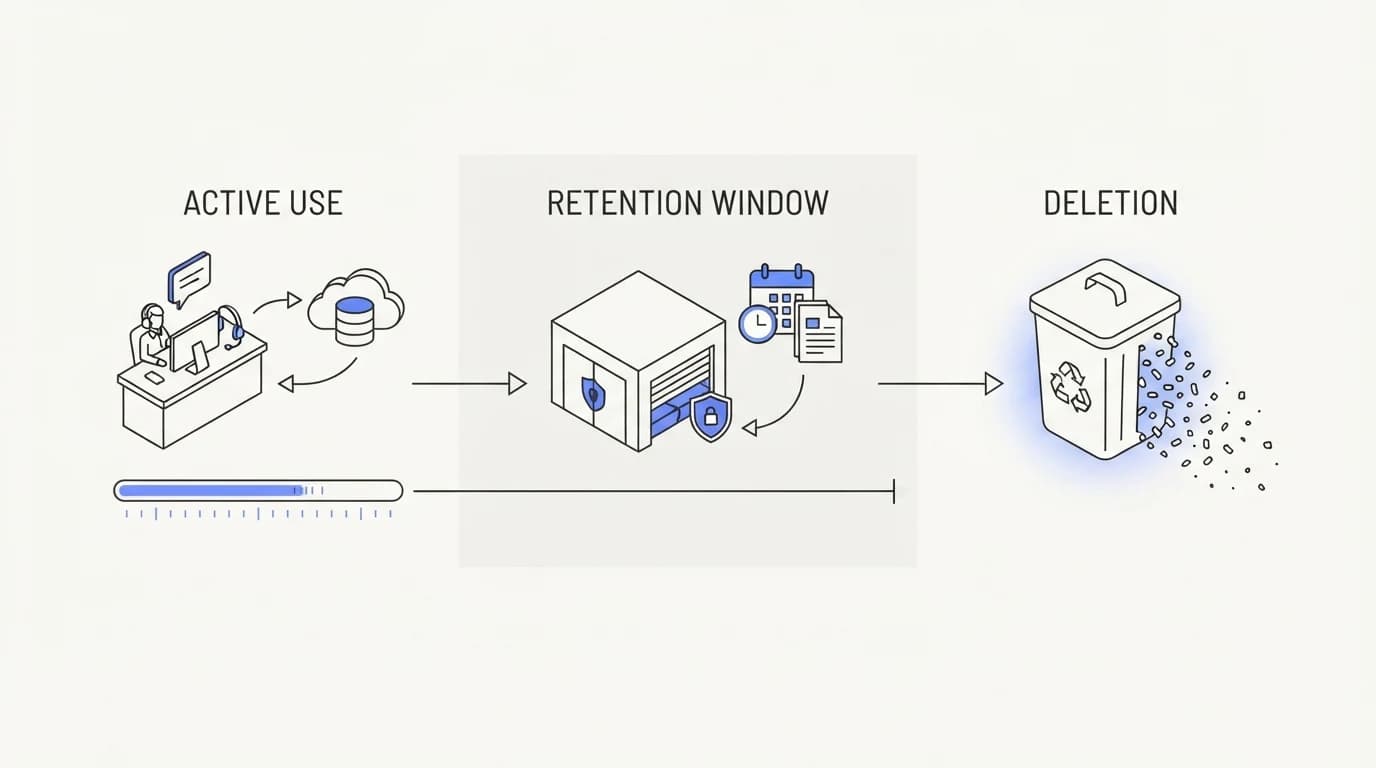
Article 5 of the GDPR sets a storage limitation principle: personal data should be kept in a form permitting identification of the person for no longer than necessary for the purposes it was collected for, according to EUR-Lex. The same article's data minimization principle requires that what is collected be adequate, relevant, and limited to what the purpose actually needs.
For AI support, this means a retention window has to exist and has to be defensible, not left as an indefinite default because a database or a vector index has no built-in expiration. An open-ended retention window is not automatically noncompliant, but it is hard to justify against the necessity standard the moment anyone asks why a two-year-old conversation with no ongoing relevance is still fully retained.
This principle is the same one that governs a support agent's own conversation memory design, covered in depth in conversation memory for a support agent: remember what genuinely serves the purpose, and delete or summarize the rest on a defined schedule rather than an indefinite one. The two articles describe the same discipline from different angles, one as a privacy obligation and one as a product design choice that happens to satisfy it.
A workable pattern is a tiered retention window: full detail while a case is active, a compact summary for a defined period after resolution, and deletion or anonymization once that period closes. The specific lengths are a business judgment informed by how long the data remains useful, not a number this guide can supply, since it depends on your product, your customer relationships, and any parallel obligations, such as billing records, that may require longer retention for unrelated reasons.
Revisit the retention window periodically rather than setting it once at launch and never returning to it. A window that made sense for a small early customer base can become harder to defend once volume grows and the accumulated data starts to look less like a working record and more like an archive nobody is using.
Subprocessors: your AI vendor and the data it touches
Article 28 of the GDPR governs the relationship between a data controller, generally your company, and a processor acting on its behalf, which includes most AI support vendors handling customer conversations, per the EUR-Lex text. The controller may only use processors providing sufficient guarantees that processing meets the regulation's requirements.
If your AI support vendor itself relies on another company, such as a model provider, to process the conversation, that company is a subprocessor. Article 28 requires that a processor not engage a subprocessor without the controller's prior authorization, whether specific or general, and that the original processor remains fully liable if the subprocessor fails to meet its obligations.
The practical question to ask any AI support vendor is simple: who touches this data, and under what agreement. A vendor should be able to name its subprocessors, including the model or infrastructure provider behind the agent's responses, and should have a data processing agreement in place that covers the chain, not just the direct relationship with your company. This is one of the concrete items worth confirming directly on a vendor's security documentation before deployment.
A vague answer to who processes this data is a warning sign independent of the AI question entirely. It is the same question a careful buyer would ask of any vendor handling customer data, and AI support simply adds one more layer, the model provider, to a chain that already existed for hosting, email delivery, and analytics tooling.
Keep a short internal list of every subprocessor in the chain, updated whenever a vendor changes its own suppliers. A list that exists only in a vendor's terms of service, buried and unread, does not help your team answer a customer's question about who handles their data when that question actually arrives, and it is worth reviewing at least once a year even if nothing appears to have changed.
The right to erasure inside a retrieval index
 Communicate.so
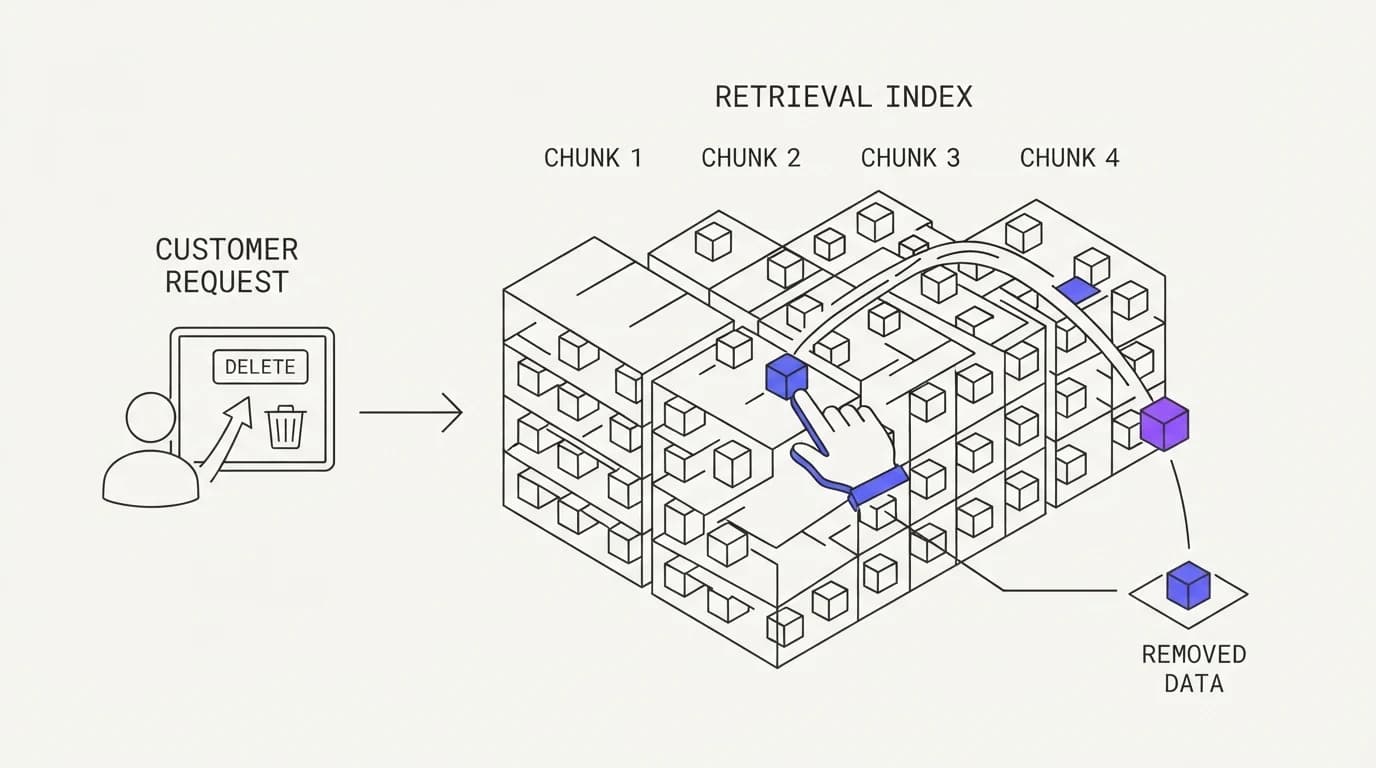
Article 17 of the GDPR gives individuals the right to have their personal data erased without undue delay under specified conditions, such as the data no longer being necessary for the purpose it was collected for, according to EUR-Lex. For a plain database record, honoring this is straightforward: find the row, delete it.
AI support complicates the mechanics without changing the obligation. A conversation used to ground an agent through retrieval-augmented generation may have been chunked, embedded, and stored inside a vector index alongside chunks from many other conversations. Locating and removing one customer's specific chunks from that index is a real engineering problem if the system was not built with that requirement from the start.
This is why the same design advice appears throughout this guide: keep customer-specific data addressable by customer identity from the beginning, whether it lives in a plain table or inside a retrieval pipeline covered in retrieval-augmented generation for customer support. A system with that structure can locate and delete one person's data cleanly. A system without it has to be reverse-engineered under time pressure the first time a real erasure request arrives.
It is worth distinguishing erasure from anonymization here. If a conversation is stripped of anything that identifies the customer, and cannot reasonably be re-linked to them, it may no longer be personal data in the sense the regulation covers, which is a separate path from deletion and one that preserves some analytical value. Whether a given anonymization approach genuinely meets that bar is a technical and legal judgment worth confirming with counsel rather than assuming.
| Question to ask | What it covers | Where to verify |
|---|---|---|
| What lawful basis covers this processing | Article 6: contract, legitimate interests, consent, or others | Written internal record, counsel review |
| How long is conversation data retained | Article 5: storage limitation and data minimization | Documented retention schedule |
| Who processes this data on our behalf | Article 28: processor and subprocessor obligations | Vendor data processing agreement |
| Can we locate and delete one customer record | Article 17: right to erasure | System design, tested deletion path |
| Is data addressable by customer identity | Practical prerequisite for erasure | Architecture review |
| Do we have a data processing agreement with our AI vendor | Article 28 requirement | Signed DPA on file |
| Have we documented the subprocessor chain | Article 28 transparency | Vendor disclosure, contract terms |
| Is retention length defensible against necessity | Article 5 standard | Documented rationale per data type |
Read the table as a working checklist rather than a compliance certificate. Answering every row honestly does not by itself guarantee compliance with every obligation in the regulation, but a team that can answer all eight plainly is in a materially stronger position than one that has never asked them.
Building an AI support system that can answer these questions
 Communicate.so
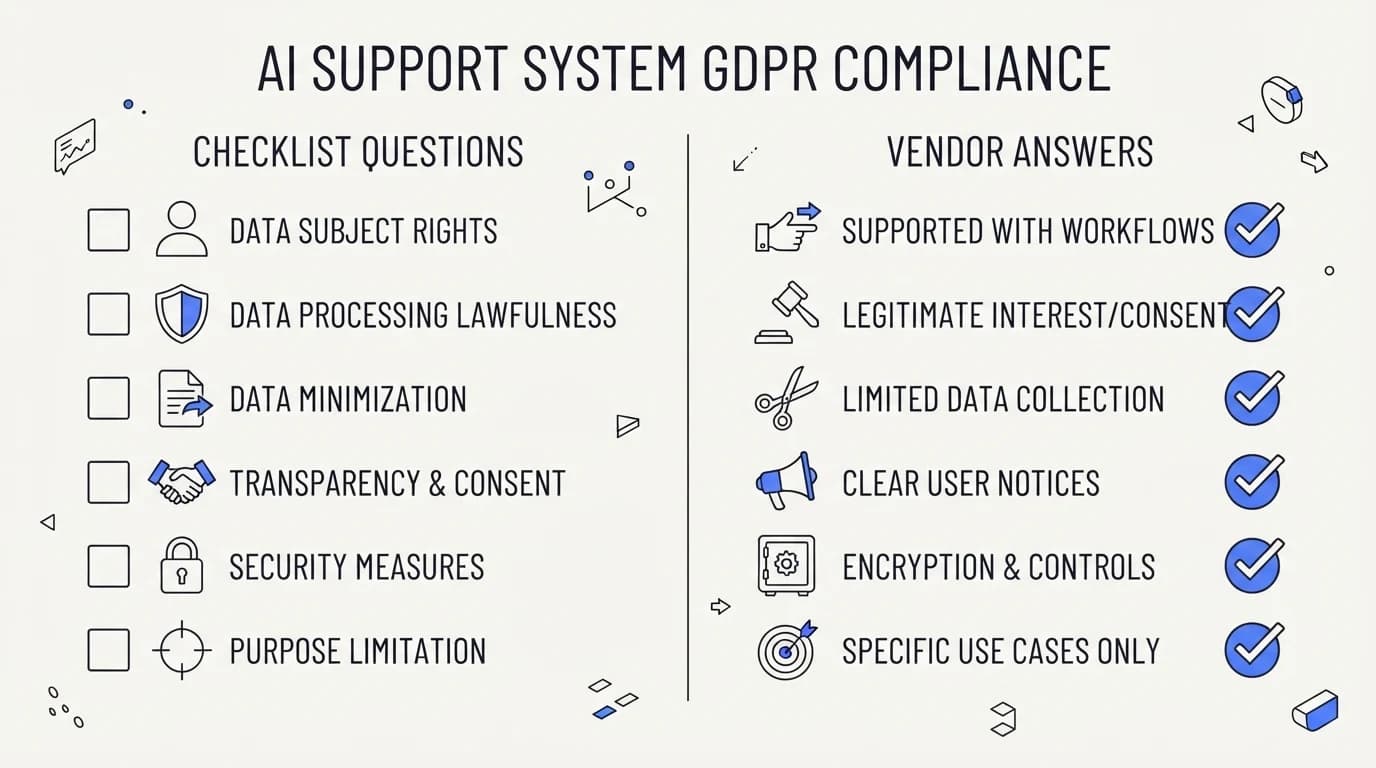
The practical path is to design for these four questions from the start rather than retrofit answers after a request or an audit arrives. That means documenting the lawful basis per purpose, setting and enforcing a retention schedule, maintaining a current list of subprocessors with agreements in place, and keeping customer data addressable enough that erasure is a real, testable operation.
None of this requires exotic infrastructure. A documented basis, a scheduled retention job, a signed data processing agreement with your vendor, and a deletion function keyed by customer identity cover the majority of what these four articles ask for in a support context specifically.
Vendor selection is part of this design work, not separate from it. An AI support vendor that cannot name its subprocessors, has no documented retention approach, or cannot demonstrate a working deletion path is pushing all four of these questions back onto you unanswered, regardless of what the vendor's marketing claims about being compliant, a distinction worth checking directly against a vendor's security page rather than assuming.
The regulation rewards teams that can explain their system plainly. A support lead who can say in two sentences what basis justifies the processing, how long data is kept, who touches it, and how a deletion request gets honored has done the real work, whatever the eventual legal review confirms in the details.
Where Communicate fits, honestly
Communicate is GDPR-ready but not certified. It runs a single AI model, gpt-4o-mini, through OpenRouter as a subprocessor for generating responses, and it does not hold SOC 2, HIPAA, or ISO 27001 certification. It runs in a single region and supports TOTP two-factor authentication, encryption at rest, and workspace isolation.
Conversation memory is scoped rather than unlimited by default, which is the same design principle this guide argues for independent of any specific vendor: keep what serves the purpose, and build deletion as a real, addressable operation rather than an afterthought.
None of this is a substitute for your own legal review. If your business has specific obligations under the GDPR or any other regulation, confirm them with qualified counsel and review the current posture on the security page directly, including what it does and does not cover, before deploying any AI support system.
Key takeaways
- GDPR applies based on whose data is processed, not where your company is based, so an AI support agent serving EU customers is in scope.
- Article 6 requires a lawful basis for processing; most support conversations rely on contract or legitimate interests rather than consent.
- Article 5 requires a defensible retention window and data minimization, not indefinite storage because a database has no built-in expiration.
- Article 28 makes your AI vendor a processor and its model or infrastructure providers subprocessors, all needing documented agreements.
- Article 17 right to erasure requires customer data to be addressable and deletable, which a retrieval index must be built to support from the start.
Ready to evaluate an AI support system against these four questions? Review the current posture on the security page, confirm your specific obligations with qualified counsel, and start with a one-dollar account activation on the pricing page to test the agent on your own data before it goes live.
Frequently asked questions
Does GDPR apply to AI customer support agents?
Yes, if the business serves customers in the European Union. GDPR applies based on whose personal data is processed, not where the company is based, and a support conversation handled by an AI agent almost always contains personal data such as a name or email.
What lawful basis applies to AI support conversations?
Most AI support processing relies on contract, when responding is necessary to deliver a service already agreed to, or legitimate interests, when the processing is reasonably expected and proportionate. Consent is a separate, narrower basis with its own requirements, and Article 6 on EUR-Lex names all six options without ranking one above the others.
How long can an AI support system retain conversation data?
There is no single fixed number. Article 5 requires data be kept no longer than necessary for the purpose it was collected for, so the retention window has to be defensible against that necessity standard rather than left indefinite. A tiered schedule, covered in conversation memory for a support agent, is one practical way to operationalize this.
Is my AI support vendor a data processor under GDPR?
In most cases, yes. If your AI vendor handles customer conversations on your behalf rather than deciding independently why the data is processed, it is acting as a processor under Article 28, and it needs a data processing agreement with your company that covers its own subprocessors as well.
What is a subprocessor in an AI customer support context?
A subprocessor is a company your AI vendor relies on to process the data further, commonly the underlying model or infrastructure provider generating the agent's responses. Article 28 requires the vendor to have your authorization before engaging a subprocessor and to remain liable if that subprocessor fails to meet its obligations.
Does GDPR require disclosing that a chatbot is AI?
GDPR itself does not set that specific disclosure rule; it is addressed separately under the EU AI Act's transparency obligations, covered in the EU AI Act customer support guide. The two regulations overlap in spirit, honesty toward the person interacting with the system, but they are distinct legal instruments.
What is the right to erasure and how does it apply to AI?
Article 17 gives individuals the right to have personal data erased without undue delay under specified conditions. For AI support, the obligation is unchanged, but the mechanics are harder once conversation data has been chunked and embedded into a retrieval index rather than stored as a single readable record, a challenge covered in retrieval-augmented generation for customer support.
Can a vector database make GDPR compliance harder?
It can, specifically for erasure and retention, if the system was not built to keep customer data addressable by identity from the start. A vector index that blends many customers' embedded conversations without a clean way to isolate one person's chunks turns a routine deletion request into a difficult engineering problem.
Does anonymized conversation data still count as personal data?
If data is genuinely anonymized, meaning it cannot reasonably be re-linked to an identifiable person, it generally falls outside the scope of personal data the regulation covers. Whether a specific anonymization approach meets that bar is a technical and legal judgment worth confirming with counsel, since pseudonymization, which remains reversible, does not qualify on its own.
What should I ask an AI support vendor about GDPR?
Ask who processes the data and under what agreement, what the retention schedule is, whether customer data can be located and deleted on request, and whether the vendor is certified or merely GDPR-ready. These map directly to the four questions this guide covers, and a vendor's security page is the place to check the answers directly.
Is being GDPR-ready the same as being GDPR-certified?
No. GDPR does not have an official certification scheme in the way SOC 2 does, so GDPR-ready generally means a vendor has built its system around the regulation's principles, while any specific compliance claim should be verified against what the vendor actually documents rather than assumed from the phrase alone.
Does the GDPR apply outside the European Union?
It applies based on whose personal data is being processed, not where the processing company is headquartered. A business outside the EU that serves customers located in the EU is still subject to the regulation for that processing, which is why AI support deployments should not assume the rules are a regional concern.
What is the difference between a controller and a processor?
A controller decides why and how personal data is processed, which is usually your company for customer support data. A processor, such as most AI support vendors, processes that data on the controller's behalf and under its instructions. The distinction determines who carries which obligations under Article 28.
Can a customer ask what data an AI support system holds about them?
Yes, and a well-designed system should be able to answer plainly and act on a deletion request without a manual database investigation. This requires the same addressable-by-customer design discussed in conversation memory for a support agent, built in from the start rather than retrofitted.
Does using AI increase GDPR risk compared to a traditional helpdesk?
The underlying obligations are the same either way, since both systems process personal data. What changes with AI is the mechanics of locating and deleting specific data once it has been chunked and embedded for retrieval, which is a practical engineering risk rather than a change in the legal standard itself.
What data minimization means for an AI support agent?
Data minimization, part of Article 5, means collecting and retaining only what is adequate, relevant, and necessary for the purpose. For an AI agent's conversation memory, this argues against storing a full raw transcript by default when a compact summary would serve the same purpose, a design tradeoff detailed in conversation memory for a support agent.
Should retention policy be the same for support and billing data?
Not necessarily. Billing and dispute records often carry separate retention requirements unrelated to support purposes, and forcing one retention schedule to cover both tends to produce a policy that is too long for support data or too short for billing data. Treating them as separate systems with separate schedules avoids that mismatch.
Where can I read the official GDPR text?
The authoritative source is Regulation (EU) 2016/679 published on EUR-Lex, the European Union's official legal database. Secondary explainer sites can help with orientation, but any specific compliance decision should be checked against the primary text or confirmed with qualified counsel.
Is this guide legal advice?
No. This is an educational explainer of general GDPR concepts as they relate to AI customer support, not legal advice for any specific business. Confirm every obligation that applies to your company, your customers, and your jurisdiction with qualified counsel before making compliance decisions.
What is the first step to prepare an AI support agent for GDPR?
Write down, in one paragraph, which lawful basis covers your support processing, how long you retain conversation data, who your subprocessors are, and whether you can locate and delete one customer's data on request. That single document surfaces most of the gaps before a lawyer or an auditor ever needs to ask.