
EU AI Act customer support: what it means for teams
 Communicate.so
EU AI Act customer support explained: disclosure duty, risk tiers, human oversight, and how to prepare AI support responsibly.
TL;DR: The EU AI Act is the European Union's risk-based law for artificial intelligence, and it touches customer support directly through one plain duty: when people interact with an AI system, they generally need to know it is AI and not a person. This guide is an educational explainer, not legal advice, and it walks through what the Act is, how its risk tiers work, where most AI support chatbots land, and what the transparency, human-oversight, and record-keeping expectations mean for a support team in practice. The short version is that a typical AI support agent is a limited-risk system whose main obligation is disclosure, so the honest, well-run approach and the compliant approach point in the same direction. Tell customers they are talking to AI, keep a human path open, ground answers in your own content, and keep records of how the system behaves. The Act entered into force in 2024 and applies in phases, so timelines and specifics keep moving, and you should confirm the details that apply to your business with qualified counsel.
If you run AI in customer support and sell to people in Europe, the EU AI Act is a name you have probably seen and quietly hoped you could ignore. You cannot ignore it, but the good news is that most of what it asks of a support chatbot is what a responsible team would do anyway. The duty that matters most is simple: be honest that the customer is talking to a machine.
This guide is written for the person who owns that decision: a founder, a support lead, or an operations owner deploying an AI agent into a live queue. It explains the Act in plain terms, maps where a support bot sits in its risk tiers, and translates the legal ideas into operational habits you can actually adopt. It stays deliberately educational, and it points you to the primary sources rather than inventing specifics that only a lawyer should confirm.
One caveat up front, stated clearly so it frames everything below. This is not legal advice, and nothing here is a substitute for guidance from a qualified professional who understands your product, your data, and your obligations. The goal is to help you ask better questions and build responsibly, so that when you do talk to counsel, you arrive with a system that is already close to right rather than one you have to unwind.
What the EU AI Act means for AI customer support
The EU AI Act is the European Union's horizontal law governing artificial intelligence, meaning it applies across sectors rather than to one industry. It takes a risk-based approach: instead of regulating all AI the same way, it sorts systems into tiers by the level of risk they pose to people, and it attaches heavier obligations to higher-risk uses. A customer support chatbot and a medical diagnostic system are treated very differently, and that proportionality is the core idea to hold onto.
The Act entered into force in 2024 and applies in phases, with different obligations becoming applicable on different timelines rather than all at once. Because those phases are still rolling out, the precise dates and thresholds are exactly the kind of detail you should confirm against the primary text rather than a blog. The authoritative sources are the European Commission and the official legal text published on EUR-Lex, and they are where any specific claim about timing should be checked.
For customer support, the practical takeaway is that most AI support does not fall into the heavily regulated tiers at all. A chatbot that answers questions and resolves tickets is generally a limited-risk system, and its central obligation is transparency: making sure people know they are dealing with AI. That is a meaningful duty, but it is a manageable one, and it is nothing like the compliance burden placed on genuinely high-risk uses.
It helps to separate the Act from the anxiety around it. The Act does not ban AI in support, does not require you to prove your model is perfect, and does not demand a certification for a normal help chatbot. What it does is insist on honesty and human accountability, which is why responsible customer support automation and compliant automation tend to look like the same thing in practice.
The Act also reaches beyond Europe's borders in the sense that it can apply based on where your users are, not only where your company sits. If people in the EU interact with your AI support, the transparency expectations are relevant to you even if your team works elsewhere. This is why treating disclosure as a default rather than a regional toggle is the simpler and safer engineering choice.
None of this replaces reading the source or asking a lawyer, and that is the honest boundary of this guide. What follows explains the risk tiers, the transparency duty, and the oversight and record-keeping ideas in operational terms, so you can build an AI agent that is defensible by design. Treat it as a map, and treat the EUR-Lex text as the territory.
How the risk tiers apply to AI customer support
 Communicate.so
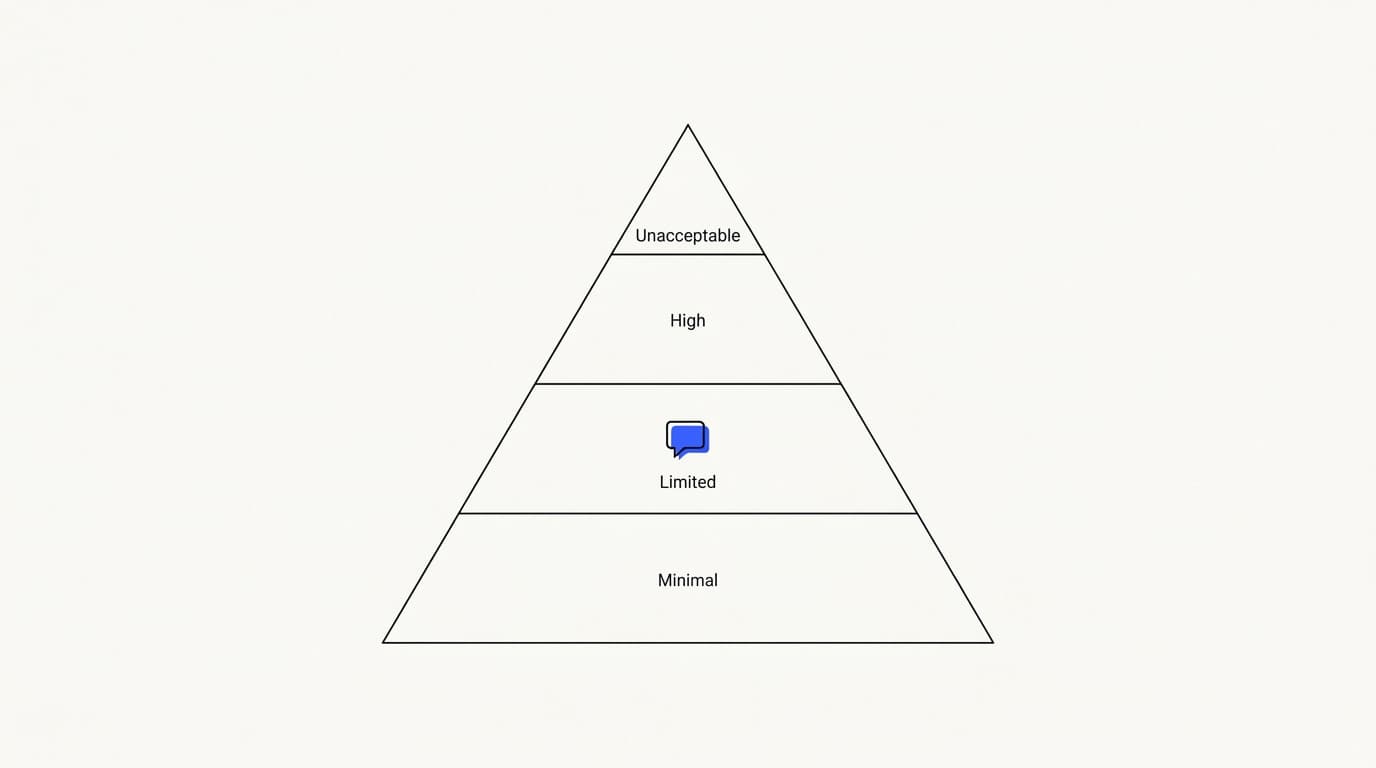
The Act sorts AI systems into four broad risk tiers, and knowing which one your support tool sits in tells you most of what you need. The tiers run from unacceptable risk, through high risk, to limited risk, down to minimal risk. Obligations get lighter as you move down, and a normal support chatbot lives near the bottom, not the top.
The unacceptable-risk tier covers uses the Act treats as off-limits because they threaten fundamental rights, such as certain manipulative or social-scoring systems. These are prohibited outright, and no ordinary customer support use comes close to this category. If your chatbot answers billing questions and points people to help articles, this tier is simply not about you.
The high-risk tier covers systems used in sensitive domains where a bad outcome carries serious consequences for people's rights or safety, and it comes with substantial obligations around risk management, data quality, documentation, and oversight. A general support chatbot is not high-risk on its own, but context matters, because the same technology pointed at a consequential decision can change tier. If your agent starts making or heavily influencing decisions about credit, employment, or access to essential services, that is a moment to stop and get advice, and to read the European Commission guidance on what qualifies.
The limited-risk tier is where most AI support chatbots actually sit, and its defining obligation is transparency toward the person interacting with the system. The reasoning is that a chatbot is not dangerous, but a person deserves to know they are talking to a machine so they can calibrate how much to trust it. This is the tier that shapes day-to-day support design, and it is the one worth understanding well.
The minimal-risk tier covers the vast majority of AI uses that pose little risk, like spam filters, and carries no specific obligations under the Act beyond existing law. Some behind-the-scenes support tooling may fall here, but the customer-facing chat surface is the part that triggers the transparency duty. The table below places common support uses against the tiers, and it is a starting orientation, not a legal classification of your specific system.
| Support use of AI | Likely tier | Transparency duty | Heavy compliance load |
|---|---|---|---|
| Chatbot answering FAQs and resolving tickets | Limited | ✓ | ✗ |
| AI drafting replies a human agent reviews | Limited or minimal | ✓ | ✗ |
| Behind-the-scenes routing and tagging | Minimal | ✗ | ✗ |
| AI deciding credit, jobs, or essential access | Potentially high | ✓ | ✓ |
| Manipulative or social-scoring systems | Unacceptable | ✗ | ✗ |
Read the table as a prompt to think, not as a ruling. The rows that matter for most support teams are the top two, where the obligation is disclosure rather than a compliance program. The high-risk row is the one to watch, because the tier is driven by what the AI is used to decide, not by the fact that it is a chatbot, and drifting toward consequential decisions is how a limited-risk tool quietly becomes something heavier.
If there is one operational habit to take from the tiers, it is to keep your support agent scoped to support. An agent that answers questions and hands off hard cases stays comfortably in the limited-risk world, while an agent you quietly wire into high-stakes decisions can pull you somewhere you did not plan to go. Bounding what the agent is allowed to do, the core idea behind AI agent guardrails, is both good product design and a way to stay in the tier you expect.
The transparency duty: telling users they are talking to AI
 Communicate.so
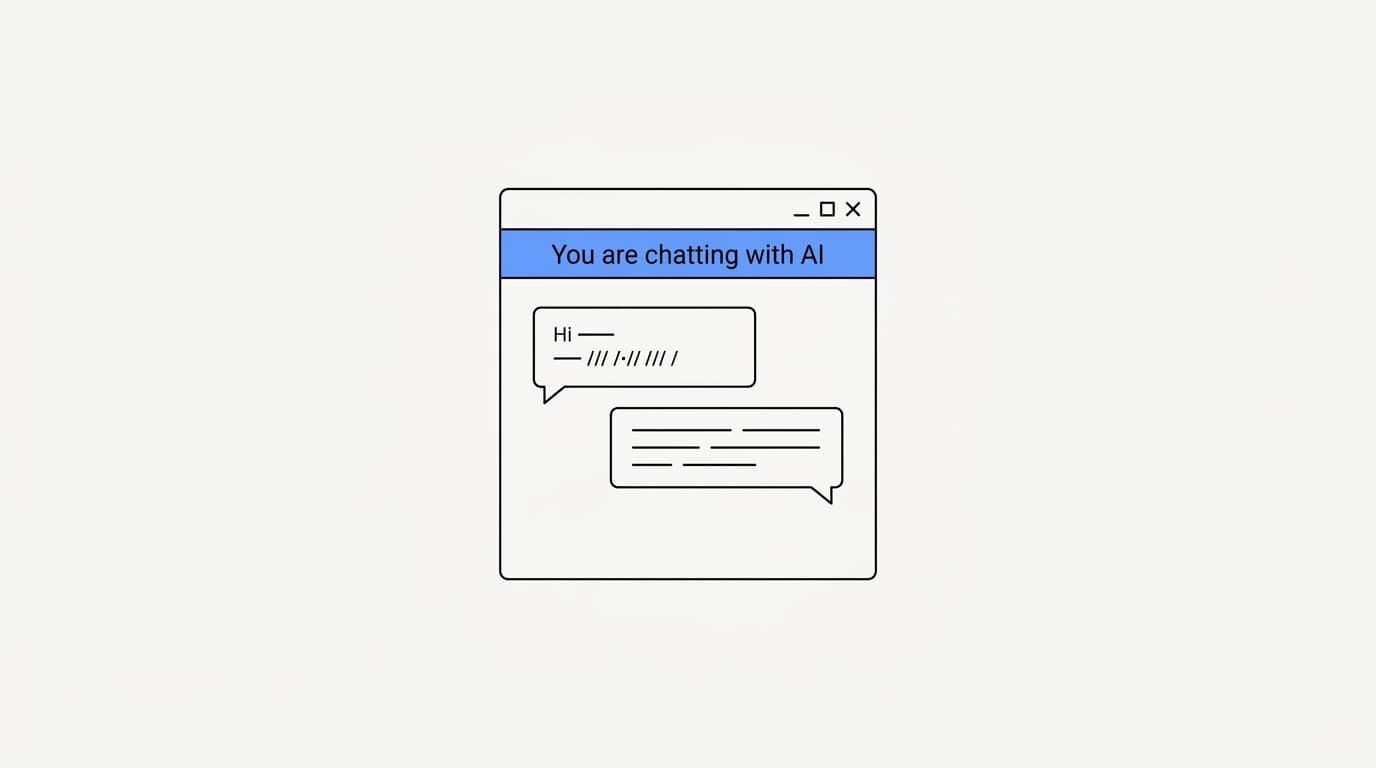
The single most important idea for AI support under the Act is the transparency duty, and it is refreshingly plain. When a person interacts with an AI system, they should generally be made aware that they are dealing with AI rather than a human, unless it is already obvious from the context. For a support chatbot, that means disclosure, and disclosure is the obligation that shapes how you present the agent.
The spirit of the duty is informed interaction, not a buried legal footnote. The point is that a customer should be able to tell, at the moment it matters, that the entity answering them is a machine, so they can decide how much weight to give the answer. A disclosure that technically exists but is hidden in a policy document nobody reads does not serve that purpose, and it misses the intent even if it ticks a box.
In practice this is a design choice more than a legal one, and the good news is that clear disclosure also builds trust. Label the agent plainly at the start of the conversation, give it a name and a manner that does not pretend to be a specific human being, and make the AI nature evident rather than concealed. This is the kind of detail that lives in your AI agent configuration, and getting it right costs almost nothing while avoiding the exact deception the duty targets.
Disclosure does not mean the experience has to feel robotic or cold. An AI agent can be warm, helpful, and pleasant while still being honestly labeled as AI, and most customers are perfectly comfortable with a bot that is upfront about what it is. The problem the Act guards against is the bot that impersonates a person, because that is where trust breaks when the truth surfaces later.
There is a related honesty duty worth naming, even though it is less central to a text support chatbot. The Act also expects certain AI-generated or manipulated content, such as deepfakes, to be disclosed as artificial. For most support teams this is not a daily concern, but if your agent ever generates media or synthetic voices, it is another place where labeling is the expectation, and where the EUR-Lex text is the source to check.
The cleanest way to satisfy the transparency duty is to make disclosure a default that you never have to remember to switch on. Build the AI label into the widget, the first message, and the agent's self-description, so that every customer in every region sees it without a per-market configuration. A default-on disclosure is simpler to operate and harder to get wrong than a setting someone has to enable, and it removes an entire category of mistakes.
Transparency also pairs naturally with honesty about the agent's limits. An agent that discloses it is AI and also admits when it does not know, rather than inventing a confident answer, is being truthful on two fronts at once. That second kind of honesty is the subject of reducing AI hallucinations in support, and it complements disclosure, because a labeled agent that then lies about facts has only solved half the trust problem.
Human oversight and keeping records
 Communicate.so
Beyond disclosure, two ideas from the Act translate cleanly into good support practice: human oversight and record-keeping. Even where the heaviest obligations do not apply to a limited-risk chatbot, the underlying principles are worth adopting, because they are what make an AI support operation accountable. Oversight means a person can step in, and record-keeping means you can explain what happened.
Human oversight, in support terms, means the AI is never the only door a customer can reach. There should be a clear, available path to a human when the agent cannot help or when the customer simply wants a person, and that path should not be hidden to inflate an automation number. Oversight is not a background technicality; it is the escape hatch that keeps automation from trapping people.
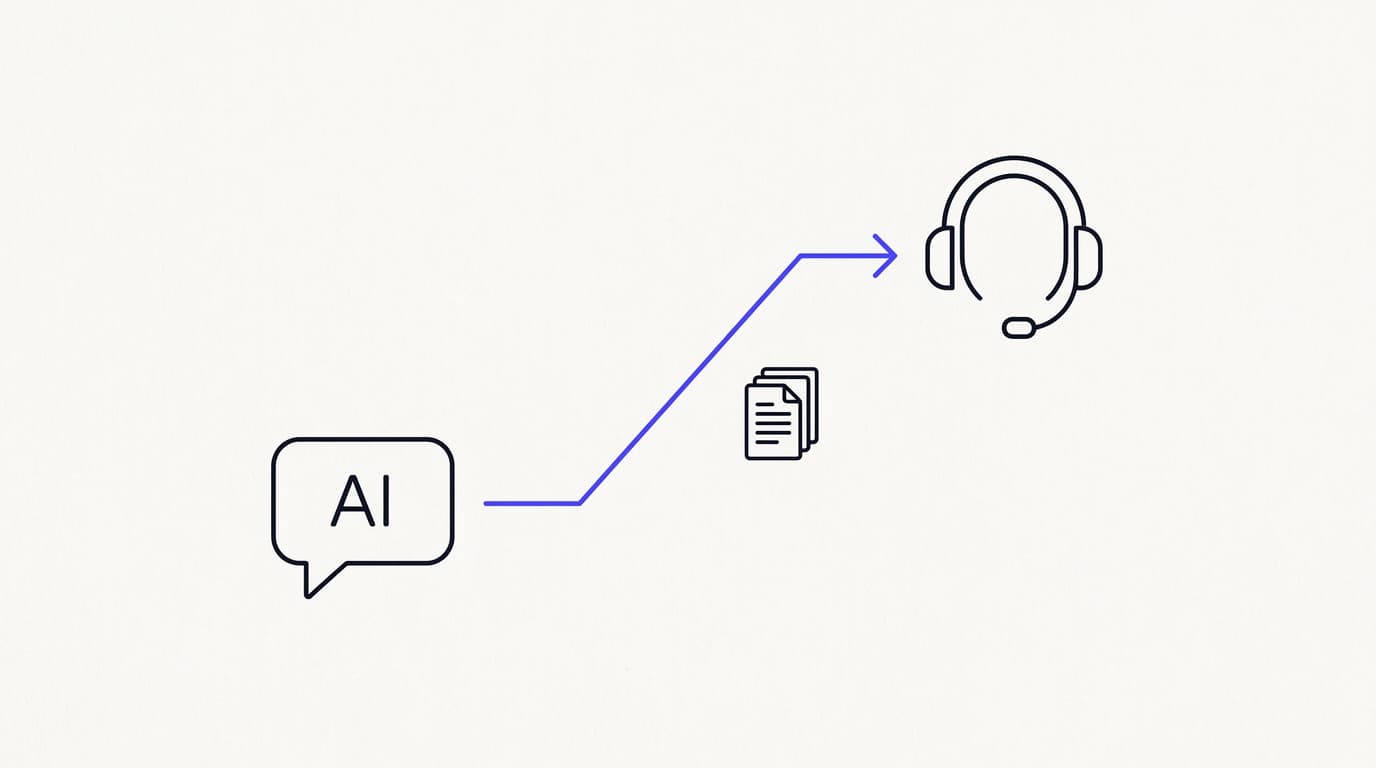
The practical mechanism is a clean escalation from AI to a person, with the conversation history intact so the customer does not repeat themselves. A shared inbox where the agent handles what it can and a human picks up the rest, with full context, is the concrete shape of human oversight in a real support tool. The quality of that AI to human handoff is where oversight is either real or merely claimed.
Oversight also means a person can supervise and, when needed, override the AI rather than deferring to it blindly. A support lead should be able to see what the agent is doing, correct it, and take a conversation away from it, so the human stays accountable for the outcome. An AI that cannot be watched or overruled is not overseen, and designing for supervision is how you keep a human genuinely in charge.
Record-keeping is the second habit, and it is about being able to reconstruct what your AI did. Keeping logs of conversations, escalations, and the reasons the agent gave or refused answers means that when something goes wrong, you can investigate rather than guess. This is ordinary operational hygiene, and your analytics and conversation history are where most of it already lives, so the lift is usually organizing what you have rather than building something new.
Records serve you before they ever serve a regulator, which is the honest reason to keep them. When a customer disputes what the bot told them, a log settles it; when the agent keeps failing a question, a record shows you where; when you tune the system, history tells you whether it improved. The accountability the Act values and the debugging you need day to day are satisfied by the same practice, which is why record-keeping is worth doing regardless of the law.
Security sits alongside record-keeping, because logs of customer conversations are sensitive data you are now responsible for. Keeping that data encrypted, access-controlled, and inside a clear boundary is part of handling it responsibly, and it intersects with data-protection duties that predate the AI Act. How a tool handles this shows up on its security posture, and it is a fair question to ask any vendor whose agent will be reading and storing your customers' messages.
What the EU AI Act means for enterprise trust
The Act is often framed as a burden, but for anyone selling AI support to serious buyers it is closer to a trust framework. Enterprise buyers increasingly ask how your AI behaves, whether it discloses itself, and whether a human stays accountable, and the Act gives those questions a shared vocabulary. A vendor who can answer them plainly has an advantage, not a handicap.
Trust in AI support is fragile precisely because the failure modes are public and personal. A bot that impersonates a human, or that invents a policy and states it as fact, damages the brand in a screenshot, and no amount of efficiency makes up for that in a buyer's eyes. The transparency and oversight ideas in the Act are aimed at exactly these failures, which is why building to them reads as competence to a cautious customer.
There is a wider evidence base that discipline, not model cleverness, is what separates AI projects that work from ones that do not. RAND's 2025 review of more than 2,400 enterprise AI initiatives found roughly 80% failed to deliver measurable value, mostly on operational discipline rather than model quality (RAND). Disclosure, oversight, and record-keeping are that discipline in a support context, so the same habits that keep you defensible are the ones that keep the deployment from failing.
The upside case for AI support remains large, which is why the trust layer matters rather than nullifies the opportunity. Gartner has projected that by 2029, agentic AI will autonomously resolve 80% of common customer service issues without human intervention (Gartner). Reaching a number like that with buyers who trust you depends on doing the accountable version, because a fast, opaque, occasionally lying agent is the kind that gets switched off after one bad incident.
Frameworks beyond the EU Act point the same way, and naming them signals maturity to a technical buyer. Voluntary guidance like the NIST AI risk management framework and security work from OWASP on risks specific to language-model applications cover overlapping ground: transparency, oversight, and guarding against misuse. You do not need to master all of them, but knowing they exist helps you talk credibly about how your AI agent is governed.
The trust payoff compounds over time, because a support operation that is honest by default rarely has to walk anything back. The team that discloses its AI, keeps a human path open, and logs what happened is not scrambling when a customer or a buyer asks hard questions. That steadiness is worth more than any single compliance checkbox, and it is the real reason to treat the Act as a design input rather than a threat.
The honest caveat holds through all of this: adopting these habits is not the same as being certified or guaranteed compliant, and no article can promise that. What you can do is build an AI support system that is transparent, overseen, and documented, and then confirm the specifics with counsel who knows your situation. Good practice plus professional advice is the durable combination, and the EUR-Lex text is always the final word over any summary.
How to prepare your AI customer support
 Communicate.so
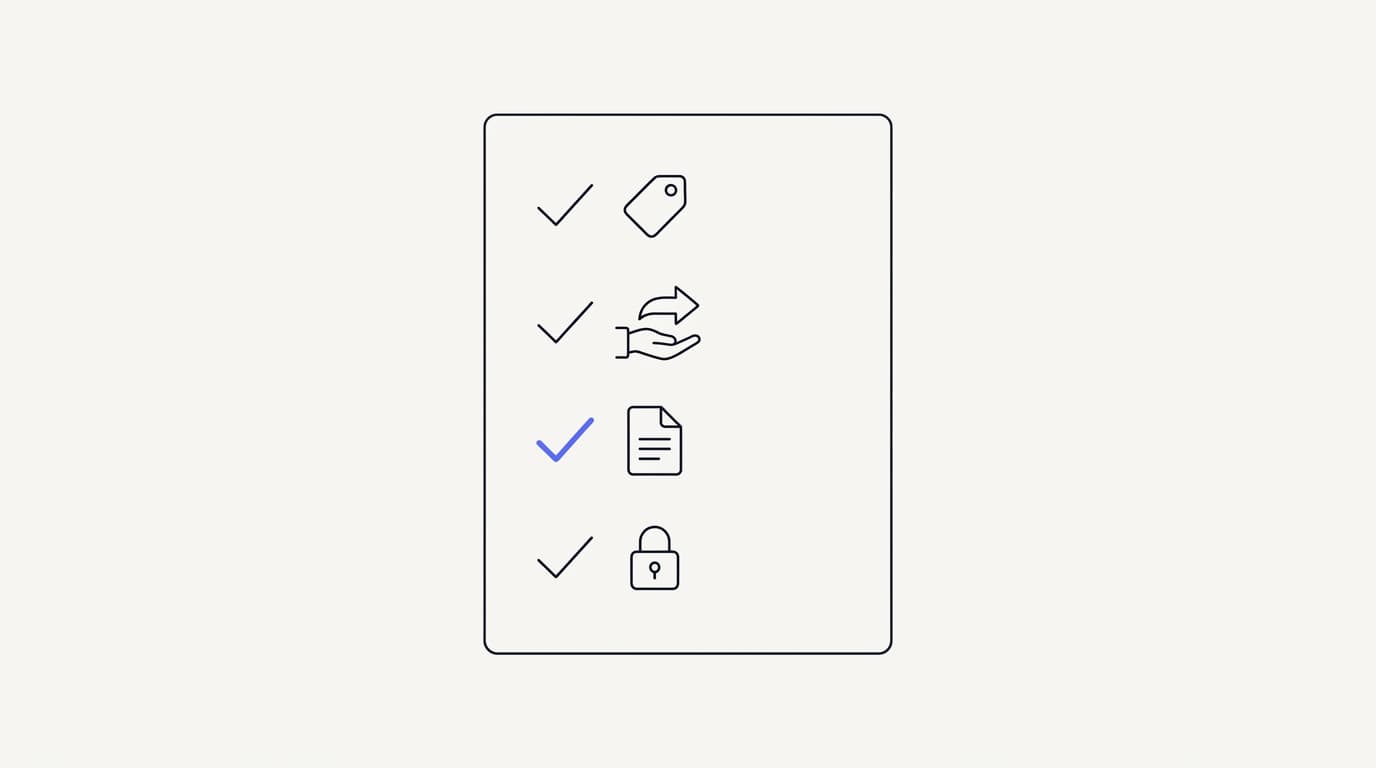
Preparing well is mostly about turning the ideas above into defaults, and the order is simple enough to run without a legal team in the room. The steps below are operational habits, not compliance certifications, and they get you most of the way to a responsible deployment before you ever bring in counsel to confirm the rest. Treat them as a starting checklist you adapt to your product.
Start by making disclosure the default across every surface. Label the agent as AI in the widget, in its opening message, and in how it describes itself, so no customer is left guessing whether they are talking to a person. Build it in once rather than toggling it per market, and the transparency duty is satisfied by design rather than by memory, which is the whole point of a default.
Next, guarantee a human path and make it visible. Wire a clean escalation from the agent into a place where a person can take over with full context, and never hide the route to a human to pump an automation metric. A shared inbox with presence-based takeover is the concrete version of this, and the AI to human handoff is the part of the build most worth getting right.
Then ground the agent and let it refuse, because honesty about facts is part of responsible AI. Connect the agent to your own content so it answers from your real policies rather than a model's guesswork, and let it say it does not know and hand off instead of inventing an answer. This is the heart of reducing AI hallucinations in support, and it is what keeps a disclosed agent from being an honestly-labeled source of wrong information.
Bound what the agent is allowed to do, so a limited-risk tool stays limited-risk. Scope its actions, keep it out of consequential decisions unless a human confirms them, and define the edges of its authority up front. Setting those limits, the practice behind AI agent guardrails, both improves the product and keeps you in the risk tier you intended rather than drifting into a heavier one.
Keep records and protect them, because accountability and security travel together. Retain conversation logs, escalations, and the reasons behind answers so you can reconstruct what happened, and hold that data under sensible controls like encryption and access limits. Most of this already lives in your analytics and your tool's security posture, so the task is usually to organize and confirm rather than to build from scratch.
| Preparation step | Responsible default | What it maps to |
|---|---|---|
| Disclose the agent is AI | ✓ | Transparency duty |
| Keep a visible human path | ✓ | Human oversight |
| Ground answers, allow refusal | ✓ | Honesty and accuracy |
| Scope what the agent can do | ✓ | Staying in the limited tier |
| Log interactions, secure the data | ✓ | Record-keeping and security |
| Claim to be certified compliant | ✗ | Confirm specifics with counsel |
Read the last row of that table as the honest boundary of any preparation checklist. Doing these steps well makes your AI support transparent, overseen, and documented, but it does not entitle anyone to claim certified compliance, and a vendor who promises that is overreaching. Do the work, keep the records, and confirm the specifics that apply to you with a qualified professional and the primary text on EUR-Lex.
Where Communicate fits, honestly
Communicate is a grounded AI support agent, and its defaults line up with the responsible habits this guide describes rather than against them. The agent discloses that it is AI, grounds its answers in your connected data, and hands off when it is unsure, so disclosure and honesty are built in rather than bolted on. If you want a bot that impersonates a human to seem more convincing, it is deliberately not that tool, and that is the point.
Human oversight is a first-class part of the product, not an afterthought. The Shared Inbox uses presence-based human takeover with a per-turn backstop, so a person can step in and the AI will not talk over them mid-reply, which is the concrete shape of keeping a human in charge. When the agent escalates, the AI to human handoff carries the full context so the customer does not start over.
Here is the plain description of what it does, without inflation. The live channels are a web widget, live chat, and email, with in-app messages, analytics, and scoped actions running from the same agent and knowledge base. There is no WhatsApp, Messenger, SMS, or voice, so if any of those is a hard requirement, it is not your best fit today, and that is worth knowing before you evaluate it against the Act's disclosure duty on those surfaces.
On the security and data side, which matters for record-keeping, the posture is stated plainly. Communicate offers encryption at rest, TOTP two-factor authentication, workspace isolation, and self-serve data export with cascading delete, and it is GDPR-ready though not certified. It runs a single model, gpt-4o-mini through OpenRouter, with response and prompt caching, and you can read the full security posture rather than take a summary on faith.
Now the honest limits, because a guide about compliance should not oversell one. Communicate holds no SOC 2, HIPAA, or ISO 27001, runs in a single region, does not offer SSO, and makes no claim of EU AI Act certification or a compliance guarantee, since no vendor honestly can. Dodo is the merchant of record for billing, entry is a one-time $1 activation that includes 100 test credits with no free tier, and questions go to [email protected].
Use those test credits to try the disclosure and handoff behavior yourself before you trust it in front of customers.
Key takeaways
- The EU AI Act is a risk-based EU law that entered into force in 2024 and applies in phases, and for customer support the central duty is transparency: people should know when they are talking to AI.
- Most AI support chatbots are limited-risk systems whose main obligation is disclosure, not the heavy compliance load placed on genuinely high-risk uses like decisions about credit or jobs.
- Human oversight means a clear, visible path to a person and the ability to supervise and override the AI, which in practice is a clean handoff into a shared inbox with full context.
- Record-keeping and security are ordinary operational hygiene that also satisfy accountability: log interactions and reasons, and protect that data with encryption and access controls.
- Doing these things well makes your AI support responsible and defensible, but it is not certification; confirm the specifics that apply to your business with qualified counsel and the primary text.
Want to build AI support that is honest by default? Start with a one-dollar account activation that includes 100 test credits, connect your content, and test the disclosure and human handoff behavior yourself. Then confirm the specifics for your situation with counsel, using the European Commission and EUR-Lex as your primary sources.
Frequently asked questions
What is the EU AI Act?
The EU AI Act is the European Union's horizontal law governing artificial intelligence, using a risk-based approach that sorts systems into tiers and attaches heavier obligations to higher-risk uses. It entered into force in 2024 and applies in phases rather than all at once. The authoritative sources are the European Commission and the official text on EUR-Lex, and this answer is educational rather than legal advice.
Does the EU AI Act apply to customer support chatbots?
Yes, but usually in a light way. A typical AI support chatbot is a limited-risk system, and its main obligation is transparency, meaning people should be made aware they are interacting with AI. It generally does not carry the heavy compliance load reserved for high-risk uses, though the specifics for your situation should be confirmed with counsel.
What are the risk tiers in the EU AI Act?
The Act uses four broad tiers: unacceptable risk, which is prohibited; high risk, which carries substantial obligations; limited risk, which mainly requires transparency; and minimal risk, which carries no specific obligations beyond existing law. Obligations get lighter as you move down the tiers. Most customer support chatbots sit in the limited-risk tier.
Which risk tier does an AI support agent fall into?
Most AI support agents are limited-risk systems, because they answer questions and resolve tickets rather than make consequential decisions about people. The tier can change if the same technology is pointed at high-stakes decisions like credit or employment. Keeping the agent scoped to support, the idea behind AI agent guardrails, is how you stay in the tier you expect.
Do I have to tell customers they are talking to AI?
Generally yes. The Act's transparency duty means people should be made aware they are interacting with an AI system rather than a human, unless it is already obvious from context. For a support chatbot this means clear disclosure, which you can build into the AI agent so every customer sees it by default.
Confirm how it applies to you with a qualified professional.
How should an AI support agent disclose that it is AI?
Make the disclosure clear at the moment it matters, not buried in a policy document. Label the agent as AI in the chat widget, in its opening message, and in how it describes itself, and avoid having it pretend to be a specific human being. Building disclosure in as a default across every surface is simpler and safer than enabling it per market.
Does the EU AI Act ban AI in customer support?
No. The Act does not prohibit AI in customer support, does not require you to prove a model is perfect, and does not demand a certification for a normal help chatbot. It focuses on transparency and human accountability.
Responsible automation and compliant automation tend to look like the same thing in practice.
What is human oversight under the EU AI Act?
Human oversight means a person can supervise, step into, and override the AI rather than deferring to it blindly. In support, the concrete form is a clear, visible path to a human and a clean escalation with full context, often through a shared inbox. An AI that cannot be watched or overruled is not genuinely overseen.
What records should I keep for AI customer support?
Keep logs of conversations, escalations, and the reasons the agent gave or refused answers, so you can reconstruct what happened when something goes wrong. Most of this already lives in your analytics and conversation history. Records serve your own debugging and dispute resolution before they ever serve a regulator, which is why the habit is worth keeping regardless.
Does the EU AI Act apply to companies outside Europe?
It can apply based on where your users are, not only where your company is based. If people in the EU interact with your AI support, the transparency expectations are relevant even if your team works elsewhere. Treating disclosure as a default rather than a regional toggle is the simpler engineering choice, and the European Commission is the source to confirm scope.
When does the EU AI Act take effect?
The Act entered into force in 2024 and applies in phases, with different obligations becoming applicable on different timelines rather than all at once. Because those phases are still rolling out, the precise dates are exactly the detail to confirm against the primary text on EUR-Lex rather than a summary. This answer is educational and not legal advice.
Are there fines under the EU AI Act?
The Act includes penalties for non-compliance, but the specific amounts and how they apply are details that depend on the violation and your circumstances, and they should be confirmed against the official text and with counsel. This guide deliberately does not quote figures, to avoid stating a number out of context. The EUR-Lex text is the authoritative source.
Can I claim my AI support is EU AI Act compliant?
Be careful here. Doing the responsible steps well makes your system transparent, overseen, and documented, but that is not the same as being certified or guaranteed compliant, and no vendor can honestly promise that for you. Confirm the specifics that apply to your business with a qualified professional before making any compliance claim.
Is a grounded AI agent easier to run responsibly?
Grounding helps, because an agent that answers from your own content and refuses when it does not know is being honest about facts on top of disclosing that it is AI. That reduces the confident-wrong-answer failure mode that damages trust. The practice is covered in reducing AI hallucinations in support, and it complements the Act's transparency duty.
How does the EU AI Act relate to GDPR?
They are separate laws that overlap in practice, because AI support handles personal data that GDPR governs while the AI Act governs the AI system itself. Keeping conversation data encrypted, access-controlled, and exportable matters for both, which shows up in a tool's security posture. Confirm how the two apply together for your business with counsel.
What happens if my AI agent makes high-stakes decisions?
The risk tier is driven by what the AI is used to decide, not by the fact that it is a chatbot. If your agent starts making or heavily influencing decisions about credit, employment, or access to essential services, it may move toward the high-risk tier with much heavier obligations. That is a moment to stop, get advice, and read the official guidance before proceeding.
Do I need a lawyer to deploy AI customer support?
You can adopt the responsible defaults, disclosure, a human path, grounding, scoping, and record-keeping, without a lawyer in the room, and that gets you most of the way. But confirming the specifics that apply to your product, data, and markets is exactly what qualified counsel is for. Good practice plus professional advice is the durable combination.
Does disclosing the AI make the experience worse for customers?
No. An AI agent can be warm, helpful, and pleasant while being honestly labeled as AI, and most customers are comfortable with a bot that is upfront about what it is. The trust problem the Act guards against is the bot that impersonates a person, because that is where trust breaks when the truth surfaces later.
What frameworks beyond the EU AI Act should I know?
Voluntary guidance like the NIST AI risk management framework and security work from OWASP on language-model application risks cover overlapping ground: transparency, oversight, and guarding against misuse. You do not need to master them, but naming them helps you talk credibly about how your AI is governed to a technical buyer.
How do I prepare my AI support for the EU AI Act?
Make disclosure a default, guarantee a visible human path, ground the agent and let it refuse, scope what it can do, and keep secured records of interactions. Most of this is good product design that also maps to the Act's expectations, and it lives in your agent config, your shared inbox, and your analytics. Then confirm the remaining specifics with counsel and the primary text.