
PII redaction for customer support: redact before retrieval, not after logging
 Communicate.so
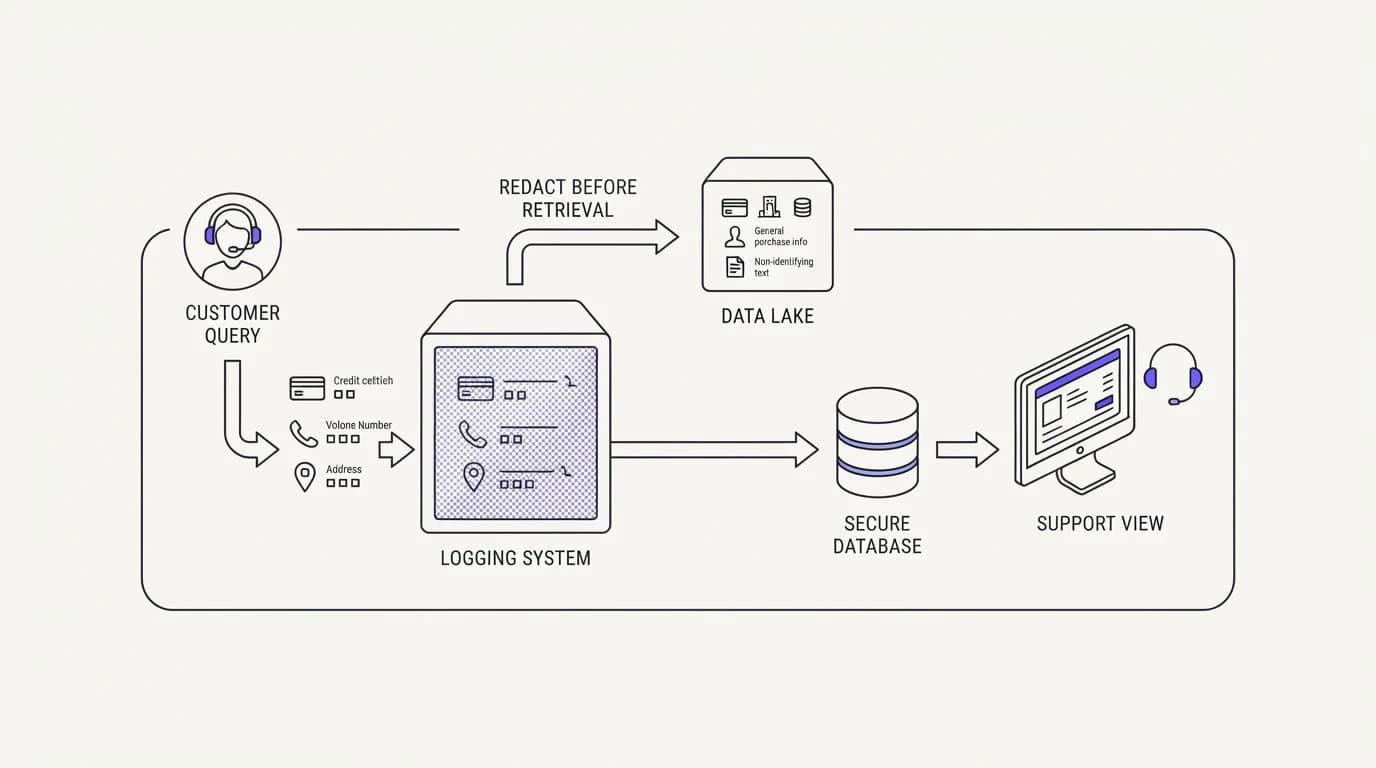
Where card numbers and personal data actually leak in an AI support stack, and why redaction has to run before content reaches a retrieval index, not after.
TL;DR: Most teams think about PII redaction as a logging problem: scrub sensitive fields before they hit a log file or an analytics dashboard. That catches the easy leak and misses the one that matters for an AI support stack, because a customer's card number, typed mid-conversation, can be embedded into a retrieval index long before anyone thinks to redact it. This guide walks through where personal data actually enters a support AI pipeline, what PCI DSS requires for card data specifically, why redaction has to run at ingestion rather than after the fact, and what a support team can verify about a vendor's practice instead of taking a privacy policy on faith. It closes with the honest state of redaction inside communicate.so today.
A customer support conversation is one of the least controlled places personal data enters a company. Nobody designs a form field for it. A customer typing 'my card ending 4471 was charged twice' has just volunteered a partial card number into a free-text box that was never built to handle it, and that box may feed directly into an AI agent's retrieval pipeline.
Redaction conversations usually start and end with logging: strip sensitive fields before they land in a log aggregator or analytics tool. That is necessary and not sufficient for a support AI, because the retrieval index a grounded AI agent reads from is a second, quieter place the same data can end up, and it is rarely covered by a standard logging redaction policy.
Where personal data actually enters a support stack
Personal data enters a support conversation through the customer, not through a form. That is the structural problem. A billing form validates and formats a card number before it is submitted.
A support chat box accepts whatever a customer types, unfiltered, because filtering it would block the customer from describing their problem.
Customers volunteer far more than support teams expect. Full names, email addresses, and order numbers are the baseline. Card numbers, partial or full, show up when a customer describes a billing dispute.
Social security numbers, driver's license numbers, and health details appear in industries where the underlying transaction requires them, even when the support tool has no field designed to hold them.
Attachments are a second entry point that is easy to miss. A customer who screenshots a bank statement to prove a duplicate charge, or uploads a photo of an ID for a verification request, has just handed a support tool an image containing structured sensitive data that text-based redaction never touches. If your stack supports file uploads through embed widgets or email, that channel needs its own answer, not an assumption that the text redaction rules cover it.
The third entry point is the AI agent's own responses. An agent that echoes back a customer's account number to confirm it, or repeats a card's last four digits in a summary, has just written that data into the conversation log a second time, even if the customer's original message was properly redacted.
The distinction that matters: redact before retrieval, not after logging
 Communicate.so
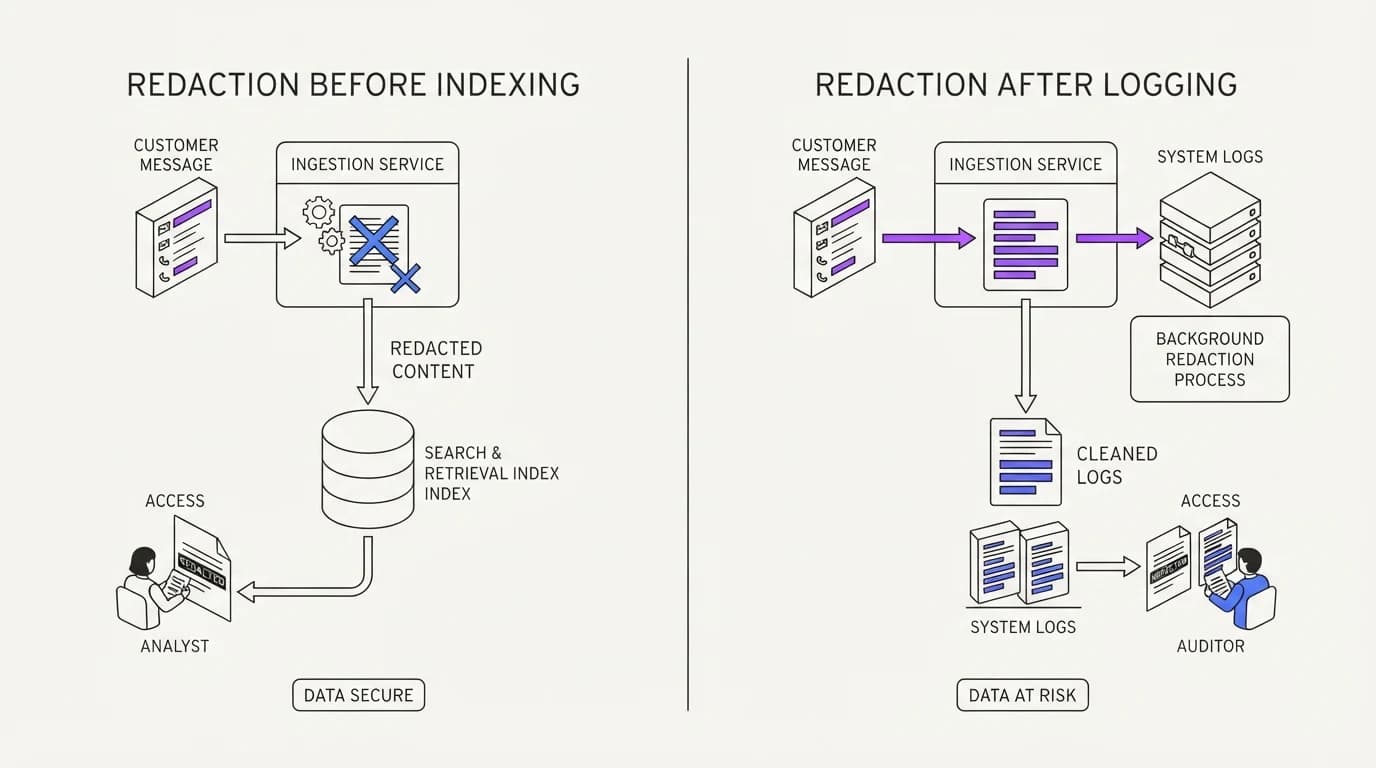
Redacting a log file after the fact protects your observability tooling. It does not protect your retrieval index. Those are two different systems, populated at two different points, and a redaction policy scoped to one does nothing for the other.
A log file is typically write-once and read by engineers debugging an issue. Redacting it after ingestion, by scrubbing patterns before display or export, closes that exposure reasonably well because the raw data sits in one place and the fix touches one pipeline.
A retrieval index is different. Once a customer's card number is embedded into a vector store as part of a conversation snippet, it can resurface in a completely unrelated conversation, because retrieval works by similarity, not by access control tied to the original customer. Redacting the log after the fact does nothing to remove what is already embedded and searchable.
This is the practical reason redaction has to run at ingestion, before the text is chunked and embedded, not as a cleanup pass afterward. Once sensitive text is inside vectors, removing it requires re-indexing the affected content, which most teams do not have tooling to do reliably, let alone on a schedule fast enough to matter.
The fix is architectural, not procedural. A pattern-matching or model-based redaction step needs to sit between the raw customer message and the embedding step, stripping or masking card numbers, government IDs, and other high-risk patterns before anything is written to a store an AI agent can retrieve from later.
What PCI DSS actually requires for card data
Card data is the sharpest example because the rules are specific and external, not a company's own policy choice. The PCI Security Standards Council publishes exact guidance on what can be stored and what cannot, and a support stack that touches card numbers is in scope whether or not anyone designed it to be.
Requirement 3 of PCI DSS covers protecting stored account data, and it starts from a minimization principle: account data storage should be kept to a minimum, limited to what is required for legitimate business, legal, or regulatory purposes. A support conversation that captures and retains a full card number indefinitely, just because a customer typed it, fails that principle before encryption even enters the picture.
Sensitive authentication data, meaning full track data, the card verification value, and PIN data, must never be stored after authorization, encrypted or not. That single rule has direct consequences for a support AI: if a customer pastes a CVV into a chat box while describing a failed payment, that value cannot legitimately persist anywhere in the stack, including a retrieval index, once the immediate exchange is over.
The primary account number, when it is stored at all, must be rendered unreadable through strong cryptography, and when displayed, masked to at most the first six and last four digits. A support transcript that shows a full sixteen-digit card number in a searchable conversation history is not meeting that bar, regardless of what encrypts the database underneath it.
The practical takeaway for a support stack is not that you need to become a PCI-compliant payment processor. It is that a card number typed into a support chat is regulated data the moment it appears, and the redaction step has to catch it before storage, not after a compliance review flags it months later, a distinction PCI DSS's own data storage guidance is built around.
Beyond card numbers: the wider PII surface
 Communicate.so
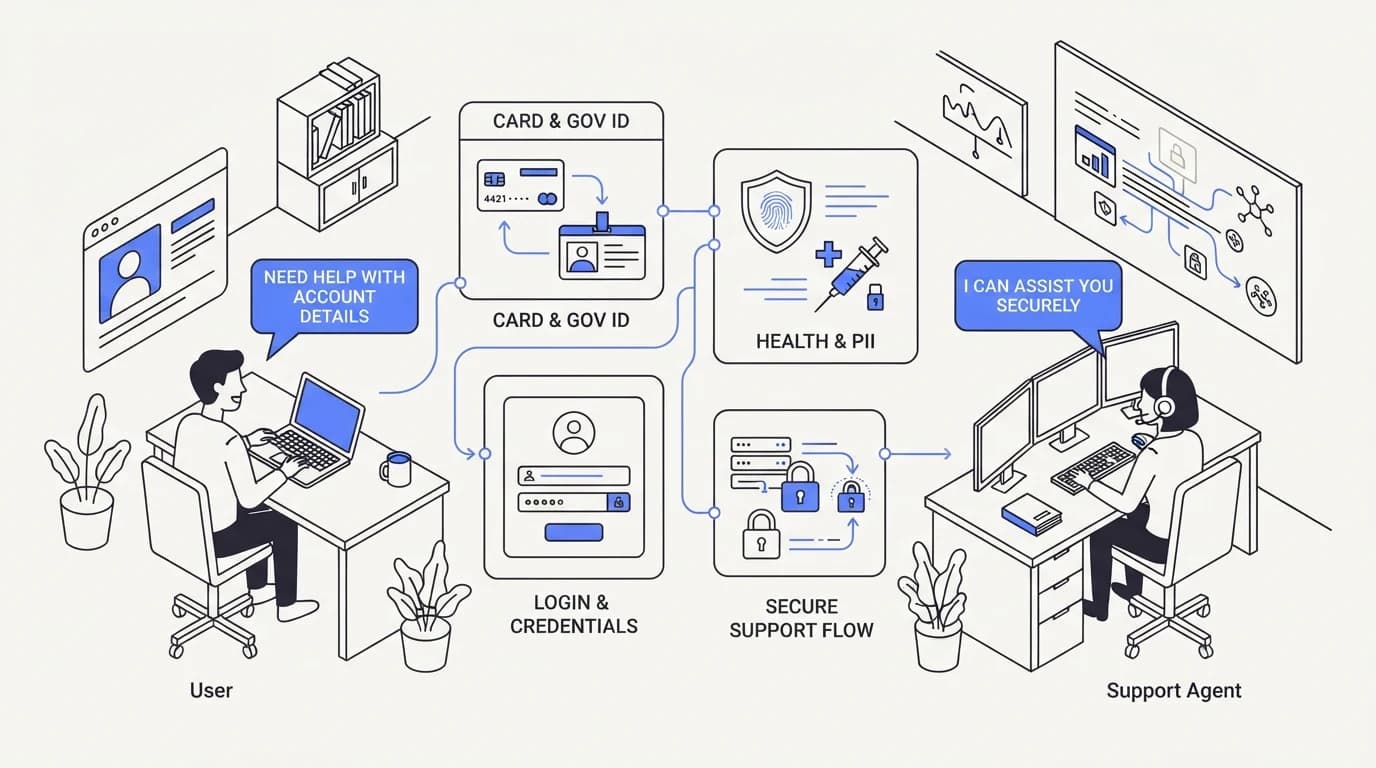
Card numbers get the regulatory attention, but they are not the only pattern that needs catching. A support conversation is where customers paste passwords while describing a login problem, share a government ID number to prove identity, and mention health conditions when explaining why a return is urgent.
Login credentials are an underrated risk because customers paste them with good intentions, trying to help a support agent reproduce a bug. A password typed into a chat box and embedded into a retrieval index is a credential that now lives somewhere far more exposed than the authentication system it was meant for, and it needs the same never-store treatment as a CVV.
Government identifiers, from social security numbers to passport numbers, follow recognizable formats that pattern-based redaction can catch reliably, in the same way a PII scanner flags a card number. Health information is harder, because it rarely follows a fixed pattern and depends on context, which is where a model-assisted redaction step earns its cost over pure regex.
The common thread across all of these categories is the same architectural point from the previous section. Whatever catches a card number before it reaches a retrieval index needs to catch these too, in the same pass, at the same point in the pipeline, not as a second bolt-on rule added after an incident.
Industry-specific categories add another layer. A healthcare support line will see references to diagnoses, prescriptions, and treatment dates that carry their own regulatory weight beyond general privacy law. A financial services line will see account numbers, routing numbers, and balances that carry the same never-store logic PCI DSS applies to sensitive authentication data, even outside a formal card transaction.
Neither category shows up in a generic PII pattern list built around card numbers alone, which is why a one-size redaction filter tends to under-cover regulated industries specifically.
A useful test for any redaction system is to ask what happens with a value that is sensitive in context but not in isolation, such as a date of birth mentioned next to a diagnosis, or an address mentioned next to a note about a protective order. Pure pattern matching catches the isolated formats reliably and misses the contextual pairing, which is exactly where a model-assisted second pass earns its cost for teams operating in a regulated or high-sensitivity industry.
What to verify about a vendor, not just what to ask
A privacy policy states intent. Verification confirms whether the architecture matches it. Ask a vendor to walk through, concretely, what happens to a card number typed into a chat: does a pattern matcher catch it before embedding, does it get masked in the stored conversation, and does it ever reach the model provider unredacted.
Ask specifically whether redaction runs before or after the retrieval index is populated. A vendor that describes redaction only in the context of logs or analytics has answered a different question than the one that matters, and it is worth pressing until you get a direct answer about the embedding pipeline specifically.
Ask what happens to sensitive authentication data specifically, since PCI DSS's never-store rule for values like a CVV is unambiguous and a vendor's answer should be equally unambiguous. If the response is a general statement about encryption rather than a direct confirmation that the value is never persisted, treat that as an open question, not a satisfied one, and weigh it alongside the questions covered in SOC 2 for AI customer support when you evaluate a vendor's compliance posture as a whole.
| Redaction practice | Protects log files | Protects a retrieval index |
|---|---|---|
| Scrubbing patterns before writing to logs | ✓ | ✗ |
| Masking display fields in a support dashboard | ✓ | ✗ |
| Redacting before the embedding step | ✓ | ✓ |
| Never storing sensitive authentication data at all | ✓ | ✓ |
| Re-scanning old logs after the fact | ✓ (partial) | ✗ |
The table's message is blunt. Only redaction that happens before embedding, or a policy that never stores the data at all, protects the retrieval layer. Everything scoped to logs alone leaves the index exposed, which is exactly the gap most vendor security reviews miss because they ask about logging and stop there.
A vendor's own product architecture decisions shape how hard this problem is to solve well. A system with a single, shared knowledge base per workspace and a smaller number of retrieval paths is easier to audit for redaction coverage than one with dozens of specialized indexes, each populated by a different ingestion path. When you evaluate a vendor's data sources setup, ask how many distinct places customer text gets written to, because each one is a place redaction has to run correctly.
Building the habit on your own side, not just the vendor side
 Communicate.so
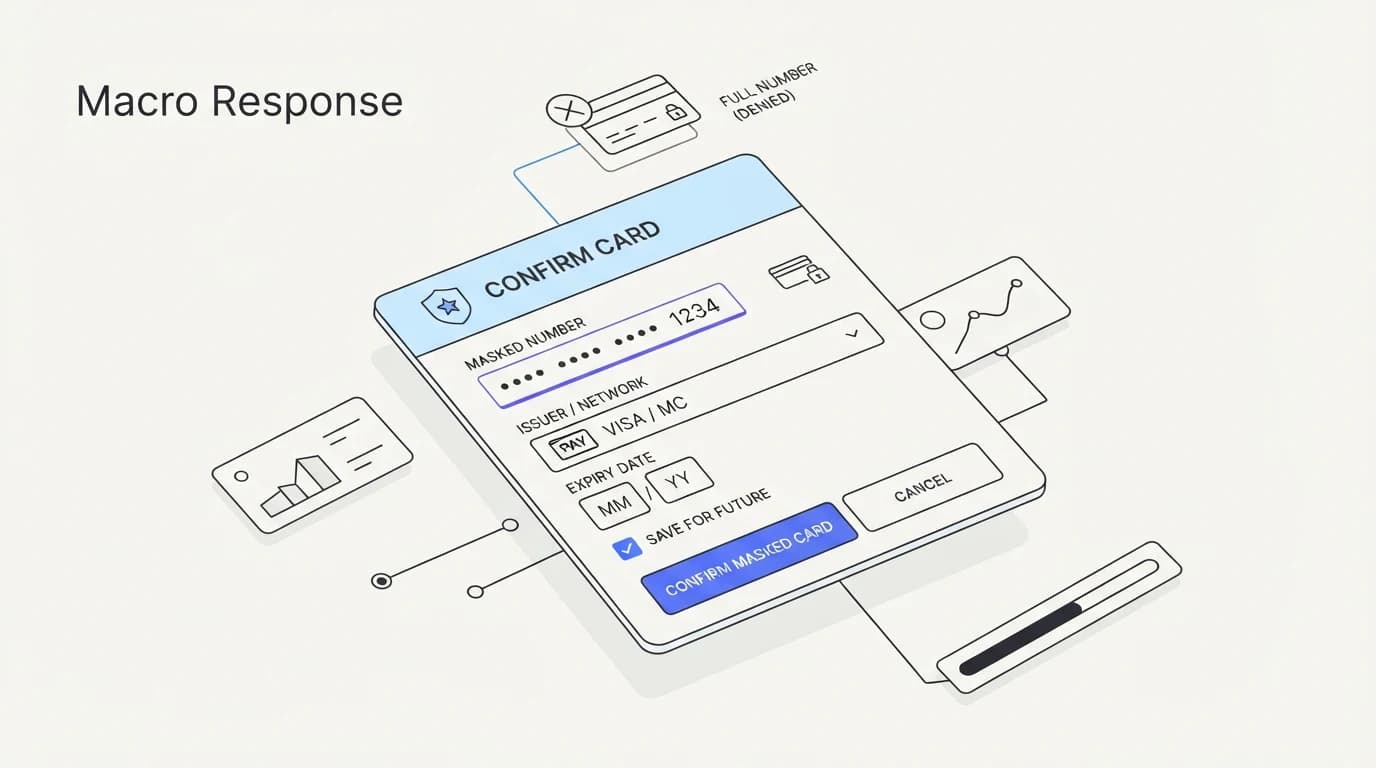
Even with a vendor that redacts correctly, a support team benefits from reducing what customers are prompted to share in the first place. A macro or canned response that asks a customer to confirm the last four digits of a card, instead of the full number, sets the pattern before the AI or a human ever needs to redact anything.
Train frontline responses, whether human or scripted, to redirect a customer away from pasting a password or a full card number, and toward a masked or partial confirmation instead. That single habit change reduces the volume of sensitive data entering the pipeline more than any redaction filter downstream, because prevention beats cleanup.
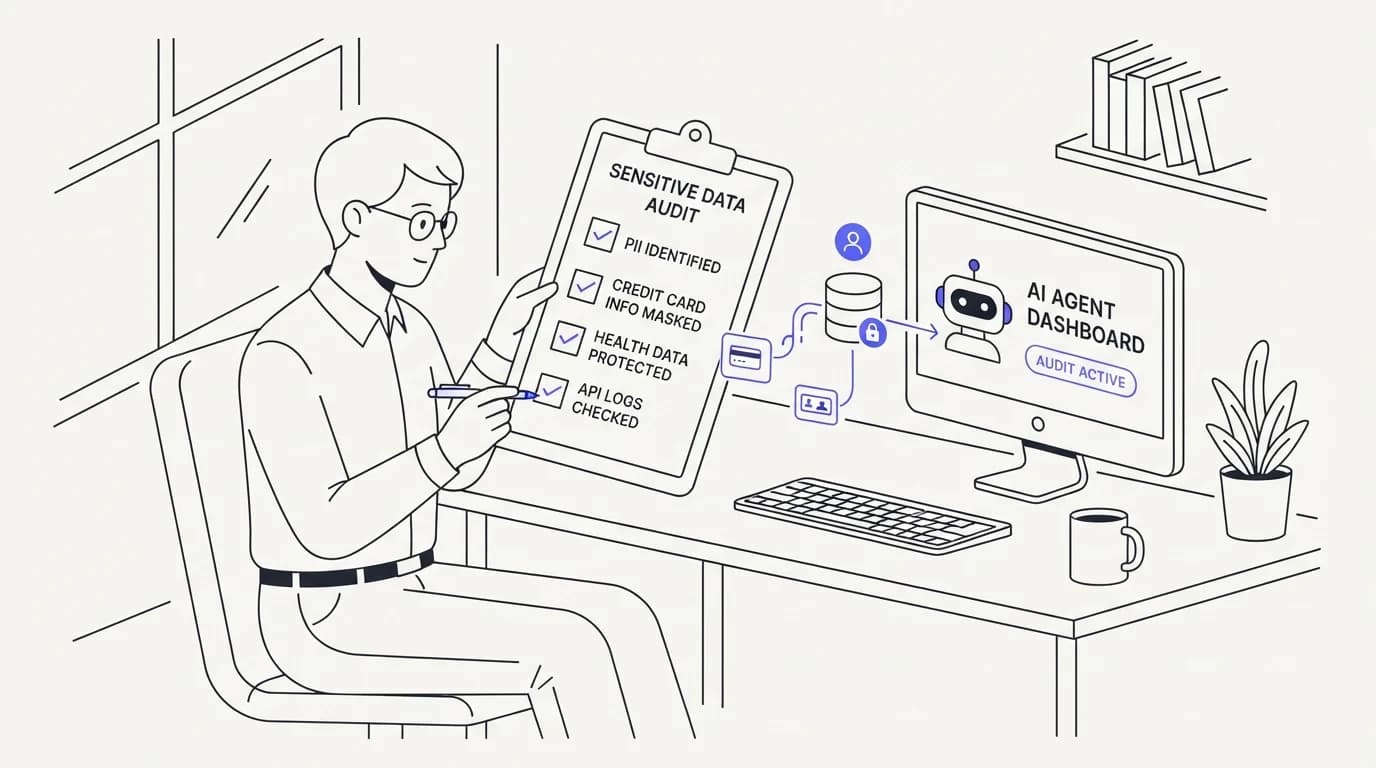
Periodically sample real conversations, with consent processes appropriate to your jurisdiction, to check whether sensitive patterns are showing up unredacted in whatever the AI agent retrieves or a human agent sees. This is the same discipline a shared inbox team should already apply to spot-check tone and accuracy, extended to a specific check for leaked personal data.
 Communicate.so
Document the check as a recurring task, not a one-time audit. Support scripts change, new channels get connected, and a redaction gap that did not exist at launch can appear months later when a team adds a new intake form or a new attachment type without revisiting the same question.
Assign ownership explicitly. A redaction gap that nobody is specifically responsible for tends to surface only after a customer or a regulator finds it, which is the most expensive way to learn about it. A named owner, even on a small team, who reviews a sample of conversations quarterly is a cheap insurance policy against a much larger cleanup later.
Where communicate.so stands, honestly
Communicate.so states its data handling posture on the security page, including encryption at rest and workspace isolation, but does not currently publish a dedicated, field-level redaction guarantee for card numbers or other high-risk patterns ahead of embedding. That is a gap worth stating plainly rather than implying a protection that has not been independently verified.
If your support volume regularly includes card numbers, government identifiers, or health details typed directly into chat, ask any vendor, including this one, for a specific, current answer on redaction timing before you connect a channel that regularly sees that kind of traffic. A general privacy statement is not the same as a confirmed answer to the before-or-after-embedding question this guide is built around.
Key takeaways
- Personal data enters a support stack through customer messages and attachments, not through a validated form, so redaction has to handle unstructured, unpredictable input.
- Redacting logs protects observability tooling; it does nothing for a retrieval index, which needs redaction before the embedding step, not after.
- PCI DSS requires minimizing stored card data, masking the primary account number to first six and last four digits, and never storing sensitive authentication data like a CVV, encrypted or not.
- The same before-embedding redaction needs to catch passwords, government IDs, and health details, not just card numbers.
- Ask any vendor a direct question about redaction timing relative to the retrieval pipeline, and reduce what customers are prompted to share in the first place.
Reducing what sensitive data reaches an AI agent starts with the frontline habits in this guide and a direct question to any vendor about redaction timing. Review the security posture of any tool touching customer conversations, and pair it with the questions in SOC 2 for AI customer support before you connect a channel that regularly carries sensitive detail.
Frequently asked questions
What is PII redaction in a customer support context?
PII redaction is the process of detecting and removing or masking personally identifiable information, such as card numbers, government IDs, and login credentials, from customer support conversations before that data is stored, logged, or used to train or ground an AI system. In a support AI stack, the critical distinction is when the redaction happens relative to the retrieval index.
Why is redacting logs not enough?
A log file and a retrieval index are separate systems populated at different points. Redacting logs protects debugging and analytics tooling. It does nothing for a retrieval index, which can already contain the unredacted data if the redaction step only ran on the logging path, not on the path feeding the embedding pipeline.
Can a card number typed into a chat legally be stored?
It can be stored only under PCI DSS's minimization and protection rules: kept to what is required for a legitimate purpose, rendered unreadable through strong cryptography, and masked to at most the first six and last four digits when displayed. Sensitive authentication data like a CVV can never be stored after authorization, per PCI DSS requirement 3.
What is sensitive authentication data, and why is it treated differently from a card number?
Sensitive authentication data includes full magnetic stripe or chip track data, the card verification value, and PIN data. Unlike the primary account number, which can be stored under strict protection rules, sensitive authentication data can never be stored after the transaction is authorized, encrypted or not, because its sole purpose is verifying the transaction in the moment.
Does redaction need to run in real time, or can it happen in a nightly batch?
For a retrieval index, redaction needs to run before the content is embedded, which in practice means at or near ingestion time, not in a nightly batch. A batch job that redacts data hours after it has already been embedded and made searchable has not prevented the exposure, only delayed noticing it.
What happens if sensitive data is already embedded in a retrieval index?
Removing it requires identifying the affected content and re-indexing it, since deleting the source text does not automatically remove what was already converted into vectors and stored. This is expensive and error-prone at scale, which is the core argument for redacting before embedding rather than cleaning up after the fact.
Should file attachments and screenshots be redacted too?
Yes, if your support channel accepts them. A screenshot of a bank statement or an uploaded photo of an ID contains the same sensitive data as typed text, but text-pattern redaction does not see it. If your stack allows uploads through embed widgets or email, confirm separately whether image content is scanned or excluded from retrieval entirely.
Is masking the same thing as redaction?
Masking typically means showing a partial value, such as the last four digits of a card, while the underlying full value is stored securely elsewhere. Redaction typically means removing or replacing the sensitive value entirely so it is not retrievable in that form at all. PCI DSS uses masking for display and separately requires the full stored value to be protected through strong cryptography.
Does GDPR require PII redaction specifically?
GDPR does not use the word redaction, but its data minimization principle under Article 5 requires that personal data collected and processed be adequate, relevant, and limited to what is necessary for the purpose. Redacting sensitive fields that are not needed for the support purpose is a practical way to meet that principle, covered in more depth in the GDPR and AI customer support guide.
Can an AI agent be trained to avoid asking for sensitive data it does not need?
Yes, and it is a meaningful prevention layer. An AI agent with clear guardrails can be instructed to request a masked confirmation, such as the last four digits of a card, instead of prompting a customer for the full number, which reduces the volume of sensitive data entering the pipeline in the first place.
How do I test whether a vendor actually redacts before embedding?
Ask for a specific technical description of the pipeline order: does the redaction filter run before or after the text is chunked and sent to an embedding model. A vendor that cannot describe this order specifically, or answers only in terms of encryption at rest, has not confirmed the thing you are actually asking about.
What role does encryption play if redaction already removes the data?
Encryption protects data that is legitimately stored, at rest and in transit, from unauthorized access. Redaction decides what should be stored at all. They solve different problems: encryption assumes the data is there and needs protecting, redaction reduces what data exists to protect in the first place.
A mature stack needs both, not one instead of the other.
Are there penalties specifically for failing to redact PII in an AI support tool?
There is no redaction-specific statute, but the underlying obligations carry real penalties. PCI DSS violations can trigger fines and loss of card processing privileges through the card networks, and GDPR violations tied to inadequate data minimization or security can trigger fines up to 4% of global annual turnover. Redaction is a practical control that helps satisfy both, not a separate legal requirement on its own.
Does redaction slow down an AI agent's response time?
A well-implemented pattern-based redaction step adds negligible latency, typically milliseconds, because it runs as a lightweight scan before the embedding call rather than a separate round trip. Model-assisted redaction for harder cases like health context can add more latency, which is why most production systems combine fast pattern matching for known formats with a lighter-weight fallback for ambiguous cases.
Should support agents be trained to redact manually as a backup?
Yes, as a backstop, not a primary control. Manual redaction by a human agent catches what automated systems miss, particularly ambiguous or context-dependent sensitive information, but it is inconsistent under volume and should never be the only line of defense for data that automated pattern matching can catch reliably.
What is the difference between redaction for compliance and redaction for AI safety?
Compliance-driven redaction focuses on legally regulated categories like card numbers and government IDs, tied to specific statutes. AI-safety-driven redaction is broader, covering anything that should not resurface in an unrelated conversation through retrieval, including internal notes or context a customer would not expect to see repeated back to them. A thorough stack addresses both, since compliance categories are a floor, not a ceiling.
Can redaction be undone if a support agent legitimately needs the full value later?
It depends on whether the system uses reversible masking, where an authorized user can retrieve the original value through a separate, access-controlled process, or irreversible redaction, where the value is gone entirely. PCI DSS's rule against storing sensitive authentication data means some values, like a CVV, cannot be reversible by design, because they cannot be stored at all.
Does redaction need to be different for voice or phone support transcripts?
The pattern is the same, but the timing is tighter. A voice transcript is often generated by a separate speech-to-text step before it reaches the same pipeline text-based chat uses, and that transcription step is another point where a raw card number or password can be captured. If a support stack adds voice, confirm redaction runs on the transcript before it reaches the same retrieval index, not just on the chat channel it was originally built for.
How should a small support team without engineering resources approach this?
Start with the prevention side, since it costs nothing to implement. Rewrite macros and canned responses that currently ask for a full card number or password so they ask for a masked confirmation instead. Then ask every vendor in the stack the direct redaction-timing question from this guide, and treat a vague answer as a reason to keep looking rather than a satisfied requirement.
What is the single biggest mistake teams make with PII redaction?
Assuming that a redaction policy written for logs and analytics automatically covers a retrieval index, because both look like storage from a distance. They are different systems with different exposure profiles, and a policy that only names logs leaves the index, the part an AI agent actually reads from, unaddressed.