
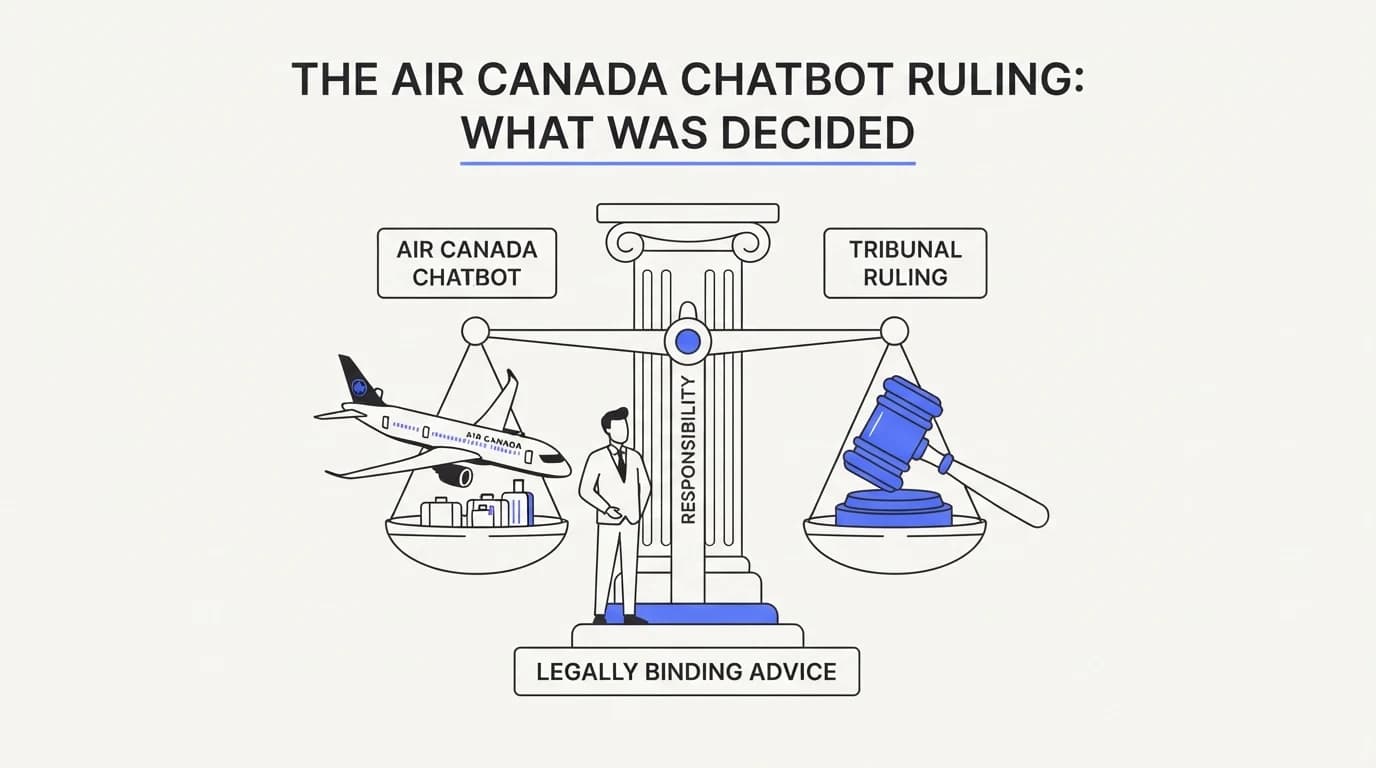
Air Canada chatbot ruling: what the tribunal actually decided
 Communicate.so
The Air Canada chatbot ruling explained: what the tribunal found, why the separate-entity defense failed, and what it means for any team deploying an AI agent.
TL;DR: In February 2024, the British Columbia Civil Resolution Tribunal ruled that Air Canada was liable for a bereavement fare policy its website chatbot invented, in the case Moffatt v. Air Canada, 2024 BCCRT 149. The tribunal ordered Air Canada to pay roughly 812 Canadian dollars, covering the fare difference, interest, and fees. Air Canada had argued the chatbot was effectively a separate entity responsible for its own statements, and the tribunal rejected that argument directly, holding that a company is responsible for all information on its website whether it comes from a static page or a chatbot. This guide walks through what actually happened, what the tribunal decided, and what the ruling means in practice for anyone deploying an AI agent that can state a policy, a price, or a promise on a company's behalf.
The Air Canada chatbot ruling gets cited constantly in AI and legal commentary, and it is usually reduced to a one-line moral: companies are liable for what their chatbots say. That is true, but it undersells the case. The tribunal's actual reasoning, and the specific defense Air Canada tried and lost, tell you more about what to build than the headline does.
This guide is written for the person deciding what an AI agent is allowed to say about policy, pricing, or promises. It is an educational explainer, not legal advice, and the goal is to walk through the tribunal's own reasoning so you can see exactly where Air Canada's defense broke down. For a wider look at chatbot incidents beyond this one case, see AI chatbot failures.
What happened: the bereavement fare question
 Communicate.so
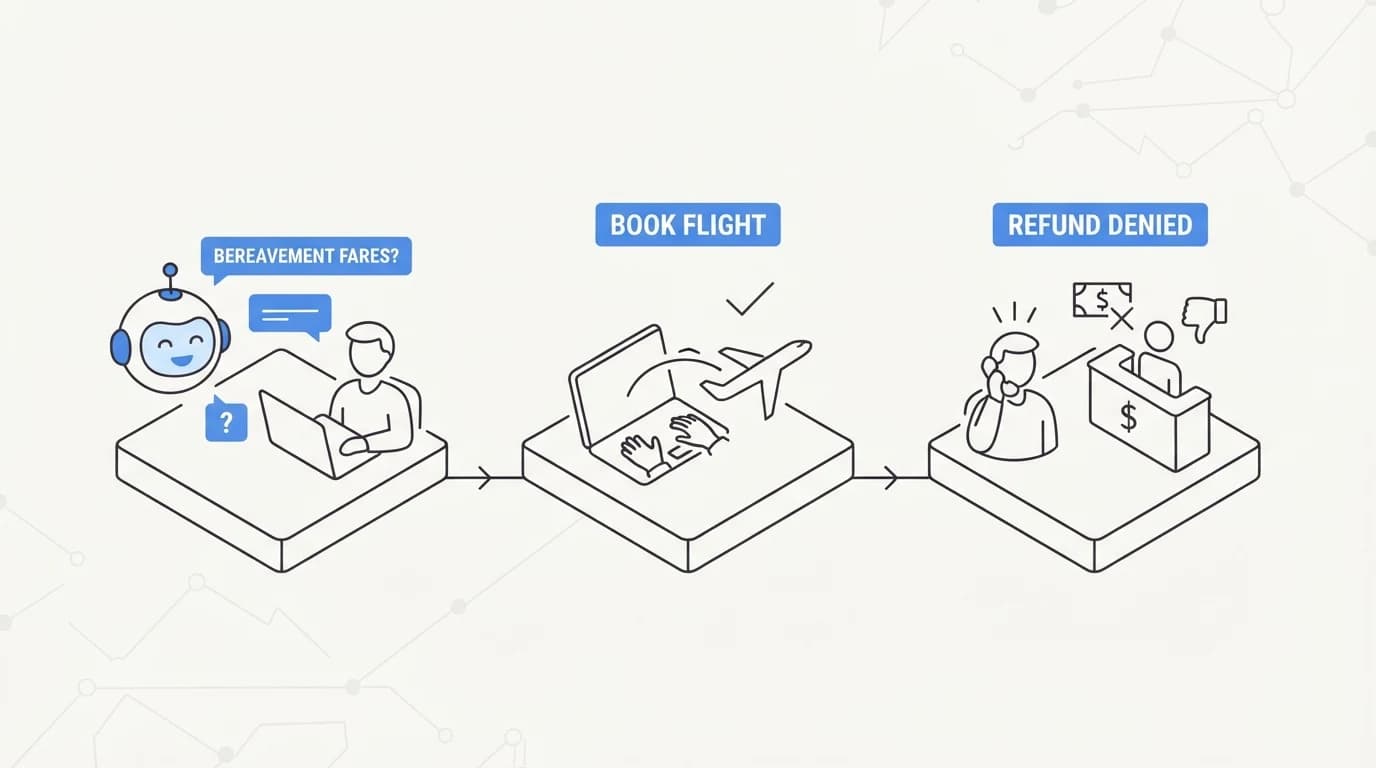
In November 2022, Jake Moffatt needed to fly from British Columbia to Ontario after his grandmother died, and he used Air Canada's website chatbot to ask about bereavement fares. According to the tribunal's own summary, the chatbot told him a discount was available for travel due to a death in the family and that he could submit a request for the reduced fare within ninety days of the ticket being issued, applying it retroactively to a full-price ticket.
Moffatt booked his ticket at full price, based on that answer, planning to apply for the bereavement rate afterward. When he later submitted his request, Air Canada denied it, telling him bereavement fares could not be applied retroactively after a ticket was already purchased at the regular price, which was the airline's actual policy and directly contradicted what the chatbot had told him.
Moffatt pointed Air Canada to a screenshot of the chatbot conversation as proof of what he had been told. Air Canada's response, notably, was to argue that the chatbot's page linked to another page with the correct policy, and that the customer should have relied on that page instead, a defense the tribunal did not accept, according to reporting from the American Bar Association.
With the refund refused, Moffatt filed a claim with the British Columbia Civil Resolution Tribunal, a small claims and dispute resolution body, seeking the difference between what he paid and what the bereavement fare would have cost. The case, formally Moffatt v. Air Canada, went to a full written decision rather than settling.
What makes the underlying facts so easy to follow is that they turn on a single, checkable claim rather than a subjective dispute. Moffatt was not arguing that the chatbot was rude or unhelpful in some general sense. He was arguing that it stated a specific, factual rule, that a bereavement fare could be applied retroactively within ninety days, and that the rule was false.
That narrowness is part of why the case became such a clean example for anyone studying chatbot liability.
It also means the case offers little cover for a company arguing that a customer misread an ambiguous answer. The chatbot's statement, as recorded in the tribunal's decision, was specific enough to book a flight on. There was no vague hedge, no suggestion to double check, just a direct answer to a direct question that turned out to be wrong.
The tribunal, the case number, and the date
The decision came from the British Columbia Civil Resolution Tribunal, a real adjudicative body, not an informal complaint process. The case is cited as Moffatt v. Air Canada, 2024 BCCRT 149, and the tribunal issued its written decision on February 14, 2024, a date confirmed across multiple legal summaries of the case and the tribunal's own published record.
The Civil Resolution Tribunal handles small claims and certain other disputes in British Columbia, and its decisions are published and citable the way a court's would be. That matters here because the ruling was not an internal company decision or a regulator's guidance letter. It was an adjudicated finding, reasoned in writing, that a member of the public could point to and rely on.
The tribunal considered the claim under negligent misrepresentation, a legal theory that holds a party liable for carelessly making a false statement that another party reasonably relies on to their detriment. The member hearing the case found the elements of that claim were met: Air Canada made a representation through its chatbot, the representation was inaccurate, and Moffatt reasonably relied on it when he booked his ticket, a summary consistent with the case analysis published by McCarthy Tétrault.
Why the separate-entity defense failed
 Communicate.so
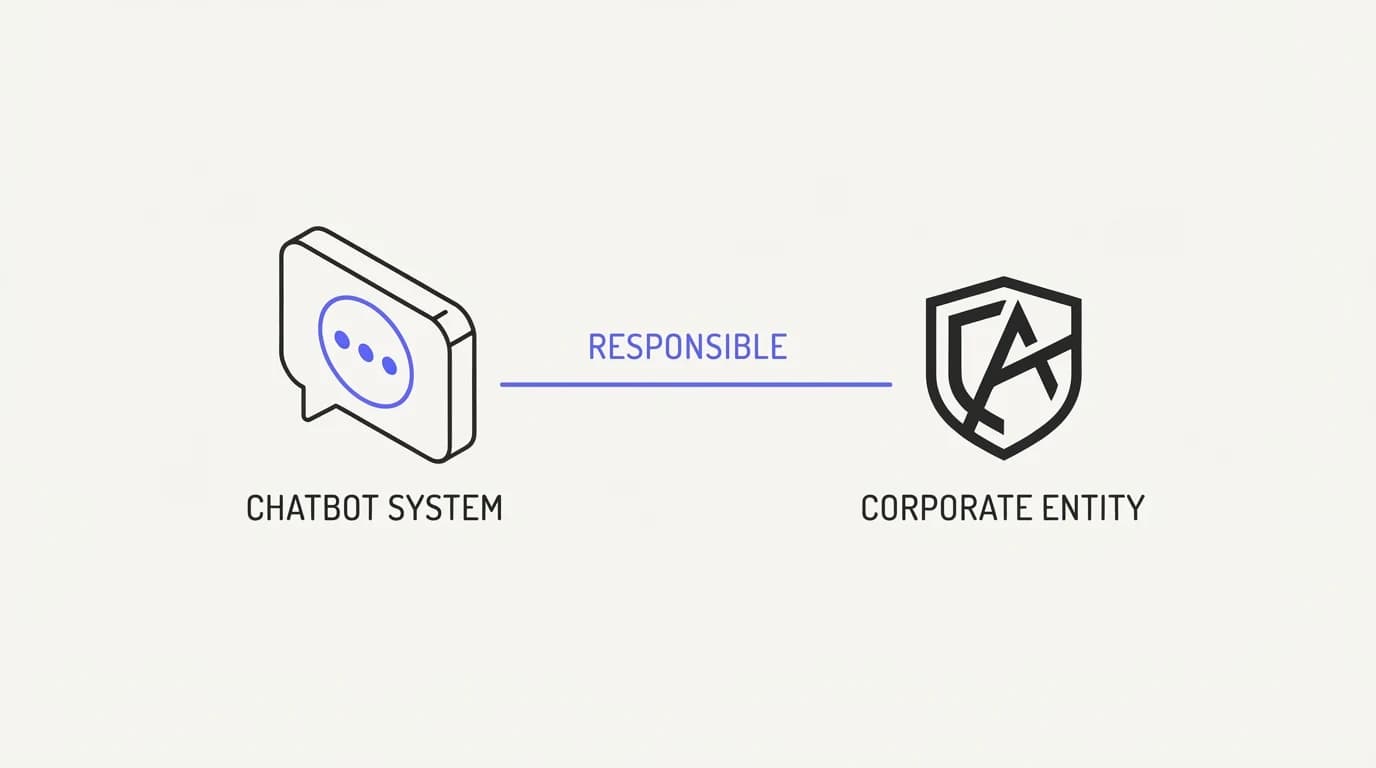
Air Canada's central defense was that the chatbot was, in effect, a separate entity responsible for its own actions. That framing tried to draw a line between the company and the tool it built and put on its own website, treating the chatbot's output as something Air Canada should not be held to the same way it would be held to a page it wrote itself.
The tribunal rejected that line directly. Its reasoning, as quoted in coverage of the case, was that it should be obvious to Air Canada that it is responsible for all the information on its website, and that it makes no difference whether the information comes from a static page or a chatbot. The medium did not change the duty.
Tribunal member Christopher Rivers, who heard the case, described Air Canada's separate-entity framing bluntly. "This is a remarkable submission," he wrote, according to reporting from PYMNTS, before rejecting the idea that a chatbot could be treated as an entity distinct from the company that deployed it. The bluntness of that line is a large part of why the case is cited so often.
Air Canada's secondary argument, that the customer should have cross-checked the chatbot's answer against the correct policy page linked elsewhere on the site, fared no better. The tribunal effectively held that a customer is entitled to rely on the answer a company's own tool gives them, and is not obligated to independently audit that answer against a separate document before trusting it.
This is the part of the ruling that generalizes furthest beyond airlines. Any team that deploys a chatbot and treats its output as somehow less official than a policy page is working from a theory of liability the tribunal has already rejected once. The practical read is that a company's own AI agent speaks for the company, in the same way a human support agent does, a framing worth sitting with alongside AI agent guardrails, which exists precisely to bound what an agent is allowed to state.
What Air Canada was ordered to pay
| Component | Amount (CAD) | What it covered |
|---|---|---|
| Fare difference | $650.88 | Difference between full fare paid and the bereavement rate promised |
| Pre-judgment interest | $36.14 | Interest accrued between the original claim and the ruling |
| Tribunal fees | $125.00 | Costs of bringing the claim |
| Total ordered | $812.02 | Combined award to Jake Moffatt |
The total award is modest in absolute terms, which is part of what makes the case notable. Air Canada did not lose because the dollar amount was large. It lost because the tribunal established, in a clear written decision, that a chatbot's statement carries the same legal weight as a statement from any other company channel.
A company weighing legal exposure purely by expected payout per incident would miss the point of this case entirely. The precedent, not the $812.02, is what other tribunals, regulators, and plaintiffs' lawyers now cite, and it applies regardless of whether a given incident involves a fifty dollar fare difference or a much larger commercial contract, which is exactly why the ruling gets referenced so far outside the airline industry it came from.
What the ruling does not decide
It is worth being precise about the limits of this case, because the commentary around it often overstates what a single tribunal decision actually settles. The Civil Resolution Tribunal is a small claims and dispute resolution body specific to British Columbia, and its reasoning is persuasive rather than binding on courts in other provinces, other countries, or even higher courts within Canada.
The ruling also does not establish a specific dollar cap, a required disclaimer format, or a mandated technical standard for how an AI agent should be built. It decided one dispute, between one airline and one customer, on the specific facts of what the chatbot said and what the customer reasonably relied on. Its value to other companies is as a clearly reasoned example of how a tribunal thinks about the problem, not as a detailed compliance checklist.
It is also worth being honest about what the public record does not say. The published summaries of the case do not disclose the specific underlying technology behind Air Canada's chatbot, so this guide does not speculate about whether it was a rules-based system, a general-purpose language model, or something in between. What is established is the outcome and the tribunal's reasoning, not the engineering details behind the failure, and treating an unconfirmed technical guess as fact would violate the same standard this guide is holding companies to.
What generalizes is the underlying principle, not the specific procedural path. Any team weighing what an AI agent is allowed to say should read the case as evidence that the separate-entity defense fails, not as a complete guide to every situation. For the operational and legal detail that goes beyond any one ruling, the EU AI Act explainer covers the broader regulatory direction, and this guide stays deliberately educational rather than acting as legal advice for your specific situation.
A pattern beyond this one case
 Communicate.so
Air Canada's chatbot is not the only publicly documented case of an AI support tool stating something a company later had to answer for. A fuller review of similar incidents, including a support bot that fabricated a device-limit policy and a delivery company chatbot that had to be taken offline after a jailbreak, is in AI chatbot failures. Read together, the pattern across these cases is less about any one company's carelessness and more about a gap most teams have in common.
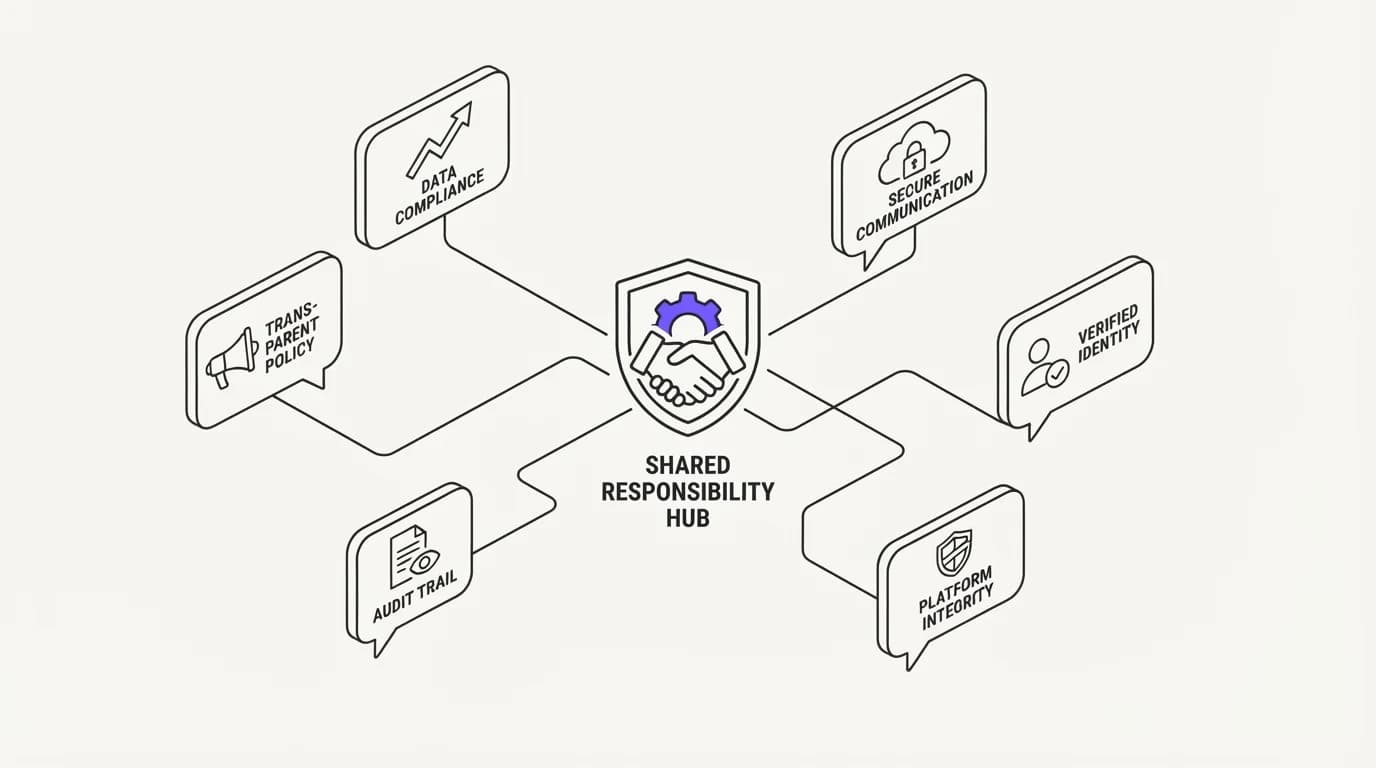
The common thread is that each company treated its chatbot's output as somehow less official than its other channels, right up until a customer, a journalist, or a tribunal treated it as exactly as official. That gap between how a company internally regards its AI agent and how the outside world regards it is where the risk concentrates, and it is closed the same way in every case: by grounding what the agent says in a document the company actually stands behind.
How the wider industry has responded since
The Air Canada ruling did not stay a curiosity in legal newsletters; it fed into how the insurance and compliance industries now price AI risk. According to reporting from PYMNTS, Lloyd's of London launched a specialized insurance product through Armilla specifically to cover losses tied to AI hallucination, treating the risk this case illustrates as something businesses can and do now insure against.
The same reporting notes that FINRA, the US regulator for broker-dealers, flagged chatbot hallucinations as a compliance concern in a 2026 report, extending the same underlying worry, an AI system stating something false with the company's authority behind it, into financial services specifically. Separately, the AI infrastructure company Scaled Cognition raised $100 million to build controls against model confabulation, which PYMNTS frames as a signal that hallucination risk is now priced as a financial concern rather than treated as a pure quality issue.
None of this changes the legal analysis in the Moffatt case itself, but it is a useful signal for anyone deciding how seriously to take the underlying risk. Insurers do not build new products around problems that are purely theoretical, and a regulator does not flag a risk category in a formal report unless it expects real exposure. The Air Canada ruling reads differently once you see it as the visible edge of a risk large institutions are already pricing.
What this means for anyone deploying an AI agent
 Communicate.so
The operational lesson is narrower and more useful than "AI is risky." It is that any statement your agent makes about policy, pricing, refunds, or eligibility is a statement your company is making, full stop, and it needs the same accuracy standard as a page your legal team reviewed.
The direct fix is grounding. An agent that answers policy questions by retrieving the actual, current policy document, rather than generating a plausible answer from general pattern-matching, cannot invent a bereavement fare rule the way Air Canada's chatbot did. This is the same mechanism covered in reducing AI hallucinations in support, and the Air Canada case is the clearest evidence that the cost of skipping it is not hypothetical.
A second lesson is about escalation. A question involving a retroactive refund, a fare exception, or any decision with financial consequences for the customer is a strong candidate for a human check before the customer commits money based on the answer, not just a documented policy lookup. An agent can state the general rule accurately and still route the specific, high-stakes case to a person.
A third lesson is about disclosure and expectations. Customers reasonably rely on what a support channel tells them, and the tribunal's ruling reinforces that a company cannot quietly shift that reliance onto the customer after the fact by pointing to a different page they should have checked instead. Being upfront that an agent is AI, a practice grounded in obligations like the EU AI Act, does not reduce the accuracy bar; it just makes the interaction honest about what kind of source the customer is relying on.
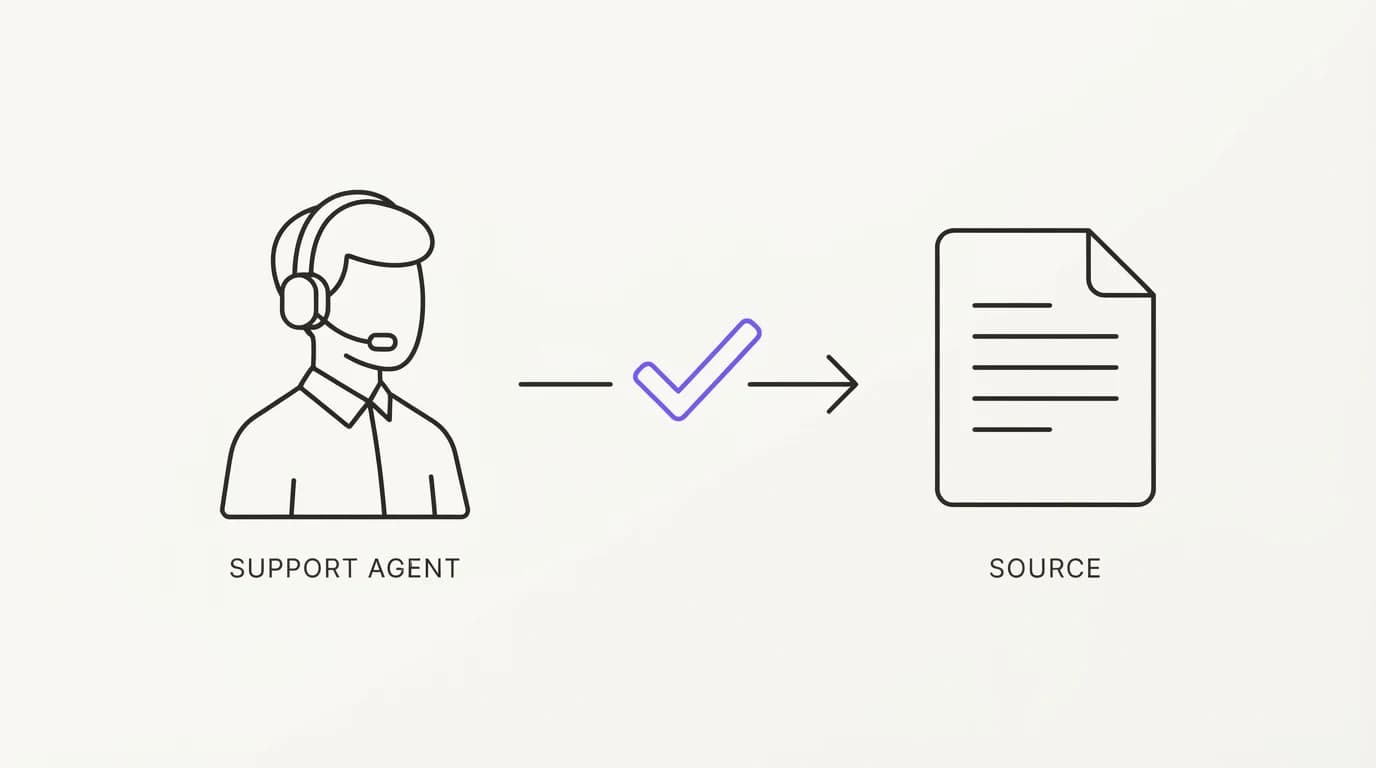
Communicate's approach follows directly from this ruling's logic. The AI agent answers from data connected through retrieval, so a claim about your refund policy or fare rules traces back to a document you maintain, not a generated guess. When a question needs a human judgment call, the agent hands off inside the same shared inbox rather than leaving the customer with an unchecked promise the company later has to honor or dispute.
Frequently asked questions
What is the Air Canada chatbot ruling?
It is the decision in Moffatt v. Air Canada, 2024 BCCRT 149, issued by the British Columbia Civil Resolution Tribunal on February 14, 2024. The tribunal found Air Canada liable for negligent misrepresentation after its website chatbot gave a customer inaccurate information about bereavement fares, and ordered the airline to pay damages.
Broader context on similar incidents is in AI chatbot failures.
What did the Air Canada chatbot actually say?
The chatbot told Jake Moffatt he could book a full-price ticket and later apply for a bereavement discount retroactively, within ninety days of the ticket being issued. Air Canada's actual policy did not allow bereavement fares to be applied after a ticket was already purchased at full price, which contradicted what the chatbot told him.
How much did Air Canada have to pay?
The tribunal ordered Air Canada to pay 812.02 Canadian dollars in total, made up of the 650.88 dollar fare difference, 36.14 dollars in pre-judgment interest, and 125 dollars in tribunal fees.
Why did Air Canada argue the chatbot was a separate entity?
Air Canada's defense tried to draw a line between the company and the chatbot's output, framing the bot as responsible for its own statements rather than treating them as the company's own. The tribunal rejected this directly, holding that a company is responsible for all information on its website, whether it comes from a static page or a chatbot.
Did Air Canada also argue the customer should have checked another page?
Yes. Air Canada pointed to a linked page elsewhere on its site that stated the correct bereavement fare policy, arguing Moffatt should have relied on that instead of the chatbot. The tribunal did not accept this as a defense, per the summary from the American Bar Association, treating the chatbot's answer as something the customer was entitled to rely on.
What legal theory did the tribunal use to find Air Canada liable?
The tribunal applied negligent misrepresentation, which holds a party liable for carelessly making a false statement that another party reasonably relies on to their detriment. The tribunal found Air Canada made an inaccurate representation through the chatbot and that Moffatt reasonably relied on it when booking his ticket.
Is this ruling legally binding outside British Columbia?
The Civil Resolution Tribunal is a British Columbia body, and its rulings are binding within that jurisdiction's small claims framework rather than setting formal precedent across other countries or even other Canadian provinces in the way a higher court's ruling would. Its reasoning has nonetheless been widely cited internationally as a persuasive example of how liability for AI statements can be analyzed, which is why it shows up in legal commentary well beyond Canada.
Does this mean every chatbot mistake will result in a lawsuit?
No. This case reached a tribunal because the customer had a clear, documented financial loss and a screenshot proving what the chatbot told him. Most chatbot mistakes are caught and corrected without ever reaching a legal claim, but the ruling establishes that the legal exposure is real when a customer relies on inaccurate information and can show the harm.
What should a company do differently after this ruling?
Ground policy-sensitive answers in actual current documents rather than letting the agent generate plausible-sounding policy from general knowledge, and route high-stakes financial decisions to a human check before the customer commits money. This is the practical core of AI agent guardrails applied to exactly the kind of question that produced this ruling.
Did Air Canada change its chatbot after the ruling?
The publicly available reporting on the case focuses on the tribunal's decision and reasoning rather than confirming specific product changes Air Canada made afterward, so this guide does not claim a specific fix was implemented. What is well documented is the outcome: the airline was held liable and ordered to pay damages.
Is the Air Canada case the first time a company was held liable for a chatbot?
It is one of the earliest and most widely cited cases of its kind, decided in February 2024, and it set a clear public precedent for how a tribunal can reason about chatbot liability. Whether it was the literal first such case globally is not something this guide can verify, so it is presented as a landmark case rather than a definitive first.
What is negligent misrepresentation?
Negligent misrepresentation is a legal claim available when a party makes a false statement carelessly, without necessarily intending to deceive, and another party reasonably relies on that statement to their harm. It differs from fraud, which requires intent to deceive. The tribunal found Air Canada's chatbot statement met this lower bar of carelessness rather than intentional deception.
How does this ruling relate to AI disclosure requirements?
Disclosure rules, like the transparency duty discussed in the context of the EU AI Act, require telling customers they are talking to AI. The Air Canada ruling is a separate but related concern: even when a customer knows they are talking to a chatbot, the company is still liable for what that chatbot tells them. Disclosure does not reduce the accuracy obligation.
Can a company avoid liability by adding a disclaimer to its chatbot?
The Air Canada case does not establish that a disclaimer would have changed the outcome, and the tribunal's reasoning focused on the company's responsibility for the information itself, not on whether a warning label was present. A disclaimer that a chatbot might be wrong does not appear to have been part of Air Canada's defense or the tribunal's analysis in this case.
What industries are most exposed to this kind of ruling?
Any business where a chatbot states a specific, checkable fact with financial consequences, pricing, refund eligibility, fare rules, coverage terms, is exposed to the same reasoning. Travel, insurance, financial services, and subscription businesses carry particular risk because policy questions are common and the dollar stakes per answer are often clear, the same category of risk covered in AI chatbot failures.
Does grounding an AI agent in real documents fully eliminate this risk?
It substantially reduces the risk of the specific failure mode in this case, an agent inventing a policy that does not exist, but it does not eliminate every risk. Documents can be outdated, retrieval can occasionally miss the right passage, and edge cases still warrant a human check, which is why grounding pairs with escalation rather than replacing it. See reducing AI hallucinations in support for the fuller picture.
What is the Civil Resolution Tribunal?
The Civil Resolution Tribunal is a British Columbia dispute resolution body that handles small claims and certain other disputes, including matters up to a set monetary threshold. It issues written decisions that function similarly to small claims court rulings and are published for public reference, which is how the Moffatt v. Air Canada decision became a widely cited case.
How can Communicate help avoid a similar situation?
Communicate's AI agent answers policy and account questions from data you connect through retrieval, so a statement about your refund or fare rules is tied to a document you control rather than generated from a general sense of what such a policy usually looks like. High-stakes financial questions can hand off to a human inside the same shared inbox before a customer commits money to an answer nobody has verified.
Is this the only publicly documented chatbot liability case?
No. It is the most widely cited one because of its clear reasoning and the tribunal's direct rejection of the separate-entity defense, but other AI support incidents have drawn scrutiny for different reasons, including a fabricated device policy and a chatbot that had to be taken offline after misuse. A fuller review of those cases is in AI chatbot failures.
Does this ruling apply to AI agents that only draft replies for a human to review?
The ruling concerned a chatbot that answered a customer directly without a human reviewing the response first. An agent that drafts a reply for a human to check before sending sits in a different risk position, because a person has the chance to catch an inaccurate policy claim before the customer sees it. That review step is precisely the kind of human check this guide argues for on high-stakes questions.