
Fine-tuning vs RAG for customer support: why retrieval wins almost every time
 Communicate.so
Fine-tuning vs RAG for support agents: the cost, staleness, and update-frequency arithmetic that makes retrieval the default choice for most teams.
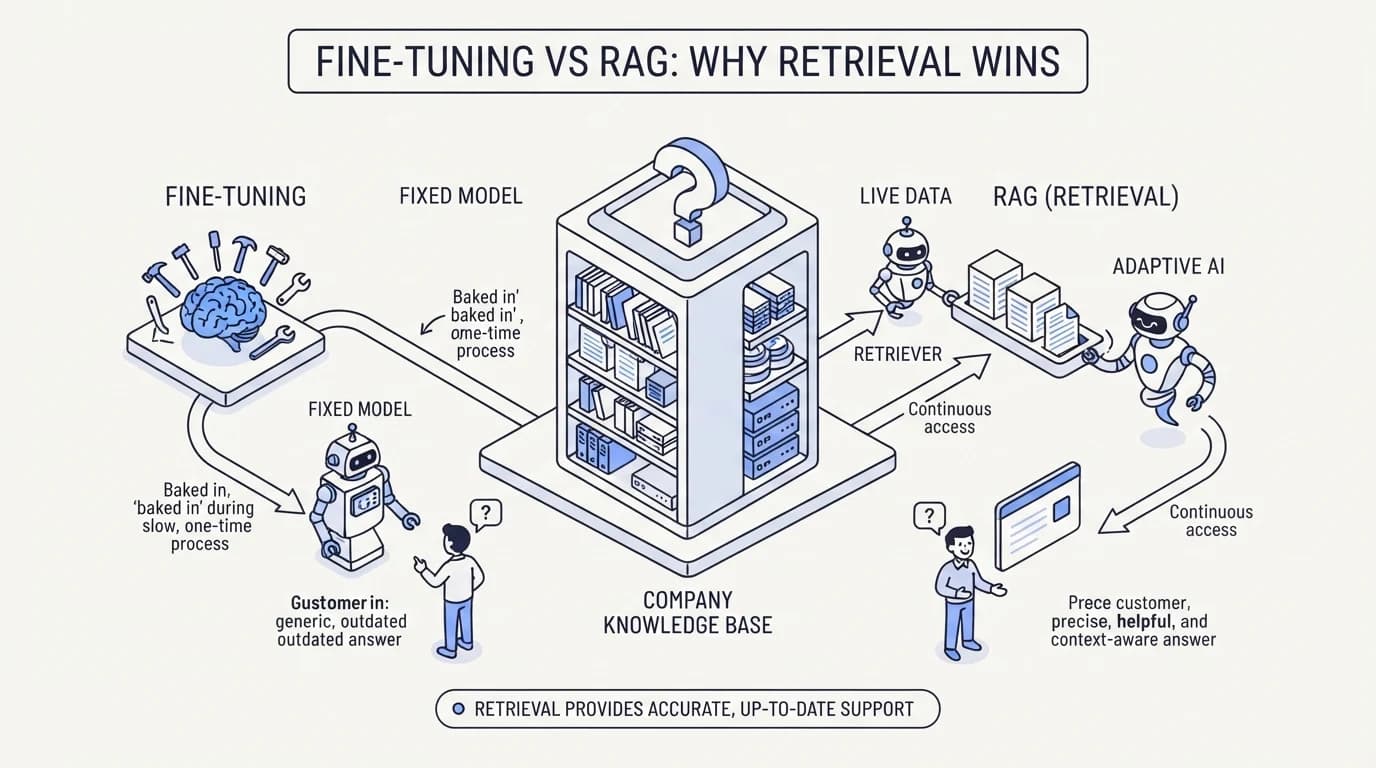
TL;DR: Fine-tuning bakes knowledge into a model's weights through additional training, while retrieval-augmented generation, RAG, fetches relevant content at answer time and feeds it to the model as context. For customer support, retrieval wins in almost every real scenario, because support answers change weekly, a fine-tuned model's knowledge is frozen at the moment training finished, and retraining on every policy update is neither fast nor cheap enough to keep pace. This guide walks through what each approach actually does under the hood, the real cost and staleness arithmetic that favors retrieval, and the narrow set of cases where fine-tuning still earns its place, usually for tone and format rather than facts. It ends with a worked cost comparison so the trade-off is concrete rather than a matter of taste.
Ask a support team whether to fine-tune their model or build retrieval and you will often get a confident wrong answer, because fine-tuning sounds like the more serious engineering investment. The honest comparison, fine-tuning vs RAG, turns on how often your answers change, not on which approach sounds more sophisticated.
This guide is for the engineer or founder deciding how to ground a support agent in company-specific knowledge. It assumes you have read or will read RAG for customer support for the retrieval side, and focuses here on the direct comparison against fine-tuning, with the arithmetic that makes the choice concrete rather than philosophical.
What fine-tuning actually does
Fine-tuning takes a pre-trained model and continues training it on a smaller, task-specific dataset, adjusting the model's internal weights so its behavior shifts toward that dataset's patterns. OpenAI's fine-tuning documentation describes this as teaching a model a particular style, format, or narrow skill it does not reliably produce from a prompt alone.
The knowledge a fine-tuned model gains is baked into its parameters at training time. Once training finishes, that knowledge is frozen. The model does not know about anything that happened, or any policy that changed, after its training data was collected, and it has no built-in way to check whether what it knows is still accurate.
Fine-tuning is genuinely good at shifting behavior patterns: matching a specific tone, following a rigid output format, or handling a narrow, stable classification task. It is comparatively poor at being a reliable, updatable source of facts, because updating a fact means retraining, and retraining is not something you do casually for every policy change, a distinction Google Cloud's explainer on retrieval-augmented generation makes explicitly when contrasting the two approaches.
The cost of a fine-tuning run scales with dataset size and model size, and it is not a one-time cost, it recurs every time you want the model to reflect new information. For a support use case where policies, pricing, and product features change regularly, that recurring cost compounds fast.
What RAG actually does
 Communicate.so
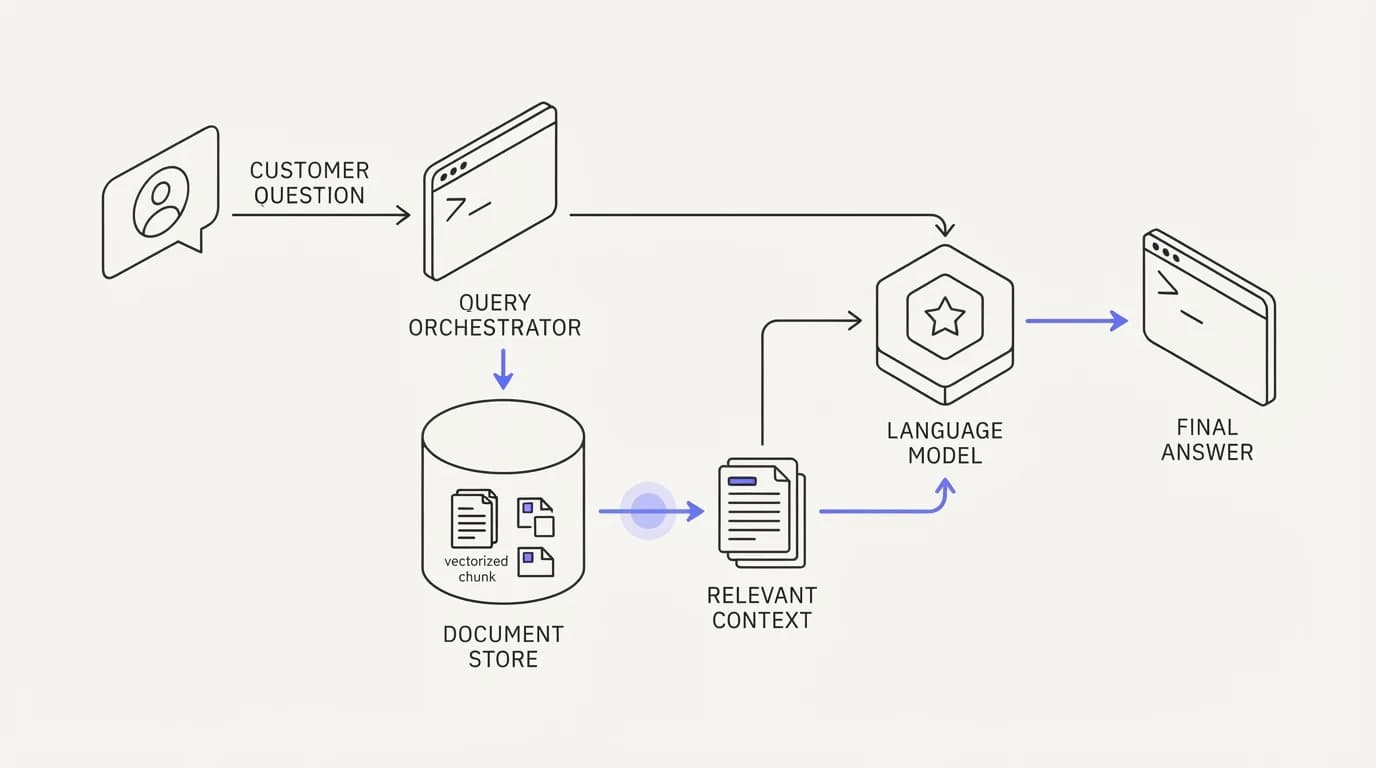
RAG keeps the model's weights untouched and instead retrieves relevant content at the moment of the question. A customer's message triggers a search against your indexed documents, help articles, policy pages, product docs, and the most relevant passages are inserted into the prompt alongside the question before the model generates an answer.
This means updating the agent's knowledge is as simple as updating the source document. Change your refund policy page, and the next question about refunds retrieves the new text immediately, with no retraining step and no delay beyond however long your indexing pipeline takes to pick up the change.
The trade-off is that RAG depends heavily on retrieval quality. If the wrong passage is retrieved, or the right passage is chunked so badly that critical context is missing, the model answers confidently from incomplete information, a failure mode covered in depth in reduce AI hallucinations in support. Retrieval quality, not model size, is usually the bottleneck on answer accuracy.
RAG also gives you something fine-tuning cannot: a citation trail. Because the model's context explicitly includes the retrieved passage, you can show which document an answer came from, which matters both for customer trust and for your own debugging when an answer turns out wrong.
The staleness arithmetic: why support content changes too often for fine-tuning
Run the actual numbers for a typical support operation. A mid-sized company updates pricing pages, feature documentation, and policy text on the order of weekly to monthly, not annually. Each update is small, a changed threshold, a new feature, a revised deadline, but the cumulative drift adds up fast.
With fine-tuning, every one of those updates either waits for a batch retraining cycle or gets ignored until the next one. If you retrain monthly, your model is running on knowledge that is, on average, two weeks stale, and up to a full month stale for a change made the day after a training run completed.
With RAG, the same update is live the moment your document index refreshes, often within minutes for a well-built pipeline. The staleness window shrinks from weeks to minutes, and that difference compounds every time policy changes, which for most support organizations is often, a cadence documentation maintenance guidance from Zendesk treats as a routine operational reality rather than an exception.
The failure mode of stale knowledge in support is not abstract. A frozen model that still believes an old return window is correct will state it with the same confidence as a current one, and the customer has no way to know the answer is out of date unless they happen to check the actual policy page themselves.
| Dimension | Fine-tuning | RAG |
|---|---|---|
| Update latency after a policy change | Days to weeks, next training cycle | ✓ Minutes to hours, index refresh |
| Cost per knowledge update | ✗ Recurring training run | ✓ Document edit only |
| Citation trail for an answer | ✗ Not inherent | ✓ Retrieved passage is visible |
| Good for tone and format consistency | ✓ | Partial, needs prompt discipline |
| Good for frequently changing facts | ✗ | ✓ |
The cost arithmetic: a worked comparison
 Communicate.so
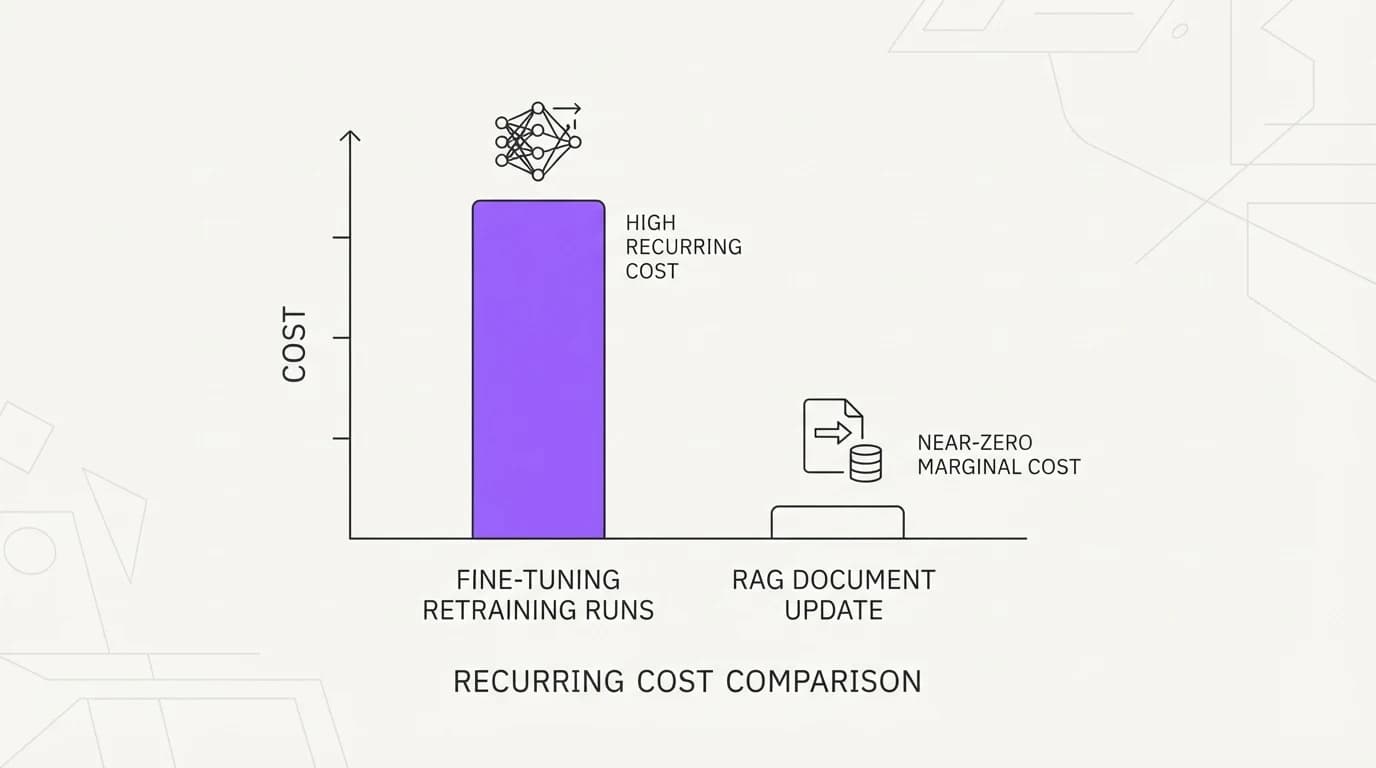
Take a support operation handling 10,000 conversations a month with content that changes on a biweekly cadence, roughly 26 update cycles a year. Under a fine-tuning approach that retrains to match that cadence, you pay for 26 training runs annually, each with its own compute cost, data preparation time, and validation pass before it can be trusted in production.
Under a RAG approach, the same 26 content changes are 26 document edits, each essentially free beyond the time it takes someone to update the source page. The indexing pipeline that picks up the change is a fixed, largely one-time engineering cost, not a recurring per-update cost.
Multiply that difference across a year of updates and the gap becomes hard to ignore. Twenty-six retraining runs, each carrying its own compute and staff time, add up to a meaningful recurring line item, while twenty-six document edits add up to little beyond the normal cost of keeping documentation current.
Even setting aside the direct training compute cost, the engineering time to prepare a clean fine-tuning dataset, validate the retrained model against a golden set of the kind covered in AI agent evaluation and testing, and roll it out safely, is real labor spent every single cycle. A RAG pipeline pays that validation cost once, at build time, and the per-update marginal cost afterward is close to zero.
The one place the arithmetic can favor fine-tuning is extremely high query volume against a narrow, stable task where retrieval latency itself becomes the bottleneck, and even then a well-cached RAG setup usually closes most of that gap without touching model weights at all.
Where fine-tuning still earns its place
Fine-tuning is not without value, it is a mismatch specifically for fact freshness, not a mismatch for every use. Tone and voice consistency is a legitimate fine-tuning use case: teaching a model to consistently write in a specific brand voice across thousands of interactions is a stable pattern that does not change weekly.
Rigid output formatting is another reasonable fit. If every response needs to follow an exact structural template, and prompt-based formatting instructions prove unreliable at scale, fine-tuning on examples of the correct format can lock in that consistency more reliably than an ever-longer system prompt.
Narrow, stable classification tasks, like routing a message into one of a small fixed set of categories, can also benefit from fine-tuning, because the categories themselves rarely change even if the specific content within each category does. This is a genuinely different kind of stability than the factual content covered by RAG for customer support, and it is worth distinguishing the two rather than treating fine-tuning as universally wrong for support.
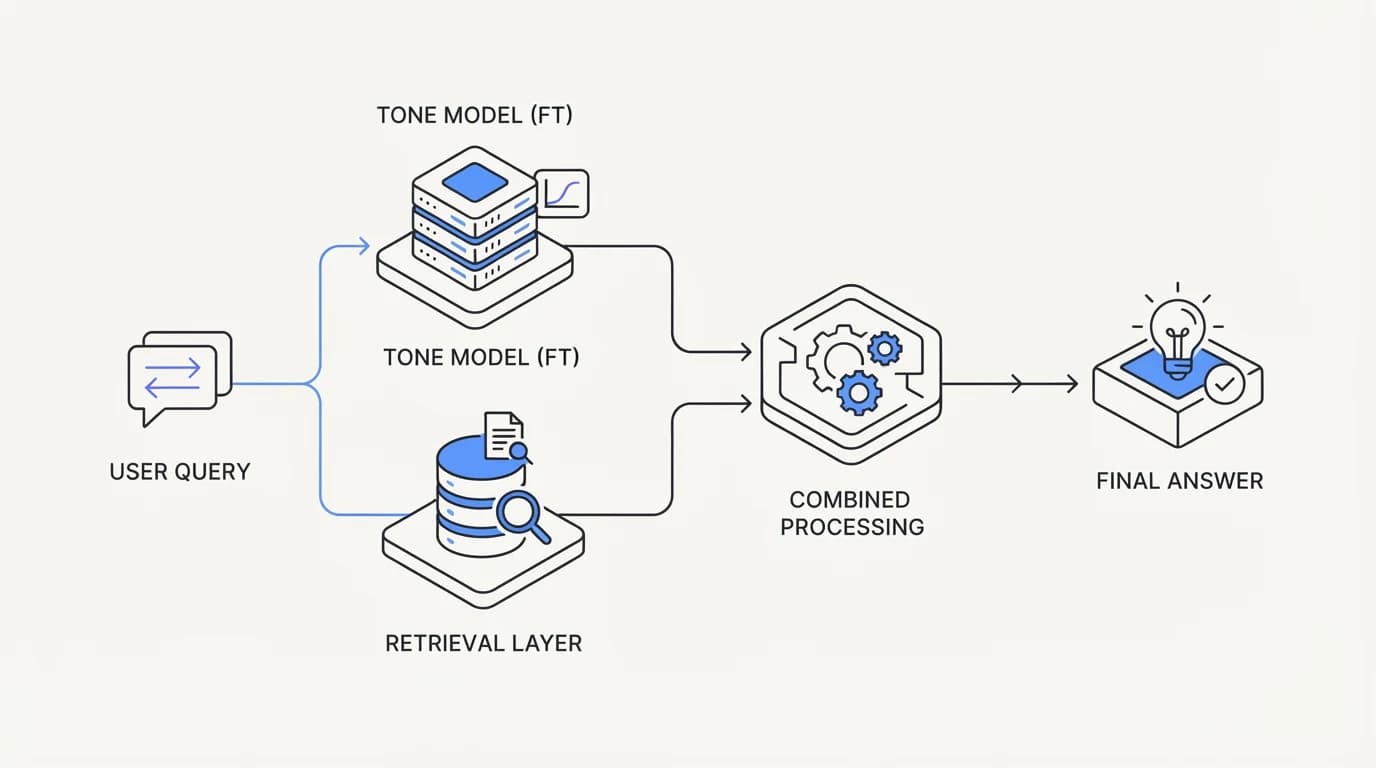
The practical pattern many production systems land on is not either-or. A model fine-tuned lightly for tone and format, combined with RAG for facts, captures the strength of each: consistent voice and structure from the tuning, current and citable facts from retrieval.
Hybrid approaches: fine-tuning for style, RAG for facts
 Communicate.so
A hybrid setup separates the two jobs cleanly. The fine-tuned layer, if used at all, governs how the agent writes: sentence length, formality, the shape of an apology or an escalation message. The retrieval layer governs what the agent knows: the actual policy, the actual price, the actual feature list.
This separation matters because it lets you update facts without touching the tuned behavior, and adjust tone without needing to re-verify every fact the model can state. Each layer can be tested and iterated independently, which is a cleaner engineering boundary than one model trying to hold both jobs at once.
Most teams starting from scratch do not need the tuning half of this at all. A well-prompted model with strong retrieval and a clear style guide in the system prompt gets most of the tone consistency without a training pipeline, and the AI agent guardrails approach to refusal and escalation language works the same way, as prompt instructions rather than trained weights.
Reach for fine-tuning only after you have exhausted prompt-based tone control and found it genuinely insufficient at your scale, not as a first move. The retrieval layer should be built and solid before tone tuning is even a consideration, because a beautifully-voiced answer built on stale facts is still a wrong answer.
A decision framework: choosing between fine-tuning and RAG
Start with a single question: how often does the information the agent needs to know change? If the answer is weekly or monthly, which covers the overwhelming majority of support content, retrieval is the default and fine-tuning for facts is close to a non-starter given the staleness arithmetic above.
If the need is specifically about consistent tone or a rigid output format rather than facts, and prompt engineering has genuinely failed to produce reliable results, fine-tuning becomes a reasonable secondary layer on top of a retrieval-grounded fact base, not a replacement for it.
Check your citation and auditability needs next. If you need to show a customer or an auditor exactly which document an answer came from, a requirement that surfaces often in regulated or compliance-sensitive support, RAG's retrieved-passage trail is close to mandatory, something a frozen fine-tuned model cannot produce natively, a gap NIST's AI risk management framework flags as a traceability concern for any deployed model making consequential claims.
Finally, weigh your actual engineering capacity for either path. A RAG pipeline needs solid document ingestion, chunking, and retrieval tuning. A fine-tuning pipeline needs clean training data, a retraining cadence, and validation infrastructure to avoid silently degrading the model with each new training run.
Most support teams have an easier time building and maintaining the former.
What migrating from fine-tuning to RAG actually involves
 Communicate.so
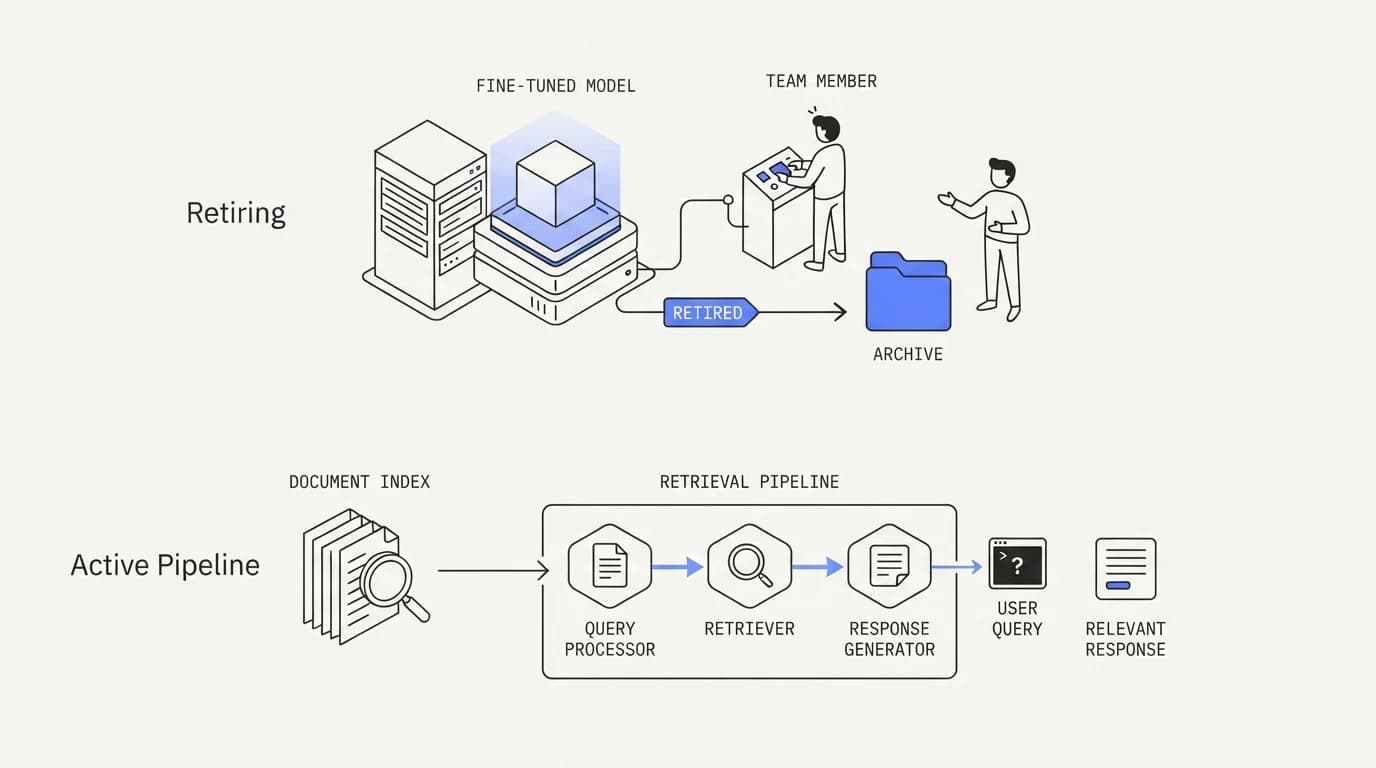
Teams that started with fine-tuning for support facts and want to move to retrieval face a real but bounded migration. The first step is inventorying what the fine-tuned model actually knows: pull the training dataset and treat every fact-bearing example as a candidate source document that needs a canonical, maintained home outside the model.
The second step is building the document store and retrieval pipeline the fine-tuned model never had, since fine-tuning skipped that layer entirely by baking answers directly into weights. This is genuinely new infrastructure, not a configuration change, and it deserves the same chunking and indexing care described in the RAG mechanics section above.
The third step is a parallel run: route a sample of live traffic through both the old fine-tuned model and the new retrieval-grounded setup, and compare outcomes against a golden set built from real tickets, the same evaluation discipline covered in AI agent evaluation and testing. Do not cut over fully until the retrieval-grounded answers hold up against that comparison.
The fourth step is decommissioning the retraining pipeline, not immediately, but once the retrieval setup has proven stable in production for a full content-update cycle or two. Keep the last fine-tuned model available as a fallback during that window, since a working fallback costs little and a failed migration with no fallback costs a great deal.
Expect resistance to the migration from whoever built the original fine-tuning pipeline, not out of stubbornness but because the retraining process represents real prior investment that is hard to set aside. Frame the change around the staleness arithmetic covered earlier in this guide rather than as a rejection of the earlier work, since the two approaches solve genuinely different problems and the original tuning effort was not wasted if any of it can be redirected toward tone and formatting through AI agent guardrails-style prompt instructions instead.
Budget more calendar time for this migration than the model swap itself suggests. The retrieval pipeline, document ingestion, chunking strategy, and evaluation setup are the bulk of the real work, and teams that treat the migration as a one-line model change tend to under-invest in exactly the infrastructure that makes RAG for customer support actually reliable in production.
Where communicate fits, honestly
Communicate uses retrieval, not fine-tuning, to ground its AI agent in your connected content: help center articles, documents, and other data sources are indexed and retrieved at answer time, so updating a policy page updates what the agent knows without any retraining step.
The single model running underneath, gpt-4o-mini through OpenRouter, is not fine-tuned per workspace. Every workspace's differentiation comes entirely from the content connected and retrieved, which keeps the update path the same simple document edit for every customer regardless of scale.
The honest limits: there is no fine-tuning option offered today for teams that specifically want a custom-tuned tone or format baked into weights, that would need to be handled through prompt-level style instructions instead. Entry is a one-time $1 activation with 100 test credits, detailed on the pricing page. Questions go to [email protected].
Key takeaways
- Fine-tuning bakes knowledge into frozen model weights at training time, while RAG retrieves current content at answer time, and support content changes far too often for the fine-tuning update cycle to keep pace.
- The staleness window for fine-tuning is days to weeks between retraining runs, versus minutes to hours for a RAG index refresh after a document edit.
- The recurring cost of retraining on every policy change compounds fast, while a RAG pipeline pays its validation cost once at build time and each update afterward is close to free.
- Fine-tuning still earns its place for tone, rigid output format, and narrow stable classification tasks, not for facts that change on any regular cadence.
- A hybrid approach, light tuning for tone paired with retrieval for facts, captures both strengths, but most teams starting fresh only need solid retrieval and a clear system prompt.
Ready to ground a support agent in content that updates as fast as your policies do? Start with a one-dollar account activation that includes 100 test credits, connect your help center through data sources, and test how quickly a policy edit shows up in a live answer. The RAG for customer support guide covers the retrieval pipeline itself in more depth.
Frequently asked questions
What is the core difference between fine-tuning and RAG?
Fine-tuning continues training a model on a task-specific dataset, adjusting its internal weights so knowledge becomes baked in and frozen at training time. RAG leaves the model's weights untouched and retrieves relevant content at the moment of the question, feeding it into the prompt as context, a distinction covered in the RAG for customer support guide in more depth.
Why does RAG generally win for customer support specifically?
Because support content, policies, pricing, feature availability, changes on a weekly to monthly cadence for most companies, and RAG's update path is a simple document edit with no retraining required. Fine-tuning's update path requires a new training run for every change, which cannot realistically keep pace with that cadence.
How stale can a fine-tuned model's knowledge get?
As stale as the gap between training runs. If you retrain monthly, the model's knowledge is on average two weeks out of date and can be up to a full month stale for a change made right after a training run finishes, with no built-in way for the model to know its own knowledge might be outdated.
How fast can a RAG-grounded agent reflect a policy change?
As fast as your document indexing pipeline refreshes, often within minutes for a well-built setup. Updating the source document is enough, there is no retraining step, which is why the staleness window shrinks from weeks to minutes compared to a fine-tuning approach.
Does fine-tuning have any real cost advantage over RAG?
Not for support use cases with regularly changing facts. Fine-tuning's recurring training cost, plus the engineering time to prepare clean data and validate each retrained model, compounds every update cycle, while a RAG pipeline's validation cost is paid mostly once at build time with a near-zero marginal cost per subsequent update.
Is fine-tuning ever the right choice for a support agent?
Yes, specifically for tone and voice consistency, rigid output formatting, or narrow stable classification tasks where the categories themselves rarely change. It is a mismatch for factual content that changes regularly, not a mismatch for every use case, a distinction covered in RAG for customer support when contrasting the two approaches directly.
What is a hybrid approach combining fine-tuning and RAG?
A hybrid setup uses a lightly fine-tuned model to govern tone, formality, and structural consistency, while a retrieval layer governs what the agent actually knows and states as fact. The two layers can be tested and updated independently, which is a cleaner boundary than one model trying to hold both jobs.
Do most teams need the fine-tuning half of a hybrid setup?
Usually not at the start. A well-prompted model with strong retrieval and a clear style guide in the system prompt achieves most of the tone consistency teams want, without the overhead of a training pipeline. Fine-tuning is worth reaching for only after prompt-based tone control has been tried and found genuinely insufficient at scale.
Why does RAG provide a citation trail and fine-tuning does not?
Because RAG explicitly inserts the retrieved passage into the model's context before it answers, that passage can be surfaced to show exactly which document an answer came from. A fine-tuned model's knowledge lives inside its weights with no inherent record of which training example produced any given statement.
What is the biggest risk of relying on a fine-tuned model for support facts?
The model can state outdated information with the same confidence as current information, and neither the model nor the customer has any built-in way to know the answer might be stale. This is the core staleness risk that makes fine-tuning a poor fit for fact-heavy, frequently changing support content.
How does retrieval quality affect a RAG-grounded agent's accuracy?
Retrieval quality is usually the real bottleneck on RAG accuracy, more than model size. If the wrong passage is retrieved or a relevant passage is chunked so critical context is separated from the rest, the model can answer confidently from incomplete information, a failure mode covered in reduce AI hallucinations in support.
What kind of dataset does fine-tuning require?
A task-specific dataset of examples demonstrating the desired behavior, style, or classification pattern, prepared and validated before each training run. Building and maintaining that dataset, and re-validating the retrained model afterward, is real recurring engineering work each cycle, not a one-time setup cost.
Can fine-tuning and RAG be compared on cost using a simple formula?
Roughly: fine-tuning cost scales with the number of retraining cycles needed to keep pace with content changes, each carrying its own training and validation cost, while RAG cost is dominated by a one-time pipeline build with a near-zero marginal cost per subsequent document update. For a support operation with frequent updates, that arithmetic strongly favors RAG.
Does a narrow, stable classification task favor fine-tuning?
It can, because the categories themselves tend to stay fixed even as the specific content within each category changes, which is a different kind of stability than the fact-freshness problem RAG solves. Routing a message into one of a small set of intents is a reasonable fine-tuning candidate where routing facts, like policy details, are not.
How do you decide between fine-tuning and RAG for a new support agent?
Start by asking how often the information the agent needs changes. Weekly or monthly content, which covers most support knowledge, points strongly to retrieval, while a genuinely stable tone or format need that prompt engineering has failed to solve points toward fine-tuning as a secondary layer, a framework covered in the decision section above and in AI agent evaluation and testing for validating either choice.
Does RAG require more engineering investment upfront than fine-tuning?
It requires different investment, not necessarily more. RAG needs solid document ingestion, chunking, and retrieval tuning built once. Fine-tuning needs clean training data, a retraining cadence, and validation infrastructure maintained on an ongoing basis every cycle, which is often the heavier long-term commitment.
What happens if you fine-tune a model on support content and never retrain it again?
Its knowledge freezes at whatever the training data reflected on that date, and every policy or product change afterward goes unrepresented in the model's answers. This is functionally the same staleness problem as never updating a RAG index, except recovering from it requires a full retraining run rather than a single document edit.
Is citation traceability required for every support use case?
Not every use case, but it matters most for regulated or compliance-sensitive support, and for any team that wants to audit or debug why an agent gave a specific answer. RAG's retrieved-passage trail supports that naturally, while a fine-tuned model's frozen weights offer no equivalent record by default.
Should a support team ever start with fine-tuning before building retrieval?
Rarely. Retrieval should be the foundation because it handles the majority of what support content actually needs, current and citable facts. Starting with fine-tuning risks investing training infrastructure into solving a tone problem before the more fundamental fact-freshness problem has even been addressed.
What does migrating from a fine-tuned support model to RAG involve?
It involves inventorying the facts baked into the fine-tuned model as candidate source documents, building the document store and retrieval pipeline the fine-tuned approach never had, running both systems in parallel against a golden set before cutover, and keeping the old model available as a fallback during the transition window. Budget more calendar time than a simple model swap would suggest, since the retrieval infrastructure is genuinely new work, not a configuration change.