
AI customer support cost: the real 2026 numbers
 Communicate.so
What AI customer support actually costs per ticket, per team, and per month, including the hidden costs vendors leave off the pricing page.
TL;DR: AI-resolved support tickets cost roughly $0.10 to $1.50 in raw tokens versus $6 to $13.50 for a human-handled contact, but the token number hides setup labor, ongoing monitoring (5 to 15 hours a month), and the human "escalation tail" that a 2026 HubSpot survey found pushes real 12-month costs to 2.3x the advertised price. The honest break-even point sits around 450 to 500 monthly AI resolutions for a typical 10-agent team, and shifts earlier or later depending on your containment rate, local hiring costs, and ticket growth.
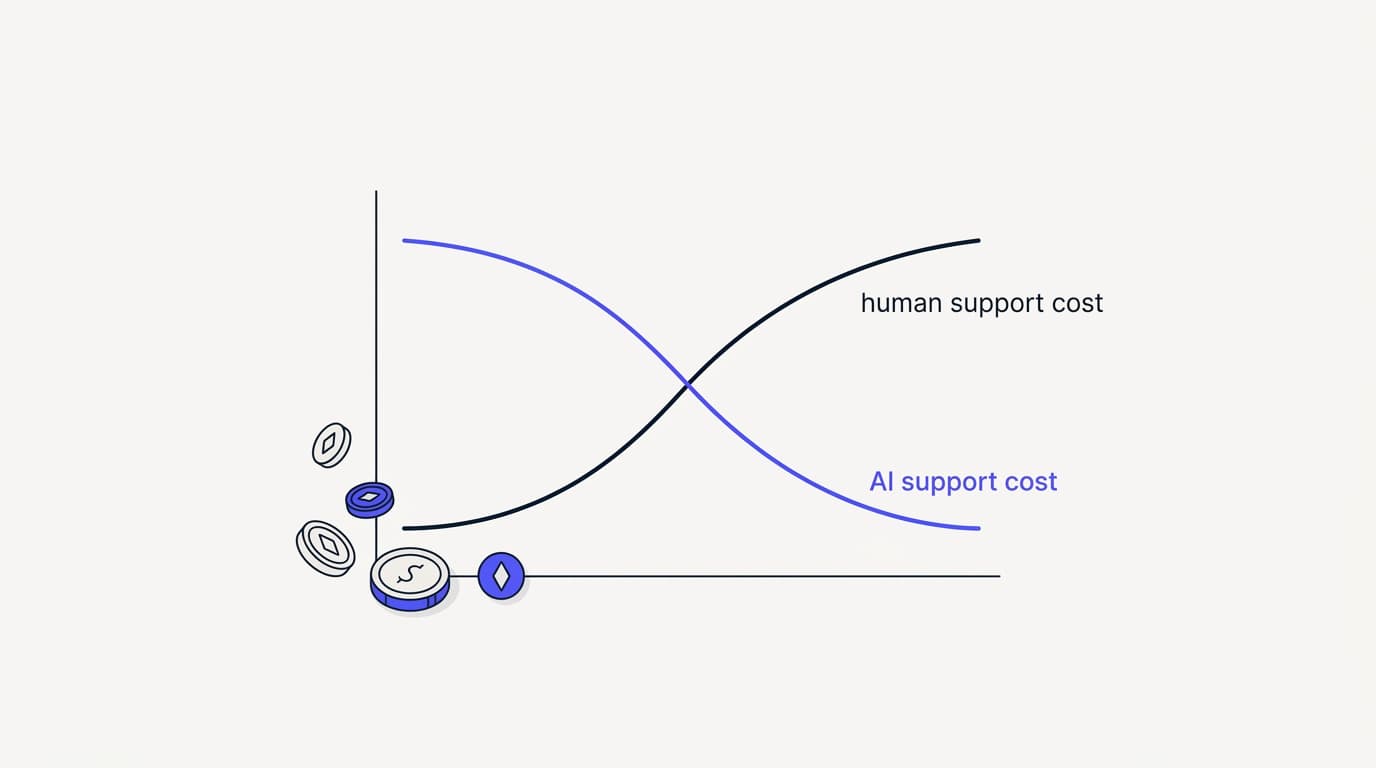
In June 2026, Gumroad founder Sahil Lavingia posted a chart that got passed around every Slack channel with "AI" in the name. It showed the company's monthly AI token spend, $43,000, landing exactly on top of its monthly payroll, also $43,000, for the first time. Five years earlier, payroll was $419,000 and token spend was zero.
The lines had been converging for two years and finally crossed.
That chart is a coding story, not a support story, but the shape of it is the right way to think about AI customer support cost. Public 2026 pricing surveys put AI resolution costs between $0.10 and $1.50 per ticket for raw tokens, against $6 to $13.50 for a human-handled contact across chat and email, climbing to $17 to $25 for phone. That gap is real and worth knowing.
It is also the wrong number to plan a budget around, because it hides three costs that show up later: the setup work, the ongoing monitoring, and the tickets an AI agent hands off to a human anyway. This piece walks through the math: what a support agent costs per conversation in tokens, what a human costs per ticket, where caching and model choice change the bill, and the volume at which AI support genuinely pays for itself instead of just looking cheap on a vendor's pricing page.
What "AI customer support cost" means
Vendors advertise AI customer support cost three different ways, and they are not comparable to each other. Per-seat pricing charges a flat monthly fee regardless of volume, the same model human help desk software has used for two decades. Per-resolution pricing charges only when the AI closes a ticket without escalation, so cost scales with how well the AI performs.
Usage-based pricing charges for raw token consumption, which is the most accurate reflection of compute cost but the hardest to forecast because it depends on conversation length, document retrieval, and how chatty your customers are.
Public pricing surveys from 2026 put AI resolution costs somewhere between $0.10 and $1.50 per resolved ticket for the token cost alone, with blended per-resolution pricing from vendors landing closer to $0.50 to $2.00 once margin is added. A human-handled ticket across phone, chat, and email runs meaningfully higher: figures cited in the same category of reporting range from roughly $6 to $13.50 per contact for assisted channels, climbing to $17 to $25 for phone specifically. That gap, a human ticket costing five to ten times more than an AI one, is the number every AI support vendor leads with.
It's also directionally accurate. It's just not the number that determines whether AI support is worth deploying for your team, because it ignores everything that happens before and after a single resolved ticket.
The token math: what a conversation costs
Strip away the vendor markup and look at raw model cost. communicate.so runs its AI Agent on gpt-4o-mini through OpenRouter, deliberately, rather than offering a menu of models. That choice matters more for cost than most teams realize, because model selection is the single biggest lever in the token bill before you touch anything else.
A typical support conversation, a customer question plus retrieved context from your data sources plus the model's answer, runs somewhere between 1,000 and 4,000 tokens depending on how much documentation gets pulled in and how long the back-and-forth runs. At gpt-4o-mini's per-token pricing, that conversation costs a fraction of a cent, well under the $0.10-per-resolution floor cited in industry pricing surveys. Swap in a frontier model like GPT-5 or Claude Opus for the same conversation and the cost can run ten to twenty times higher for output that, for a support ticket answering "where's my order" or "how do I reset my password," is rarely meaningfully better.
This is the quiet reason single-model setups outperform multi-model menus on cost: every conversation defaults to the cheapest model that can do the job, instead of an average user occasionally picking the expensive one because the toggle was sitting right there.
The second lever is prompt caching, and it moves the number more than most teams expect. Anthropic's caching implementation cuts the cost of cached input tokens by up to 90% compared to fresh processing. OpenAI's automatic caching, enabled by default on supported models, cuts cached input costs by roughly 50%, with cached tokens running about ten times cheaper than fresh ones on current GPT-5 pricing.
For a support agent, the cacheable part of the prompt is large: your system instructions, your brand voice guidelines, your product documentation, all of it repeats on nearly every single call. One infrastructure team that raised its cache hit rate from 7% to 84% reported cutting total LLM spend by 59% to 70%. A support agent that answers the same fifty questions all day, in the same voice, against the same docs, is close to the ideal case for caching.
That's exactly why response and prompt caching stays on by default rather than being a toggle buried in settings.
Put the two levers together and the token cost of a single AI-resolved ticket, on a cheap model with caching on, lands well under a dollar. Usually well under ten cents. That's the number vendors put on the homepage, and for once it isn't exaggerated.
The problem is that it's also not the number that determines your actual AI customer support cost at the end of the month.
What a human ticket actually costs, for comparison
 Communicate.so
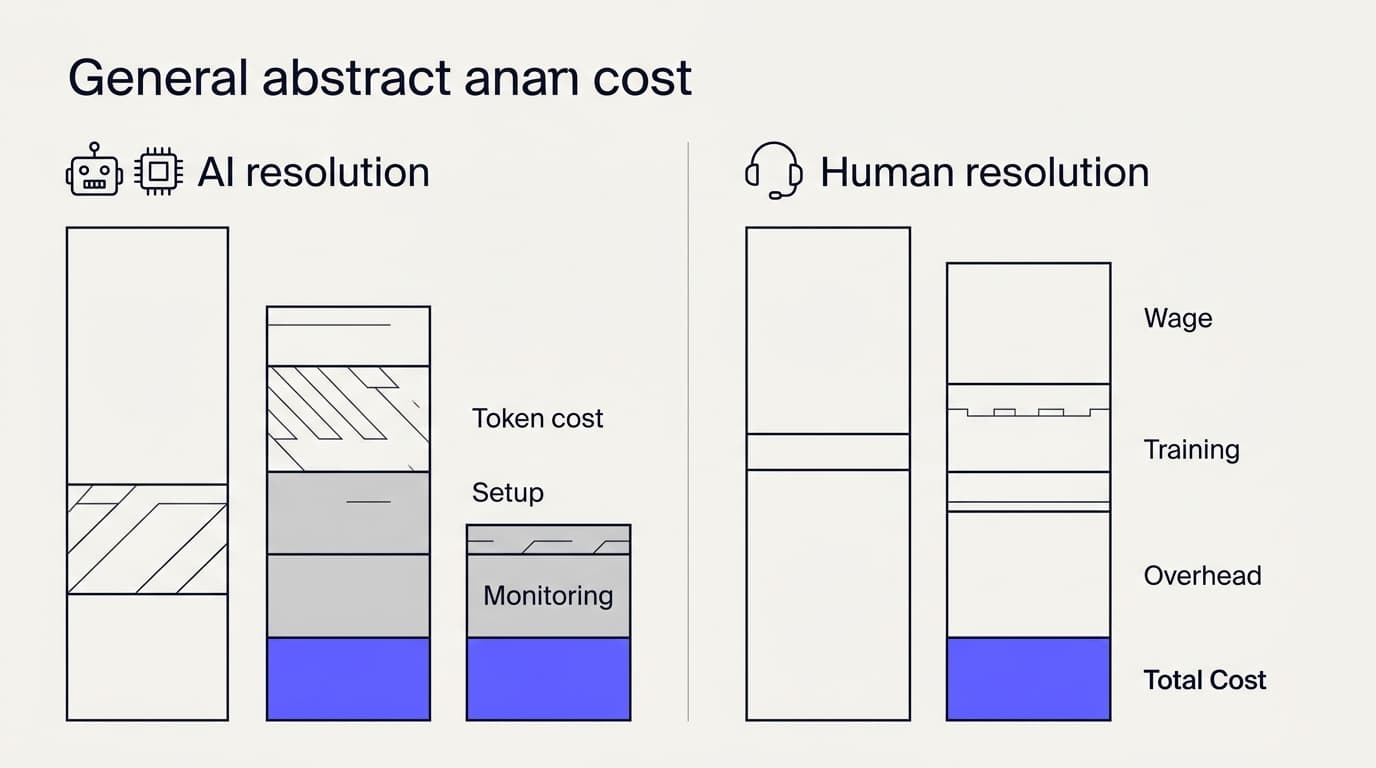
The other half of the comparison deserves the same scrutiny. A support rep's fully loaded cost isn't their hourly wage. US-based support agents typically earn $30 to $40 an hour in wages, but recruiting, training, benefits, and management overhead add another 20% to 30% on top.
Run the math on a full-time rep handling, say, 40 to 60 tickets a day across an 8-hour shift, and the effective cost per ticket for straightforward, repetitive questions lands in the $6 to $13 range cited across multiple 2025 and 2026 cost breakdowns, before you count the cost of a bad day, a sick day, or the six weeks it takes a new hire to get fully productive.
Humans are not bad at this job. They're expensive at this job when the job is answering "what's your return policy" for the four-hundredth time. Where humans earn their cost is judgment: reading between the lines of an angry email, catching a fraud pattern an AI wouldn't flag, deciding when a rule should bend.
That is exactly the split communicate.so's Shared Inbox is built around. AI and a human work the same conversation thread, and when a human opens a live chat, the conversation locks to human mode automatically. No manual toggle, no race condition where the bot answers over someone mid-typing.
The AI resumes once the human releases it. If you want the deeper mechanics of that handoff, how Shared Inbox keeps AI and humans in sync covers the presence-based takeover logic in more detail, and a broader look at the pattern generally is worth reading in our piece on AI-human handoff in support.
That split, cheap model for cheap questions, a human for judgment calls, is where the real cost comparison should start. Not AI versus human as a binary, but AI absorbing the bottom 60% to 80% of ticket volume by complexity while humans handle the rest at whatever their fully loaded cost happens to be.
The costs that never make it onto the pricing page
 Communicate.so
Here's where the vendor math and the real math diverge, and where most AI customer support cost estimates go wrong by omission rather than by being outright false.
Setup and training time. Before an AI agent answers a single real customer, someone has to feed it your documentation, test it against edge cases, and correct its tone until it sounds like your brand instead of a generic assistant. For a team with clean, current help-center docs, this might be an afternoon.
For a team whose knowledge lives in six people's heads and a half-updated Notion page, it's a multi-week project before the AI is trustworthy enough to face customers unsupervised. We wrote a practical walkthrough of this exact process in launch your first AI support agent in an afternoon, and the honest takeaway there is that "an afternoon" assumes your documentation is already in reasonable shape. If it isn't, the setup cost is real labor time that doesn't show up on any per-resolution invoice.
A more detailed rollout playbook, including where teams tend to underestimate the lift, is in our AI support agent implementation guide.
Ongoing monitoring and retraining. Documentation changes. Pricing changes.
A new feature ships and the AI's answers about the old workflow are suddenly wrong. Someone needs to review a sample of AI conversations regularly, catch drift before it becomes a pattern of bad answers, and update the source docs the agent pulls from. Estimates for this ongoing labor, whether done in-house or outsourced, run in the range of 5 to 15 hours a month for a small-to-mid support operation, or $500 to $2,000 a month if you're paying an agency to own it.
This is real, recurring cost, and it scales with how fast your product changes rather than with ticket volume. A fast-moving product with weekly releases needs more retraining attention than a stable one, regardless of how many tickets either gets.
The escalation tail. When an AI agent can't resolve something, it doesn't just fail silently, it hands the conversation to a human who now has to read the entire AI exchange, understand what's already been tried, and pick up from wherever the bot left off. That context-reconstruction time is real and it's easy to undercount, because it looks like normal human ticket handling in your metrics rather than a cost specifically attributable to AI deployment.
Several cost analyses call this out directly: the escalation line, not licensing or token spend, is usually the largest hidden cost in an AI support deployment. If your AI containment rate is lower than advertised, or if it resolves the easy 70% but the remaining 30% arrives at your human team more confused and further along in an already-bad mood, the human side of your cost equation goes up, not down.
Total cost of ownership drift. A 2026 HubSpot State of Service survey found businesses auditing their AI chatbot total cost of ownership discovered actual 12-month costs averaging 2.3 times the advertised subscription price, once integrations, overage charges during traffic spikes, and internal labor were counted. That multiplier isn't a vendor scam so much as a predictable pattern: the sticker price covers the software, not the operational work of running it well.
None of this means AI customer support is a bad deal. It means the honest AI customer support cost formula looks like this:
Total monthly cost = (tokens per resolution x resolutions) + setup amortized over its useful life + monthly monitoring hours x loaded hourly rate + human cost of the escalation tail
Skip any one of those four terms and you'll underbudget by a meaningful margin.
Where the money goes: a cost comparison
| Cost component | AI support | Human support |
|---|---|---|
| Marginal cost per simple ticket | ✓ Often under $0.10 with caching + a cheap model | ✗ $6-$13+ fully loaded |
| Marginal cost per complex ticket | ✗ Usually escalates, so cost shifts to human tail | ✓ Handles it directly, no handoff overhead |
| Setup cost before go-live | ✗ Real, one-time, scales with doc quality | ✓ Onboarding exists but is a known, budgeted quantity |
| Cost as ticket volume grows | ✓ Near-linear, low slope | ✗ Near-linear, steep slope (more reps needed) |
| Cost when your product changes | ✗ Requires retraining labor | ✓ Humans adapt without a retraining project |
| Cost of a wrong answer | ✗ Can compound at scale before anyone notices | ✓ Usually caught and corrected in the moment |
| 24/7 coverage | ✓ No shift differential, no overnight premium | ✗ Requires night shift staffing or offshore coverage |
| Judgment calls, tone-reading, de-escalation | ✗ Weak spot, needs human backstop | ✓ Where humans earn their cost |
The pattern in that comparison is the lesson: AI wins decisively on marginal cost for high-volume, low-complexity work, and loses ground fast as complexity, change frequency, and judgment requirements increase. Any AI customer support cost estimate that doesn't split ticket volume by complexity is measuring the wrong thing.
Here's how a single ticket flows through that split in practice: a new ticket arrives and gets sorted by complexity. Simple, repetitive questions go to the AI agent, and most of them close at near-zero token cost. Sensitive or judgment-call tickets route directly to a human, and any ticket the AI can't resolve escalates with full conversation context to a human via the Shared Inbox handoff.
Either way, the resolution feeds a containment rate tracked in Analytics.
The real crossover point
 Communicate.so
Here's the question that matters for a budget conversation: at what point does AI support cost less than hiring another rep?
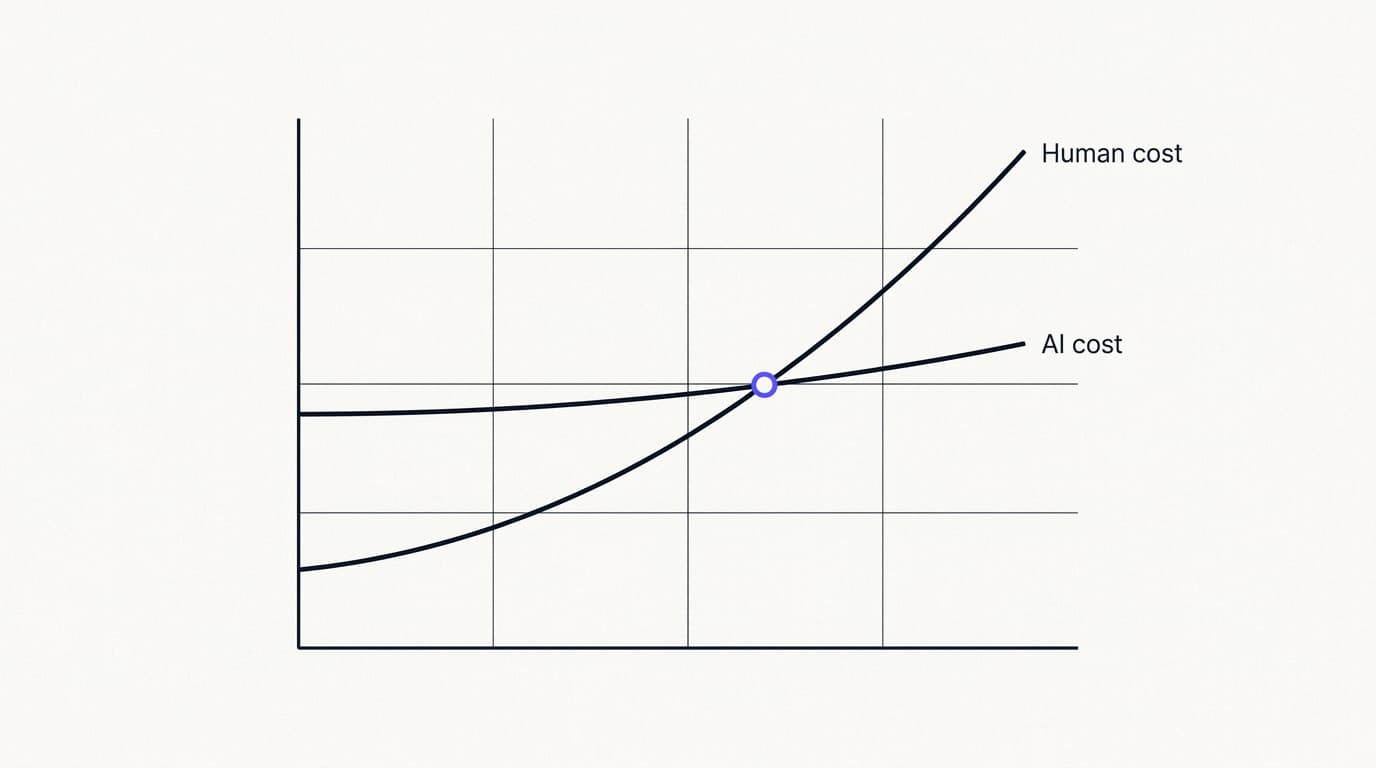
Vendor-reported figures on this vary, but the range is instructive. One 2026 analysis of a 10-agent team paying $50 per seat found the break-even point against per-resolution pricing sitting around 450 to 500 monthly resolutions, using Intercom's reported 56% average AI containment rate as the baseline. Below that volume, a flat per-seat AI subscription costs more than what it's saving you in deflected tickets.
Above it, the AI pays for its own seat and then some.
At a bigger scale, the math tilts hard toward AI. A team handling 50,000 conversations a month that shifts roughly three-quarters of that volume to AI resolution, at something close to $1 per resolved ticket, was reported to produce annual savings north of $2 million compared to fully human-staffed support at the same volume. That's not a subtle advantage.
It's the kind of number that makes a CFO stop asking whether to deploy AI support and start asking how fast it can happen.
The more useful way to think about crossover isn't a single ticket-volume threshold, though, because that threshold moves depending on three variables specific to your team:
Your current containment rate. If your AI agent resolves 30% of incoming tickets without escalation, the crossover point sits much further out than if it resolves 70%. Containment rate is a function of documentation quality, ticket complexity, and how well the AI was set up, not a fixed property of the technology.
This is the single biggest reason two companies with identical ticket volume can have wildly different AI customer support cost outcomes.
Your next hire's fully loaded cost. If the alternative to deploying AI support is hiring a rep in a high-cost market, the crossover point comes sooner. If your team is already lean and offshore, or if your existing reps have slack capacity, the crossover point moves out, sometimes past the point where it's worth the setup labor at all for a small team.
Your ticket growth trajectory. A team growing 20% quarter over quarter hits the crossover point on a much shorter timeline than a team with flat volume, because the AI's marginal cost per additional ticket is near zero while a human team's marginal cost per additional ticket requires another hire once existing reps are at capacity. If you're trying to reason about your own first response time and staffing math before deciding on AI, our first response time benchmark piece is a useful companion, since response speed and headcount are tightly linked in a way that changes the crossover calculation.
A rough rule that holds up across most of the pricing data available in 2026: teams under roughly 500 to 1,000 tickets a month rarely see AI support pay for itself faster than six months, once setup and monitoring labor are counted honestly. Teams above 2,000 to 3,000 tickets a month with any repetitive-question pattern (order status, password resets, basic how-to questions) tend to see payback inside one to three months. Between those two bands is where the containment rate variable does most of the work, and it's worth running your own numbers rather than trusting a vendor's blended average.
Team size and ticket volume, walked through
 Communicate.so
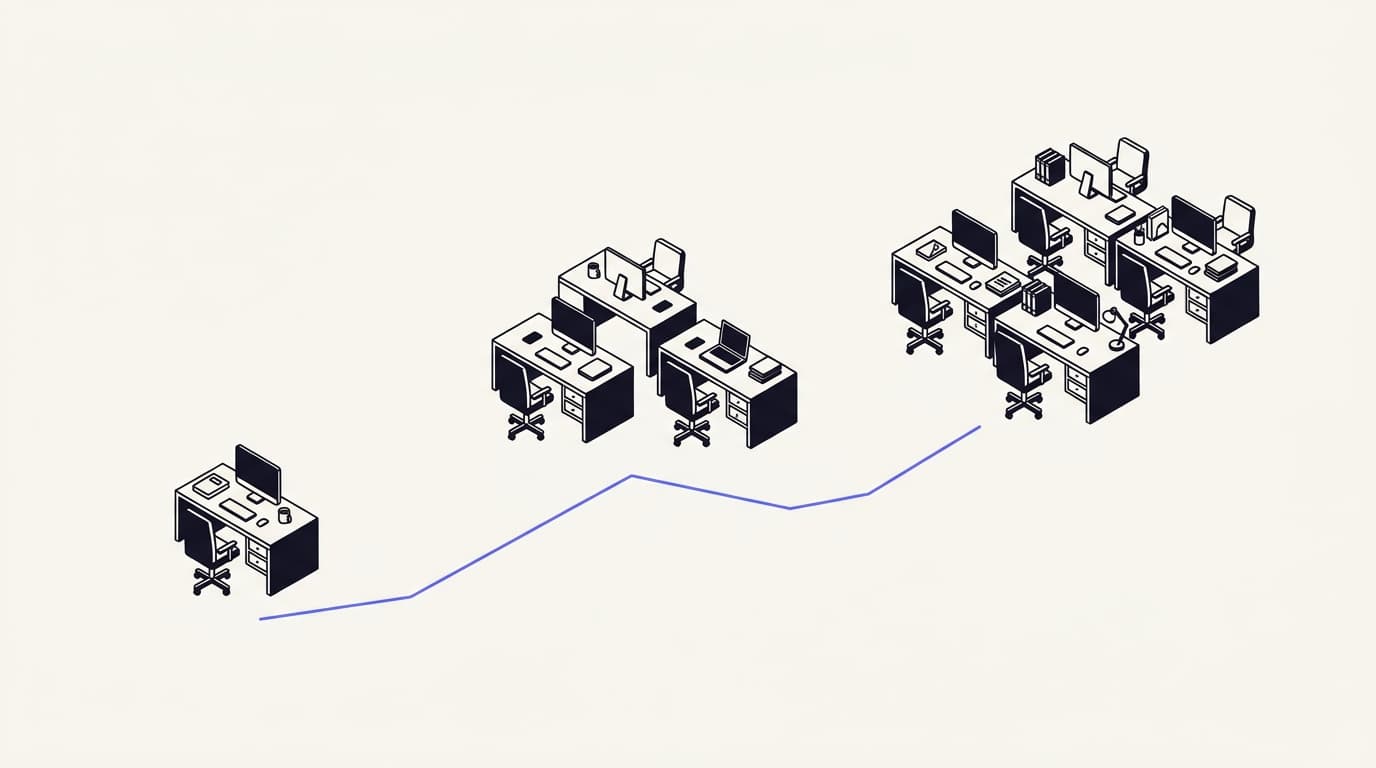
A five-person startup with 300 tickets a month. At this size, the honest recommendation is often: deploy AI support, but expect the payback period to run longer than a vendor's marketing page suggests. The token cost itself is trivial, under $30 a month even on generous usage.
The real cost is founder or early-hire time spent on setup and the ongoing few hours a month keeping the knowledge base current. This is exactly the scenario communicate.so's entry point is built for. A one-time $1 account activation includes 100 test credits, which means a small team can run real questions against their own docs and see actual containment before a single customer ever talks to the bot, rather than committing budget on faith.
See the pricing page for the current structure. At 300 tickets a month, the AI won't replace a hire, because there's no hire to replace yet, but it buys back founder time that would otherwise go to answering the same five questions on repeat.
A 15-person team with 3,000 tickets a month. This is close to the sweet spot where the math favors AI. At even a 50% containment rate, that's 1,500 tickets a month handled without human involvement, at a token cost that stays comfortably under $150 with caching on a cheap model.
The equivalent human cost for those 1,500 tickets, at even the low end of $6 per contact, is $9,000 a month. The gap is large enough to absorb a real monitoring budget, a part-time contractor reviewing AI conversations and updating docs, and still come out well ahead. This is also the range where Analytics earns its keep, because containment rate isn't a number you set once and forget.
It drifts as your product changes, and you need visibility into which ticket categories the AI handles well versus where it's quietly escalating everything.
A 50-person team scaling past 20,000 tickets a month. At this volume, the earlier-cited $2 million annual savings figure starts to feel plausible rather than aspirational, assuming containment rate holds up at scale. But this is also where the hidden costs bite hardest, because a small containment rate drop, say from 70% down to 55% after a major product change nobody remembered to feed into the AI's documentation, translates into thousands of tickets a month suddenly landing on human reps who weren't budgeted for that volume.
Teams at this scale need Actions wired up so the AI can resolve tickets end-to-end (issuing refunds, updating account details) rather than just answering questions and still routing every real task to a human, which quietly caps containment rate no matter how good the answers are.
Where AI support costs more than expected
This is the section vendor pricing pages skip, and it's the one that determines whether your actual AI customer support cost matches your budget or blows past it.
Documentation drift creates a retraining loop nobody scoped. The most common failure mode isn't dramatic. A product team ships a pricing change or a new onboarding flow, nobody updates the source docs the AI pulls from via Data Sources, and the AI confidently gives customers outdated information for weeks before someone spots the pattern in a support Slack channel.
The fix is cheap, an updated doc, but the cost of not having a process for it compounds: every wrong answer either creates a follow-up ticket that doubles the resolution cost, or produces a customer who now distrusts the bot and escalates everything going forward.
Abuse and edge cases cost more to handle than clean questions. An AI agent answering "how do I export my data" all day is cheap. The same agent fielding an attempted prompt injection, or a customer trying to social-engineer a refund it shouldn't grant, burns more tokens per exchange and is far more likely to escalate.
If your product touches refunds or account credentials, budget for a higher escalation rate there, and lean on Security controls around what actions the AI can take autonomously.
Human review overhead scales with how cautious you need to be. A B2C app selling digital downloads can tolerate a wrong AI answer about shipping times. A fintech or healthcare product answering questions with regulatory consequences cannot, and every AI response in that category may need a spot-check or a stricter escalation policy, which pushes more volume back to humans and raises effective cost per ticket.
This isn't a reason to avoid AI support in regulated categories, it's a reason to budget the review layer honestly rather than assume the vendor's advertised containment rate applies to your risk profile.
Multi-turn conversations cost more than the pricing page implies. Per-resolution quotes usually assume a clean single-exchange resolution. Real customers ask follow-up questions or need three or four back-and-forth turns before their issue surfaces.
Each turn adds tokens, and if you're running usage-based pricing directly against a model API, a support flow with heavy back-and-forth can run two to three times the single-exchange average most estimates are built on.
Seasonal spikes break flat monthly estimates. A retail brand hitting a sales event, or a SaaS product after a breaking release, sees ticket volume spike well above baseline for a short window. Per-seat AI pricing absorbs this for free.
Usage-based pricing means your bill spikes with volume too, usually fine since revenue spikes at the same time, but worth knowing in advance rather than discovering it on next month's invoice.
What reduces the number
Having walked through where the cost hides, the practical levers worth pulling, in rough order of impact:
A single, well-chosen model beats a menu of models for almost every support use case. Frontier models solve harder problems, but "where's my order" isn't a hard problem, and paying frontier-model prices for it is the single most common source of AI customer support cost overruns that never needed to happen.
Caching should be on by default and treated as a cost decision, not just a latency one. If your support agent's system prompt and documentation context are being reprocessed fresh on every single call, you're paying multiples of what caching would cost for functionally identical answers.
Documentation quality is a cost lever, not just a quality lever. Clean, current, well-structured source docs raise containment rate directly, which is the single biggest driver of whether AI support saves money or just adds a line item next to your existing human costs. This is worth treating as an ongoing investment rather than a one-time setup task.
Escalation design determines whether your hidden costs stay small or become the largest line item. A well-designed handoff, where the human picking up an escalated conversation sees full context instantly rather than re-asking the customer everything, keeps the escalation tail cheap. A poorly designed one turns every AI failure into a worse experience than if a human had handled it from the start, which is what cutting first response time to seconds, not hours is about, since speed and handoff quality are the same problem viewed from two angles.
Measurement closes the loop. Without visibility into containment rate by ticket category, cost per resolution over time, and escalation volume trends, you're guessing at your actual AI customer support cost rather than managing it. Every team past the earliest stage should be watching this the same way they watch any other unit economic.
The honest bottom line
The token cost of an individual AI-resolved support ticket is genuinely close to what vendors advertise, often under a dollar, sometimes under a dime with a cheap model and caching turned on. That part of the pitch is true. What's missing from most pricing pages is that the token cost is the smallest number in the equation once you count setup, ongoing monitoring, and the human tail of escalated conversations.
The crossover point where AI support beats hiring another rep isn't a fixed number of tickets. It moves with your containment rate, your local hiring costs, and how fast your product and documentation change. For a team under a few hundred tickets a month, the honest expectation is a payback period measured in months, not days, and the value is mostly time bought back rather than a hire avoided.
For a team past a couple thousand tickets a month with a real repetitive-question pattern, the math tends to favor AI quickly and by a wide margin, provided someone owns the unglamorous work of keeping documentation current and watching containment rate for drift.
Gumroad's token spend catching up to its payroll isn't a warning sign. It's a company that decided compute was now worth spending on at the same scale as people, because the return on that spend had become obvious. The right question for a support team isn't whether AI tokens will eventually cost as much as payroll.
It's whether the AI is resolving enough real tickets, at a low enough marginal cost, that the comparison is even worth making yet.
Key takeaways:
- Raw token cost for an AI-resolved ticket ($0.10 to $1.50) is real but is the smallest term in the full cost formula.
- A human-handled ticket costs $6 to $13.50 for chat and email, $17 to $25 for phone.
- Setup, monitoring (5 to 15 hours a month), and the escalation tail push real 12-month costs to roughly 2.3x the advertised price.
- The break-even point sits near 450 to 500 monthly resolutions for a typical team, moving earlier or later with your containment rate.
- A single cheap model plus prompt caching, the setup communicate.so runs by default, is the biggest lever for keeping the token side of the bill small.
Run your own numbers against your own tickets before trusting a vendor's blended average. Browse more cost and implementation breakdowns in the support section of the blog, or start with a $1 activation on the pricing page to test containment on your actual documentation.
Frequently asked questions
What is AI customer support cost and how is it calculated?
AI customer support cost is the total spend required to run AI-handled tickets, not just the per-token or per-resolution price a vendor quotes. The full formula is token cost per resolution, plus setup labor, plus monthly monitoring hours, plus the human cost of escalated tickets. Vendors typically quote only the first term.
How much does an AI-resolved support ticket cost in 2026?
Public 2026 pricing surveys put raw token cost for an AI-resolved ticket between $0.10 and $1.50, with blended per-resolution vendor pricing running $0.50 to $2.00 once margin is added. On a cheap model like gpt-4o-mini with prompt caching on, the actual token cost of a typical conversation often lands well under $0.10, covering only the resolution itself.
How much does a human-handled support ticket cost?
A fully loaded human ticket runs roughly $6 to $13.50 across chat and email, and $17 to $25 for phone, based on figures cited across 2025 and 2026 cost-of-service reporting. That number includes wages plus the 20% to 30% overhead of recruiting, training, benefits, and management that per-hour wage figures leave out.
Is AI customer support cheaper than hiring another support rep?
For high-volume, low-complexity ticket categories, yes, often by five to ten times on marginal cost. For judgment-heavy work, de-escalation, and edge cases, a human is usually still cheaper once you count AI's escalation and review overhead. The honest comparison splits ticket volume by complexity rather than treating AI and human support as a single binary choice.
What is the crossover point where AI support becomes cheaper than human support?
One 2026 analysis of a 10-agent team paying $50 per seat found the break-even point sitting around 450 to 500 monthly AI resolutions, using a 56% average containment rate as the baseline. Below that volume, a flat AI subscription can cost more than the tickets it deflects. The exact threshold moves with your containment rate, local hiring costs, and ticket growth rate.
How does prompt caching reduce AI customer support cost?
Caching stores the reusable parts of a prompt (system instructions, brand voice, product documentation) so they are not reprocessed on every call. Anthropic's caching cuts cached input token cost by up to 90%, and OpenAI's automatic caching cuts it by roughly 50%. One infrastructure team raised its cache hit rate from 7% to 84% and cut total LLM spend by 59% to 70%.
Why does model choice matter for AI support cost?
A frontier model like GPT-5 or Claude Opus can cost ten to twenty times more per conversation than a smaller model like gpt-4o-mini, for output that is rarely better on a routine ticket like a password reset or order status question. Defaulting every conversation to the cheapest model that can handle the job, instead of offering a menu of models, is one of the largest and easiest cost levers available.
What hidden costs do AI support vendors leave off the pricing page?
The four most common are setup and training time before launch, ongoing monitoring as documentation changes, the human cost of reconstructing context on escalated tickets, and total cost of ownership drift from integrations and overage charges. A 2026 HubSpot State of Service survey found businesses auditing chatbot total cost of ownership discovered actual 12-month costs averaging 2.3 times the advertised price.
How much does it cost to set up an AI support agent?
For a team with clean, current help-center documentation, initial setup can take an afternoon. For a team whose knowledge lives in scattered docs or in people's heads, it can run several weeks of real labor before the agent is trustworthy enough to face customers without supervision. Launching your first AI support agent walks through what that setup involves.
How many hours a month does AI support monitoring take?
Estimates for ongoing monitoring and retraining labor run 5 to 15 hours a month for a small-to-mid operation, or $500 to $2,000 a month if outsourced. This cost scales with how fast your product and documentation change, not with ticket volume.
What is containment rate and why does it determine AI support cost?
Containment rate is the share of tickets an AI agent resolves without escalating to a human. It is the single biggest driver of AI customer support cost outcomes, because a team with 70% containment gets far more value from the same token spend than a team with 30% containment. It depends on documentation quality and ticket complexity, which is why Analytics that tracks it by ticket category matters more than the top-line resolution number.
Does AI customer support replace human support agents entirely?
No. AI absorbs the bottom 60% to 80% of ticket volume by complexity, mostly repetitive questions, while humans keep handling judgment calls, de-escalation, and fraud patterns an AI would not catch. A Shared Inbox setup where a human's live reply locks a conversation to human mode is built around that split.
How long does it take for AI support to pay for itself?
Teams under roughly 500 to 1,000 tickets a month rarely see payback faster than six months once setup and monitoring labor are counted honestly. Teams above 2,000 to 3,000 tickets a month with a repetitive-question pattern tend to see payback inside one to three months. Containment rate does most of the work in moving a team between those two bands.
What is the difference between per-seat, per-resolution, and usage-based AI support pricing?
Per-seat pricing charges a flat monthly fee regardless of ticket volume. Per-resolution pricing charges only when the AI closes a ticket without escalation, so cost tracks performance. Usage-based pricing charges for raw token consumption, the most accurate reflection of compute cost but the hardest to forecast.
Why do escalated tickets cost more with AI support?
When an AI agent cannot resolve a ticket, a human has to read the full exchange, understand what was already tried, and pick up from where the bot left off. That context-reconstruction time rarely gets counted as an AI-attributable cost, even though it would not exist without the AI attempt. Several 2026 cost analyses point to this escalation tail, not licensing or token spend, as the largest hidden cost in AI support deployments.
Is AI customer support worth it for a small team under 500 tickets a month?
Usually yes, but expect a longer payback period than a vendor's marketing page suggests, since the value at this volume is mostly founder or early-hire time bought back rather than a hire avoided. A one-time $1 account activation that includes 100 test credits lets a small team run real questions against its own docs on the pricing page before committing budget on faith.
How does gpt-4o-mini compare to GPT-5 for support ticket cost?
For a routine support conversation, gpt-4o-mini can cost a small fraction of what GPT-5 or a comparable frontier model charges, often with no meaningful quality difference on questions like "where's my order" or "how do I reset my password." The gap widens further once prompt caching is layered on top of the cheaper model.
What causes AI customer support costs to run higher than expected?
The most common causes are documentation drift creating a retraining loop nobody scoped, abuse and edge cases that burn more tokens and escalate more often, human review overhead in regulated categories, multi-turn conversations that run two to three times the token cost of a single-exchange estimate, and seasonal ticket spikes hitting usage-based pricing. Each of these is a real, recurring cost that a flat per-resolution quote does not capture.
How does documentation quality affect AI customer support cost?
Clean, current, well-structured Data Sources raise containment rate directly, which is the single biggest factor in whether AI support saves money or just adds a line item next to existing human costs. Stale documentation causes the AI to give confidently wrong answers, which either creates a follow-up ticket that doubles the resolution cost or damages customer trust in a way that drags containment down permanently for that account.
What is the best way to estimate AI customer support cost before deploying?
Run the full formula rather than the vendor's headline number: token cost per resolution times expected resolutions, plus one-time setup cost, plus monthly monitoring hours at a loaded rate, plus the human cost of your expected escalation tail. Testing against real tickets from your own in-app messages or embed widgets before full rollout gives a more honest containment-rate estimate than any vendor's blended industry average.