
Average handle time reduction: a practical playbook
 Communicate.so
Average handle time reduction explained: the AHT formula, the levers that cut handle time, and how AI helps without hurting CSAT.
TL;DR: Average handle time, or AHT, is the average time it takes to fully handle one customer contact, measured across a period. The formula is total handling time divided by the number of contacts handled, where handling time is talk plus hold plus wrap-up work. Reducing it is worth doing because slow, repetitive handling costs money and tests customer patience, but the metric misleads the moment you chase it for its own sake. The levers that genuinely lower AHT all remove real friction: faster knowledge access for agents, AI drafting and reply assist, deflecting simple tickets to self-serve or an AI agent, and routing each contact to the right person first. The shortcuts that also lower the number, rushing agents against a stopwatch or cutting answers short to close fast, buy speed by spending customer trust, and they show up later as repeat contacts and falling CSAT. This guide defines the metric, works through the formula, separates the honest levers from the harmful shortcuts, and is straight about what AI does and does not change.
Average handle time is one of the oldest numbers in customer support, and one of the easiest to misuse. It is simple to measure, which is exactly why teams reach for it, and simple to game, which is exactly why it can quietly wreck the experience it was meant to improve. The number itself is neutral; what you do to move it decides whether customers are better off or worse.
This guide treats average handle time reduction as a real goal with a real trap inside it. The goal is to remove the friction that makes handling slow, so agents spend less time hunting, waiting, and repeating themselves. The trap is treating a lower number as the win regardless of how you got there, because the fastest way to close a ticket is to close it wrong.
It is written for the person who owns the queue and has to answer for both speed and satisfaction: a founder, a support lead, or an ops owner weighing whether an AI agent will actually help. We will define AHT precisely, walk the formula, sort the levers that work from the ones that hurt, and be honest about where AI moves the number and where it cannot. If first response time is also on your mind, the first response time benchmark guide is the companion read on the metric that sits next to this one.
What average handle time actually measures
 Communicate.so
Average handle time is the average duration of a single customer contact from the moment an agent starts working it to the moment the work is fully done. It began in phone support, where a contact is one call, and it has carried over to chat, email, and messaging with the same intent. The word average is doing real work here, because AHT is always a mean across many contacts over a period, never the length of one conversation.
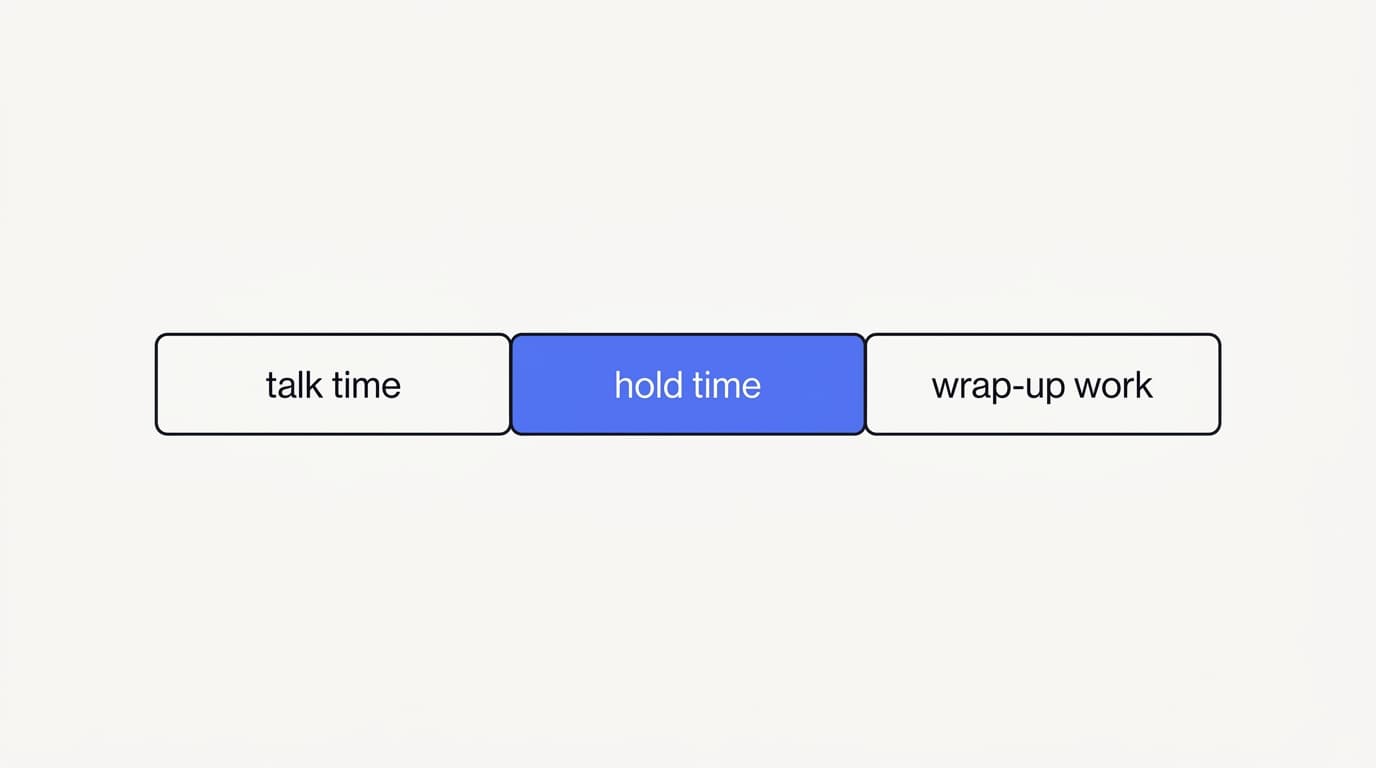
The metric has three parts, and knowing them is what makes it fixable. Talk time is the stretch where the agent is actively working the conversation with the customer. Hold time is any wait the customer sits through while the agent checks something or transfers.
Wrap-up time, often called after-contact work, is the notes, tagging, and follow-up an agent logs once the conversation itself has ended.
Investopedia and other reference sources define AHT the same way across the industry, which matters because a shared definition is what lets you compare periods honestly (Investopedia). The moment two teams count the parts differently, one including wrap-up and one not, their numbers stop meaning the same thing. Pin the definition down before you try to move it.
AHT is a cost and capacity metric first, and a quality metric only by accident. It tells you how much agent time each contact consumes, which drives staffing, cost per contact, and how much queue a fixed team can clear. It says nothing on its own about whether the customer left satisfied, which is the gap that makes chasing it blindly so risky.
This is why AHT should never be read alone. Pair it with resolution rate and a satisfaction signal so a falling handle time has to prove it did not come at the cost of correctness. Your analytics should show these side by side, because the whole point is to lower AHT while the other two hold steady or improve, not to win one number and lose two.
The average handle time formula, in plain terms
The formula is deliberately simple, which is a strength as long as you respect what goes into it. You add up all the handling time across a period and divide by the number of contacts you handled in that same period. The result is your average handle time per contact.
- AHT = (total talk time + total hold time + total wrap-up time) / total contacts handled.
- Talk time is the minutes spent actively working the conversation with the customer.
- Hold time is any wait the customer sits through while you check something, escalate, or transfer.
- Wrap-up time, also called after-contact work, is the tagging, notes, and follow-up logged once the conversation ends.
- For chat and email, read talk and hold as active handling and waiting across the thread, then divide total handling time by the number of conversations resolved.
The two variables you can move are the numerator and the denominator. Lower the numerator by removing wasted time inside each contact, the hunting, the holds, the manual write-up. Raise the denominator by resolving more contacts without adding time, which is what happens when repetitive work gets deflected or drafted for you.
Every honest lever in this guide pushes on one of those two.
A worked example makes the mechanics concrete. If your team handled 500 contacts last week and logged 2,500 total minutes of handling time, your AHT is five minutes. Trim two minutes of wrap-up per contact and, at the same volume, you free 1,000 minutes of capacity without touching the customer conversation at all.
Resist the urge to chase a single target number for AHT across your whole queue. A password reset and a billing dispute have wildly different natural lengths, so one blended target quietly pressures agents to rush the hard contacts that most need care. Segment AHT by contact type instead, the same discipline the AI support agent implementation guide applies to measuring an agent honestly.
Why reducing AHT matters, and where it misleads
The case for reducing average handle time is real and worth stating plainly. Handling time is agent time, and agent time is your largest support cost, so every minute you remove from a contact either lowers cost per contact or lets the same team clear more queue. Faster handling also usually means a shorter wait for the next customer in line, which is a genuine experience gain.
There is also a customer-effort angle that AHT touches indirectly. Long handling often means the customer is repeating themselves, waiting on holds, or being bounced between people, all of which are effort the customer feels. Research popularized by Harvard Business Review has long argued that reducing customer effort predicts loyalty better than delighting people does, and a lot of handle time is pure effort you can remove.
The trap is that AHT is trivially easy to lower the wrong way. You can drop the number tomorrow by telling agents to close faster, cut answers short, or push customers to self-serve before their problem is solved. The metric will improve and the experience will rot, and the damage shows up in a place AHT does not measure: customers coming back because the first contact did not actually fix anything.
The repeat-contact problem is not a hunch, it is a well-documented frustration. Zendesk's 2024 CX Trends research found 74% of customers rank having to repeat information among their biggest annoyances (Zendesk). A handle time you lowered by rushing produces exactly that, a second contact where the customer explains the whole thing again, so the saving was never real.
The honest framing is that AHT reduction is a means, not an end. The end is resolving customer problems correctly at a sustainable cost, and a lower AHT is worth having only when it comes from removing waste rather than removing care. The next section is about the levers that pass that test.
The levers that actually reduce average handle time
 Communicate.so
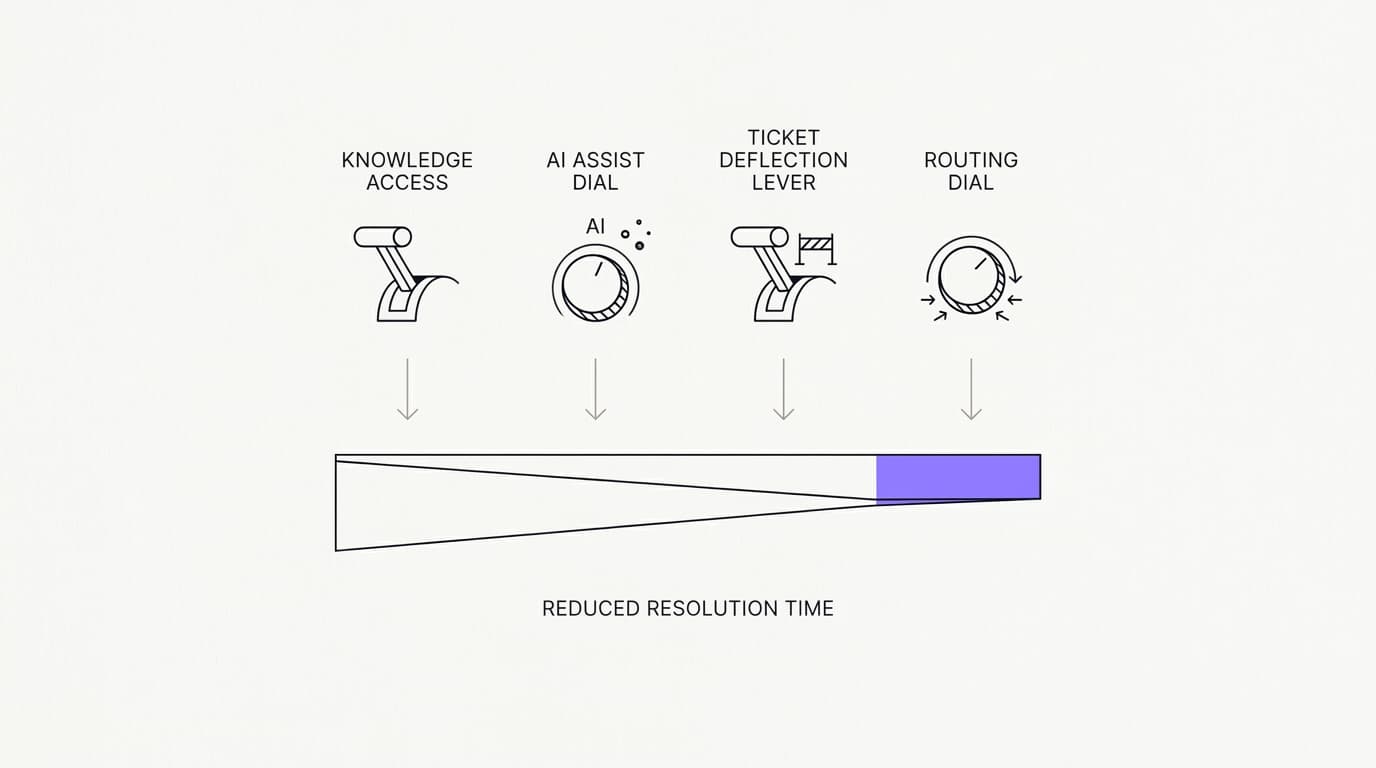
Every durable reduction in AHT comes from removing real friction, not from pressuring people. There are four levers that reliably do this, and they share a trait: each one takes work out of the contact without taking care out of it. Knowledge access, AI drafting and assist, deflection of simple tickets, and smart routing are the ones worth your time.
Faster knowledge access is the highest-leverage fix for most teams. A large share of handling time is an agent searching for the right answer across scattered docs, old tickets, and their own memory. Give agents instant, reliable retrieval from a single connected source and the hunting collapses, which is why the data you connect matters as much for human agents as it does for an AI one.
AI drafting and reply assist attack the writing and the wrap-up. An assist that drafts a grounded reply for the agent to review, or writes the summary and suggests the tags, removes the two slowest manual steps in a contact. The agent stays in control and edits before sending, so speed goes up without the answer quality dropping, a pattern the AI agent is built to support.
Deflecting simple, repetitive tickets lowers AHT by changing the mix. When self-serve content or an AI agent resolves the easy, high-volume questions, the contacts that reach a human are the ones that genuinely need a human, and the queue shrinks. Deflection done well raises capacity rather than hiding tickets, and the support ticket deflection rate guide covers how to measure it honestly so you are not just deferring problems.
Routing to the right person first cuts the most wasteful minutes of all. Time spent transferring a contact, re-explaining it to the next agent, and holding the customer while that happens is pure waste that inflates AHT and infuriates people. Getting the contact to someone who can resolve it on the first touch removes that entirely, which is a big part of what a clean AI to human handoff is for.
The table sorts the honest levers from the shortcuts that lower AHT by spending trust. Read the left column as the approach and the two right columns as the outcome. The same number moves either way, but only one side of this table survives contact with a real customer.
| Approach to lowering AHT | Reduces AHT without hurting CSAT | Shortcut that hurts CSAT |
|---|---|---|
| Faster knowledge access for agents | ✓ | ✗ |
| AI drafting and reply assist | ✓ | ✗ |
| Deflecting simple, repetitive tickets | ✓ | ✗ |
| Routing to the right person on first touch | ✓ | ✗ |
| Removing manual wrap-up and tagging | ✓ | ✗ |
| Rushing agents against a stopwatch target | ✗ | ✓ |
| Cutting answers short to close a ticket fast | ✗ | ✓ |
| Pushing customers to self-serve before resolution | ✗ | ✓ |
| Canned replies that ignore the real question | ✗ | ✓ |
Read the table as a filter, not a scoreboard. Any tactic that lands in the right-hand column will lower your AHT and raise your repeat-contact rate at the same time, which means it never really saved anything. The left-hand column is where reduction and satisfaction move together, and that is the only reduction worth reporting.
How AI reduces average handle time, specifically
 Communicate.so
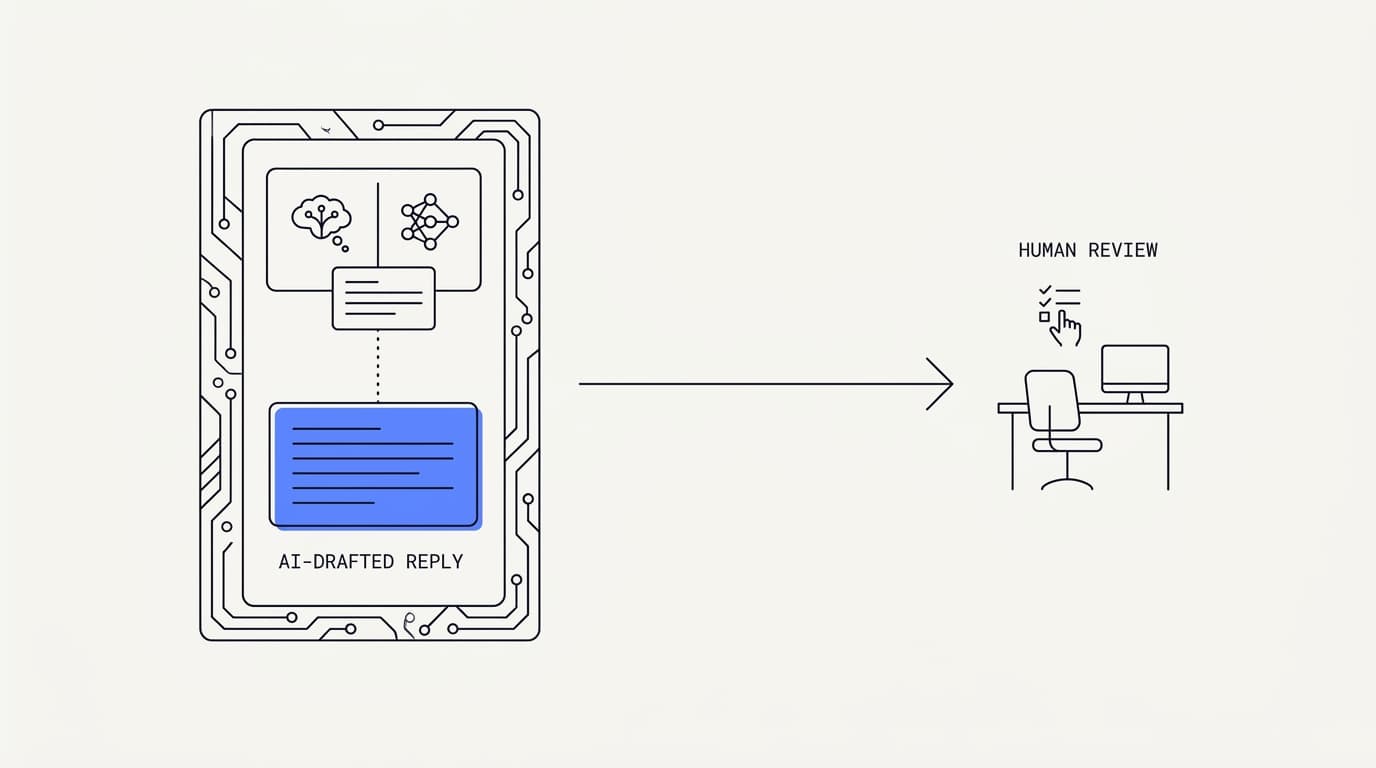
AI moves AHT through the honest levers, not around them. It is worth being specific, because the vendor pitch often blurs into magic. AI lowers handle time in three concrete ways: it retrieves the answer so the agent does not hunt, it drafts the reply and the wrap-up so the agent does not type from scratch, and it resolves simple contacts outright so they never reach a person.
Retrieval is the quiet workhorse. A grounded AI agent pulls the relevant passage from your connected sources at answer time, so instead of an agent searching three systems, the answer is already surfaced with its source. That removes the single largest chunk of talk-and-hold time in most contacts, the part where everyone waits while someone looks something up.
Drafting attacks talk time and wrap-up at once. The AI writes a grounded first draft of the reply and a summary for the notes, and the human reviews, edits, and sends, so the slow manual steps shrink while a person still owns the answer. This assist model is the safe one, because the agent catches anything the draft got wrong, unlike a fully autonomous reply on a contact that needed judgment, a balance the shared inbox is designed around.
Deflection is where AI changes the denominator. When the AI agent resolves the repetitive, well-documented questions on its own, those contacts leave the human queue entirely, so your team's remaining AHT reflects only the harder work. This is the largest single effect AI has on handle time, and the customer support automation guide walks through where automation helps and where it backfires.
The ceiling here is genuinely high when the discipline is right. Gartner has projected that by 2029, agentic AI will autonomously resolve 80% of common customer service issues without human intervention (Gartner). If most common issues resolve without a person, the contacts that remain are the complex ones, which reshapes both your AHT and what you should expect a human agent to spend time on.
The counterweight is equally important and less often quoted. RAND's 2025 review of more than 2,400 enterprise AI initiatives found roughly 80% failed to deliver measurable value, mostly on operational discipline rather than model quality (RAND). In support terms, that discipline is the knowledge, the guardrails, and the handoff, so AI cuts AHT only when the boring groundwork underneath it is done.
The honest limit: do not trade quality for speed
 Communicate.so
The single most important rule in AHT reduction is that speed is not the goal. Resolution is the goal, and speed is a happy side effect of removing friction. The moment you invert that and make speed the target, you start rewarding the behaviors that produce fast, wrong outcomes, and the customer pays for it on the second contact.
The mechanism of the failure is worth understanding. When agents are measured on handle time above all else, they learn to close contacts quickly, which means shorter answers, less checking, and more optimistic assumptions that the problem is solved. Each of those raises the odds the customer comes back, and a repeat contact costs far more total time than the minute you saved by rushing the first one.
This is why AHT has to be balanced against a resolution or satisfaction measure at all times. A falling AHT alongside a rising repeat rate is not an improvement, it is a warning, and only a paired view catches it. Usability researchers at the Nielsen Norman Group have long argued that the hardest contacts still need real attention, so a metric that punishes spending time on them is measuring the wrong thing.
The safe way to use AHT is as a diagnostic that points at friction, then to fix the friction with the honest levers. If a contact type has a high AHT, ask why: is the knowledge missing, the routing wrong, the wrap-up manual, the question genuinely hard. Fixing the cause lowers AHT as a byproduct, which is sustainable, unlike pressuring the symptom, and this is the same evidence-first habit the guide to cutting first response time applies to the response-time metric.
Hold onto one principle above all. A support interaction exists to solve the customer's problem, and a lower average handle time is only worth having when the problem still got solved. Any reduction that fails that test is a cost you have moved into the future, not a saving you have banked.
Where Communicate fits, honestly
Communicate is built around the honest levers rather than the shortcuts, which is the only reason it moves AHT in a way that lasts. The AI agent grounds its answers in your connected sources and hands off when it is unsure, so it deflects the repetitive contacts and drafts grounded replies for the harder ones instead of guessing to close fast. It is not a stopwatch you point at your team, and if a lower number by any means is what you want, it is not the tool for you.
Here is what it does without embellishment. The agent retrieves from the data you connect and escalates rather than inventing when retrieval finds nothing, the Shared Inbox uses presence-based human takeover with a per-turn backstop so the AI never talks over a person mid-reply, and analytics surfaces handle-time and resolution metrics side by side so you can see whether a faster number kept its quality. The live channels are a web widget, live chat, and email, with in-app messages and scoped actions running from the same agent and knowledge base.
On the model, Communicate runs a single model, gpt-4o-mini through OpenRouter, with response and prompt caching to keep cost and latency down. That is a deliberate choice, because the knowledge you connect and the guardrails you set drive both speed and answer quality far more than swapping models does. Caching also trims real latency, which is a small, honest contribution to handling time rather than a headline claim.
On pricing, there is no free tier. Entry is a one-time $1 activation that confirms you are a real person and includes 100 test credits, then credit-based usage from there, so cost tracks usage rather than headcount. Spend those test credits measuring AHT and resolution together on your own real questions before you trust the agent live, which is the disciplined way to prove a reduction is genuine.
Now the honest limits. Communicate is GDPR-ready but not certified, holds no SOC 2, HIPAA, or ISO 27001, runs in a single region, and does not offer SSO. It supports TOTP two-factor authentication, encryption at rest, and workspace isolation, a posture stated plainly on the security page.
Its live channels are the web widget, live chat, and email, with no WhatsApp, Messenger, SMS, or voice, so if any of those is a hard requirement it is not your best fit today, and questions go to [email protected].
Key takeaways
- Average handle time is total handling time divided by contacts handled, where handling time is talk plus hold plus wrap-up work, and wrap-up is the part teams most often forget.
- AHT is a cost and capacity metric, not a quality one, so it must always be read alongside resolution rate and a satisfaction signal to stay honest.
- The levers that genuinely reduce AHT remove real friction: faster knowledge access, AI drafting and assist, deflecting simple tickets, and routing to the right person first.
- The shortcuts that also lower AHT, rushing agents, cutting answers short, or pushing customers off early, spend customer trust and return as repeat contacts and falling CSAT.
- AI cuts AHT by retrieving answers, drafting replies and wrap-up, and deflecting repetitive contacts, but only when clean knowledge and a working handoff sit underneath it.
Ready to reduce average handle time by removing friction rather than adding pressure? Start with a one-dollar account activation that includes 100 test credits, connect your data sources, and watch handle time and resolution together in analytics before you commit. If response time is your next question, the first response time benchmark guide is the right follow-on read.
Frequently asked questions
What is average handle time?
Average handle time, or AHT, is the average duration of a single customer contact from the moment an agent starts working it to the moment the work is fully done, measured across many contacts over a period. It includes talk time, hold time, and the wrap-up work logged after the conversation. It is a cost and capacity metric, so it tells you how much agent time each contact consumes, not whether the customer was satisfied.
What is the average handle time formula?
AHT equals total talk time plus total hold time plus total wrap-up time, divided by the number of contacts handled in the same period. If your team logged 2,500 minutes of handling across 500 contacts last week, your AHT is five minutes. For chat and email, read talk and hold as active handling and waiting across the thread, then divide total handling time by conversations resolved.
What counts as wrap-up time in AHT?
Wrap-up time, also called after-contact work, is everything an agent does once the conversation with the customer has ended: writing notes, tagging the contact, updating records, and any follow-up task. It is the part of AHT that is invisible on the transcript, which is why teams underestimate it. If conversations feel short but AHT stays high, wrap-up work is usually where the time is hiding.
Is a lower average handle time always better?
No, and treating it that way is the classic mistake. You can lower AHT tomorrow by rushing agents or cutting answers short, and the number will improve while the experience gets worse. A lower AHT is only good when it comes from removing wasted time, not from removing care, so it must always be read next to resolution rate and a satisfaction signal.
Why does average handle time matter?
Handling time is agent time, and agent time is usually your largest support cost, so lowering AHT either reduces cost per contact or lets the same team clear more queue. Shorter handling also tends to mean shorter waits for the next customer in line. It matters most as a diagnostic that points you at friction worth fixing, rather than as a target to chase for its own sake.
What is a good average handle time?
There is no single good number, because a password reset and a billing dispute have very different natural lengths, and a blended target quietly pressures agents to rush the hard contacts. Rather than aiming for an industry figure, segment AHT by contact type and track whether each type is trending down while resolution holds. The right AHT is the one that removes waste without producing repeat contacts.
How do I reduce average handle time without hurting quality?
Reduce it by removing real friction, not by pressuring people. Give agents faster knowledge access from a single connected source, use AI to draft replies and wrap-up, deflect simple repetitive tickets to self-serve or an AI agent, and route each contact to the right person on the first touch. Each of these takes wasted time out of the contact without taking care out of it, which is the test a real lever has to pass.
How does AI reduce average handle time?
AI lowers AHT in three concrete ways: it retrieves the answer so the agent does not hunt, it drafts the reply and the summary so the agent does not type from scratch, and it resolves simple contacts outright so they never reach a person. The drafting model keeps a human in control to catch mistakes. It only works when clean knowledge and a working handoff sit underneath it.
Does reducing AHT lower customer satisfaction?
It depends entirely on how you reduce it. Removing friction lowers AHT and satisfaction rises or holds, while rushing agents lowers AHT and satisfaction falls as repeat contacts climb. Zendesk found 74% of customers rank repeating information among their biggest annoyances (Zendesk), and a rushed contact produces exactly that repeat, so watch both numbers together.
What is the difference between AHT and first response time?
Average handle time measures how long it takes to fully handle a contact, including talk, hold, and wrap-up, while first response time measures how long a customer waits for the first human or agent reply. They answer different questions, one about total effort and one about initial speed. Both belong on the same dashboard, and the first response time benchmark guide covers the second one in depth.
Should AHT be used as an agent performance target?
Be very careful here, because AHT handed to agents with a stopwatch attached becomes an instruction to sacrifice quality for speed. It works far better as a team-level diagnostic that flags friction than as an individual target that rewards fast closes. If you do track it per agent, always pair it with resolution and satisfaction so nobody is rewarded for closing contacts that were not actually resolved.
How does ticket deflection affect average handle time?
Deflection changes the mix of contacts your humans handle. When self-serve content or an AI agent resolves the easy, repetitive questions, those contacts leave the human queue, so the remaining AHT reflects only the harder work that legitimately takes longer. Done well it raises real capacity, and the support ticket deflection rate guide explains how to measure it so you are not just hiding tickets.
Why is my average handle time so high?
The usual culprits are hidden wrap-up work, agents hunting for answers across scattered sources, holds and transfers, and complex contact types that a blended average makes look worse than they are. Break AHT down by contact type and by its three parts, talk, hold, and wrap-up, to see where the time actually goes. High AHT is a symptom, and the cause is almost always specific friction you can name and fix.
Does average handle time include hold time?
Yes, hold time is one of the three components of AHT, alongside talk time and wrap-up work. Hold time is any wait the customer sits through while the agent checks something, escalates, or transfers the contact. It is often the most wasteful part of the number, because holds add customer effort while adding nothing to the resolution, which makes reducing them a clean win.
How is AHT measured for chat and email?
The concept carries over from phone, but the parts adapt. Talk and hold time become active handling and waiting across the thread, and wrap-up time stays the same. You divide the total handling time across all conversations by the number of conversations resolved in the period.
Asynchronous channels like email complicate this, so many teams measure active working time rather than elapsed clock time to avoid counting overnight gaps.
Can AI hurt average handle time if done badly?
Yes. Bolt an AI agent onto a messy or out-of-date knowledge base and it will hand out wrong answers quickly, which lowers AHT on the first contact and raises repeat contacts right after. The saving is an illusion, because the same customer comes back.
AI cuts AHT sustainably only when the knowledge is clean, the guardrails are set, and the handoff to a human works reliably.
How often should I review average handle time?
Review it on a regular cadence, weekly or monthly, and always alongside resolution rate and a satisfaction signal rather than alone. Watch the trend by contact type rather than one blended figure, and investigate any segment where AHT is rising or where a falling AHT is paired with a rising repeat rate. Your analytics should make that paired view easy to read at a glance.
Does reducing AHT save money?
It can, but only if the reduction is genuine. Real reductions free agent capacity, which lowers cost per contact or lets a fixed team clear more queue, both real savings. Fake reductions from rushing move the cost into the future as repeat contacts, which take more total time than the minute you saved, so they cost money rather than saving it.
Always check that repeat contacts did not rise.
How does Communicate help reduce average handle time?
Communicate reduces AHT through the honest levers. The agent grounds answers in your connected sources and deflects repetitive contacts, drafts grounded replies for the harder ones, and the Shared Inbox uses presence-based human takeover so a person can step in cleanly. It surfaces handle-time and resolution metrics together in analytics so you can prove a lower AHT kept its quality rather than trading it away.
Will reducing AHT replace the need for support agents?
No, and any vendor claiming it will is overselling. Reducing AHT with AI shifts the repetitive work off your team so people focus on the complex contacts that need judgment, which is the realistic goal. Gartner projects agentic AI will resolve 80% of common customer service issues by 2029 (Gartner), but the remainder still needs human care, and rushing those contacts is exactly the trap AHT sets.