
Fintech customer support AI: read-only scope, not open reasoning
 Communicate.so
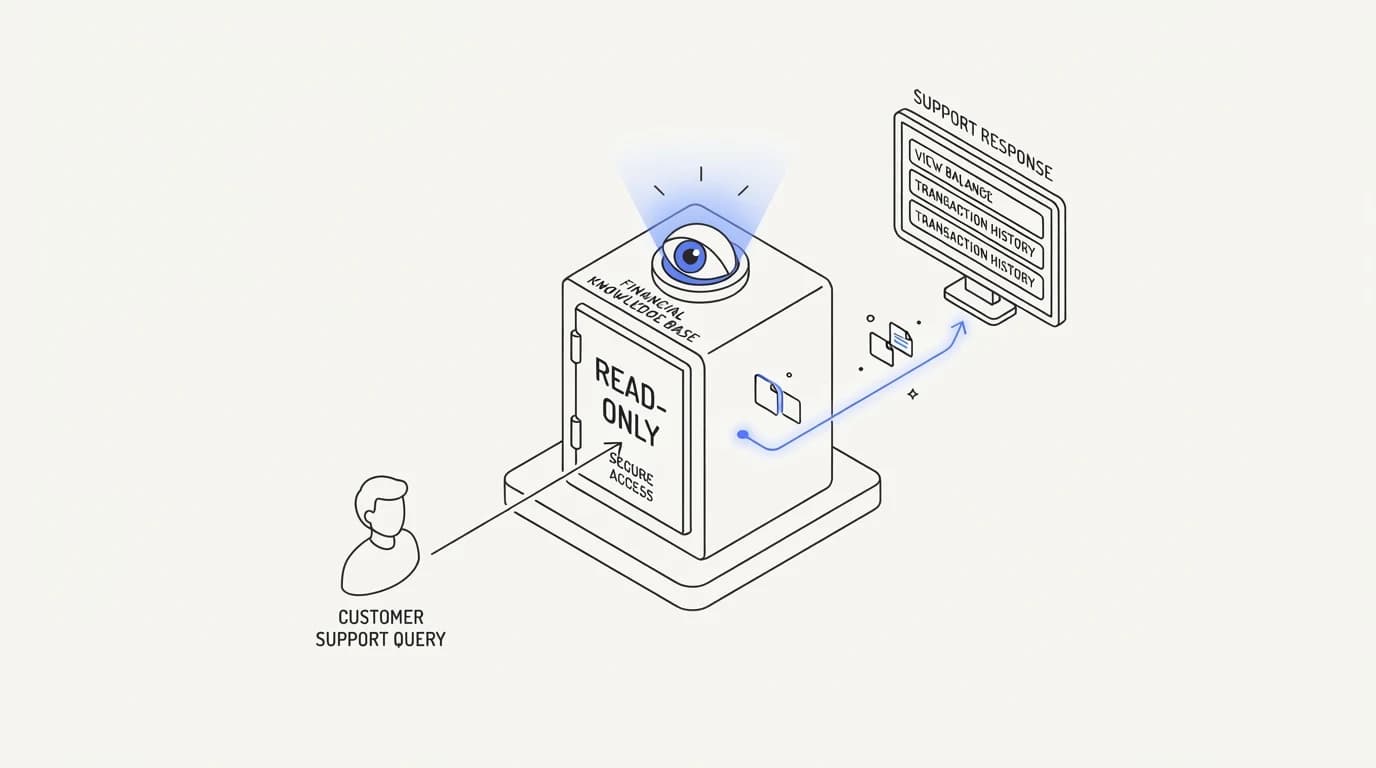
Fintech customer support AI has to treat a wrong answer as a compliance event. Read-only scope, mandatory disclosure, and a full audit trail.
TL;DR: Fintech customer support runs on a different risk model than most industries, because a wrong answer is not just a bad experience, it can be a compliance event. A support agent that misstates an account balance, implies investment advice, or confirms a transaction that never happened creates exposure that reaches beyond the conversation. FINRA has already extended its communications and recordkeeping rules to chatbot interactions, holding firms accountable for AI-generated content the same way it holds them accountable for a human representative's statements. The safe design for AI in fintech support is narrow by default: read-only account access, a hard boundary against anything that resembles financial advice, mandatory AI disclosure, and a complete audit trail of every exchange. This guide covers what that scope looks like in practice, why regulated firms cannot delegate compliance obligations to a vendor, and where the honest line sits between what an AI agent should answer and what it should always route to a licensed human.
A fintech support team evaluating AI faces a question most industries do not: what happens the day the agent gets something wrong. In ecommerce, a wrong answer about a shipping estimate is an inconvenience. In fintech, a wrong answer about a balance, a transaction, or anything that reads as guidance can trigger a regulatory review, not just an unhappy customer.
This guide is written for the person carrying that risk: a compliance lead evaluating an AI vendor, a support manager at a bank or lender scoping what the agent can touch, or a founder at a fintech startup who assumed customer support automation worked the same way it does everywhere else. It does not. The regulatory reality changes what a responsible deployment looks like from the ground up.
The position here is direct and deliberately conservative. A fintech AI agent should default to read-only account access, refuse anything that could be construed as financial advice, disclose plainly that the customer is talking to AI, and log every exchange for audit. None of this is optional caution, it follows directly from how FINRA and the SEC already treat AI-generated customer communications.
Why a wrong answer is a compliance event, not just a bad experience
In most industries, an AI support agent getting something wrong costs a customer relationship. In financial services, it can trigger a regulatory finding, because the content of that answer is a communication your firm is accountable for, whether a human or a model produced it.
FINRA has clarified that firms must ensure AI-generated communications comply with existing federal securities laws, FINRA rules, and applicable supervision and recordkeeping requirements, the same standard applied to communications drafted by a licensed representative (FINRA). An AI chatbot is not a lower-accountability channel just because no human typed the specific sentence.
This reframes the entire evaluation of an AI support tool for a regulated firm. The question is not whether the agent sounds helpful or resolves tickets quickly, it is whether every sentence it can produce would survive the same compliance review a human-written communication would face.
The content standard itself is not exotic. FINRA expects communications to be fair and balanced and prohibits false, misleading, promissory, or exaggerated statements, the same bar that has governed marketing and correspondence for decades (FINRA). What changes with AI is the volume and speed at which content gets generated, which is exactly why scope matters more here than in almost any other support context.
Read-only by default: the scope decision that matters most
 Communicate.so
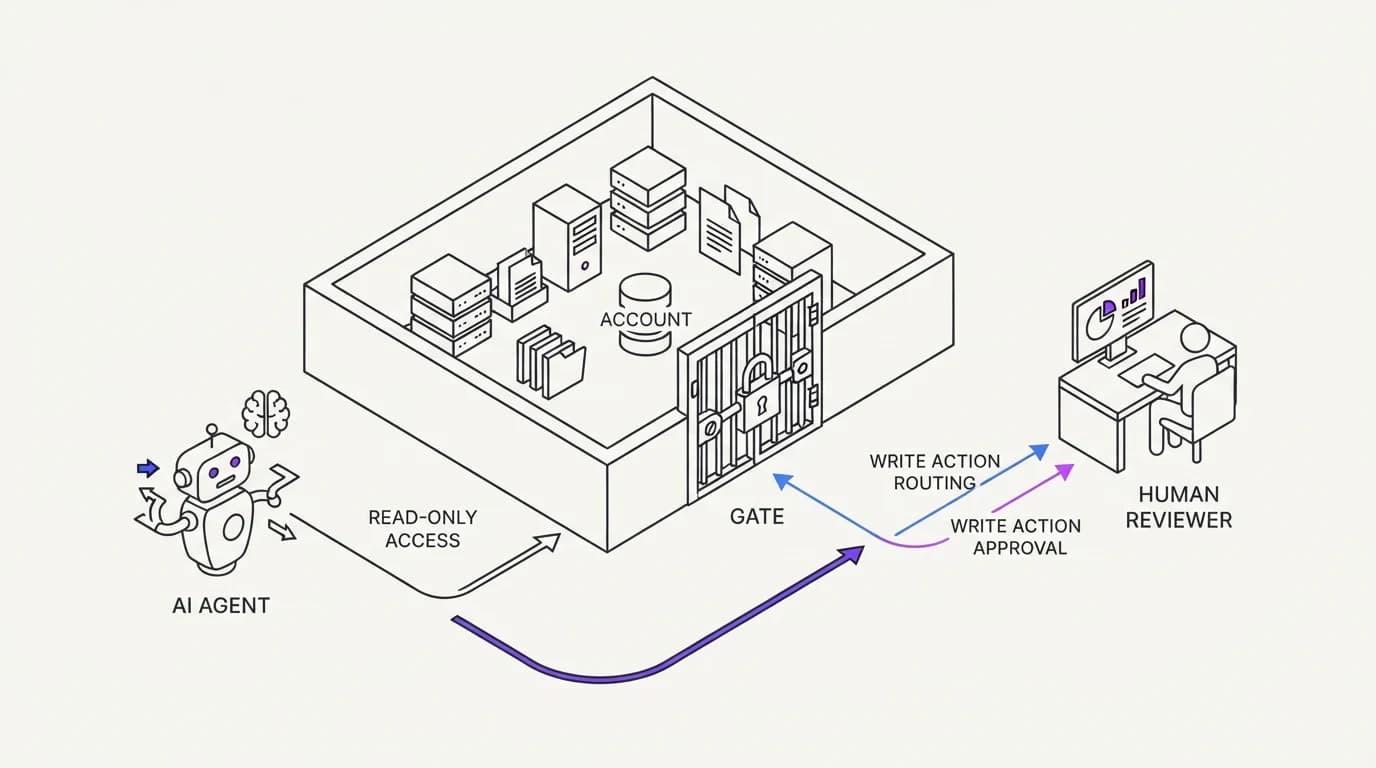
The single most important design decision for a fintech support agent is whether it can write, not just read. Reading an account balance to answer a question is a fundamentally different risk than initiating a transfer, adjusting a limit, or confirming a dispute resolution, and the two should never be treated as the same category of action.
A read-only agent can look up a balance, a transaction status, or a statement and state it accurately, which is a valuable and largely safe automation. The moment an agent can take a write action, such as moving money or changing account terms, the failure mode shifts from an embarrassing wrong answer to actual financial harm, and the actions an agent is permitted to take need explicit, narrow scoping rather than broad default access.
This is not a call to avoid actions entirely. It is a call to draw the line at read versus write and default to read, expanding to specific, tightly scoped write actions like a document resend or a support-only status update only after the risk of each specific action has been reviewed on its own merits.
Third-party accountability makes this scoping non-negotiable rather than a nice-to-have. Regulators hold financial firms responsible for third-party AI decisions that affect clients, and firms cannot delegate compliance obligations to a technology vendor (InnReg). Choosing a vendor with a permissive default scope does not transfer the risk, it just means your firm inherits a risk it did not fully evaluate.
The hard boundary: no financial advice, ever
 Communicate.so
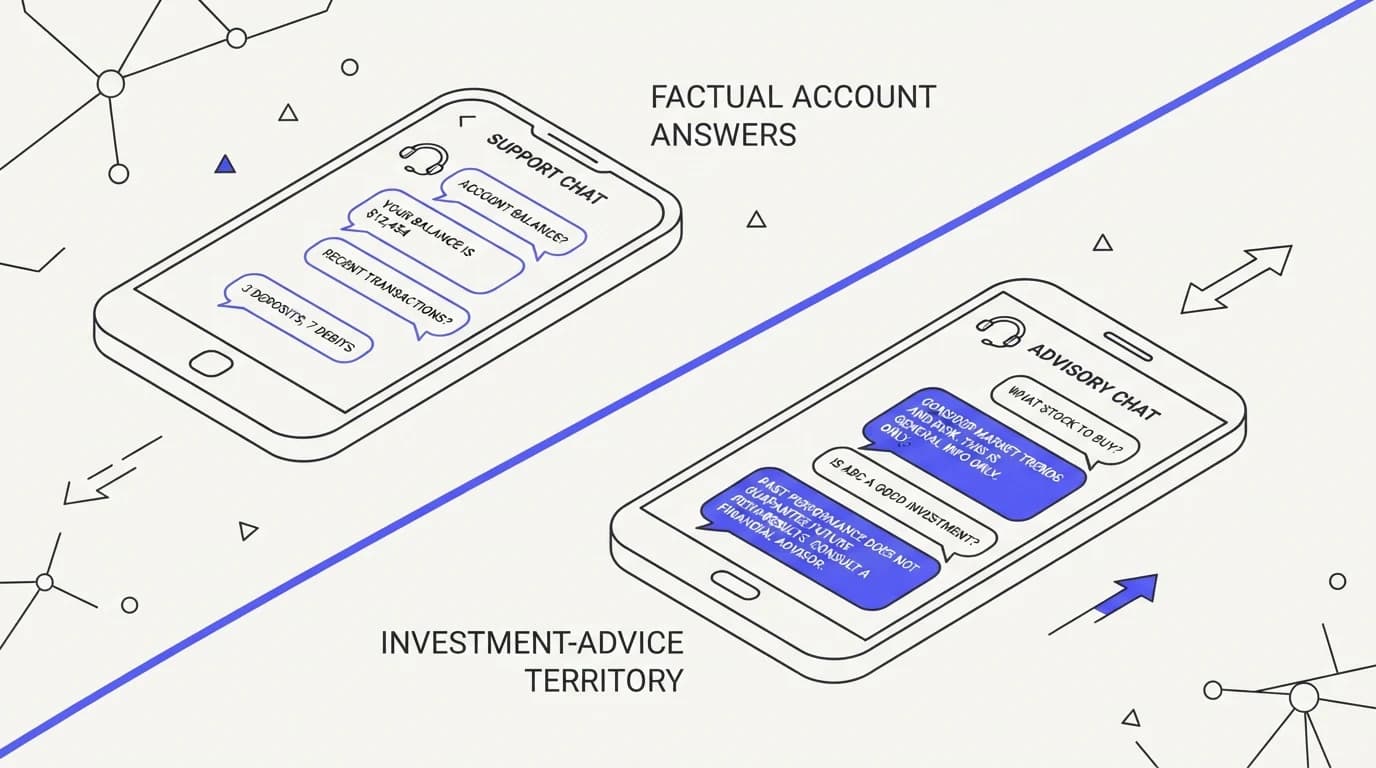
A fintech support agent needs a boundary that a general-purpose customer support agent does not: it must never produce anything that reads as investment advice, financial planning guidance, or a recommendation. Stating a fact, your account balance is $4,200, is safe. Suggesting what a customer should do with that money is not, regardless of how reasonable the suggestion sounds.
This boundary is harder to enforce than it sounds, because customers routinely phrase requests for advice as innocuous questions. Should I move my savings into this fund, is now a good time to pay down this balance, what would you do in my situation. Each of these invites exactly the kind of response a language model generates fluently and a regulator would classify as advice.
The safe pattern is a hard refusal with a clean redirect rather than a hedge. An agent that says here is your current balance and available options, but I cannot advise on what to do with them, connecting you with a licensed representative, draws the line clearly. An agent that answers with here is what I would consider has already crossed it, no matter how many disclaimers follow.
This is also where AI agent scope discipline matters more in fintech than in almost any other vertical. A support agent that can drift into advisory territory when a customer pushes hard enough is not a minor product gap, it is the exact failure mode regulators are watching for, and it needs to be a hard-coded refusal, not a soft preference the model can be talked out of.
Mandatory disclosure: telling customers they are talking to AI
 Communicate.so
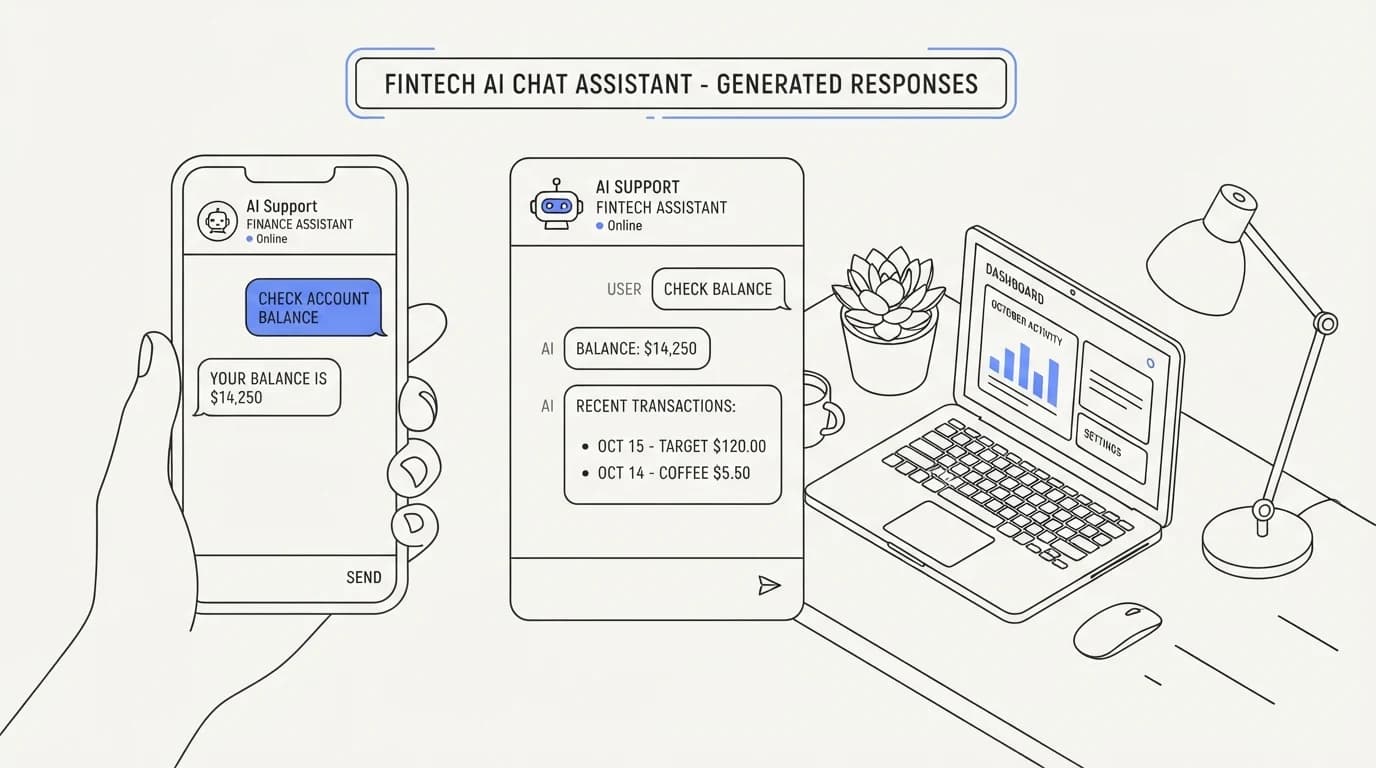
Disclosure is not unique to fintech, but the stakes make it non-negotiable rather than a nice-to-have design choice. A customer discussing their finances deserves to know whether they are talking to a person or a system, and that knowledge shapes how much weight they should give any statement the agent makes.
The EU AI Act establishes a general transparency duty for AI systems interacting with people, and financial services firms operating in or serving customers in the EU inherit that obligation directly. Even outside the EU, disclosure is simply good practice for a regulated industry where trust is the entire product.
Practically, disclosure means labeling the agent plainly at the start of every conversation, not burying it in terms of service. It also means the agent should not adopt a human name or persona that implies a person is responding, because that framing works against the exact transparency the disclosure is meant to provide.
Disclosure pairs directly with the honest admission of limits. An agent that discloses it is AI and also states plainly when a question needs a licensed human, rather than attempting an answer outside its scope, is doing the two things a regulated support interaction actually requires: honesty about what it is, and honesty about what it does not know, which reducing AI hallucinations in support covers from the technical side.
The audit trail: proving what the agent said and why
 Communicate.so
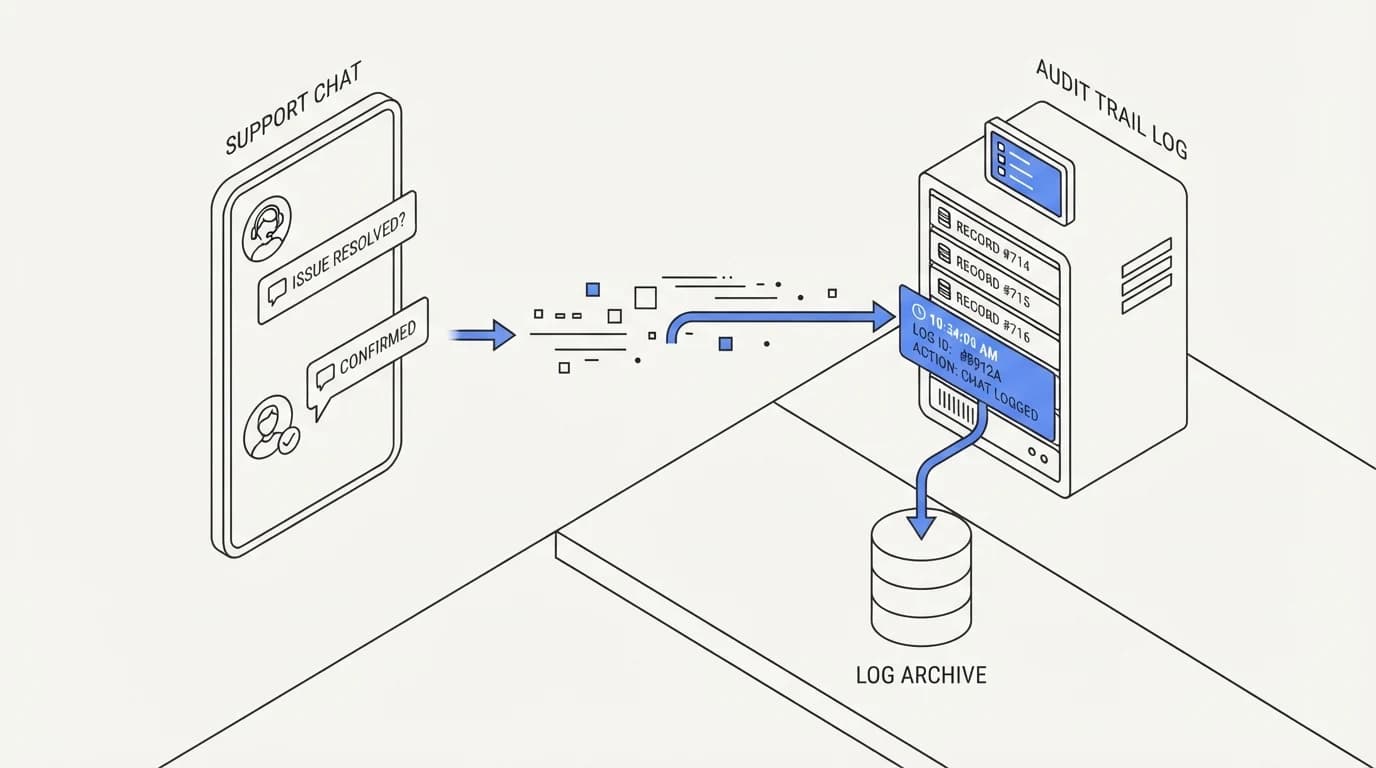
A fintech support deployment needs to be able to answer one question at any point in the future: what exactly did the agent say to this customer, and when. FINRA's recordkeeping requirements apply to AI-generated communications the same way they apply to human-generated ones, and firms need to retain and be able to produce that record on demand (FINRA).
This means every conversation the agent handles needs a complete, timestamped, unaltered record, not a summary or a sample. A support tool that only retains the last few messages, or that lets an agent edit history after the fact, does not meet the bar a regulated firm needs to clear.
The audit trail also has to capture what data the agent had access to when it answered, not just what it said. If a customer disputes a statement the agent made about their account, being able to show exactly what account data the agent could see at that moment is often as important as the transcript itself, which is why access logging belongs alongside conversation logging rather than as an afterthought covered loosely under general security practice.
Beyond regulatory defense, a complete audit trail is also the primary tool for catching drift before it becomes a pattern. Reviewing a sample of conversations where the agent came close to the advice boundary, even ones it correctly refused, tells a compliance team where customers are pushing and where the boundary needs reinforcing before an actual violation occurs.
Categorizing fintech AI content under FINRA rules
FINRA classifies chatbot communications depending on the nature and number of recipients, treating them as correspondence, retail communications, or institutional communications, each with different review and filing obligations (FINRA). This is not a detail to skip past, because it determines what supervisory review a given category of AI output requires before or after it reaches a customer.
| Support scenario | Content type | Risk level | AI can answer alone |
|---|---|---|---|
| What is my current account balance | Factual, read-only | Low | ✓ |
| When was this transaction posted | Factual, read-only | Low | ✓ |
| Should I move my savings into this fund | Advisory | High | ✗ |
| Why was my transfer declined | Factual, may need investigation | Medium | ✗ |
| How do I update my mailing address | Procedural, how-to | Low | ✓ |
| Is this the right time to refinance | Advisory | High | ✗ |
Read the table as the same category discipline that governs any support agent, sharpened by regulatory stakes. Factual and procedural questions are safe territory for an AI agent to answer directly, while anything advisory or dependent on an unresolved account issue needs a licensed human, and the AI to human handoff for that second group needs to happen before the agent generates a response, not after a wrong one has already been sent.
Building the advice boundary: a worked example
A boundary is only as good as its behavior under pressure, and customers testing a fintech agent tend to push on the advice line specifically, sometimes without realizing it. Consider a customer who asks: I have $10,000 sitting in savings, should I move it into the higher-yield account you offer. That question sounds like a simple product question and is actually a request for a recommendation.
A weak implementation answers directly, comparing the two accounts and suggesting the move, because that is the most helpful-sounding completion a language model can generate for the prompt. That answer is exactly the kind of statement FINRA's content standards were built to catch, regardless of how factually accurate the account comparison itself is.
A correctly scoped agent separates the factual half of the question from the advisory half. It states the two accounts' actual rates and terms as verified facts, then declines to recommend which one the customer should choose, routing that specific decision to a licensed representative. The customer gets real information immediately and a clear path to the recommendation they actually wanted, just from the right source.
The same pattern holds for questions about timing, such as whether now is a good moment to pay down a balance or lock in a rate. The factual components, current balance, current rate, current terms, are safe to state. The judgment about what a customer should do with those facts is where the boundary has to hold, every time, regardless of how the question is phrased or how many times a customer rephrases it hoping for a different answer.
Vendor evaluation: questions to ask before any fintech deployment
Evaluating an AI vendor for fintech support requires a different question set than a general support tool comparison, because the stakes sit on the compliance side as much as the product side. Ask whether the vendor's agent can be configured read-only by default, and whether that is an explicit setting rather than a claim without a control behind it.
Ask how the advice boundary is enforced, whether it is a prompt instruction that a persistent customer can talk past, or a structural refusal the agent cannot be argued out of. Ask what the audit trail actually captures, whether it is a full timestamped transcript plus a record of accessible account data, or a partial log that would not survive a real regulatory request. Confirm the vendor's actual certifications rather than assuming coverage, since the security posture of a vendor varies widely and the gap between GDPR-ready and SOC 2 certified, for example, is a material one for a regulated buyer.
Finally, ask what happens when the agent is uncertain. A vendor whose agent guesses when it does not know the answer is a worse fit for fintech than one that admits uncertainty and escalates, even if the second option resolves fewer conversations without a human, because the cost of a confident wrong answer in this vertical is categorically higher than the cost of a slower correct one.
Where Communicate fits, honestly
Communicate is a grounded AI agent that answers from the content and data you connect and hands off cleanly when a question falls outside safe scope, which for a fintech deployment means configuring it to stay strictly factual and read-only, refusing anything that resembles advice by default. The AI agent guardrails model this guide describes, a hard-coded refusal rather than a soft preference, is the right posture to configure from day one.
Here is what it does without embellishment. It runs on a single model, gpt-4o-mini through OpenRouter, and answers from connected content rather than open-ended reasoning, which is a meaningfully safer default for a regulated use case than a model encouraged to be maximally helpful regardless of topic.
On honest limits, stated plainly because a regulated buyer needs the real picture: Communicate is GDPR-ready but not certified, holds no SOC 2, HIPAA, or ISO 27001 certification, and does not offer SSO. For a firm that requires certified compliance infrastructure, that is a real gap to weigh, detailed on the security page, and it should be reviewed against your specific regulatory obligations before any fintech deployment, not discovered afterward. It supports TOTP two-factor authentication, encryption at rest, and workspace isolation as its current posture.
Entry is a one-time $1 activation with 100 test credits on the pricing page, worth using to test the advice-boundary refusal against your hardest real questions before any live deployment.
Key takeaways
- A wrong answer in fintech support is a potential compliance event, since FINRA holds AI-generated communications to the same standard as human-written ones.
- Read-only account access should be the default scope, with write actions like transfers or limit changes scoped narrowly and reviewed individually, not granted broadly.
- The hard boundary against anything resembling financial advice needs to be a refusal the agent cannot be talked past, not a soft preference.
- Disclosure that the customer is talking to AI is non-negotiable, and it should pair with an honest admission of what the agent does not know.
- A complete, timestamped audit trail of every conversation and the data the agent could see is required to defend what the agent said, not optional documentation.
If you are scoping an AI agent for a regulated fintech support queue, start with the read-only versus write-action boundary and the advice refusal before evaluating anything else. Review the honest limits on the security page against your specific regulatory obligations, then test the boundary with a one-time $1 activation on the pricing page.
Frequently asked questions
Why is AI customer support riskier in fintech than other industries?
Because a wrong answer is not just a bad experience, it is a communication your firm is accountable for under existing securities regulation. FINRA has clarified that AI-generated communications must comply with the same rules as human-drafted ones, including supervision and recordkeeping requirements (FINRA).
Does FINRA regulate AI chatbots used in customer support?
Yes. FINRA has extended its communications and recordkeeping guidance to chatbot interactions, treating AI-generated content the same way it treats a human representative's statements, including classification as correspondence, retail, or institutional communications depending on scope (FINRA).
Should a fintech AI agent have write access to accounts?
Default to read-only. Reading a balance to answer a question is a low-risk automation, while write actions like transfers or limit changes carry real financial harm if something goes wrong. Any write action should be scoped narrowly and reviewed individually rather than granted as part of a broad default permission set.
Can an AI agent give financial advice in a support conversation?
No, and this should be a hard boundary the agent cannot be talked past regardless of how the question is phrased. Stating a fact about an account is safe, but suggesting what a customer should do with their money reads as advice, and that boundary needs to hold even when a customer directly asks for a recommendation.
What should a fintech AI agent do when asked for investment advice?
Refuse clearly and redirect to a licensed representative rather than hedging with a disclaimer attached to an answer that still reads as advice. A response like here is your balance and options, but I cannot advise on what to do with them, and I am connecting you with someone who can, draws the line without leaving the customer stranded.
Is disclosure that a customer is talking to AI required in fintech support?
It is expected practice and, for firms serving EU customers, a direct obligation under the EU AI Act's transparency duty. Beyond any specific jurisdiction, a customer discussing their finances deserves to know whether a person or a system is responding, since that knowledge shapes how much weight they give the answer.
What needs to be in a fintech support audit trail?
A complete, timestamped, unalterable record of every conversation, plus a record of what account data the agent could see at the time it answered. FINRA's recordkeeping requirements apply to AI-generated communications the same way they apply to human ones (FINRA), and a summary or sample does not meet that bar.
Can a fintech firm delegate compliance responsibility to an AI vendor?
No. Regulators hold financial firms accountable for third-party AI decisions that affect clients, and firms cannot delegate compliance obligations to a technology vendor (InnReg). Choosing a vendor with a permissive scope does not transfer the risk, the firm deploying the agent still owns it.
What kinds of questions are safe for a fintech AI agent to answer alone?
Factual, read-only questions with a stable, verifiable answer: current balance, transaction status, when a statement was issued, how to update contact information. These carry low risk because they are lookups, not judgment calls, and they do not require the agent to interpret or recommend anything.
What kinds of questions should always route to a human in fintech support?
Anything advisory, such as whether to move money or how to plan around a financial decision, and anything requiring investigation, such as why a transfer was declined or a dispute over a charge. Both categories need a licensed human, either because the AI legally should not answer or because the answer depends on an investigation the AI cannot perform.
How does the EU AI Act apply to fintech chatbots?
A typical fintech support chatbot falls into the Act's limited-risk tier, whose main obligation is transparency, telling customers they are talking to AI. The EU AI Act customer support guide covers the risk tiers in more depth, though firms using AI for higher-stakes decisions like credit approval should confirm their specific tier with counsel.
What happens if a fintech AI agent gives a wrong answer about a balance?
Beyond the immediate customer harm, it is a communication error a regulated firm may need to account for under existing recordkeeping and communications rules. This is exactly why read-only, verified data access matters more than conversational fluency for a fintech deployment, since a wrong factual statement is the failure mode with the most direct compliance exposure.
Does using a third-party AI vendor reduce a fintech firm compliance risk?
No, and assuming otherwise is a common and costly mistake. Regulators hold the firm accountable for third-party AI decisions regardless of which vendor produced them (InnReg), so vendor selection should be treated as a compliance decision, not just a product decision.
How should a fintech support agent handle a dispute over a transaction?
It should gather the specifics, the transaction details and the nature of the dispute, and route the case to a human rather than attempt to resolve it directly. A transaction dispute often requires investigation into data the agent cannot fully verify on its own, and a wrong resolution offered by an AI agent creates real financial and compliance exposure.
What guardrails matter most for fintech customer support AI?
A hard-coded refusal on financial advice, read-only default account access, and a full audit trail matter most, in that order. AI agent guardrails covers the general pattern, and fintech is the vertical where that pattern needs to be least negotiable.
Can AI reduce fintech support costs without increasing compliance risk?
Yes, when scope is kept narrow. Automating factual, read-only questions like balance and transaction status lookups reduces volume without touching advisory or write-action territory, which is where the compliance risk actually concentrates. The cost savings come from the safe half of the queue, not from pushing automation into the risky half.
Should a fintech AI agent ever confirm that a transaction was successful?
Only by reading the actual transaction record and reporting its verified status, never by inferring success from context or a customer's description of what should have happened. Confirming a transaction that did not actually go through is exactly the kind of factual error that carries real financial and compliance consequences.
What is the difference between a factual answer and advice in fintech support?
A factual answer states verifiable data: your balance is this amount, this transaction posted on this date. Advice recommends a course of action based on that data: you should move this money, now is a good time to refinance. The first is safe territory for AI, the second requires a licensed human regardless of how confident the answer would sound.
How often should a compliance team review fintech AI support conversations?
Regularly and specifically for boundary cases, not just for complaints. Reviewing conversations where the agent came close to advisory territory, even ones it correctly refused, shows where customers are pushing and where the refusal boundary needs reinforcing before an actual violation occurs rather than after.
Is a fintech AI support agent required to be certified for compliance?
There is no single certification that covers this by default, and firms should confirm specific requirements like SOC 2 or relevant regulatory certifications directly with the vendor rather than assuming coverage. Reviewing a vendor's stated posture on the security page against your specific regulatory obligations is the right first step before any commitment.