
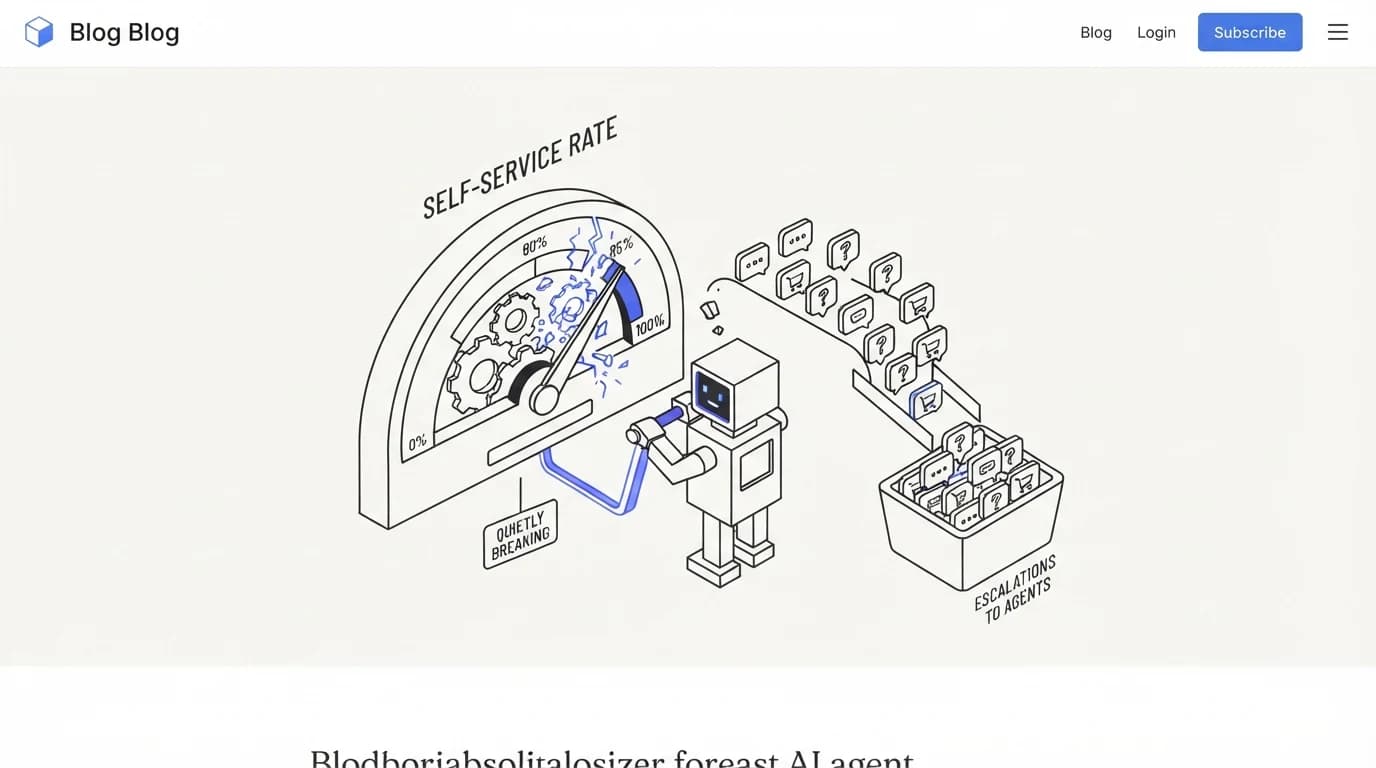
Self-service rate: the metric your AI agent is quietly breaking
 Communicate.so
Self-service rate explained: why an AI answer never counts as a doc view, and how to fix the metric before it hides real problems.
TL;DR: Self-service rate counts how many customers solve a problem without contacting a human, and most teams still measure it as a ratio of help center page views to total support volume. That formula quietly breaks the moment an AI agent starts answering questions directly in a chat widget, because a customer who gets a correct answer from the agent never lands on a documentation page, and the traditional formula records that resolved question as if it never happened. This guide takes the position that self-service rate needs a new denominator that includes AI-resolved conversations, not just page views, and it walks through how to rebuild the metric without inflating it artificially. Bookbag's 2026 benchmark work and HappySupport's metric research both confirm the same pattern: teams that only count doc views are underreporting their real self-service performance by a wide margin once an AI agent is live. Getting the metric right matters because a self-service rate that looks stuck or falling can trigger the wrong fix, more documentation work, when the real cause is a measurement gap.
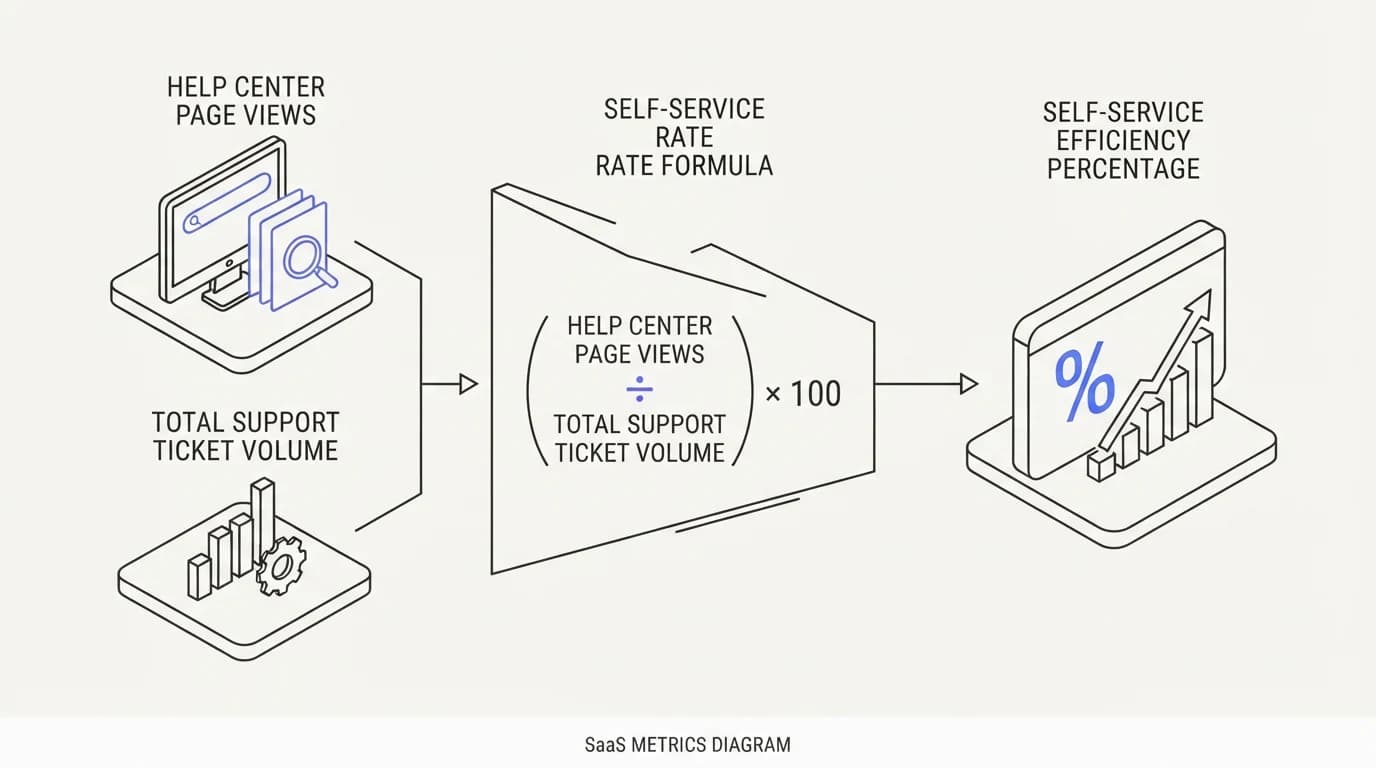
Self-service rate is the share of customer questions resolved without a human ever touching them, and it used to be a simple number: help center page views divided by total support volume, roughly. That formula was built for a world where self-service meant reading a document, and it has not caught up to a world where self-service increasingly means asking an AI agent a question directly and getting an answer in the chat window.
This guide argues the traditional self-service rate formula has a blind spot that is getting bigger every quarter: an AI agent's correct answer never counts as a documentation view, so the metric records a resolved question as unresolved. Teams that have not updated their formula are looking at a number that understates their real performance, sometimes badly, and reacting to a problem that measurement created rather than a problem that exists.
This is written for anyone who owns a help center and has watched self-service rate stagnate or drop even as an AI agent visibly resolves more conversations. The fix connects to how you train an AI agent on your help center content, because the same documentation that used to only serve page-view metrics now needs to serve a metric that tracks AI-resolved conversations too.
What self-service rate measures and why it is getting harder to measure
Self-service rate answers a specific question: out of everyone who had a problem, what share solved it without a human. It is one of the oldest support metrics, dating back to the earliest help center software, and it has always been a proxy measurement, counting behavior that correlates with resolution rather than confirming resolution directly.
The proxy always had gaps. A customer who reads a help article and still contacts support is counted as a self-service success in most legacy formulas, even though the article did not actually solve their problem. A customer who solves their problem through a community forum thread, a search engine snippet, or a friend's advice never shows up in the numerator at all, a gap HappySupport's metric research has flagged repeatedly.
These gaps were tolerable when they were small and roughly constant. The AI agent gap is neither. It grows every month an agent handles more volume, and it grows specifically in the direction that makes self-service rate look worse, not better, which is the opposite of what is actually happening inside a well-run support operation.
There is also a subtler measurement issue underneath all of this: what counts as a problem in the first place. A customer who browses a pricing page out of curiosity is not the same as a customer who lands on a troubleshooting article because something broke, and most self-service formulas do not distinguish between the two. Treating every page view as an attempted self-service resolution overstates the denominator's precision even before the AI gap enters the picture.
How self-service rate is traditionally calculated
 Communicate.so
The traditional formula divides help center sessions, or sometimes unique document views, by total support contacts over the same period, expressed as a percentage. A team with 10,000 documented page views and 4,000 support tickets in a month reports a self-service rate of roughly 71%, treating every page view as an implicit success regardless of what happened after.
This formula was reasonable when the only self-service channel was a searchable help center, because a page view was a decent proxy for someone attempting to solve their own problem. Bookbag's 2026 benchmark analysis for ecommerce still uses this page-view approach as the baseline comparison point, and it remains the most common formula in use across support tooling today (Bookbag).
The formula's weakness was always that a page view is not a confirmed resolution. Someone can open an article, fail to find their answer, and still contact support anyway, and the traditional formula counts that page view as a self-service success regardless of the outcome. That weakness becomes a much bigger problem once a second self-service channel enters the picture.
The AI blind spot: why an AI answer never counts as a doc view
 Communicate.so
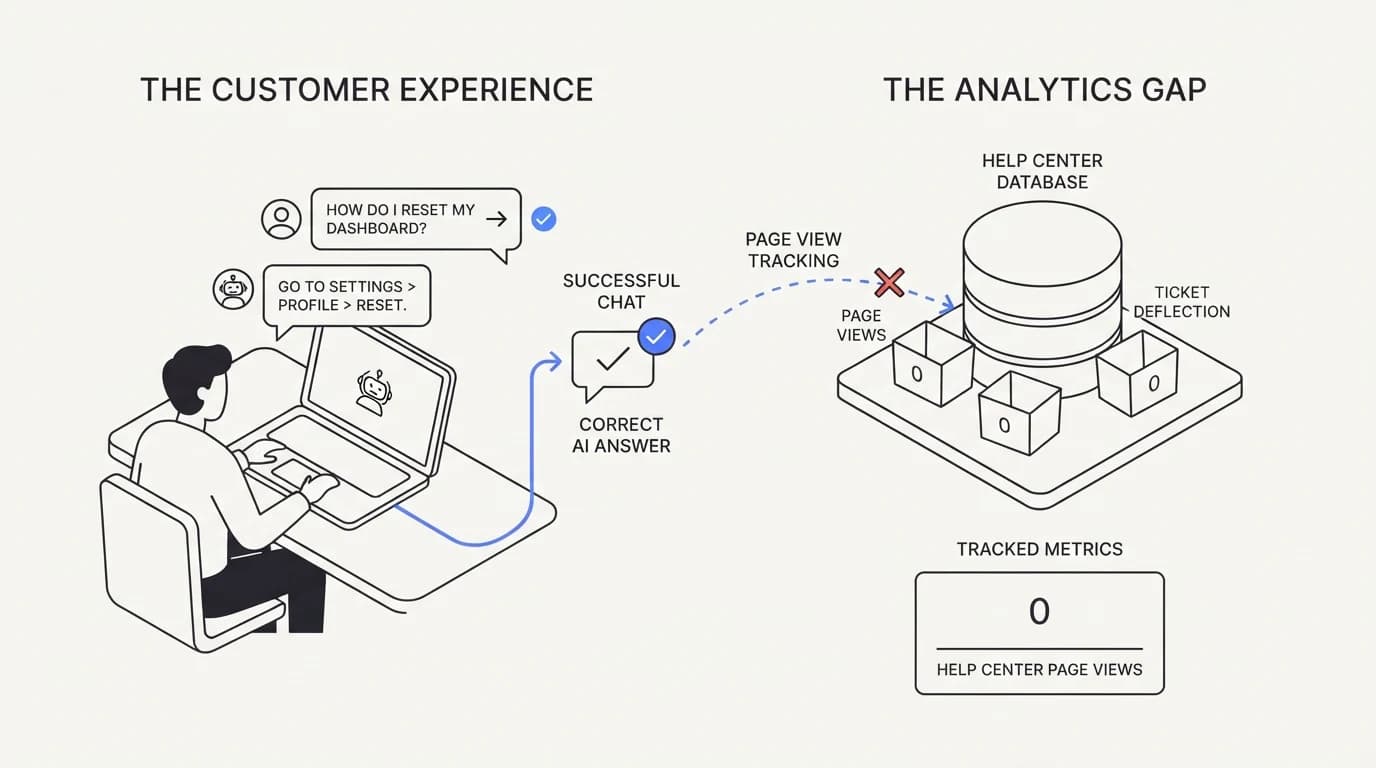
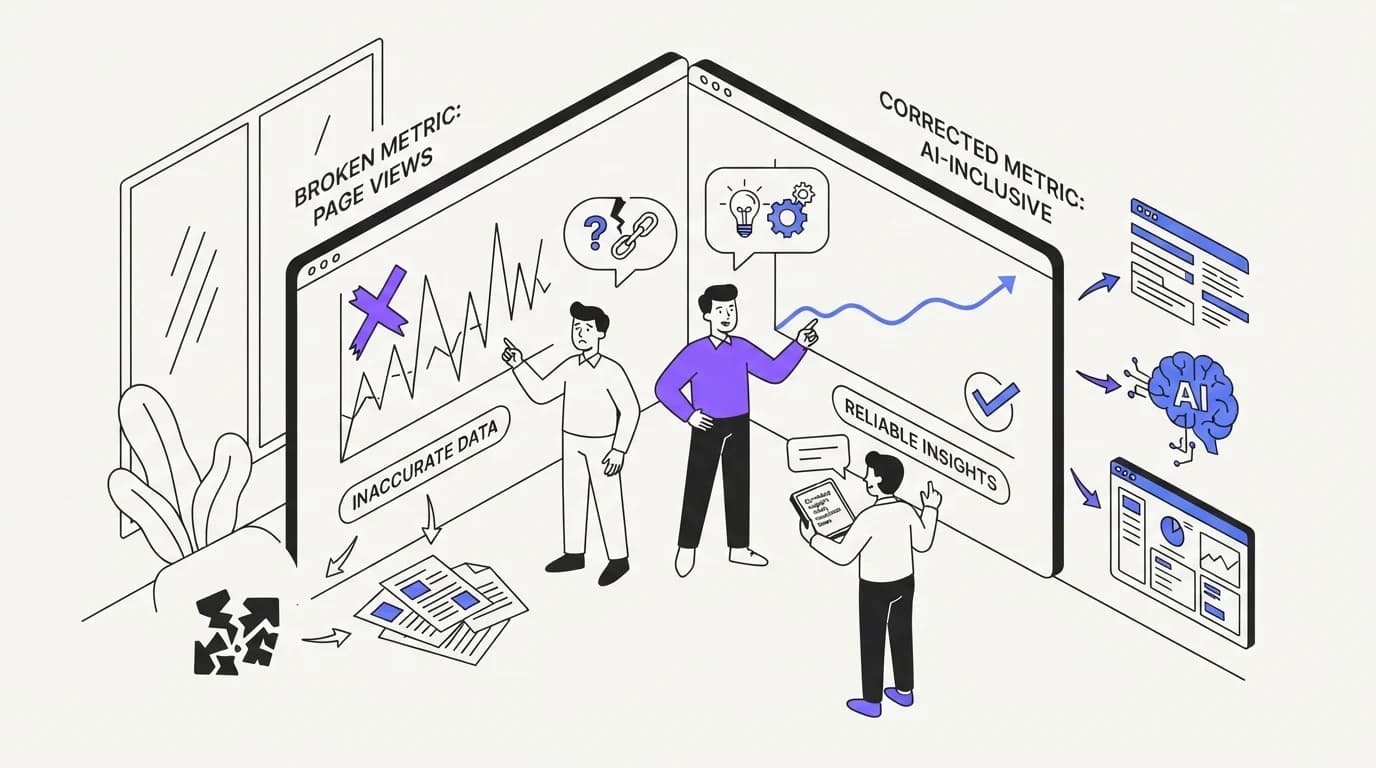
An AI agent that answers a question directly, inside a chat widget, never generates a help center page view, so the traditional formula misses it entirely. A customer who asks the agent a billing question and gets a correct, grounded answer has genuinely self-served, but that conversation shows up in neither the page-view numerator nor is it excluded from the ticket denominator unless it is explicitly logged as resolved.
This is not a small rounding error once AI adoption is real. Salesforce's research puts service organizations running AI agents at 66% in 2026, up from 39% in 2025, and a growing share of those organizations route a meaningful percentage of total volume through an agent rather than a documentation search. Every one of those AI-resolved conversations is invisible to a self-service rate formula built around page views.
The practical effect is a metric that moves the wrong direction as the underlying reality improves. A team that successfully deploys a grounded AI agent will often watch its traditional self-service rate flatten or fall, because customers who used to browse the help center now ask the agent directly, and that shift moves volume out of the numerator the old formula was built to count.
What benchmark self-service rates actually look like
Self-service and deflection numbers vary widely by definition and industry, which is part of why comparing your own number against a public benchmark needs care. Lorikeet's 2026 enterprise benchmark work puts the median AI deflection rate at 41.2%, with vendor marketing claims running closer to 80% (Lorikeet), a gap this guide's sibling article on deflection versus resolution covers in more detail.
HappySupport's benchmark research places typical AI-era deflection in a 45% to 60% range during the first year of a serious deployment, climbing to 65% to 75% once the underlying documentation and agent tuning mature. Neither of those ranges is directly comparable to a legacy page-view self-service rate, because they measure a different, broader definition of self-service that includes AI-resolved conversations by design.
The honest takeaway is that benchmark comparison only works when the definition matches. A team measuring page-view self-service rate against a benchmark that measures total deflection, AI included, will always look worse than reality, which is exactly the trap this guide is warning against.
A useful discipline is publishing your own formula alongside any number you report internally or externally, stating explicitly whether AI-resolved conversations and escalation confirmation are included. That single sentence of methodology prevents most of the confused conversations that happen when one team's self-service number is compared against another's without checking whether both are measuring the same thing.
Fixing the metric: counting AI resolutions as self-service
 Communicate.so
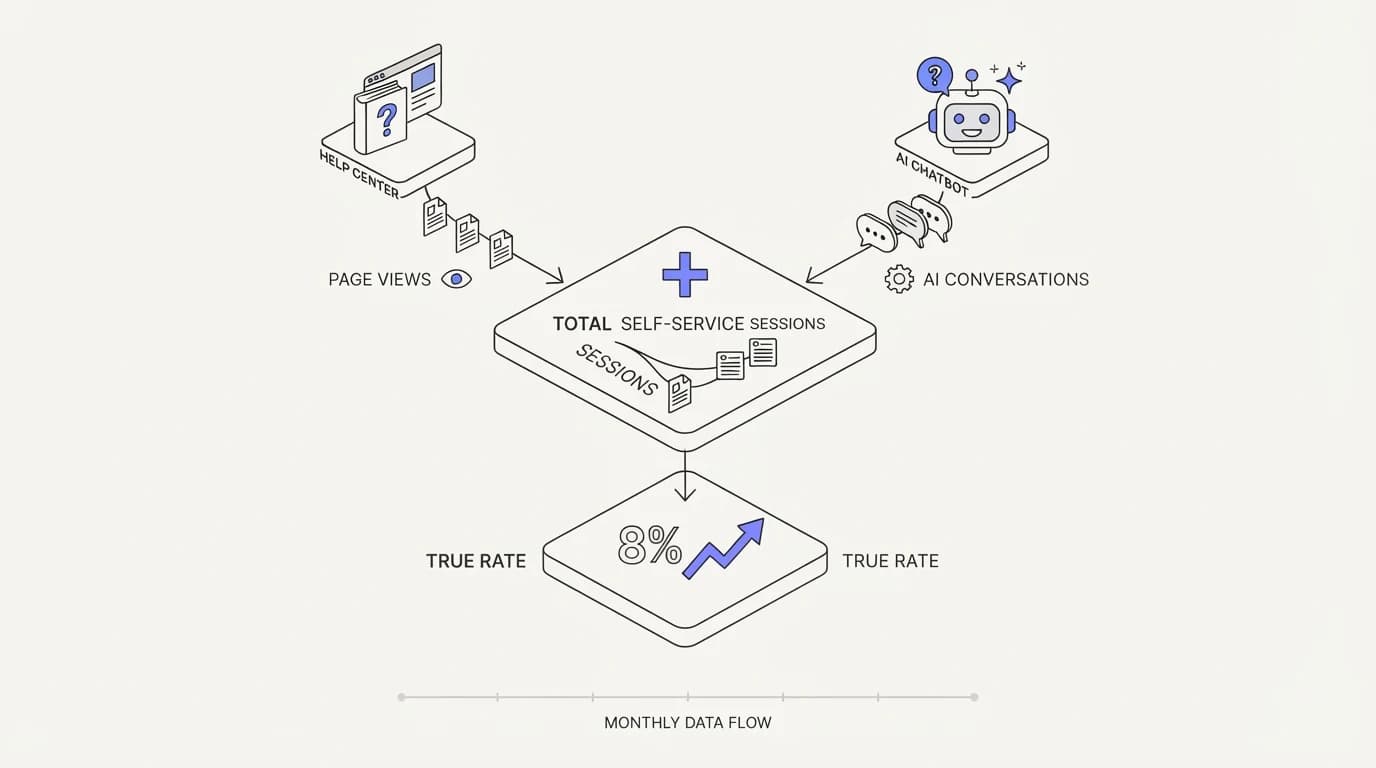
The fix is a new denominator and a new numerator. The numerator becomes confirmed self-resolved contacts, help center sessions that did not escalate to a human plus AI conversations the agent resolved without escalation, and the denominator stays total contacts across every channel including the AI agent's conversations.
Confirming resolution rather than just counting views matters more than it might sound. A help center session that ends in the customer opening a support ticket anyway should not count as a self-service success, and an AI conversation that ends in escalation to a human should not count either. Both formulas need an escalation flag to separate genuine resolution from an abandoned attempt.
Building this fixed metric requires the AI agent and the human support tool to share the same conversation log, so a resolved AI chat and an escalated one are distinguishable in the same analytics view rather than living in a separate system the help center metrics never touch. Without that shared log, the AI blind spot simply moves from invisible to manually reconciled, which is better but still slow and error-prone.
Building a help center that both humans and AI can use
A help center built only for human browsing and a knowledge base built only to feed an AI agent end up diverging over time, and that divergence is a quiet cause of AI answer quality problems as much as a measurement problem. The fix is one documentation source that serves both a human reader scanning for a heading and an AI agent retrieving a precise passage.
Structure matters more for this dual purpose than most teams expect. Long, unstructured articles are hard for a customer to scan and hard for a retrieval system to pull a precise passage from, while short, clearly headed sections with one answer per section serve both readers well. This is also the structure that keeps a page-view self-service rate and an AI-resolution rate moving in the same direction instead of drifting apart.
Connecting the same data sources that feed your public help center into the AI agent's retrieval layer keeps both channels answering from one consistent set of facts, which avoids the awkward case where a customer reads one answer on the help center and gets a different one from the chat widget.
Version control matters here too, in a plain sense: when a policy changes, the update needs to land in the one source both the help center and the AI agent read from, not in two separate documents that drift apart within a few release cycles. Teams that maintain a single source of truth for documentation report fewer of the awkward contradictions that erode customer trust in self-service generally, human-read or AI-answered.
When a low self-service rate is a real problem versus a measurement problem
Not every low self-service rate is a measurement artifact, and this guide is not arguing the number never means anything real. A genuinely low rate, even after fixing the formula to include AI resolutions, points at documentation gaps, an under-confident or poorly grounded agent, or a customer base that trusts self-service less than average for reasons worth investigating.
The diagnostic step is recalculating with the fixed formula before concluding anything. If a team's traditional page-view rate looks flat at 30% but the AI agent is resolving a meaningful share of conversations without escalation, the corrected rate might sit closer to 55%, and the real story is a measurement gap, not a self-service failure. If the corrected rate is still low, the problem is real and worth the documentation or guardrail work that follows.
Run this recalculation before any budget conversation about additional documentation headcount or a bigger AI investment, because the two problems call for different spending. A measurement gap costs nothing to fix beyond updating a formula, while a genuine self-service shortfall justifies real investment in content or agent tuning, and confusing the two wastes a budget cycle solving a problem that measurement, not reality, created.
| Channel | Counts in legacy page-view rate | Should count in true self-service rate |
|---|---|---|
| Help center article view, no follow-up contact | ✓ | ✓ |
| Help center article view, customer still contacts support | ✓ | ✗ |
| AI agent answer, no escalation | ✗ | ✓ |
| AI agent answer, customer escalates anyway | ✗ | ✗ |
| Community forum thread resolving the issue | ✗ | ✓ |
| Scripted chatbot menu with no real answer | ✓ | ✗ |
How to raise self-service rate without hurting quality
Raising self-service rate the wrong way is easy and common: make the help center harder to escalate from, or tune an AI agent to avoid escalating even when it should. Both moves inflate the number while making the customer experience worse, and both eventually show up as a drop in CSAT or a spike in public complaints once customers run out of patience with a system that will not hand them to a human.
The right way to raise the number is closing real documentation gaps and improving retrieval accuracy so the AI agent answers correctly more often, which raises genuine self-resolution rather than suppressing legitimate escalation. Reviewing the topics most often escalated, and writing or fixing documentation for the top few, is the single most effective action most teams can take.
Reducing AI hallucinations is the other lever, because a self-service rate built on confidently wrong answers is a liability dressed as a metric win. A customer who gets a wrong answer and does not escalate counts as a self-service success in a naive formula while actually representing a real support failure the team will hear about later, often publicly.
Common mistakes in tracking self-service rate
 Communicate.so
The most common mistake is comparing your own page-view-only rate against a public benchmark that includes AI deflection, which always makes your number look artificially worse. A second mistake is counting every AI conversation as a self-service success regardless of whether it escalated, which inflates the number in the opposite direction and hides real agent quality problems.
A third mistake is treating self-service rate as a target to maximize rather than a diagnostic to monitor, which pushes teams toward suppressing legitimate escalation just to move the number. A fourth mistake is measuring the metric once a quarter instead of continuously, missing the exact moment an AI agent's answer quality starts to drift, a problem the reduce AI hallucinations guide covers from the accuracy side.
A fifth mistake, subtler than the rest, is letting the marketing team and the support team report two different self-service numbers built on two different formulas, which then get compared in the same meeting without anyone noticing the mismatch. Agreeing on one formula, documented and shared across both teams, removes an entire category of confused quarterly review conversations.
Where Communicate fits, honestly
Communicate logs AI-resolved and escalated conversations in the same analytics view as human-handled ones, so a true self-service rate, AI resolutions plus help center sessions minus escalations, can be calculated without stitching together two separate systems. The agent retrieves from the same data sources you connect, which keeps the help center and the chat answers consistent instead of drifting apart.
The honest limit is that Communicate does not publish a public page-view analytics product for your help center itself, since its scope is the AI agent and the shared inbox, not full web analytics. Pairing its conversation-level resolution data with your existing help center analytics tool gives the complete corrected formula. Entry is a one-time $1 activation with 100 test credits, detailed on the pricing page, and questions go to [email protected].
Frequently asked questions
What is self-service rate in customer support?
Self-service rate is the share of customer questions or problems resolved without a human agent, expressed as a percentage of total support volume. Traditionally it has been measured through help center page views, but that formula misses conversations an AI agent resolves directly in a chat widget, which is a growing share of true self-service as AI adoption increases.
Why does an AI agent break the self-service rate formula?
A traditional self-service rate formula counts help center page views as its numerator. An AI agent answering a question directly in a chat window never generates a page view, so a correctly resolved AI conversation is invisible to the old formula, and the metric can flatten or fall even as AI agent resolutions genuinely rise.
How do I calculate a corrected self-service rate that includes AI?
Use confirmed self-resolved contacts as the numerator, meaning help center sessions and AI conversations that did not escalate to a human, divided by total contacts across every channel including the AI agent. The key correction is confirming resolution with an escalation flag rather than counting every page view or every AI conversation as an automatic success.
What is a good self-service rate benchmark?
Benchmarks vary by definition, which is the core problem this guide addresses. HappySupport's research places typical AI-era deflection, a broader definition close to a corrected self-service rate, at 45% to 60% in year one of a serious deployment, rising to 65% to 75% at maturity (HappySupport). A page-view-only legacy rate will typically read lower than these figures even in a well-performing operation.
Is self-service rate the same as deflection rate?
They overlap but are not identical. Deflection rate specifically measures conversations an AI or automated layer resolves without a human touching them, while self-service rate traditionally also includes help center browsing that never generates a ticket at all. The resolution rate vs deflection rate guide covers the distinction between deflection and true resolution in more depth.
Can a low self-service rate actually mean good performance?
Yes, when the formula is not counting AI-resolved conversations. A team with a strong, accurate AI agent can show a flat or falling page-view self-service rate purely because customers are shifting from browsing the help center to asking the agent directly. Recalculating with a corrected formula before concluding the number reflects a real problem is the first diagnostic step.
How do I stop customers from escalating after reading a help article?
Structure articles around one clear answer per section rather than long unstructured pages, since customers who cannot find a direct answer quickly tend to give up and contact support anyway. Reviewing which articles have the highest read-then-contact rate and rewriting those first usually produces the fastest improvement.
Does a higher self-service rate always mean better customer experience?
Not automatically. A self-service rate can be inflated by making escalation harder to reach, which raises the number while frustrating customers who genuinely need a human. The metric should always be read alongside CSAT and escalation-path complaints, not maximized in isolation, since a number gamed this way eventually shows up as a reputation problem.
How does documentation quality affect self-service rate?
Documentation quality drives both halves of a corrected self-service rate, since the same content that answers a human reader on the help center also grounds the AI agent's answers. The train AI on your help center guide covers structuring documentation so it serves both readers, which is the most effective fix for a genuinely low self-service rate.
What causes AI-resolved conversations to be undercounted?
The most common cause is a self-service metric built entirely around a help center analytics tool that has no visibility into a separate AI chat system. Without a shared conversation log between the two, an AI-resolved chat simply never enters the calculation, understating true self-service performance regardless of how well the agent is actually performing.
Should escalated AI conversations count toward self-service rate?
No. An AI conversation that ends in escalation to a human did not resolve the customer's problem without a person, so counting it as a self-service success inflates the metric artificially. The corrected formula in this guide explicitly excludes escalated conversations from the numerator on both the help center and AI sides.
How often should self-service rate be recalculated?
Monthly is a reasonable cadence for a stable operation, though a team actively tuning an AI agent or rewriting documentation should track it weekly during that period to catch drift quickly. A metric checked only quarterly can hide weeks of degrading answer quality before anyone notices the trend.
What role does the shared inbox play in self-service rate?
A shared inbox that logs the full conversation, including whether an AI agent resolved it or handed off to a human, is what makes a corrected self-service formula possible in the first place. Without that shared log, calculating a true self-service rate requires manually reconciling two separate systems, which most teams simply do not do.
Can self-service rate vary significantly by support channel?
Yes. Chat and messaging channels where an AI agent operates directly tend to show the largest gap between legacy and corrected self-service rates, since that is where the AI blind spot concentrates. Email and phone channels, which rarely route through a help center or an AI agent in the same way, are less affected by this specific measurement gap.
How does self-service rate relate to cost per ticket?
A rising true self-service rate should correlate with a falling cost per ticket over time, since more conversations resolve without consuming human agent time. If self-service rate rises but cost per ticket does not fall, the AI-resolved conversations may be low-value ones that were cheap to handle already, which is worth investigating before crediting the metric with real savings.
What is the biggest risk of chasing a higher self-service rate number?
The biggest risk is optimizing the metric directly rather than the underlying documentation and agent accuracy that should drive it. A team that makes escalation harder to reach, or tunes an AI agent to avoid admitting uncertainty, can raise the number while genuinely harming customers, and that gap between the metric and reality tends to surface publicly and expensively.
Does industry affect what a good self-service rate looks like?
Yes, meaningfully. Bookbag's 2026 ecommerce benchmark work shows self-service rates that differ by product category and price point, since a high-consideration purchase tends to generate more contacts a customer genuinely wants a human for, regardless of how good the documentation is (Bookbag). Comparing your rate against a benchmark from a very different industry or price point will mislead more than it helps.
How do I know if my current self-service rate is understated?
A quick check is comparing your traditional page-view self-service rate against the share of total conversations your AI agent resolves without escalation. If the agent resolves a meaningful share of volume and that share is not already reflected in your self-service number, the metric is understated, sometimes badly, and worth recalculating with the corrected formula before drawing any conclusions about performance.
Should community forums count toward self-service rate?
A community forum thread that genuinely resolves a customer's problem without support contact fits the definition of self-service and arguably should count, though most teams lack the tooling to confirm resolution in a forum thread the way they can confirm an AI conversation ended without escalation. Treat forum self-service as a directionally useful signal rather than a precisely measured one until better tracking exists.
What is the fastest way to start measuring a corrected self-service rate?
Start by pulling AI agent conversation logs and tagging each one as resolved or escalated, then add that resolved count to your existing help center numerator. This single change, done manually with a spreadsheet if needed, usually reveals the size of the AI blind spot within a single reporting cycle, before any tooling investment in a shared analytics view.