
A customer support hiring plan for teams running AI deflection
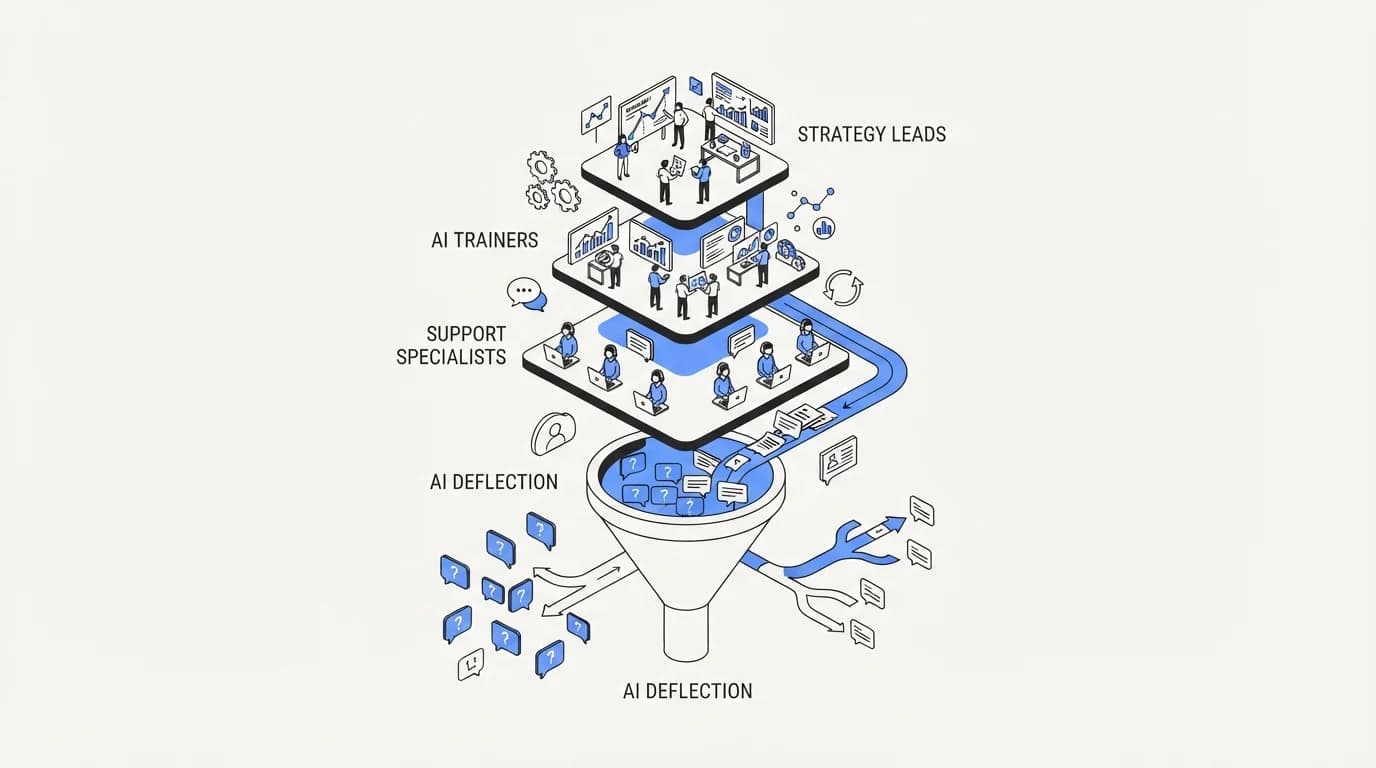 Communicate.so
How to build a support hiring plan when an AI agent deflects part of the queue. Worked headcount math for year one and maturity, with sources.
TL;DR: Most support hiring plans still assume every ticket needs a human, so headcount scales in a straight line with volume. Once an AI agent deflects part of the queue, that line breaks, and the honest replacement is a model with labelled inputs: ticket volume, deflection rate, average handle time, and productive hours per agent, run twice, once for year one deflection and once for deflection at maturity. HappySupport puts AI deflection at 45 to 60% in year one and 65 to 75% once a program matures, and those two numbers alone change a 10,000-ticket monthly queue from a 6 to 7 person team down to roughly 4, not to zero. The part most plans miss is that the tickets left over after deflection skew toward the hardest cases, so average handle time on the remainder often rises even as volume falls, and the hire you need most is a senior escalation specialist, not another queue processor. This guide walks the arithmetic end to end, names every assumption, and gives a quarter-by-quarter hiring sequence you can adapt to your own numbers.
A support hiring plan built before AI agents existed asked one question: how many tickets, divided by how many a person can handle, equals how many people you need. That formula still works as a starting point, but it silently assumes every ticket reaches a human, and once an AI agent resolves part of the queue on its own, the assumption is wrong.
This guide rebuilds the formula with deflection as a first-class input, not an afterthought. Every number here is either a labelled example input you can swap for your own, or a real published figure with its source named next to it, following the same discipline the ticket deflection rate benchmarks use.
The goal is a plan a support lead can hand to finance and defend line by line. That means showing the arithmetic, not just the conclusion, and being honest about where deflection helps headcount and where it does not.
Why AI deflection breaks the old headcount formula
The old formula treats every ticket as equally hard and every human hour as fully available for ticket work. Neither assumption survives contact with an AI agent in the queue. Deflection removes tickets unevenly, taking the easiest and most repetitive questions first, which changes both the volume a human team carries and the difficulty of what remains.
Picture a queue of 10,000 monthly tickets before any AI layer exists. The old formula divides that number by however many tickets one agent can close in a month, and the answer is a flat headcount that scales up whenever volume scales up.
Add an AI agent grounded in your help center content and the first thing to change is the denominator: fewer tickets reach a human at all. The second, quieter change is that the tickets which do reach a human are disproportionately the ones the AI could not resolve, which tend to be the ambiguous, multi-step, or account-specific cases that take longer to close.
A hiring plan that ignores the second change will overcorrect. It sees deflection cut ticket volume in half and assumes headcount should be cut in half too, then gets surprised when average handle time on the remaining queue climbs and the smaller team is still stretched.
What deflection actually means before you build a model
Deflection rate is the share of incoming tickets an AI agent resolves without a human touching them. It is easy to state and easy to inflate, so the number you plug into a hiring model needs a named source, the same way the average handle time figures in this program carry sources.
HappySupport's benchmark review puts AI deflection at 45 to 60% in a program's first year, rising to 65 to 75% once the program matures (HappySupport). That range is the backbone of the model in this guide, because it reflects a program that ramps rather than one that hits peak performance on day one.
Vendor marketing does not always agree with that range. Lorikeet's benchmark analysis reports a Zendesk enterprise median deflection of 41.2%, well under HappySupport's year-one floor, alongside a marketed claim from Decagon of 80% deflection, well above HappySupport's maturity ceiling (Lorikeet). The gap between a marketed number and a median outcome is the reason a hiring plan should model a range, not anchor to the most flattering figure a vendor will quote.
A hiring model built on an 80% deflection assumption will understaff badly if your real program lands closer to the 41.2% median. A model built on the HappySupport range gives you a floor and a ceiling to plan between, and lets you update the plan honestly as your own measured deflection comes in.
The headcount model, input by input
 Communicate.so
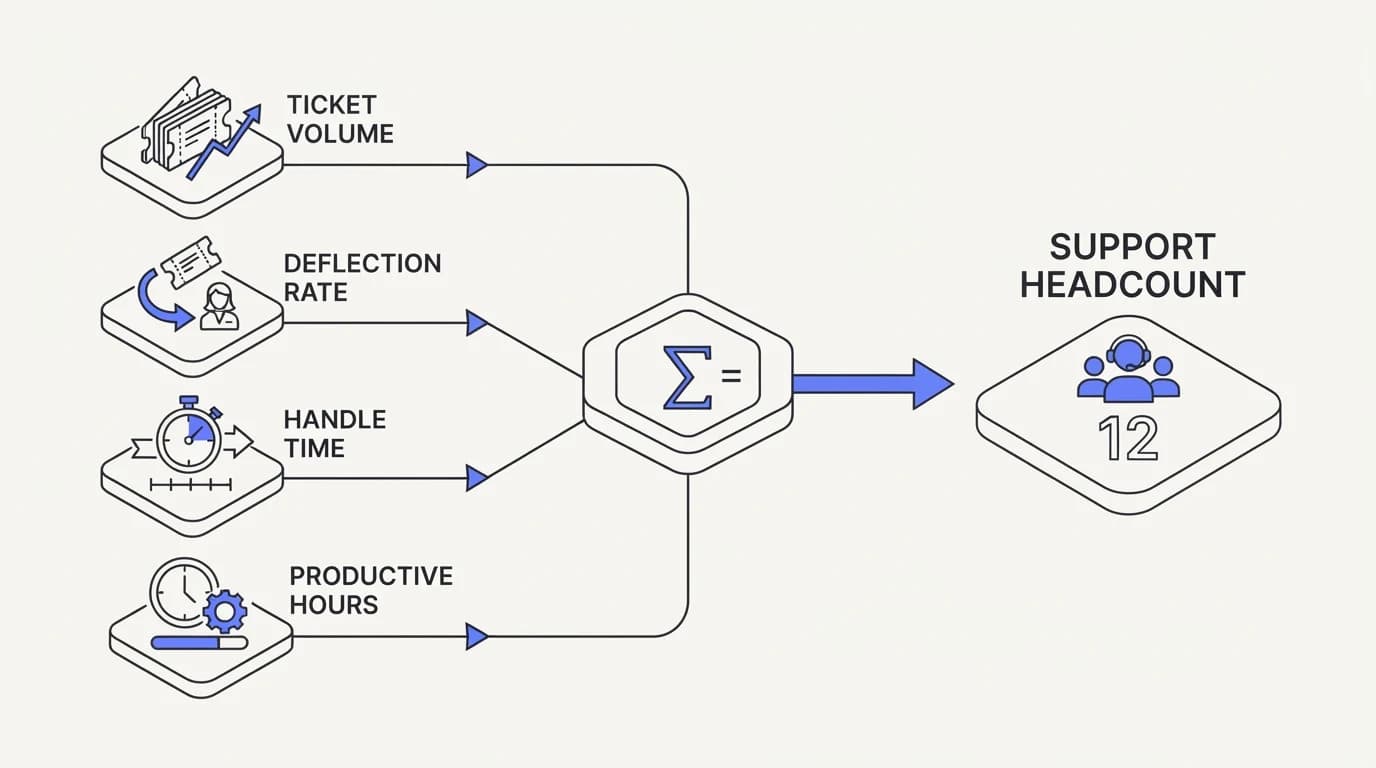
Four inputs drive the model, and each one needs a label and a source or an explicit example value. Swap in your own numbers wherever you have them, and keep the example values only where you do not yet have measured data.
Input one is monthly ticket volume: the count of inbound conversations before any AI deflection happens. This is the easiest number to get right, because most teams already track it in their inbox or helpdesk reporting.
Input two is the deflection rate: the share of that volume the AI agent resolves without escalation. Use your own measured rate once you have three months of data, and use the HappySupport range as a planning floor and ceiling before then.
Input three is average handle time (AHT), the minutes a human agent spends per ticket once it reaches them. Treat pre-deflection AHT and post-deflection AHT as two different numbers, not one, since the remaining queue skews harder, a distinction the average handle time guide covers in more depth.
Input four is productive hours per agent per month: the time an agent actually spends on ticket work after subtracting meetings, training, breaks, and coaching time. A common planning figure is 120 productive hours per month against a roughly 160-hour work month, and that gap is real overhead, not a rounding error.
Running the arithmetic: year one versus maturity
Here is the full calculation, with every input labelled, run twice. The example queue is 10,000 monthly tickets, a round number chosen for clarity, not a claim about any specific company.
Example input: monthly ticket volume = 10,000. Example input: pre-deflection average handle time = 8 minutes. Example input: productive hours per agent per month = 120.
Year one deflection rate (HappySupport low end): 45%. Tickets reaching a human: 10,000 multiplied by (1 minus 0.45) equals 5,500 tickets.
Year one handle time on the remainder: hold at 8 minutes for this first pass, since a young program has not yet skewed hard toward escalations. Total human handling minutes: 5,500 multiplied by 8 equals 44,000 minutes, or about 733 hours.
Year one required headcount: 733 hours divided by 120 productive hours per agent equals 6.1 agents, rounded up to 7 to cover normal variance in daily volume.
Maturity deflection rate (HappySupport mid-range): 70%. Tickets reaching a human: 10,000 multiplied by (1 minus 0.70) equals 3,000 tickets, a real drop from 5,500, and on paper that looks like a headcount cut of nearly half, the kind of number that gets cited without the next step, the way ticket deflection rate coverage sometimes stops short.
But the remainder at maturity is not the same mix of tickets it was in year one. As the AI agent absorbs more of the routine questions, what is left skews toward multi-step, account-specific, and ambiguous cases, so the model should raise handle time on the remainder, not hold it flat.
Maturity handle time on the remainder: 15 minutes, nearly double the pre-deflection average, reflecting a queue that is now mostly escalations. Total human handling minutes: 3,000 multiplied by 15 equals 45,000 minutes, or about 750 hours.
Maturity required headcount: 750 hours divided by 120 productive hours per agent equals 6.25 agents, rounded up to 7. The volume dropped by 70%, but the headcount barely moved, because the remaining work got harder at almost exactly the rate the volume got smaller.
| Assumption | Year one | At maturity |
|---|---|---|
| Monthly ticket volume | 10,000 | 10,000 |
| Deflection rate (HappySupport) | 45% | 70% |
| Tickets reaching a human | 5,500 | 3,000 |
| Average handle time on remainder | 8 min | 15 min |
| Total human handling hours | 733 | 750 |
| Required headcount at 120 hrs/agent | 7 | 7 |
| Naive halved-headcount assumption correct | ✗ | ✗ |
| Handle-time-adjusted model correct | ✓ | ✓ |
Read the table left to right and the mistake becomes visible immediately. A team that models deflection without adjusting handle time will plan for roughly 4 agents at maturity, using the flat 8-minute assumption on 3,000 tickets, and will be understaffed by three people the moment escalation-heavy tickets fill the queue.
Hire for escalation depth, not queue volume
 Communicate.so
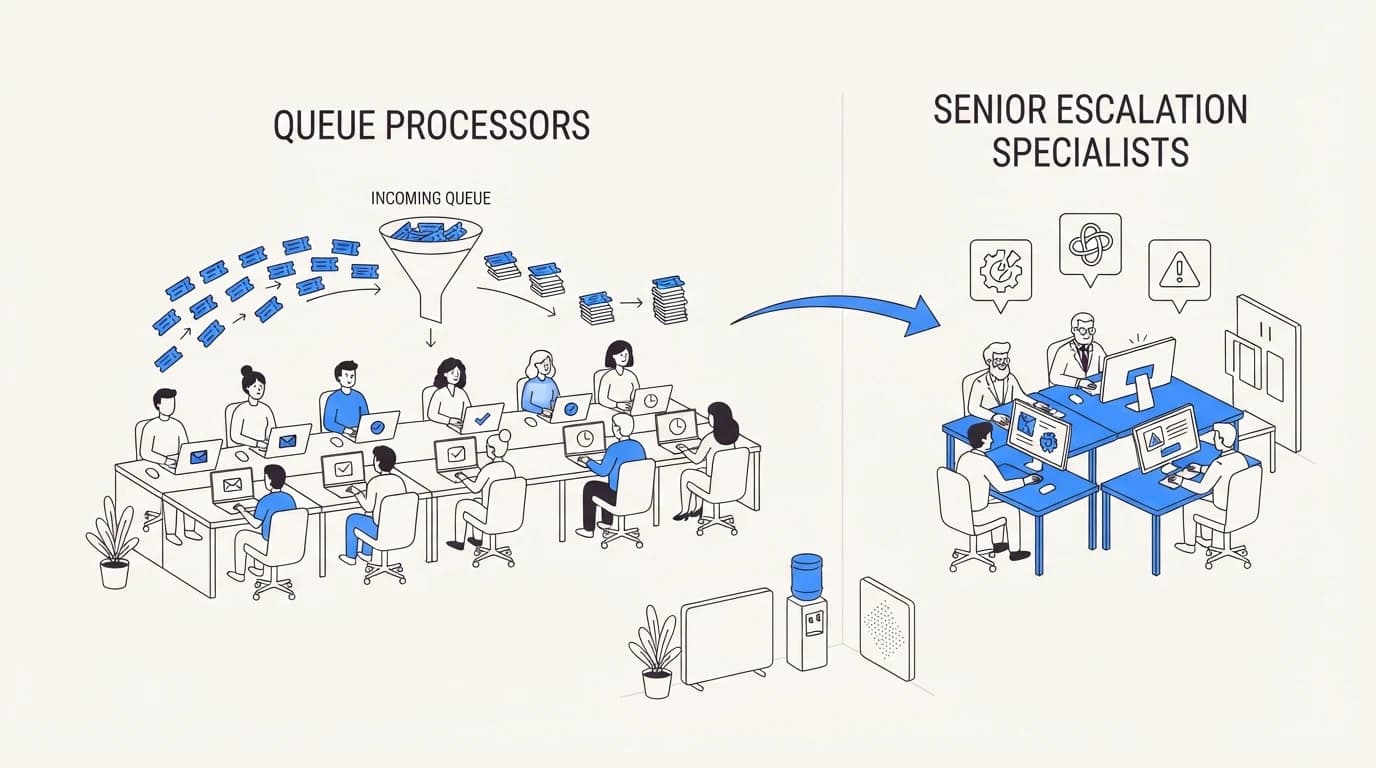
The arithmetic above says the headcount number barely changes, but the skills you hire for should change a great deal. Year one support is mostly triage and repeatable answers, so a team weighted toward generalist agents who can move fast through volume makes sense.
At maturity, the queue that survives deflection is the queue the AI agent could not resolve on its own, which usually means the AI was uncertain, the answer required account-specific judgment, or the question sat outside the connected knowledge base. A human handoff that lands on a generalist with no escalation training just re-creates the same friction one level down.
Hire for escalation depth means favoring agents who can debug ambiguous account issues, who know when to override a policy and when to hold the line, and who can recognize when a case needs a specialist or a manager rather than another attempt at the same answer.
It also means investing in fewer, more senior roles instead of many junior ones. Seven generalists handling 5,500 easy tickets and seven escalation specialists handling 3,000 hard ones are different teams with different pay bands, different training paths, and a different relationship to your shared inbox, even though the raw headcount number looks identical.
The practical test is simple. Look at your current escalation queue and ask whether the agents on it were hired for that work or grew into it by accident. If it is the latter, your hiring plan has been following the old formula even if your deflection numbers have not.
A quarter-by-quarter hiring plan you can adapt
 Communicate.so
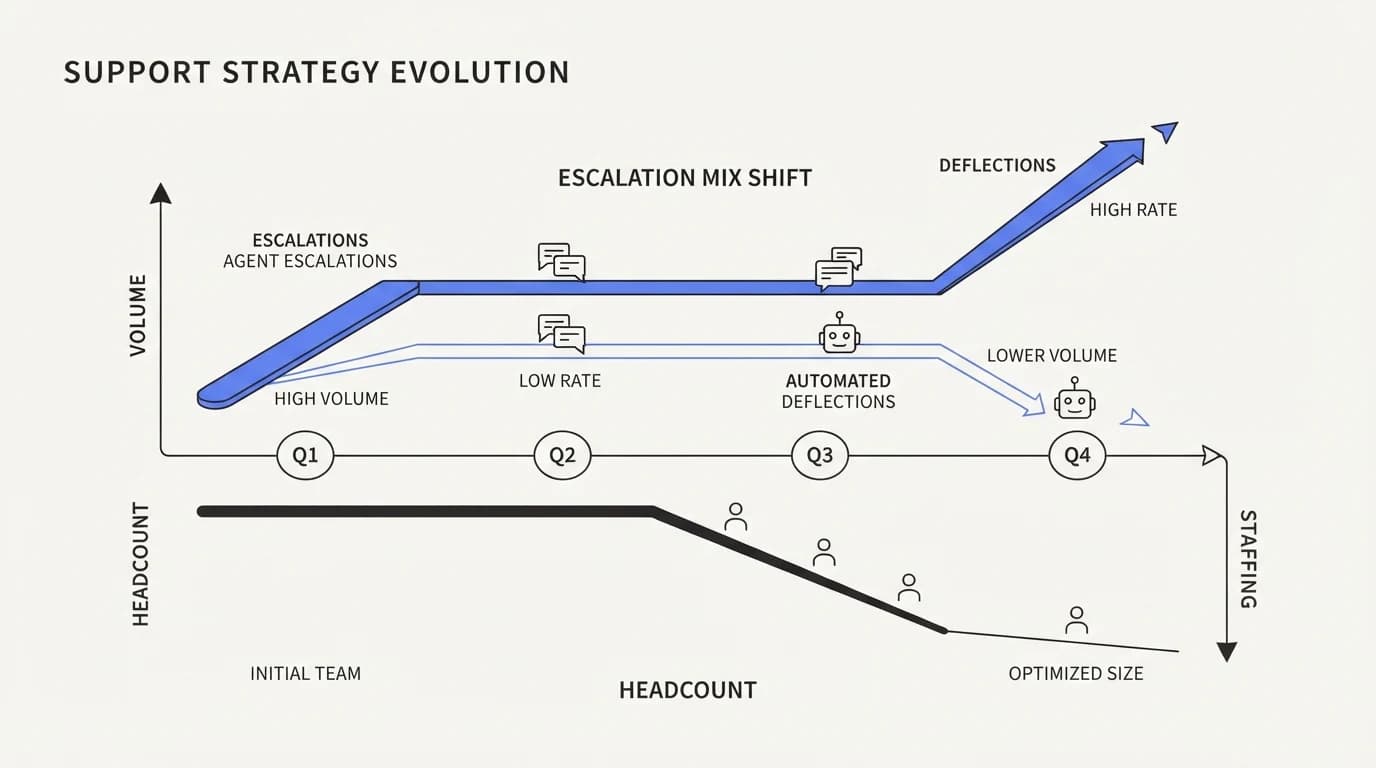
Turn the model into a sequence rather than a single number, since deflection climbs over the first year rather than jumping straight to maturity. The quarters below map to the HappySupport ramp and use the same 10,000-ticket example queue.
Quarter one: deflection is still ramping as the AI agent learns your content and your team tunes escalation rules. Plan for close to full pre-AI headcount, roughly 8 to 9 agents on the example queue, since early deflection gains are real but not yet reliable enough to cut staffing against.
Quarter two: deflection typically reaches the low end of the year-one range, around 45%. This is the point to run the year-one calculation above and start trimming toward 7 agents, ideally through attrition and reduced contracting rather than layoffs, since deflection curves can stall.
Quarter three: deflection should be climbing toward the top of the year-one range, and this is the right moment to start shifting the mix rather than the count, moving a generalist role into an escalation-focused one as the implementation matures and the remaining queue skews harder.
Quarter four and beyond: as deflection approaches the 65 to 75% maturity range, run the maturity calculation and confirm headcount against measured handle time on the actual remaining queue, not the example figures in this guide. Expect the number to hold closer to flat than a simple volume-based cut would suggest, for the reasons the arithmetic above lays out.
Re-run the model every quarter with your own measured numbers instead of the HappySupport range once you have real data. A plan built on someone else's benchmark is a starting point, not a permanent budget line.
Where the model breaks: common mistakes
Three mistakes account for most of the bad hiring plans built around AI deflection. Each one is an omission from the model above, not a flaw in the arithmetic itself.
The first mistake is holding handle time flat while deflection rises. This is the error worked through in the maturity calculation, and it is the single biggest source of understaffing once a mature AI program is in place.
The second mistake is trusting a marketed deflection number instead of a measured one. Decagon's marketed 80% figure sits well above Lorikeet's reported 41.2% Zendesk enterprise median (Lorikeet), and a hiring plan anchored to the marketed number will be short-staffed from month one.
The third mistake is treating headcount as the only lever. Productive hours per agent, average handle time, and escalation training all move the required number as much as deflection does, and a plan that only tracks deflection is watching one input out of four.
There is also a demand-side pressure worth naming plainly. Gartner reports that 91% of CX leaders say they are under pressure from executives to deploy AI (DigitalApplied), and that pressure sometimes pushes a headcount cut ahead of the deflection data that would justify it. Cutting the team before the AI agent has a measured track record on your own queue reverses the order the model above depends on.
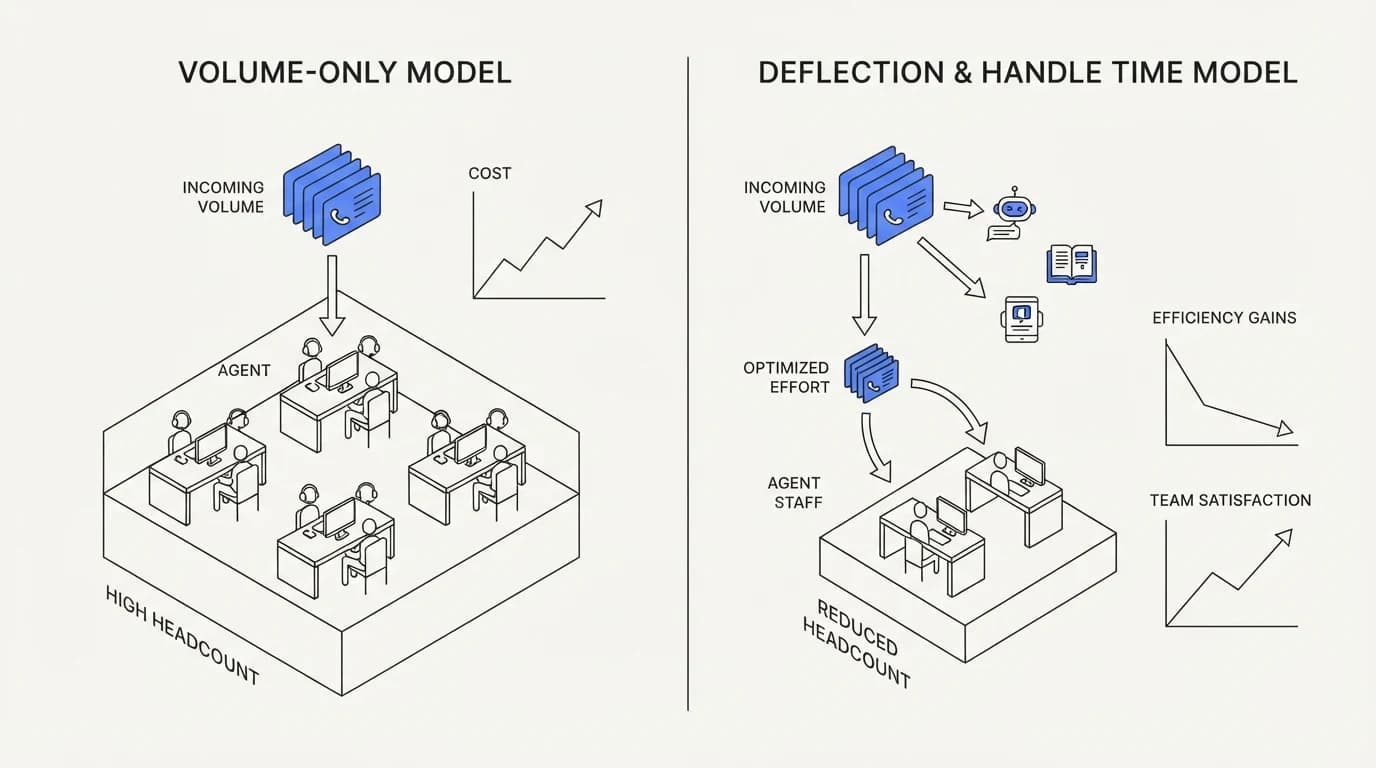
Headcount planning: with AI deflection versus without
 Communicate.so
The comparison below summarizes the practical differences between a legacy volume-only plan and a deflection-and-handle-time model. Neither column claims a static advantage; the point is which inputs each approach tracks.
| Planning input | Volume-only plan | Deflection-and-AHT model |
|---|---|---|
| Tracks raw ticket volume | ✓ | ✓ |
| Tracks AI deflection rate by source | ✗ | ✓ |
| Adjusts AHT for post-deflection queue mix | ✗ | ✓ |
| Distinguishes escalation skill from queue skill | ✗ | ✓ |
| Defensible to finance line by line | ✗ | ✓ |
| Sensitive to marketed vendor deflection claims | ✓ | ✗ |
| Needs quarterly re-run as deflection ramps | ✗ | ✓ |
A volume-only plan is not wrong, it is incomplete, the same gap the support ticket deflection rate benchmarks exist to close. Once an AI agent sits in front of the queue, volume alone stops describing the work a human team actually does.
Where Communicate fits, honestly
Communicate is an AI agent grounded in your connected content, paired with a shared inbox where an unresolved conversation hands off to a human with full context intact. It does not replace the hiring model in this guide, it is one of the inputs, since your measured deflection rate on Communicate is what should eventually replace the HappySupport range in your own calculation.
It runs on the channels most teams need to start: a web widget, live chat, and email, plus in-app messages, analytics, and scoped actions from one knowledge base, so behavior stays consistent while you track deflection across every surface. There is no WhatsApp, Messenger, SMS, or voice today, which matters if your queue lives on those channels.
On cost, there is no free tier. Entry is a one-time $1 activation with 100 test credits, then usage-based pricing from there, detailed on the pricing page, which is a smaller line item than the headcount decisions this guide is about but worth checking before you commit.
The honest limit is that a hiring plan needs your real numbers, not a vendor's. Run the model in this guide with your own measured deflection and handle time once you have three months of data, and treat any tool's deflection claim, including this one, as a hypothesis to verify against your own queue.
Key takeaways
- Build the headcount model on four labelled inputs: ticket volume, deflection rate, average handle time, and productive hours per agent, and cite a real source for deflection rather than a marketing number.
- HappySupport's range of 45 to 60% deflection in year one and 65 to 75% at maturity is a defensible planning floor and ceiling until you have your own measured rate.
- Handle time on the remaining queue rises as deflection rises, because the AI resolves the easy tickets first, so a naive volume-based headcount cut understaffs the escalation queue.
- Hire for escalation depth once deflection matures, not more generalist queue processors, since the surviving tickets are the ones the AI already could not resolve.
- Re-run the model every quarter against your own measured deflection and handle time instead of leaving it on example numbers or a vendor's marketed claim.
Ready to measure your own deflection rate instead of planning against someone else's benchmark? Activate an account for one dollar, connect your content to the AI agent, and run this model again in three months with real numbers from your own queue.
Frequently asked questions
How do I calculate support headcount when an AI agent is deflecting tickets?
Start with four labelled inputs: monthly ticket volume, deflection rate, average handle time on the tickets that still reach a human, and productive hours per agent per month. Multiply volume by (1 minus deflection rate) to get the human queue, multiply that by handle time to get total minutes, then divide by productive hours per agent. The ticket deflection rate benchmarks are a reasonable starting deflection figure before you have your own data.
What deflection rate should I plan a hiring model around?
HappySupport reports 45 to 60% deflection in a program's first year, rising to 65 to 75% at maturity (HappySupport). Use the low end of the year-one range for a conservative first plan, then update with your own measured deflection once you have three months of data rather than staying on the benchmark indefinitely.
Why does headcount not drop in proportion to the deflection rate?
Because the tickets an AI agent cannot resolve tend to be harder than the ones it can. As deflection rises, the human queue shrinks in count but skews toward multi-step, ambiguous, or account-specific cases, so average handle time on the remainder climbs and offsets much of the volume drop.
Should I trust a vendor's marketed deflection percentage?
Treat it as an upper bound, not a planning number. Lorikeet's analysis found a Zendesk enterprise median deflection of 41.2%, well under a Decagon marketed claim of 80% (Lorikeet). Build your hiring plan on your own measured rate as soon as you have it, and use published ranges only as a starting floor and ceiling.
What is a reasonable number of productive hours per support agent per month?
A common planning figure is around 120 productive hours per agent per month against a roughly 160-hour work month, with the remainder covering meetings, training, coaching, and breaks. Adjust this to your own team's calendar and shift structure rather than treating 120 as a universal constant.
How do I decide between hiring generalists and escalation specialists?
Look at what the AI agent is already resolving. If most deflected tickets are simple and repeatable, generalists still make sense for the surviving volume in year one. Once deflection matures and the surviving queue is dominated by cases the AI could not resolve, weight new hires toward escalation depth rather than another queue processor role.
How often should I re-run the headcount model?
Quarterly, at minimum, and always after a measurable jump in deflection or a change in average handle time. Deflection typically ramps over the first year rather than arriving all at once, so a plan built once at launch will be stale within a quarter or two.
Does average handle time usually go up or down after deploying an AI agent?
It depends which population you are measuring. Pre-deflection AHT across all tickets often looks flat or slightly lower, but AHT on the subset that reaches a human after deflection frequently rises, because that subset is now weighted toward harder cases. The average handle time guide breaks down both measurements.
What is a realistic timeline for AI deflection to reach maturity?
HappySupport's range implies roughly a year from initial deployment to the 65 to 75% maturity band, assuming steady investment in content grounding and escalation tuning. Programs that skip content maintenance or ignore escalation feedback often stall well below that range instead of climbing into it.
Can I use this model for a queue smaller than 10,000 tickets a month?
Yes. The formula scales linearly with volume, so a 1,000-ticket queue uses the same four inputs at one-tenth the scale. The rounding at the end, where a fractional headcount rounds up to cover variance, matters proportionally more at small volumes, so budget a slightly larger buffer on a small queue.
Should I count part-time or contract agents differently in this model?
Convert everyone to a common unit of productive hours per month before running the math, then convert the answer back into whatever mix of full-time, part-time, and contract roles fits your budget. The model does not care about employment type, only about total productive hours available against total required hours.
What happens to the model if my AI agent has no measured deflection data yet?
Use the HappySupport year-one range as your planning floor and ceiling, run the calculation with both ends, and staff toward the more conservative (lower deflection) result until you have three months of your own data. An AI agent implementation that has not been live long enough to measure deflection should not be assumed to already be at maturity.
How does escalation quality affect the hiring plan?
Poor escalation handling inflates handle time on the human queue, which directly raises the required headcount in the model. A clean AI to human handoff that preserves conversation context shortens handle time on escalated tickets, which is one of the few levers that improves headcount efficiency without adding people.
Is it safe to cut support headcount immediately after launching an AI agent?
No. Deflection ramps over months, not days, so cutting headcount at launch based on a projected maturity deflection rate will leave the queue understaffed during the ramp period. Cut gradually, tied to measured deflection each quarter, not to a projection made before launch.
How do seasonal volume spikes interact with this model?
Run the model separately for peak and off-peak months if your ticket volume varies meaningfully by season. A headcount sized for average monthly volume will be short during a spike and idle during a trough, and a seasonal buffer, temporary contractors, or flexible scheduling usually fits better than resizing the permanent team to peak volume.
What role does the knowledge base play in the headcount model?
Knowledge base coverage is the biggest lever on the deflection rate itself. An AI agent trained on a thin or outdated help center will deflect fewer tickets than the HappySupport range assumes, which raises human headcount even if every other input in the model stays the same.
Should the hiring plan include a dedicated escalation review role?
On a team above roughly 5 to 7 agents, a dedicated senior reviewer who audits escalated cases and feeds corrections back into the knowledge base is usually worth the headcount. That role improves future deflection, which lowers required headcount later, so it partly pays for itself over a few quarters.
How do I present this model to finance for budget approval?
Show every labelled input, the source for each published figure, and both the year-one and maturity calculations side by side. Finance teams respond better to a defensible range with named assumptions than to a single confident headcount number with no visible arithmetic behind it.
What is the biggest risk in a support hiring plan built around AI deflection?
Holding average handle time flat while assuming deflection cuts headcount proportionally. That single omission is responsible for most of the understaffing that shows up three to six months after an AI agent reaches its stated deflection rate.
How do I know when my support team has genuinely reached AI deflection maturity?
Maturity shows up as a deflection rate that holds steady for two or more consecutive quarters without new content investment, sitting inside or above HappySupport's 65 to 75% range. If the rate is still climbing quarter over quarter, or if it dips whenever the knowledge base goes stale, the program is still ramping, not mature.