
Support team structure when AI answers tier 1
 Communicate.so
Support team structure guide: how the tier 1/2/3 pyramid changes when AI holds the first line, and what the new org chart looks like.
TL;DR: The classic tier 1, tier 2, tier 3 support pyramid assumed a wide base of junior agents answering repetitive questions before anything reached a specialist. When an AI agent grounded in your own content resolves that repetitive volume, the base of the pyramid stops being a row of people and becomes a system a smaller group of senior agents supervises. Zendesk enterprise customers see a median AI deflection of 41.2 percent, according to Lorikeet's 2026 benchmark study, and mature programs push past that as the model and the content improve. That shift does not delete the team, it moves headcount up the pyramid into escalation handling, quality review, and AI oversight, work the old structure never staffed for at this scale. This guide lays out the new org chart, how staffing ratios change, and where restructuring plans usually break.
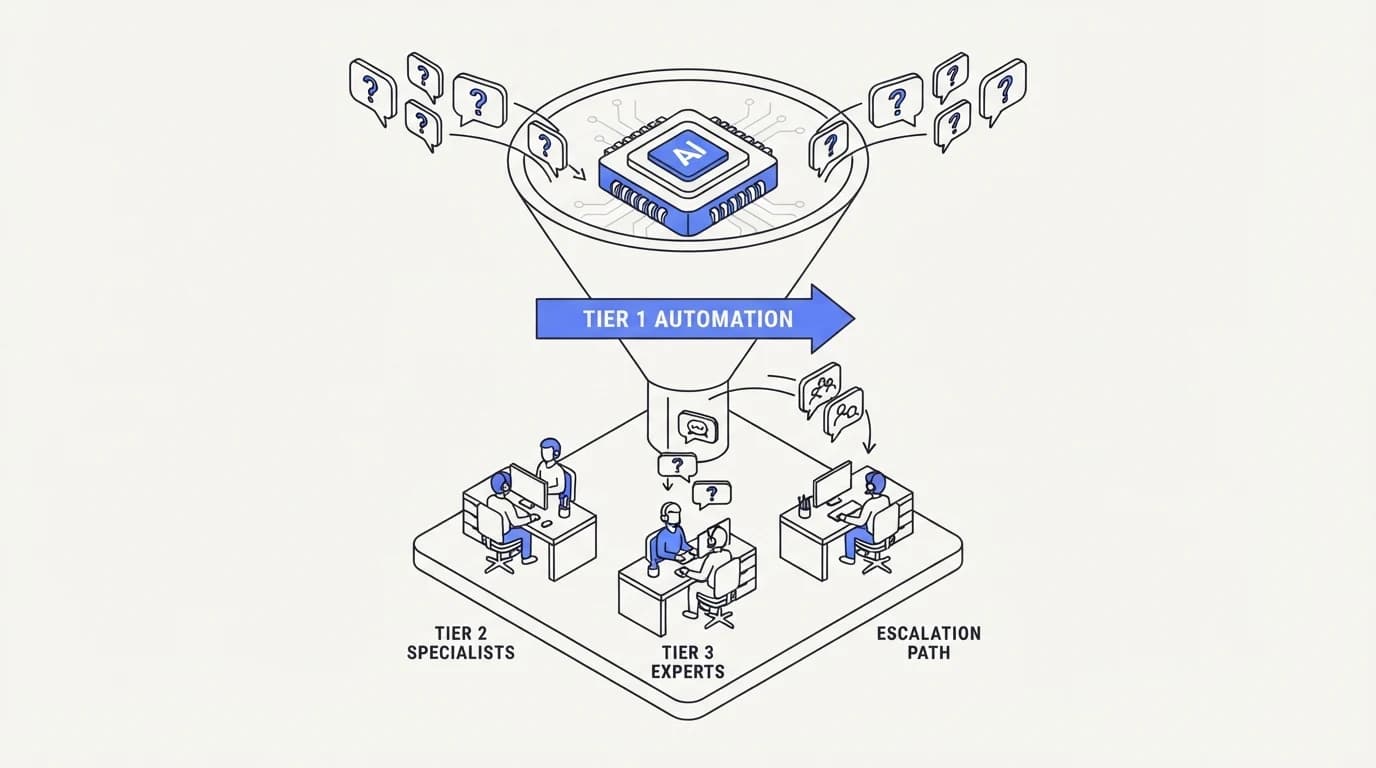
Every support team over a certain size settled on the same shape for a decade: tier 1 answers the easy stuff, tier 2 handles anything with real complexity, tier 3 is engineering or a product specialist for the rare case nobody else can close. It worked because humans were the only option at the front door. Once an AI agent sits at that front door and resolves the routine majority, the assumptions under the pyramid stop holding.
This is not a hiring-freeze story or a layoff story. It is a structure story: who does what, how many of them you need, and what the reporting lines look like once the first line of defense is software instead of a person reading from a macro. Managers who skip this planning tend to keep the old headcount and wonder why the team feels idle, or cut too fast and get blindsided by an escalation queue nobody staffed for.
The tier 1/2/3 pyramid before AI
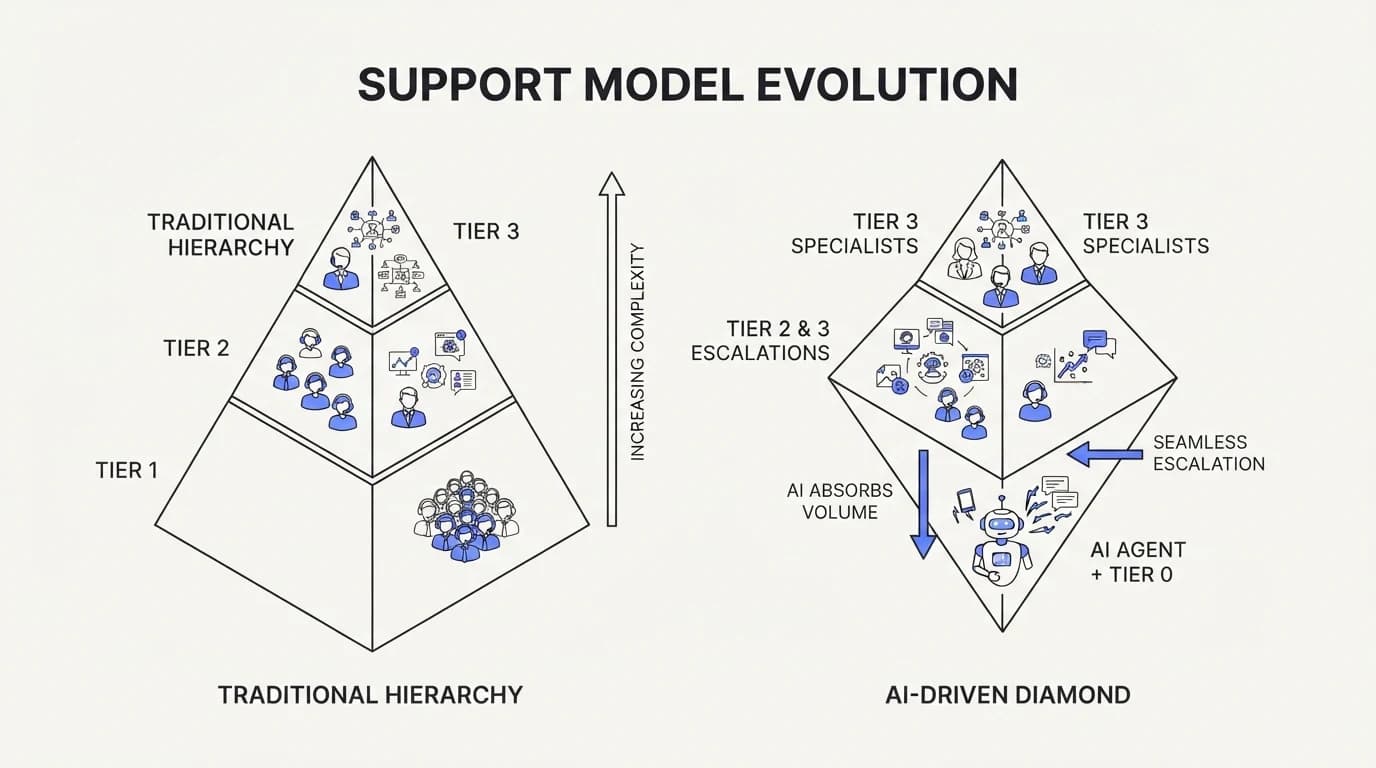
The traditional structure staffs heaviest at the bottom. Tier 1 agents, often the newest and lowest paid on the team, handle password resets, order status, billing questions, and anything answerable from a script. Tier 2 agents carry product depth and handle the cases tier 1 could not close in one reply.
Tier 3, usually a handful of specialists or engineers, takes the cases that need code access or deep product knowledge.
The ratio in that model is roughly triangular: many tier 1 seats, fewer tier 2 seats, a small tier 3 group. Managers sized tier 1 headcount against ticket volume, because tier 1 was the bottleneck. Add more customers, add more tier 1 agents, repeat every quarter.
That model has a real cost. Repetitive questions, the ones a help center already answers in writing, get answered again and again by a human reading the same information out loud. The team scales linearly with volume because the bottom of the pyramid was never designed to scale any other way.
What changes when AI holds tier 1
An AI agent grounded in your knowledge base, macros, and past tickets can answer the same repetitive questions tier 1 used to own, at any hour, without a queue. Service organizations running AI agents in production reached 66 percent in 2026, up from 39 percent in 2025, according to Salesforce data reported by DigitalApplied. The base of the pyramid did not disappear, it moved into a system that a person configures and checks rather than staffs directly.
The practical effect is that tier 1 volume, measured in human hours, collapses first. Tickets still arrive at the same rate, or a higher one, but most of them never reach a person's queue. What lands with humans is the residue: cases the AI was not confident about, cases a customer explicitly asked to escalate, and cases outside what the AI was trained to answer.
That residue is not simpler than the old tier 2 queue, it is closer to it. Agents spend their day on the cases that used to justify a tier 2 title, which means the skill bar for the humans who remain goes up, not down. Teams that plan for this in their onboarding checklist avoid the surprise of junior hires with nothing junior left to do.
The new org chart
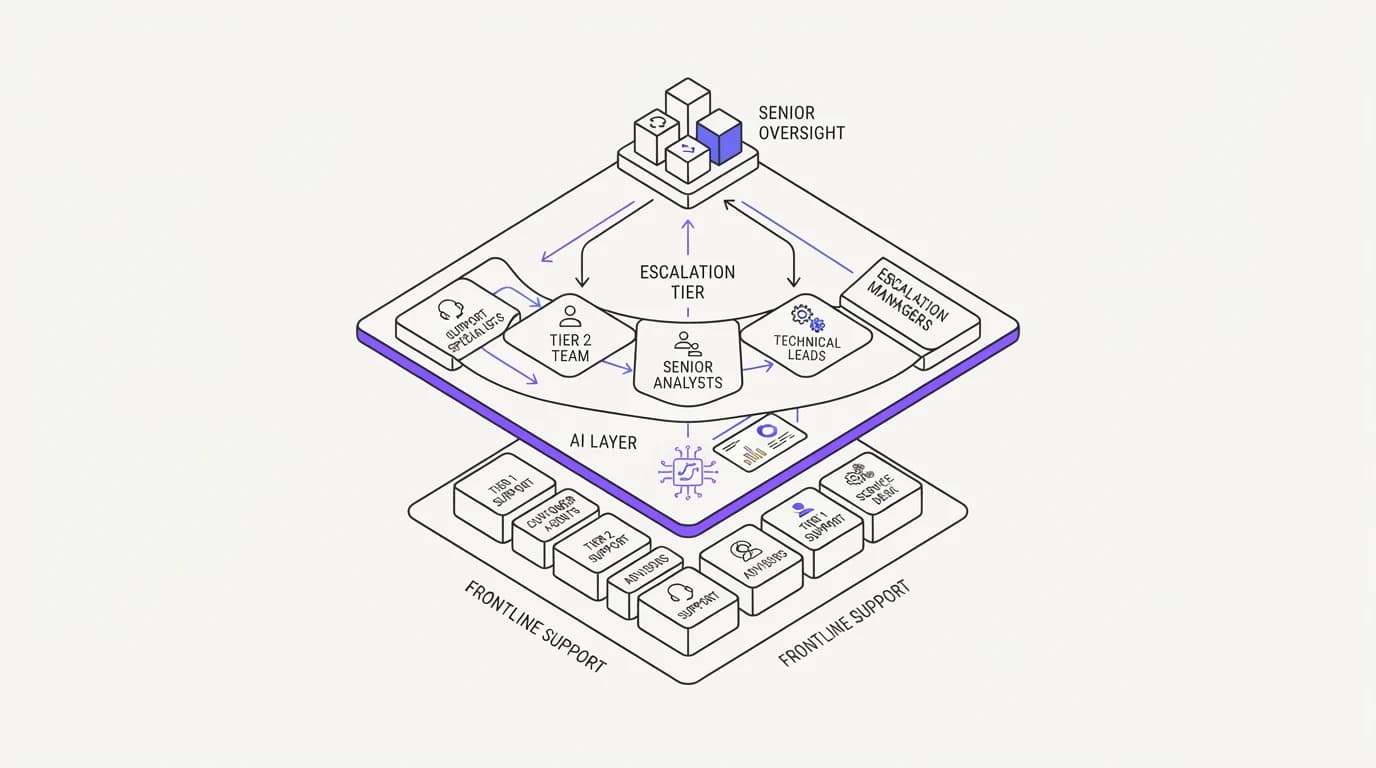
The pyramid becomes closer to a diamond. A thin AI layer absorbs the wide base of simple volume. A wider band of what used to be tier 2 agents, now the primary human tier, handles escalations, judgment calls, and anything that needs empathy or a policy exception.
A small senior group still owns the hardest cases, plus a new function: AI oversight.
AI oversight is the role the old chart never had. Someone has to review what the AI told customers, catch drift before it becomes a pattern, and feed corrections back into the data sources the agent is grounded on. On a small team this is a part-time duty for a senior agent.
On a larger team it becomes a named role, sometimes called an AI quality lead or a support ops lead.
Reporting lines flatten as a side effect. With fewer people between the front line and the manager, a team that once needed three tiers of escalation often runs on two: the AI layer, and one human tier that absorbs everything the AI could not close.
 Communicate.so
Staffing ratios: how many humans per AI agent
There is no universal ratio, because it depends on deflection rate and ticket complexity, but the math is straightforward once you know your own numbers. Start with total ticket volume, subtract the share the AI resolves without a human touch, and staff the humans against what is left, not against the original total.
Deflection maturity matters here. Programs in their first year typically resolve 45 to 60 percent of volume without a human, rising to 65 to 75 percent at maturity, according to HappySupport's benchmark analysis. A team that staffs for year-one deflection and does not revisit the ratio at month twelve ends up overstaffed relative to the volume actually reaching humans, which is a real cost most finance teams will ask about.
| Signal | Staff toward legacy tier 1 ratio | Staff toward post-AI ratio |
|---|---|---|
| AI deflection under 40 percent | ✓ closer fit | ✗ premature |
| AI deflection 45 to 60 percent (year one) | ✗ overstaffed | ✓ transitional ratio, revisit quarterly |
| AI deflection 65 percent or higher (mature) | ✗ badly overstaffed | ✓ correct target |
| Ticket mix mostly repetitive (billing, status, FAQ) | ✗ wastes senior time | ✓ AI absorbs most, humans handle exceptions |
| Ticket mix mostly complex or regulated | ✓ humans needed regardless | ✓ AI still deflects simple subset |
Reset the ratio on a schedule, not on instinct. A quarterly review of deflection rate against headcount catches the drift before it becomes a budget argument.
Ticket complexity changes the math even at a fixed deflection rate. A support desk fielding mostly billing status and order tracking questions can push deflection higher and staff leaner, since that volume is exactly what an AI agent handles well when it is grounded on current account data. A desk handling regulated financial products or medical information will see a lower ceiling on deflection no matter how good the model is, because more of the volume genuinely needs a human sign-off, and the staffing ratio should reflect that ceiling rather than a generic industry average.
Where humans move: tier 2 becomes the floor
The agents who used to be tier 1 do not vanish from the org chart, most of them move up. The skills that made someone good at tier 1, patience, clear writing, product familiarity, are exactly what a tier 2 role needs once the AI has already screened out the pure repetition. The floor of the human team rises to what used to be the middle.
This is good news for career paths and a real complication for hiring. A support team can no longer bring on someone with zero product knowledge and have them productive in a week answering scripted questions. The entry point for a new human hire now looks more like the old tier 2 bar, because the AI has already claimed the tier 1 work.
Some teams solve this by keeping a rotation: new hires shadow the AI's conversations before taking live escalations, learning the product through the cases the AI could not close rather than through the easy ones it now owns. That rotation doubles as quality review, since a new hire reading transcripts will spot AI mistakes a manager might miss.
Roles that shrink and roles that grow
- Pure tier 1 responder: shrinks fastest, since it was defined by the repetitive volume the AI now absorbs.
- Escalation specialist: grows, because this is where human judgment concentrates once the AI screens the queue.
- AI quality reviewer or oversight lead: new role, did not exist in the legacy structure at all.
- Content and knowledge base owner: grows, since the AI is only as good as what it is grounded on.
- Team lead or shift manager: shrinks in headcount but the remaining leads manage a smaller, more senior group.
The content owner role deserves attention most teams skip. An AI agent answers from what it is trained on, and stale macros or missing articles show up as wrong answers to customers within days. Someone on the team needs explicit ownership of keeping the knowledge base current, or the whole structure degrades quietly.
This does not need to be a full-time job on a small team, but it has to be someone's named responsibility, checked on a fixed schedule rather than whenever an agent happens to notice a gap.
Escalation design: how AI hands off cleanly
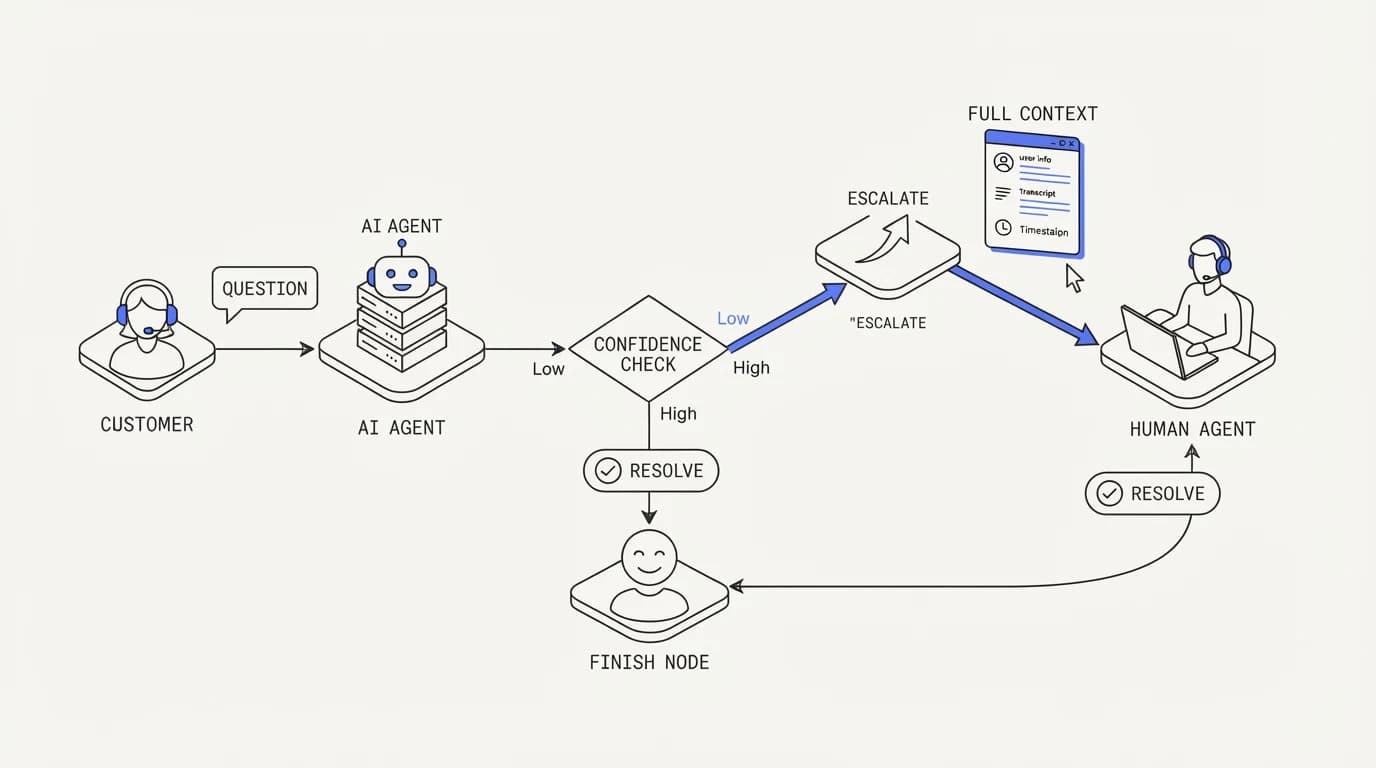
The seam between the AI layer and the human layer is where most restructured teams either work well or fall apart. A clean handoff carries the full conversation history, so the human sees exactly what the AI already tried, not a bare summary. A bad handoff drops context and forces the customer to repeat themselves, which is one of the most common complaints Twig catalogs about AI support tools in its 2026 review.
Design the escalation path around confidence and topic, not a single blanket rule. Route billing disputes and anything with legal exposure to a human by default, even if the AI is confident, and let the AI handle the rest until it explicitly signals uncertainty. Communicate's human handoff model carries full context to the agent picking up the case, so the escalation reads like a warm transfer rather than a cold restart.
Presence matters too. If a human is already viewing a conversation, the AI should not answer over them mid-reply. That kind of collision is rare but corrosive to customer trust when it happens, and it is a structure problem, not a model problem, so it belongs on the same planning document as headcount.
 Communicate.so
Metrics that describe the new structure
Legacy tier 1/2/3 dashboards tracked tickets per agent and average handle time, both built around headcount. A restructured team needs a different set: deflection rate, escalation accuracy (did the AI escalate the right cases, not just any case it was unsure about), and human resolution time on the cases that do reach a person. Communicate's analytics view breaks these out by channel so a manager can see where the AI is carrying real load and where it is not.
Watch escalation accuracy closely in the first quarter after restructuring. An AI that escalates too aggressively defeats the point of the new structure, since humans end up seeing nearly everything anyway. An AI that escalates too rarely creates a different risk: customers stuck with a wrong answer and no visible path to a person.
First response time still matters, but its meaning changes. When the AI answers instantly, the number that matters for staffing is time to human response on the subset that actually reaches a person, which is a smaller and more meaningful denominator than the first response time benchmark a legacy team tracked.
Common structure mistakes
| Mistake | What it looks like | Fix |
|---|---|---|
| Keeping the old tier 1 headcount | Agents idle or reassigned to busywork | Re-ratio staffing against post-deflection volume quarterly |
| No named AI oversight owner | Answer drift goes unnoticed for weeks | Assign a person or rotation to review transcripts weekly |
| Hiring entry-level for the new floor role | New hires struggle, since the floor is now tier 2 depth | Hire at the old tier 2 bar or extend onboarding |
| Escalation rule is a single blanket threshold | Either overloaded humans or missed wrong answers | Route by topic risk plus confidence, not one number |
| No content ownership assigned | AI answers from stale macros | Give someone explicit, measured responsibility for the knowledge base |
Most of these mistakes share a root cause: treating the restructure as a technology rollout instead of an org design decision. The AI is the trigger, but the fix is a staffing and role decision a manager has to make deliberately.
A subtler mistake is measuring success by deflection rate alone. A high deflection number that comes with a rising rate of reopened tickets or a falling customer satisfaction score is not a win, it is a hidden cost showing up somewhere the dashboard is not looking. Pair deflection with a satisfaction check on AI-only resolutions before declaring the restructure a success, and be ready to route more cases to humans if that number slips.
Communication with the existing team is also easy to underweight. Agents who hear about a restructure secondhand, through a headcount freeze or a vague announcement, assume the worst before they see the new role definitions. A short, specific memo describing what changes, what does not, and where each current agent lands in the new chart prevents most of the anxiety a restructure otherwise creates.
A 90-day plan to restructure the team
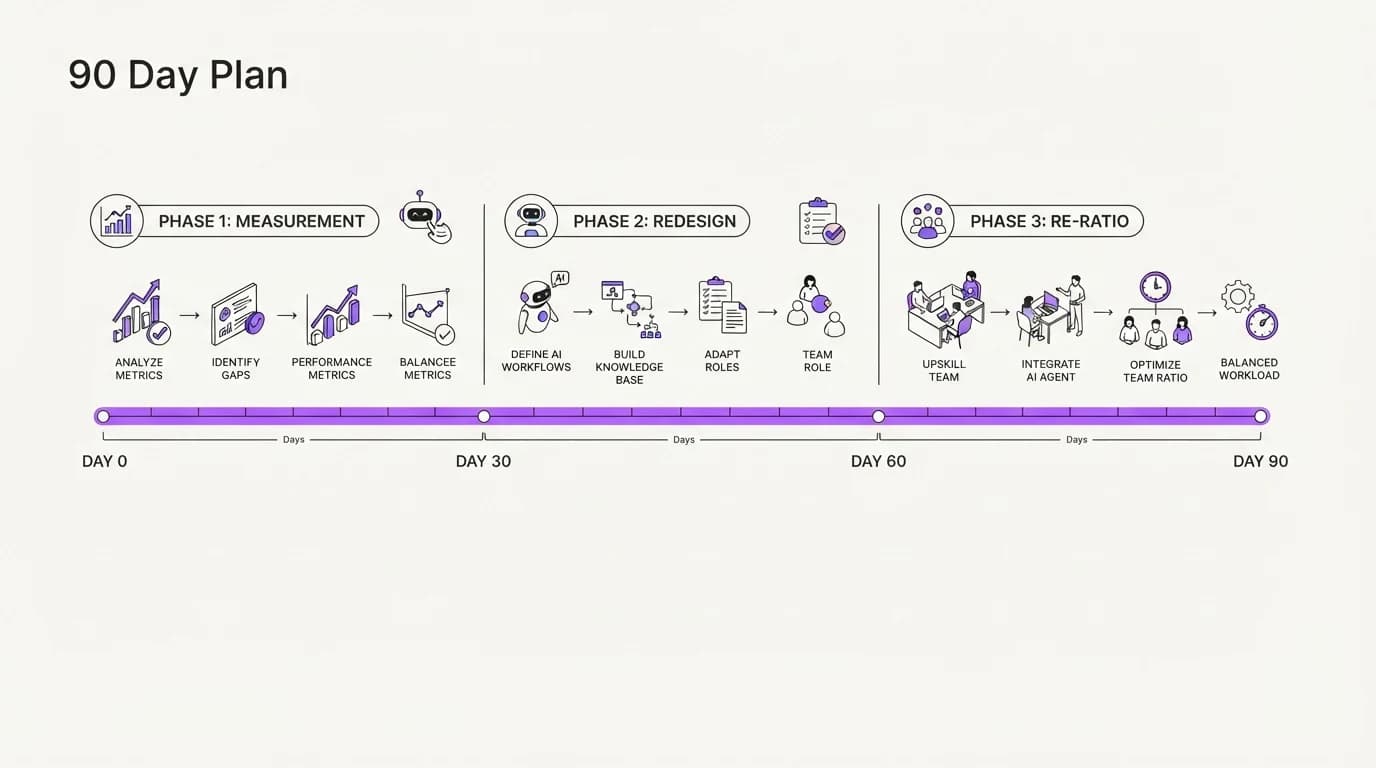
Days 1 to 30: measure deflection on real traffic before changing headcount. Connect the AI agent to your data sources and let it run alongside the existing team so you have a real number, not an estimate, for how much volume it absorbs.
Days 31 to 60: redesign the escalation path and assign the AI oversight role explicitly. Move any agent whose day was mostly tier 1 volume into the new floor role, with extra onboarding on the cases they will now handle instead.
Days 61 to 90: re-ratio staffing against the deflection number from day 30, not against the old headcount plan. Review escalation accuracy weekly and adjust routing rules before locking the structure in for the quarter. Teams that follow Communicate's implementation guide during this window catch most routing mistakes before they reach customers at scale.
 Communicate.so
The teams that get this right start with the smallest workable version: one channel, one AI agent, a measured deflection rate before anyone changes a job title. Communicate's pricing starts with a one-dollar activation that includes 100 test credits, which is enough to run that first measurement without committing headcount decisions to a guess.
 Communicate.so
A restructured team is not a smaller team by definition, it is a differently shaped one. Compare that against the support escalation workflow your team already runs, and the gaps in the current pyramid usually show up fast. Pair the new structure with a shared inbox so the AI and the human tier work the same queue instead of two disconnected systems.
Frequently asked questions
Does AI eliminate the need for tier 1 support staff?
It eliminates the volume that used to define tier 1, not the people, most of whom move into the new floor role handling escalations. A team still needs humans for anything the AI is not confident about, anything with legal or billing exposure, and anything a customer explicitly asks to escalate. The AI agent changes what tier 1 work is, it does not remove the tier entirely.
What is the new floor role called if not tier 1?
Most teams keep calling it tier 1 informally, but the work looks closer to legacy tier 2: judgment calls, exceptions, and cases with real context. Some teams rename it escalation specialist to make the skill shift explicit in hiring and pay. The title matters less than making sure the job description matches the actual work now landing in that queue.
How many support agents do I need per AI agent?
There is no fixed ratio, it depends on your deflection rate and ticket complexity. Staff against the volume that reaches humans after deflection, not against total ticket volume, and revisit the number quarterly since deflection typically improves as the AI and its content mature.
Who should own AI quality and oversight?
A senior agent or support ops lead, on a small team as a part-time duty and on a larger team as a named role. This person reviews a sample of AI transcripts weekly, flags wrong or off-tone answers, and feeds corrections back into the knowledge base the AI is grounded on.
What happens to tier 3 in the new structure?
Tier 3 stays roughly the same size and function, since it was never staffed against high volume in the first place. The escalation path into tier 3 changes, since cases now arrive after an AI screen and a tier 2 human screen rather than after two human screens.
Should I lay off tier 1 agents when I add an AI agent?
Most restructures move existing tier 1 agents into the new floor role rather than cutting them, since that role needs product knowledge those agents already have. Gartner's 2026 research found that half of companies that cut customer service staff citing AI ended up rehiring for similar work under different titles by 2027. Retraining an existing agent is usually cheaper and faster than a layoff followed by a rehire.
How do I measure whether the restructure worked?
Track deflection rate, escalation accuracy, and human resolution time on what actually reaches a person, not tickets per agent from the old model. Communicate's analytics dashboard reports these by channel, which makes it clear whether the AI is carrying the load the restructure assumed it would.
Does the new structure work for a five-person support team?
Yes, and the effect is proportionally larger on a small team, since one person freed from repetitive volume can meaningfully change what the whole team covers. A five-person team often needs only one person on AI oversight part time, with the rest absorbing the escalation queue directly through a shared inbox.
What ticket types should never go to AI, even at high deflection?
Billing disputes with financial exposure, anything with legal or compliance weight, and cases a customer explicitly asks to escalate to a person. High deflection on the easy majority does not mean every case is safe to automate, and routing rules should carve these out by default rather than leaving it to the model's confidence score alone.
How long does it take to see the new structure pay off?
Most teams see a measurable deflection number within 30 days of connecting an AI agent to real traffic, and a stable staffing ratio within a quarter. The first 90 days matter most, since routing mistakes made early tend to get baked into habits if they are not corrected.
Do I need new job titles for the restructured team?
Not strictly, but clarity helps hiring and pay decisions. Renaming the floor role to reflect its actual escalation-heavy work, and naming the AI oversight duty explicitly even if it is part time, both prevent the quiet mismatch between job title and job reality that causes turnover.
What is escalation accuracy and why does it matter?
Escalation accuracy measures whether the AI hands off the right cases, not just any case it happens to be unsure about. An AI that escalates too much defeats the purpose of the restructure, and one that escalates too little leaves customers with wrong answers and no visible path to a human.
Can a support team run entirely without a tier 2?
Very small teams sometimes collapse tier 2 and tier 3 into one senior group, since the volume never justified three separate tiers even before AI. Once an AI agent absorbs the tier 1 volume, that collapsed structure gets simpler still: an AI layer plus one human tier handling everything from routine escalations to genuine specialist cases, coordinated through one shared inbox.
How do I know if my AI deflection rate is good?
Compare it against your own program's maturity rather than a single industry number. First-year programs typically land between 45 and 60 percent deflection, rising to 65 to 75 percent at maturity, according to HappySupport's benchmark research, while a Zendesk enterprise median sits at 41.2 percent per Lorikeet's 2026 study. Track your own trend month over month rather than chasing a marketed figure from a single vendor.
What causes an AI to under-deflect right after launch?
Thin or outdated grounding content is the most common cause. An AI agent trained on your help center and past tickets can only answer what it has seen, so gaps in that content show up directly as escalations the AI could have avoided with better source material.
How do I prevent AI answers from drifting over time?
Assign explicit ownership of both the AI transcript review and the content it is grounded on. Weekly review of a transcript sample catches drift before it becomes a pattern customers notice, and feeding corrections back into the source content is what actually fixes it rather than just flagging it.
Does restructuring change how support managers spend their time?
Yes, managers spend less time on queue triage and more time on content quality, escalation design, and coaching the smaller human team on harder cases. The job shifts from managing volume to managing judgment, which is a different skill set than running a large tier 1 floor.
What is the biggest risk in restructuring too fast?
Cutting headcount before you have a real deflection number, based on a vendor's marketed rate instead of your own measured traffic. Decagon has marketed an 80 percent deflection claim, well above the Zendesk enterprise median of 41.2 percent that Lorikeet measured across real customers, and staffing against a marketed number instead of a measured one is how teams end up understaffed for the volume that actually reaches humans.
Where should I start if I have not restructured yet?
Start by connecting an AI agent to one channel and measuring real deflection for 30 days before changing any job titles or headcount. Communicate's pricing starts with a one-dollar activation and 100 test credits, enough to get a real number before committing to a structure change.
Does the new structure change how new hires are trained?
Yes. Training used to start with the easiest tier 1 questions and build up. With that layer handled by AI, new hires now start closer to the escalation queue, so onboarding needs to move faster into product depth and judgment calls.
Shadowing real AI transcripts before taking live cases, as outlined in Communicate's onboarding checklist, closes that gap without throwing a new hire straight into the hardest cases. The structure itself keeps evolving too, since deflection typically rises as the AI's grounding content improves, so treat the org chart as a staffing model reviewed each quarter rather than a one-time reorg.