
Healthcare customer support AI: the PHI boundary that decides everything
 Communicate.so
Healthcare customer support AI explained: what an agent can answer without touching a record, and where HIPAA stops the conversation.
TL;DR: Healthcare customer support AI works when it stays on one side of a clear line: general questions about hours, billing, insurance, and how the practice works on one side, and anything that requires reading or writing a patient record on the other. The first category is where an AI agent can resolve real volume safely. The second category is where HIPAA and plain clinical judgment say a person has to be involved, and where a vendor that touches protected health information becomes a business associate with its own legal obligations. This guide walks through that boundary in operational terms: what an agent can answer without ever seeing a record, what triggers a business associate agreement, how to scope an agent so it never drifts into clinical territory, and what a clean human handoff looks like when a question crosses the line. None of this is legal advice, and nothing here substitutes for review by counsel who understands your specific data flows and covered-entity status.
A hospital system, a dental group, and a telehealth startup all ask the same question when they look at AI agents for support: can we actually use this, or does health data make it too risky. The honest answer depends entirely on what the agent touches, not on the industry label. A chatbot that never opens a chart is a very different animal from one wired into a patient portal.
This guide is written for the person who owns that call inside a healthcare organization: an operations lead, a patient experience manager, or a founder building a health product with a support queue. It draws the PHI boundary explicitly, explains why crossing it changes your legal posture, and lays out how to build a support agent that helps patients without becoming a liability. Where a claim touches HIPAA specifically, it points to the primary source at HHS.gov rather than a paraphrase.
The position this guide takes is a design one, not a legal one. Scope your agent to the side of the line where it can genuinely help, treat any path into a patient record as a decision that needs a business associate agreement and real security review, and never let a support tool quietly become a clinical one because nobody drew the boundary on purpose.
What healthcare customer support AI actually does
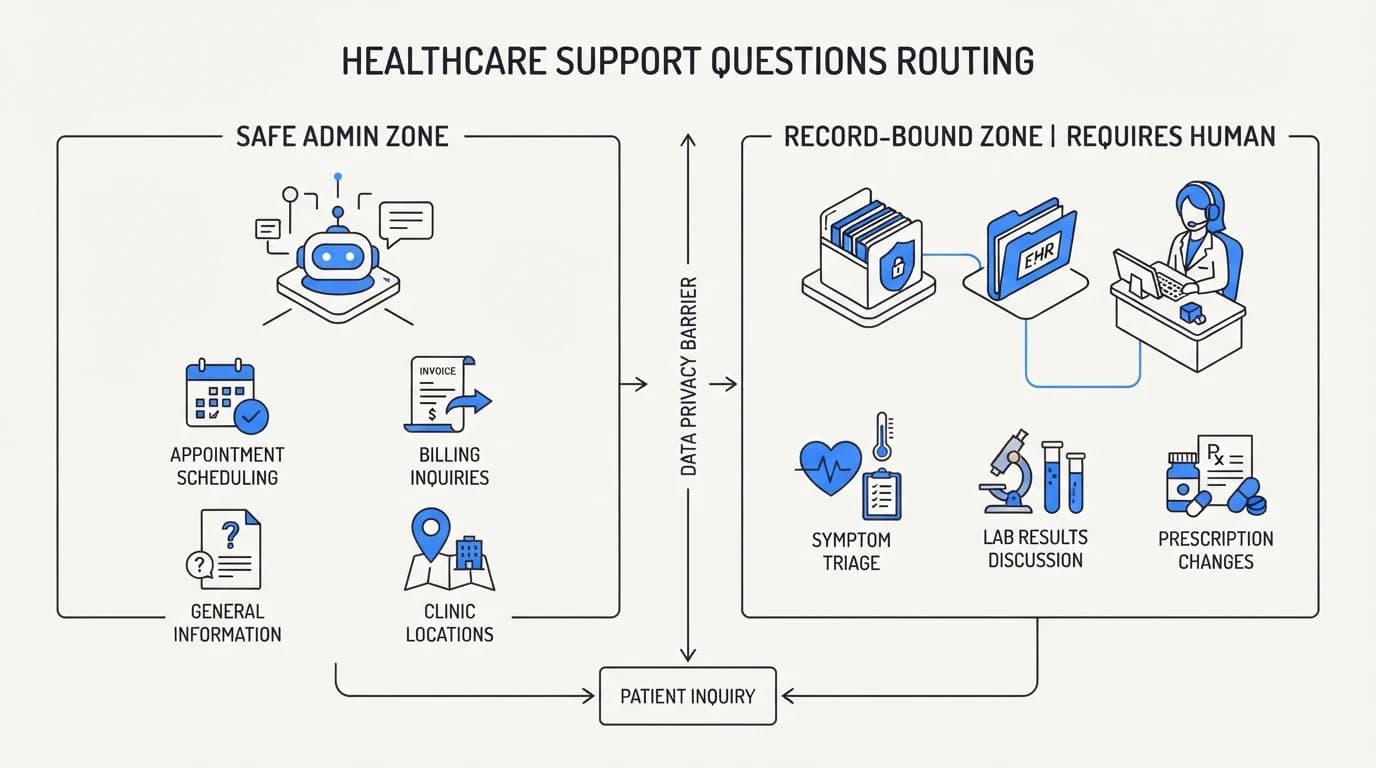
A healthcare support queue looks different from a typical SaaS inbox because the questions split cleanly into two families. One family is administrative: office hours, insurance networks accepted, how to request a records transfer, where the parking is, how to reschedule an appointment. The other family is clinical or account-specific: what a lab result means, whether a medication is safe to combine with another, what is in a specific patient's chart.
An AI agent earns its keep in the first family. Administrative questions repeat constantly, they have stable, factual answers, and a grounded agent can resolve them the same way customer support automation resolves repetitive questions in any other industry. The value is real: front desk staff stop repeating the same five answers all day, and patients get a response outside business hours instead of a voicemail.
The second family is where healthcare support genuinely differs from a normal help desk. A wrong answer about a return policy costs a company money. A wrong answer about a drug interaction, a symptom, or what a specific patient's results mean can hurt someone.
That asymmetry is why healthcare support AI needs a harder boundary than most other industries, not a softer one.
The mistake many teams make is treating healthcare customer support AI as one product category, when it is really two very different jobs wearing the same chat window. Getting this right starts with naming the split honestly, then designing the agent, and the data it can reach, around that split rather than around what looks technically possible.
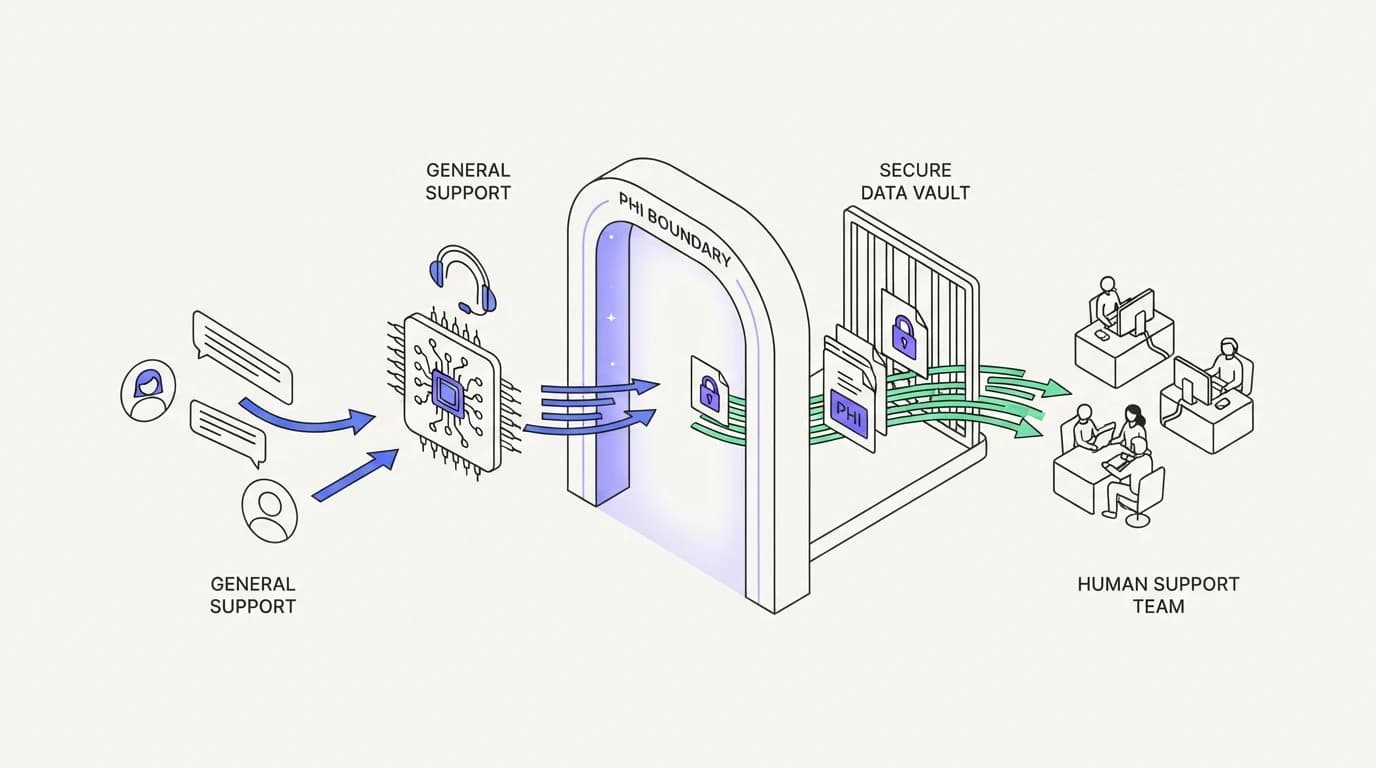
The PHI boundary: what an agent can answer without touching a record
 Communicate.so
Protected health information is any individually identifiable health information tied to a person's past, present, or future health, care, or payment for care. That definition, set out by HHS, is broader than most teams assume. A name paired with an appointment type, a policy number tied to a diagnosis code, even a callback number linked to a specific visit can qualify.
The practical test for a support agent is simple to state and hard to enforce without discipline. If answering the question requires looking up a specific person's record, appointment, claim, or result, the agent is now handling PHI. If the question has the same correct answer for every caller, it almost never does.
Questions that sit safely on the administrative side include office hours, which insurance plans a practice accepts, how to request a copy of your own records through the proper channel, general billing policy, how scheduling works, and what a service or procedure generally involves before a clinician discusses it with a specific patient. An agent grounded in a practice's own published content, the way RAG for customer support grounds any support agent, can answer these correctly and consistently.
Questions that cross into PHI include anything that names a specific patient's diagnosis, test result, medication list, appointment history, or account balance tied to their visits. A patient asking a general chatbot whether their test came back normal is not asking a policy question, they are asking the agent to read their chart, and an agent that answers that without proper authorization and safeguards has stepped outside a limited-risk support role.
The cleanest way to hold this boundary is architectural, not just instructional. Give the agent access to your help center, policies, and FAQ content through data sources, and do not connect it to your electronic health record or patient portal as a retrieval source at all. An agent that structurally cannot see a chart cannot leak one, which is a stronger guarantee than a prompt instruction telling it to behave.
Where HIPAA stops the conversation
HIPAA is the United States federal law governing the privacy and security of protected health information, enforced by the Department of Health and Human Services. It applies directly to covered entities, defined by HHS as health plans, healthcare clearinghouses, and healthcare providers who transmit health information electronically in connection with certain transactions.
It also applies indirectly to business associates, which HHS defines as any person or organization, other than a member of the covered entity's own workforce, that creates, receives, maintains, or transmits PHI on the covered entity's behalf to perform a function or service. A support vendor that never touches PHI is neither.
| Support scenario | Touches PHI | Vendor likely a business associate | Support AI appropriate scope |
|---|---|---|---|
| Chatbot answers hours, insurance, and billing policy | ✗ | ✗ | ✓ |
| Agent drafts a general FAQ reply a staffer reviews | ✗ | ✗ | ✓ |
| Agent looks up a specific patient's appointment or balance | ✓ | ✓ | ✗ without a BAA |
| Agent reads or summarizes a chart, result, or diagnosis | ✓ | ✓ | ✗ |
| Agent routes a message to a clinician without reading content | ✗ | Depends on transport | ✓ with review |
Read the table as a scope decision, not a checklist to satisfy after the fact. The moment a support agent is asked to look up something specific to one patient's care or account, you are past a HIPAA-relevant line, and the right move is to route that request to a human on your staff, not to try to make the AI compliant enough to handle it. The primary source for any specific compliance question is HHS.gov, and a healthcare attorney should confirm how it applies to your exact setup.
Business associate agreements and what they change
 Communicate.so
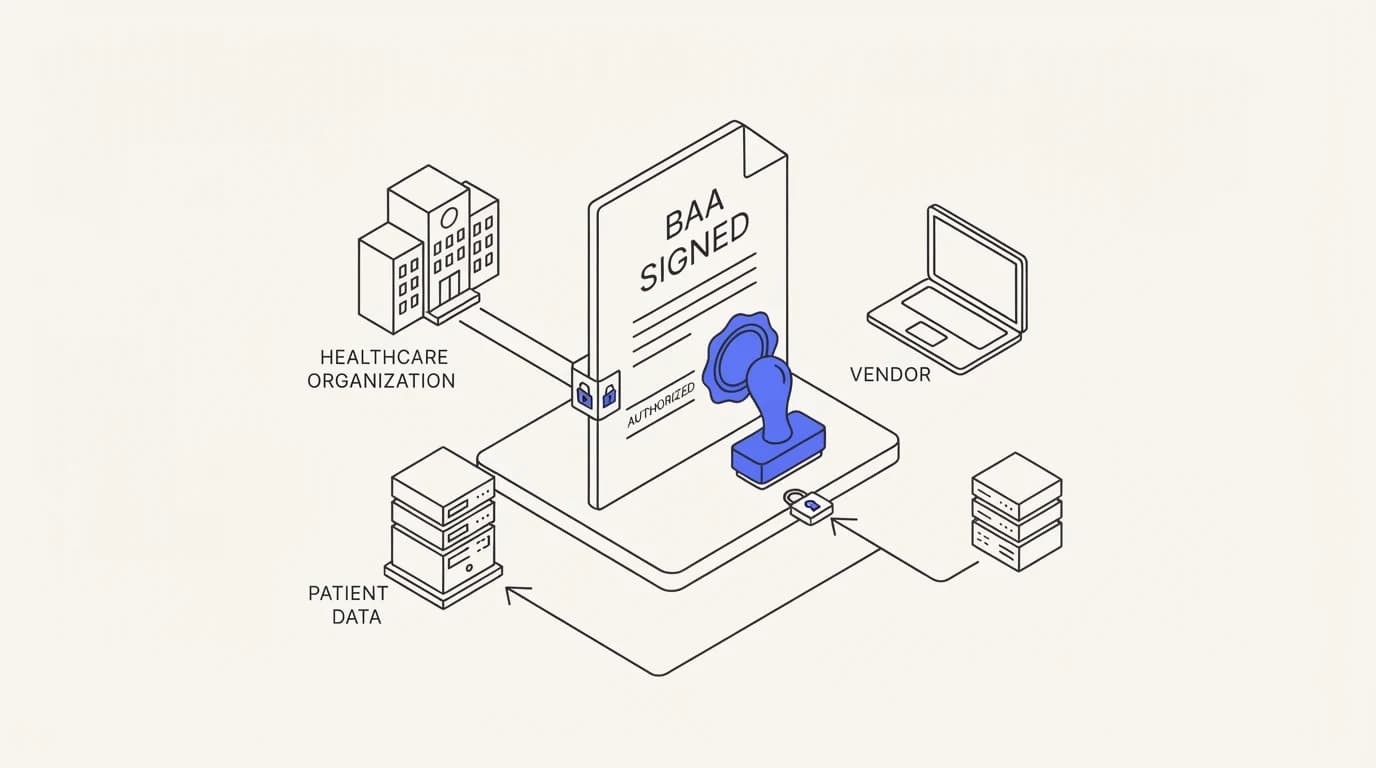
A business associate agreement is a contract, required by HIPAA, between a covered entity and any vendor that will create, receive, maintain, or transmit PHI on its behalf. Per HHS guidance, it must spell out the permitted uses of the data, require the vendor to implement administrative, physical, and technical safeguards, and bind subcontractors to the same terms.
Signing a BAA is not a formality, it is an operational commitment. The vendor takes on real obligations around breach notification, access controls, and audit trails, and the covered entity remains accountable for choosing a vendor that can actually meet them. This is why the decision to let any AI tool touch PHI should happen deliberately, with security and compliance in the room, not as a side effect of connecting one more data source.
The lighter path, and the one most support teams should default to, is keeping the AI agent entirely outside the BAA question by keeping it outside PHI. An agent scoped to administrative content, security permitting, never needs to see a record, which means the covered entity never has to extend PHI access to a support tool at all. That is not a workaround, it is the safer and simpler architecture.
When a healthcare organization does need an AI vendor inside the PHI boundary, whether for clinical documentation, care coordination, or a portal-integrated assistant, the BAA, the vendor's security posture, and a real risk assessment come before the integration, not after a pilot goes live. That process is squarely legal and security work, and it deserves a specialist, not a blog post.
Designing agent scope for a healthcare queue
Scoping starts with an honest inventory of the questions your front desk and billing team actually field. Most healthcare organizations find the majority cluster into a short list: hours and location, insurance accepted, appointment policies, billing and payment plans, records requests, and general information about services offered.
Ground the agent only in content you control and would say out loud to any caller. Your website, your published FAQ, your patient handbook, and your billing policy are all fair source material, the same way training an agent on your help center works for any support deployment. If a document mentions individual patients or cases, it does not belong in the agent's sources.
Write the refusal behavior as deliberately as the answer behavior. The agent should recognize a question that requires patient-specific lookup and decline to guess, then route the person to a staffer or a secure patient portal channel instead of attempting an answer from general knowledge. A confident wrong answer about a specific account is worse than a clean handoff.
Guardrails matter more here than in almost any other vertical, and the discipline is the same one described in AI agent guardrails: bound what the agent is allowed to attempt, not just what it is told to avoid. A tool-level restriction that makes patient lookups structurally unavailable is stronger than an instruction the model might not follow under pressure.
Escalation: when a person has to take over
 Communicate.so
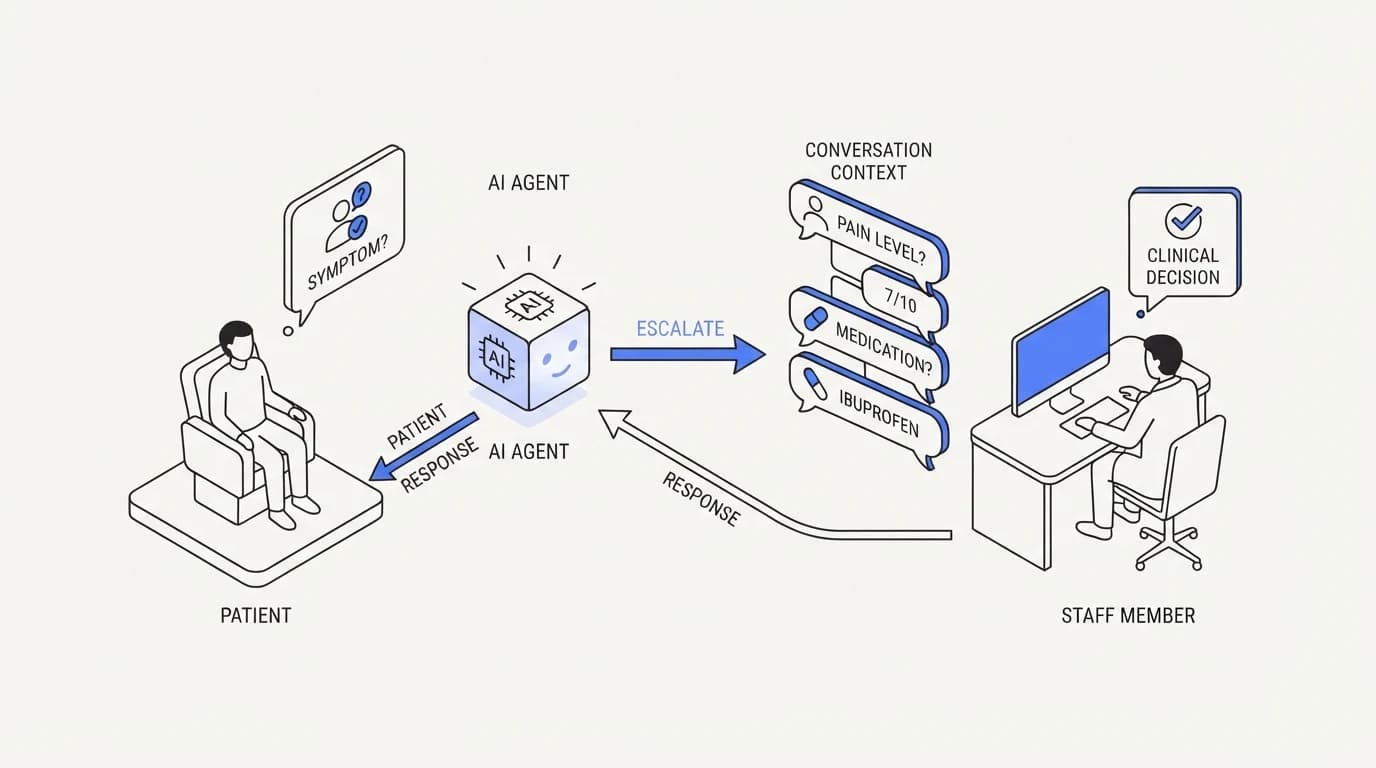
Escalation in a healthcare queue has to be fast and unambiguous, because the questions that cross the PHI line are often the ones a patient is most anxious about. A person asking about a delayed result or a billing dispute tied to their account should reach a human quickly, not get stuck negotiating with a bot that cannot help them.
The handoff should carry the conversation so far, so the patient does not repeat themselves to the person who picks it up. Losing context at the exact moment a question gets sensitive is the fastest way to make a patient feel unheard, and it undoes whatever goodwill the AI built by answering the easy questions well.
A shared surface where the AI and staff work the same queue keeps this handoff clean, the same model described in AI to human handoff. When escalation is a smooth pass rather than a cold transfer to a different system, staff spend their attention on the genuinely hard cases instead of re-reading a transcript from scratch.
Grounding and the cost of a wrong health-adjacent answer
Even on the administrative side of the boundary, grounding matters more in healthcare than almost anywhere else, because patients treat anything said by a practice's official channel as authoritative. An agent that guesses at a billing policy or a records timeline is stating something a patient may act on.
This is the same failure mode documented across support AI generally. CMSWire found the share of organizations reporting a negative consequence from generative AI rose from 44% in 2024 to 51% in 2025, and Twig lists hallucinated answers and missing escalation paths among the top complaints about AI support tools. Neither study is healthcare-specific, but the mechanism generalizes directly.
The fix is the same one that applies everywhere: the agent answers from your actual published content and says it does not know rather than filling a gap with a plausible guess. That discipline, covered in depth in the guide to reducing AI hallucinations in support, is not optional in a healthcare context, it is the baseline a patient-facing tool has to clear before it goes live.
A February 2026 incident where a cloud storage company's chatbot cited a downgrade policy that did not exist, reported by SocialIntents, shows how a confident invented policy erodes trust even outside healthcare. Apply that same caution to a health system's chatbot and the stakes only rise, which is one more reason to keep the agent strictly on documented, administrative ground, a discipline covered further in reducing AI hallucinations in support.
Channels and volume patterns in healthcare support
 Communicate.so
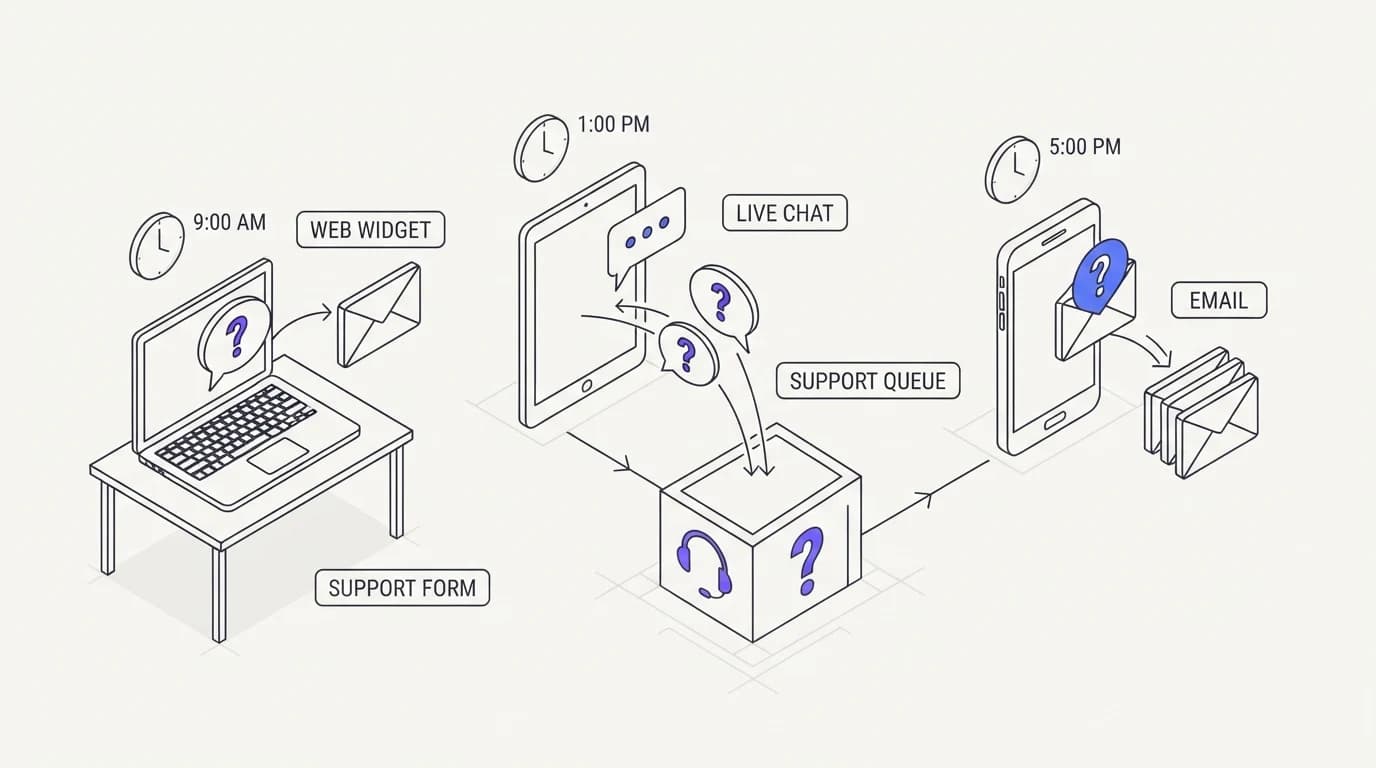
Healthcare contact volume has its own rhythm, shaped by open-enrollment periods, appointment reminder windows, and after-hours anxiety that a front desk cannot staff for. A 24/7 AI agent covers the administrative questions that arrive at 9 p.m. when a patient is worried about a bill or trying to confirm tomorrow's appointment, without staffing a night shift for questions that have the same answer regardless of the hour.
Multiple channels matter too, because patients reach out through whatever is in front of them: a website widget while browsing services, a chat during business hours, an email after a visit. Consistency across those channels, the same policy answers and the same escalation behavior everywhere, is what keeps a healthcare brand from contradicting itself to the same patient on two different surfaces.
Reporting is worth building in from day one, not bolted on later. Analytics on what patients actually ask, how often the agent hands off, and where it declines to answer gives an operations team a clear map of where the administrative boundary sits in practice, and where staff should expect to spend their time.
Where Communicate fits, honestly
Communicate is a grounded AI agent built to answer from content you connect and hand off cleanly when a question goes past what it should attempt. For a healthcare organization, that means scoping it to your published administrative content and treating anything patient-specific as a hard stop that routes to your staff, not a case the agent tries to resolve.
Here is what it does without embellishment. It runs a web widget, live chat, and email through one shared inbox and one knowledge base, with in-app messages and analytics on the same surface, so behavior stays consistent across channels. It does not integrate with electronic health record systems or patient portals, and it should not be pointed at PHI.
Communicate is GDPR-ready but not certified, and it does not currently hold a HIPAA business associate agreement, SOC 2, or ISO 27001 attestation. That is stated plainly on the security page, and it means the honest, currently supported use is administrative support content, not anything that requires a signed BAA. If your workflow needs a BAA-backed vendor touching PHI directly, that is a different category of tool, and this guide would rather tell you that clearly than oversell the fit.
On pricing, entry is a one-time $1 activation with 100 test credits, then usage-based credits from there, detailed on the pricing page. Spend those credits testing the agent against your real administrative FAQ before deciding whether the scope fits your queue.
Key takeaways
- Healthcare support questions split into administrative and patient-specific, and only the administrative half is safe territory for an AI agent without a business associate agreement.
- PHI is broader than most teams assume, covering any identifiable health information tied to a person's care, payment, or condition, per HHS.
- A vendor becomes a business associate the moment it creates, receives, maintains, or transmits PHI on a covered entity's behalf, and that triggers a required BAA.
- The safest architecture keeps the agent structurally unable to see a record at all, rather than relying on instructions to keep it from looking.
- Grounding and clean human escalation matter more in healthcare than almost any other vertical, because a confident wrong answer carries real cost.
Ready to scope an AI agent to the administrative side of your healthcare queue? Start with a one-dollar account activation that includes 100 test credits, connect your published policies through data sources, and test it against your real front-desk questions before it goes live.
Frequently asked questions
Is AI customer support legal in healthcare?
Yes, for administrative questions that never require reading a specific patient's record. HIPAA regulates the handling of protected health information, not the general concept of an AI chatbot, so a scoped agent answering hours, billing policy, and insurance questions does not by itself trigger HIPAA obligations. Confirm your specific setup with counsel and consult HHS.gov for the primary rules.
Does a support chatbot need to be HIPAA compliant?
It needs to be HIPAA compliant only if it creates, receives, maintains, or transmits protected health information on behalf of a covered entity. A chatbot scoped strictly to public, non-patient-specific content is not handling PHI and does not trigger that requirement on its own. The moment it looks up anything tied to a specific patient, that changes.
What counts as protected health information in a support conversation?
Any individually identifiable information related to a person's past, present, or future physical or mental health, the care they received, or payment for that care, as defined by HHS. A name linked to an appointment type, a diagnosis, or a billing record tied to a visit all qualify, even in a short chat message.
Can a chatbot answer questions about a specific patient's test results?
Not without proper authorization, security controls, and typically a business associate agreement if a third-party vendor is involved. Test results are protected health information, and a general support agent answering that kind of question without those safeguards in place is operating outside a safe, limited-risk scope. Route that request to clinical staff instead.
What is a business associate agreement and when do I need one?
A business associate agreement is a contract required by HIPAA between a covered entity and any vendor that handles PHI on its behalf, per HHS guidance. You need one whenever a support vendor will create, receive, maintain, or transmit protected health information, not for a vendor that only ever sees public, non-patient content.
Can a healthcare AI agent handle appointment scheduling?
General scheduling policy, such as how far in advance to book or what the cancellation window is, is safe administrative territory. Looking up or modifying a specific patient's actual appointment usually touches PHI, since the appointment is tied to that person and their care. Treat scheduling lookups as patient-specific unless your architecture keeps them fully separate from any identifying detail.
Should a healthcare chatbot ever discuss symptoms or diagnoses?
No. Symptom and diagnosis questions are clinical judgment calls, not support tickets, and a support agent that attempts them is stepping outside both its safe scope and its competence. Route any symptom or diagnosis question straight to a clinician or a nurse line, and keep the agent's AI agent scope limited to administrative content that never requires medical judgment.
How do I keep a support AI from accidentally seeing patient records?
Connect it only to sources you control and would say out loud to anyone: your website, your public FAQ, and your general policies. Do not connect it to your electronic health record system, your patient portal, or any database that stores individual patient data as a retrieval source. An agent that structurally cannot reach a record cannot leak one.
What happens if a healthcare AI agent gives a wrong answer?
The consequences scale with what the answer touched. A wrong hours or billing answer is an inconvenience to fix. A wrong health-adjacent answer, even an administrative-sounding one about medication pickup or a procedure, can cause real harm, which is why grounding and a documented refusal behavior for anything uncertain matter more here than in most industries, a theme covered in reducing AI hallucinations in support.
Can small medical practices use AI customer support?
Yes, and the administrative-only scope described in this guide is often the best fit for a small practice, since it resolves repetitive front-desk questions without requiring the security investment a PHI-touching system would need. A solo practice or small group can start with hours, insurance, and billing policy coverage and expand carefully from there.
Does GDPR apply to healthcare AI support in Europe?
Health data is treated as a special category under GDPR, which means stricter processing conditions than ordinary personal data. If your organization serves patients in the EU, GDPR obligations apply alongside any local health-data rules, and that is worth confirming with counsel separately from any US-focused HIPAA analysis, since the two frameworks are not interchangeable. Communicate is GDPR-ready but not certified, detailed on the security page.
What is the difference between a covered entity and a business associate?
A covered entity, per HHS, is a health plan, healthcare clearinghouse, or provider that transmits health information electronically for certain transactions. A business associate is a separate organization, such as a vendor, that handles PHI on the covered entity's behalf. Both carry HIPAA obligations, but the business associate's obligations flow from its contract with the covered entity.
How should escalation work for a healthcare support agent?
Fast and unambiguous. The moment a question requires patient-specific information or clinical judgment, the agent should stop, say so, and route the person to a staffer with the conversation history intact, the pattern described in AI to human handoff. A patient asking about a delayed result should never be stuck arguing with a bot that cannot help them.
Does a healthcare AI agent need a security review before launch?
Yes, and that review should happen before connecting any data source, not after a pilot is already live. Confirm exactly what content the agent can retrieve, verify it contains no patient-specific information, and document the scope decision so it survives staff turnover. A security review is cheap compared to discovering PHI leaked into a chatbot's training data after the fact.
Can patients dispute a bill through an AI agent?
An agent can explain general billing policy and how to start a dispute, but resolving a specific account's disputed charge requires looking at that account, which is patient-specific territory. Route the actual dispute to billing staff, and let the agent handle the policy explanation and the handoff cleanly.
What is the safest first use case for healthcare AI support?
Front-desk administrative questions: hours, location, insurance accepted, general appointment and cancellation policy, and how to request records through the proper channel. These have stable answers, never require a patient lookup, and give you a real read on how well a grounded AI agent performs before you consider anything closer to the PHI boundary.
How do I train an AI agent on healthcare content correctly?
Connect only your public, approved content: your website, published FAQ, patient handbook, and billing policy documents, the same approach covered in training AI on your help center. Audit that source material for any patient-specific references before connecting it, and keep the source set to content you would be comfortable having a stranger read.
Can AI reduce wait times in a healthcare call center?
It can reduce wait times for the administrative share of calls, often a meaningful portion of total volume, by resolving them immediately through chat instead of a hold queue. Salesforce-sourced data reported by DigitalApplied found 66% of service organizations were running AI agents in 2026, up from 39% in 2025, a trend healthcare call centers are part of for exactly this reason.
What should I tell patients about talking to an AI agent?
Tell them plainly, at the start of the conversation, that they are talking to an AI assistant and how to reach a human if they need one. Clear disclosure builds trust rather than eroding it, and it sets the right expectation for what the agent can and cannot help with, which matters even more in a healthcare context than in most others.
Is it worth building a custom healthcare chatbot instead of using a general AI agent platform?
Usually not, unless you have a specific integration need a general platform cannot meet. A grounded agent platform scoped tightly to administrative content solves the common case, and building custom infrastructure to do the same job usually costs far more than the incremental control is worth. Start with a scoped, off-the-shelf agent and only build custom if a genuine gap appears.