
Customer support SLA with AI: rewriting the clauses that break
 Communicate.so
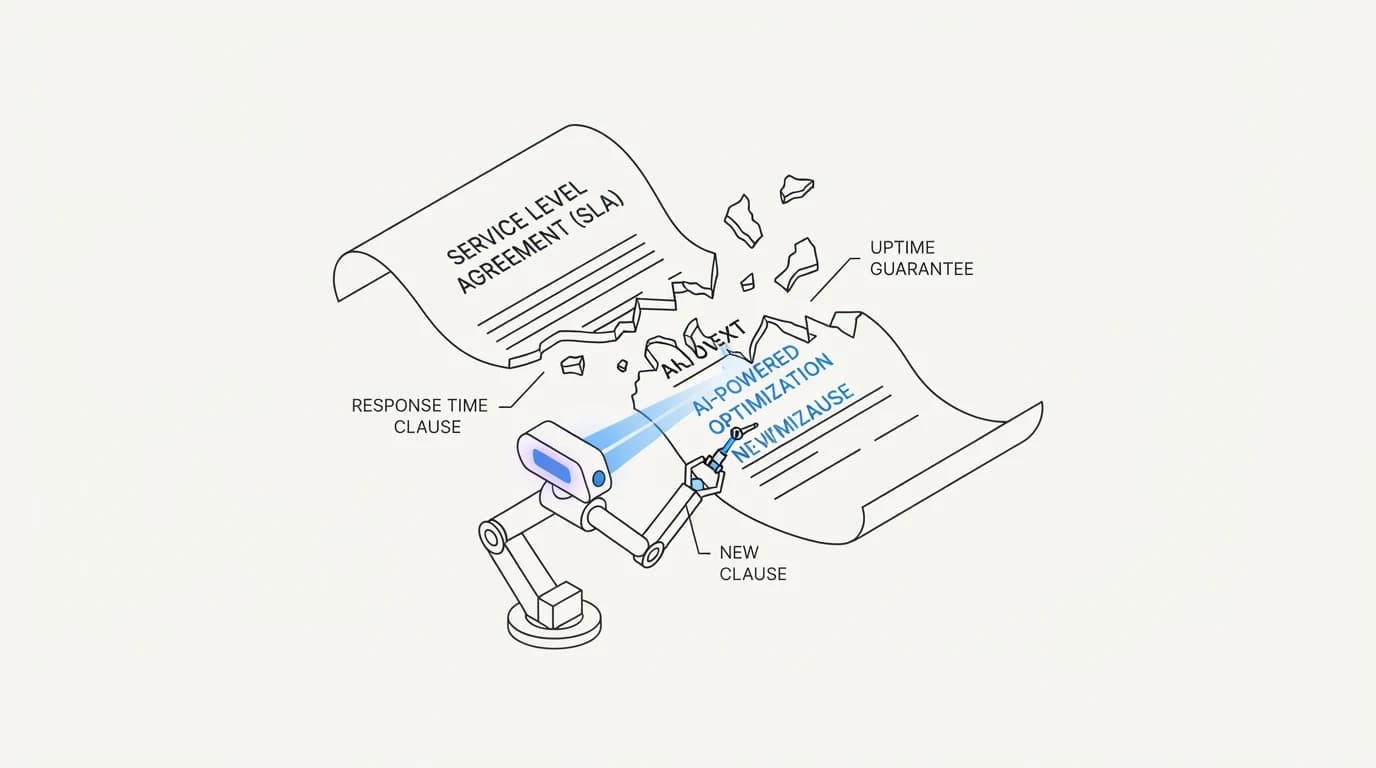
Customer support SLA with AI: why response-time clauses stop working and how to rewrite resolution, handoff, and reporting clauses.
TL;DR: A service level agreement written for a team of humans assumes replies take minutes to arrange and resolutions take days to close, and an AI agent breaks both assumptions inside the first week. When a bot answers in seconds, a first response clause built around human typing speed stops measuring anything useful and starts rewarding an automated acknowledgment that does not answer the question. This guide rewrites the clauses that actually need to change: first response, resolution time, the AI to human handoff, and the reporting language that proves the numbers are real. It includes real clause text you can adapt, not a description of what a clause might contain. The short version is that AI should shift SLA weight away from response speed, which it wins by default, toward resolution quality and escalation discipline, which is where customers actually feel the difference.
A support lead at a mid-size SaaS company told her team the AI agent had made the first response SLA obsolete within two weeks of turning it on. Every conversation got a reply in under ten seconds, the dashboard turned green, and nobody noticed that half those instant replies were the agent politely saying it did not know the answer. The SLA had become a number the company could no longer fail, which meant it had stopped measuring the thing customers cared about.
This is the trap most teams fall into after deploying an AI agent into a support queue with an SLA written for people. First response time SLAs were built to solve a coordination problem: humans need a nudge to reply fast, so a company measures and pays attention to the clock. An AI agent does not have that problem, it replies immediately by default, and a clause that only measures speed can no longer tell you whether the team is doing well.
This guide walks through what breaks in a human-era SLA once AI joins the queue, and it rewrites the clauses that need to change: first response, resolution time, the AI to human handoff, and the reporting section that proves the numbers are real. Where the first response time benchmark data shows what good used to look like, this piece is about writing the contract for what good looks like now.
What a support SLA actually promises
A service level agreement is a commitment with a number attached, not a vague promise to try hard. It names a metric, a target, a measurement window, and usually a consequence for missing the target, most often a service credit. Strip away the legal language and every support SLA answers one question: how long will a customer wait, and what happens if the wait runs longer than promised.
Most SLAs anchor on two metrics. First response time measures how long a customer waits for the first reply after contact, and resolution time measures how long the customer waits for the issue to actually close. The two numbers sound similar and behave completely differently, because a fast first reply says nothing about whether the underlying problem got fixed.
Teams that have worked to cut first response time already know the difference between a metric that looks good on a dashboard and one that customers actually feel. A fast acknowledgment reduces anxiety, a fast resolution reduces the actual problem, and a well written SLA measures both instead of leaning on the easier one.
The measurement window and the consequence matter as much as the number itself. A target with no defined start point, no defined end point, and no real consequence for missing it is not a service level agreement, it is a hope written down. Every clause in this guide names all three: what starts the clock, what stops it, and what happens if the team misses.
Why AI breaks the old SLA math
 Communicate.so
The traditional first response clause assumes a human has to notice a message, read it, and type a reply, and that chain of actions takes real time even for a fast team. An AI agent skips almost all of that chain. It reads the message and replies in seconds, which means a first response target written for human speed gets hit automatically, every time, whether or not the reply actually helps the customer.
This is not a hypothetical problem for a handful of early adopters. DigitalApplied reports that the share of service organizations running AI agents in production reached 66% in 2026, up from 39% in 2025, citing Salesforce research, and the same analysis found 91% of CX leaders under executive pressure to deploy AI, citing Gartner (DigitalApplied). Most support teams are living this shift now, not planning for it.
The practical effect is that first response time collapses toward zero and stops discriminating between good and bad performance. A team with an excellent AI agent and a team with a mediocre one both post near-instant first response numbers, because the clock only measures how fast something replied, not whether the reply was correct or useful.
Resolution tells a more honest story, because deflection and resolution vary widely by execution. HappySupport puts realistic AI deflection at 45% to 60% in year one, rising to 65% to 75% at maturity (HappySupport), while Lorikeet's review of enterprise Zendesk deployments found a median deflection rate of 41.2%, well below vendor marketing claims like Decagon's advertised 80% (Lorikeet). Those numbers move with real changes in content quality and agent configuration, unlike a first response clock an AI wins by simply existing.
The stakes of getting the resolution and handoff clauses wrong are rising too. CMSWire reports the share of organizations experiencing a negative consequence from generative AI grew from 44% in 2024 to 51% in 2025.
That statistic comes from CMSWire, and it is a reminder that an SLA which lets a fast, wrong AI reply satisfy the contract does nothing to guard against that trend, which is why resolution time has to be the number that counts.
The conclusion is not that first response time stops mattering, it is that it stops being the metric that separates a good SLA from a bad one. An SLA that still weights first response as the primary commitment is measuring the part AI made trivial and ignoring the part AI made hard, which is resolving the issue correctly and knowing when to hand it to a person.
Response time SLAs vs resolution time SLAs
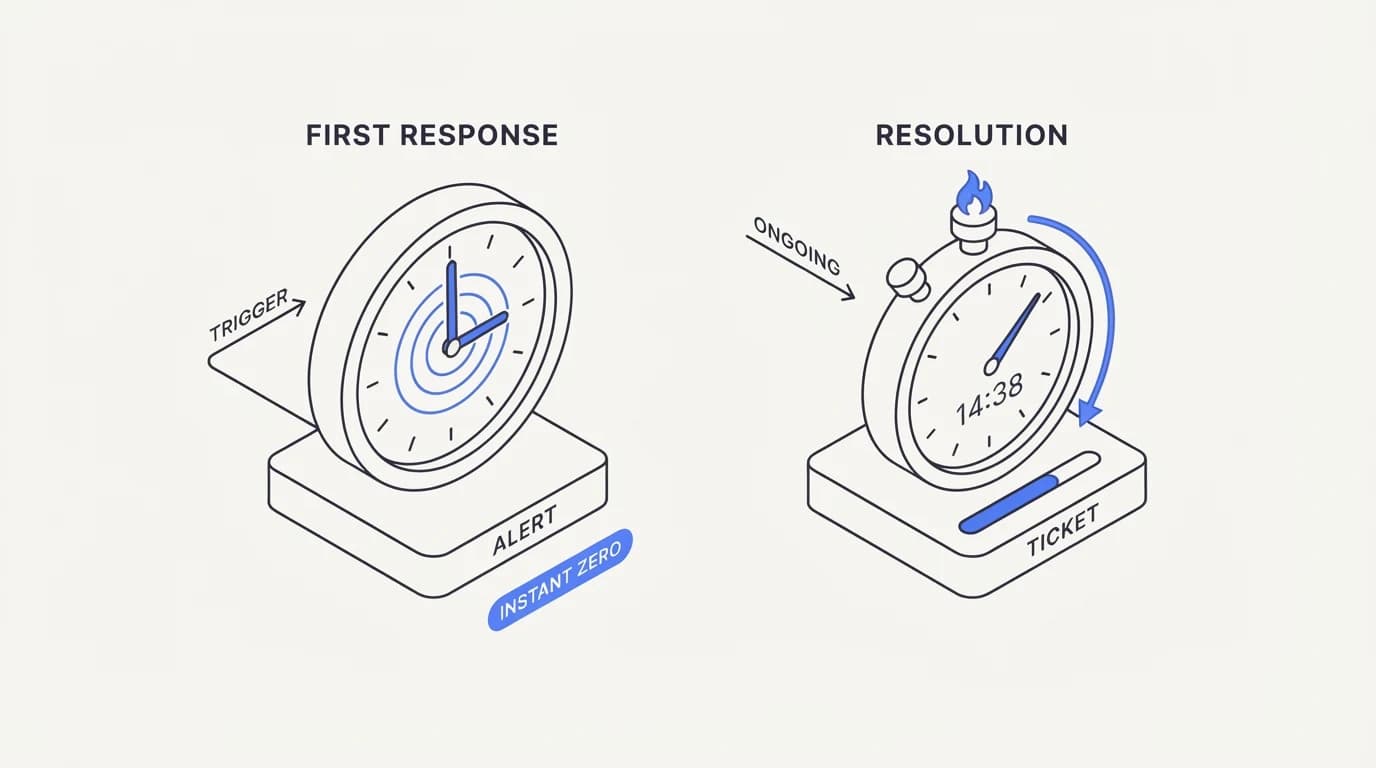
Response and resolution measure different moments in the same conversation, and an AI-aware SLA needs to treat them as two separate commitments with two separate targets, not one blended number. Conflating them is how a company ends up praising a ten-second average while a customer waits three days for an actual fix.
A response time clause should measure the gap between a customer's message and the first substantive reply, whether that reply comes from the AI agent or a human. It should explicitly exclude a bare acknowledgment, because a message that says only we got your question is not a response, it is a placeholder, and letting it count undermines the whole point of the clause.
A resolution time clause should measure the gap between the ticket opening and the customer confirming the issue is closed, or a defined silence window passing after a proposed fix. This is the number that tracks whether support ticket deflection rate claims a company makes are actually holding up in the queue, not just in a sales deck.
The table below lays out how the two metrics should be treated differently once an AI agent is in the loop, because writing one clause to cover both is where most of the confusion starts.
| SLA element | Response time clause | Resolution time clause |
|---|---|---|
| Clock starts at | Message received | Ticket created |
| Clock stops at | First substantive reply | Customer confirms resolved |
| AI reply counts | yes | yes, if it actually resolves |
| Bare acknowledgment counts | no | no |
| Meaningfully changed by AI | yes, near instant | no, depends on content quality |
| Should carry the heavier weight now | no | yes |
Weighting resolution more heavily than response is not a cosmetic change, it changes what the team optimizes for. A team chasing a response number will keep tuning the AI to reply faster, which it is already good at. A team chasing a resolution number has to improve the content the AI is grounded in, tighten the AI agent guardrails around what it is allowed to claim, and fix the handoff, which is where the real work lives.
Rewriting the first response clause
 Communicate.so
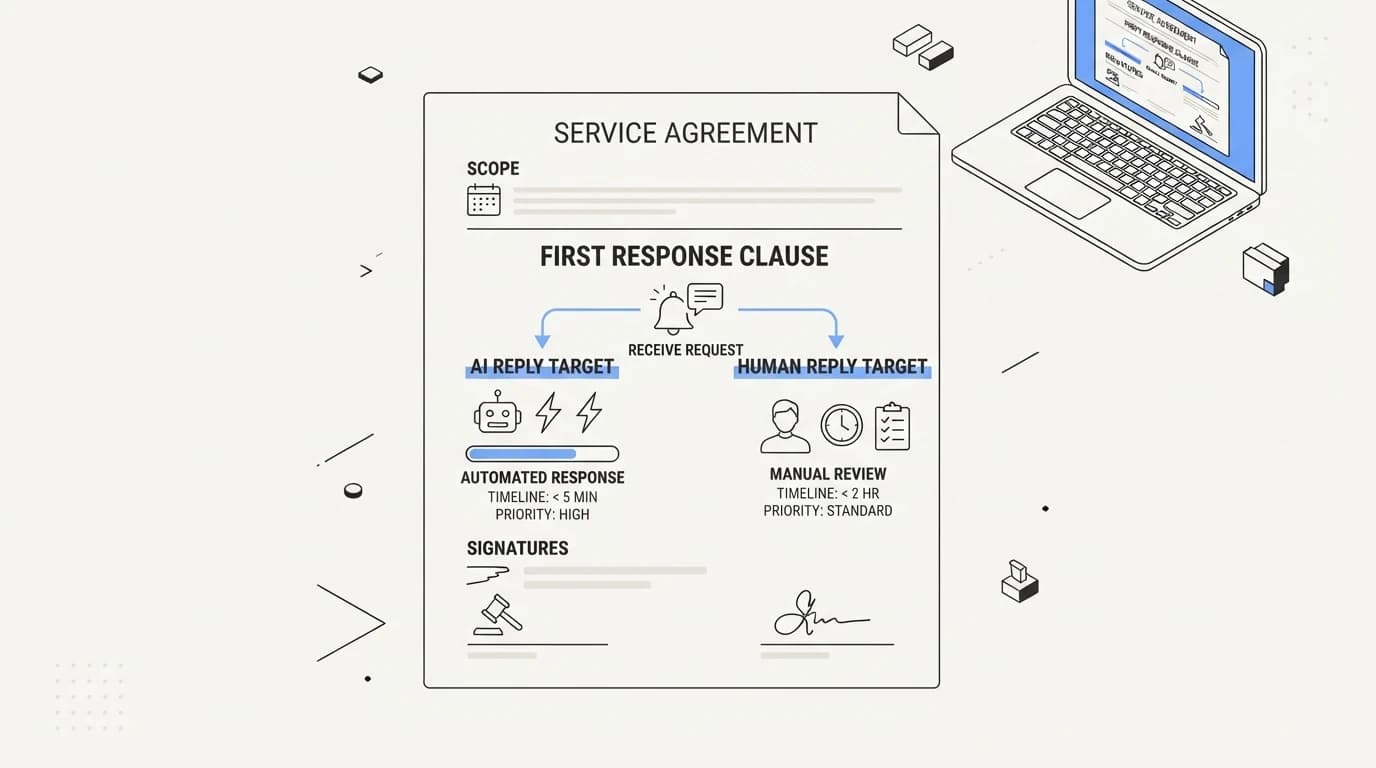
The rewrite starts by naming which actor answered and holding both to a standard, instead of pretending every reply came from a person. A modern first response clause has to say explicitly that an AI reply counts, define what disqualifies a reply as a bare acknowledgment, and set a separate, longer target for the human first response that follows an escalation.
Here is a first response clause rewritten for a queue where an AI agent answers first. The AI agent commits to a first response within 60 seconds for any message received through a live channel, delivered by an agent grounded in the customer's connected help content. Where the AI agent cannot resolve the request or is not confident in the answer, it hands the conversation to a human agent, and the human first response commitment is 4 business hours for standard priority tickets and 1 business hour for high priority tickets.
First response time is measured from message receipt to the first substantive reply, whether that reply comes from the AI agent or a human agent, and an automated acknowledgment alone does not satisfy this clause.
Three details in that clause do real work. The 60-second AI target is deliberately tight because an AI agent should not need minutes to retrieve a grounded answer, and a slow AI response usually signals a retrieval or infrastructure problem worth investigating on its own. The human target only starts once the AI has already handed off, so the company is not double-counting the same wait twice.
The exclusion of a bare acknowledgment closes the loophole that made the old clause meaningless.
The clause also has to survive contact with a bad AI answer, not just a slow one. A fast, wrong reply that satisfies a response-time clock while hallucinating a policy that does not exist is worse than no reply at all, which is one reason the resolution clause in the next section has to carry more weight than this one.
Rewriting the resolution time clause
Resolution is where an AI-aware SLA earns its keep, because this is the number a customer actually feels. A ticket that gets an instant, unhelpful reply and then sits unresolved for three days has failed the customer regardless of what the response-time dashboard shows, and the resolution clause is what catches that failure.
Resolution time is measured from ticket creation to the customer confirming the issue is resolved, or 24 hours passing without further customer contact after a proposed resolution, whichever comes first. Standard priority tickets carry a resolution target of 1 business day. High priority tickets carry a resolution target of 4 business hours.
Tickets escalated from the AI agent to a human agent retain the clock that started at ticket creation, and escalation does not reset the resolution timer.
That last sentence is the part most rewrites get wrong. If escalating to a human resets the resolution clock, the company has just built an incentive to hand off slowly resolving tickets to a person and call the AI portion a separate, already closed matter. Keeping one continuous clock from ticket creation to actual resolution removes that loophole and keeps the whole team honest about total customer wait time.
Pair this clause with an internal target for average handle time on the human side, because a resolution SLA sets the outer bound the customer sees while handle time is the operational number a team manages day to day to stay inside it.
Analysts expect this balance to keep shifting toward AI. Gartner projects agentic AI will autonomously resolve 80% of common customer service issues by 2029 (Gartner), which is one more reason a resolution clock, not a response clock, is the number worth tightening over time.
Building an escalation clause for AI handoffs
 Communicate.so
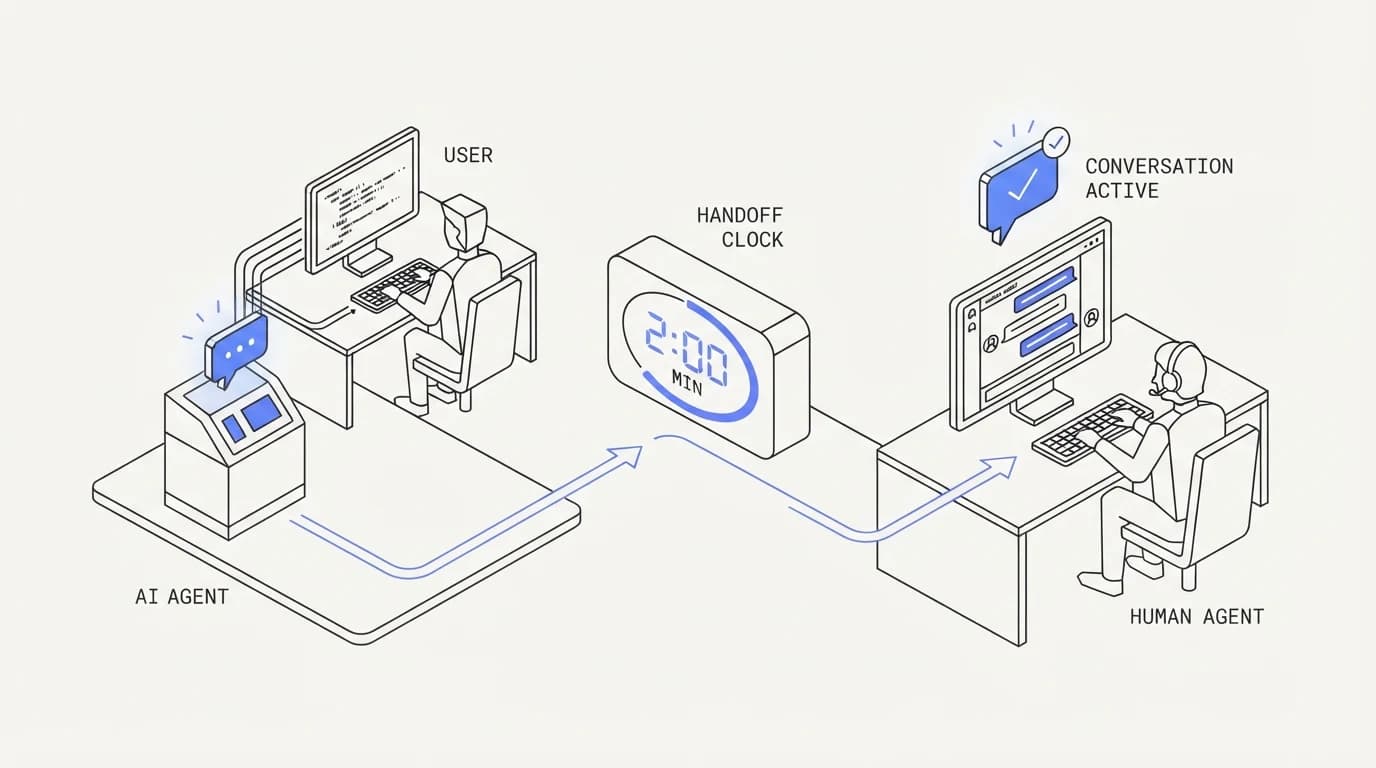
An SLA without a handoff clause treats the AI agent and the human team as two unrelated systems, which is exactly backward, because the handoff is the single moment most likely to silently break a customer's trust. The clause needs to define when a handoff must happen, how fast it must happen, and how the receiving human is held to a clock.
When the AI agent determines it cannot answer a request confidently, or the customer explicitly asks for a human, the agent hands off the conversation to a human agent with the full conversation history attached. The handoff itself must occur within 2 minutes of the triggering message. The human agent's first response after handoff must occur within the priority-based first response target defined elsewhere in this agreement, and handoff time is tracked separately from that target so a slow handoff cannot disguise a slow human response.
Splitting handoff time from response time is what makes this clause enforceable rather than aspirational. A support escalation workflow that buries handoff delay inside a broader response window will always look fine on paper while customers experience a long, silent gap between asking for a person and a person actually replying, which is the exact failure the AI to human handoff has to be designed against.
Twig's review of common AI support complaints names a missing escalation path among the top frustrations customers report, alongside hallucinated answers and robotic tone (Twig). A handoff clause with a hard 2-minute target and full context transfer is a direct answer to that specific complaint, not a general availability promise.
Losing that context is exactly what customers already resent in ordinary support interactions. Zendesk's 2024 CX Trends research found 74% of customers rank being asked to repeat information among their biggest support annoyances (Zendesk), and a slow or context-free handoff recreates that exact failure with an AI agent as the first point of contact.
Reporting and audit language for an AI-assisted SLA
A target without a reporting obligation is unenforceable in practice, even when it is enforceable on paper, because nobody can prove a breach they cannot see. An AI-assisted SLA needs a reporting clause that separates AI-only resolutions from human-assisted ones, so both sides can tell which part of the system is carrying the load.
A vendor will provide the customer with a monthly report showing first response time, resolution time, AI-only resolution rate, and human escalation rate, broken out by priority tier. Any month in which resolution time for high priority tickets exceeds the target on more than 5% of tickets triggers a service credit calculated under the credit schedule in the agreement. The customer may request the underlying ticket-level data used to calculate these metrics for any audit period within the preceding twelve months.
The audit-data right in that last sentence matters more than it looks, because a vendor that reports only aggregate numbers is asking to be trusted rather than verified. Underlying ticket-level access, the same visibility a good analytics view should already give an internal team, is what turns a reporting clause from a courtesy into an actual check.
Breaking the report out by priority tier also stops a vendor from hiding a bad high-priority month behind a strong low-priority average. A blended resolution number can look healthy while the tickets that matter most, the urgent ones, are quietly missing target every month.
What to do if you already have an old SLA
 Communicate.so
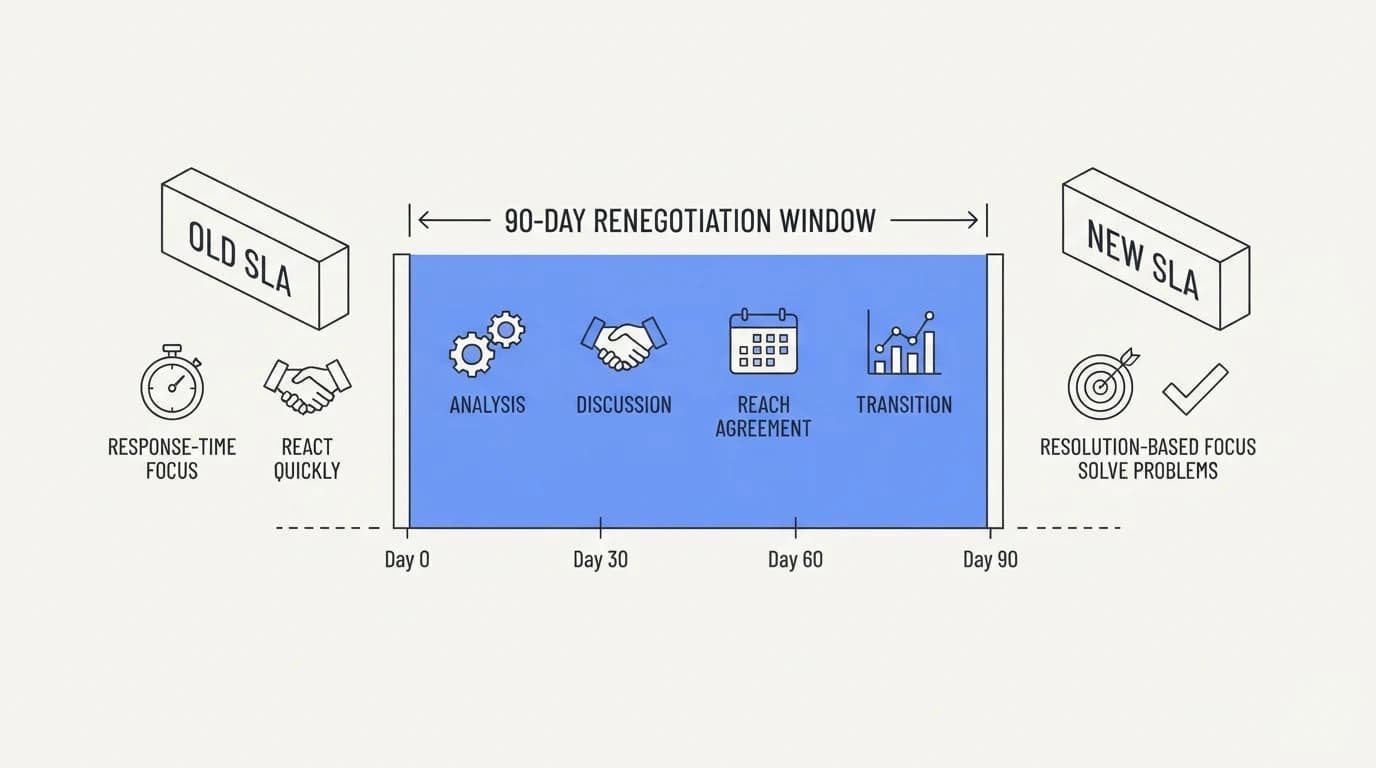
Most teams deploying an AI agent are not writing an SLA from a blank page, they are trying to fit AI into a contract that was signed before the agent existed. Renegotiating every customer contract on day one is not realistic, so the practical answer is a transition clause that keeps the old commitment in force while the new terms get finalized.
Where an existing service level agreement defines targets solely in terms of acknowledgment or first response, and does not distinguish between AI-agent responses and human responses, the parties agree to renegotiate the agreement within 90 days of AI agent deployment to add resolution-time targets and an AI-to-human handoff clause consistent with the terms above. The original response-time targets remain in force until the renegotiated terms are executed.
This clause is especially relevant for teams moving off a legacy helpdesk, where the original SLA was written entirely around ticket-queue mechanics with no concept of an AI first responder. Anyone working through a migration from Zendesk to an AI-native setup should treat SLA renegotiation as a checklist item, not an afterthought that surfaces after a customer complains.
The 90-day window is a starting point, not a fixed rule. Shorten it for high-value enterprise accounts where the exposure of an outdated clause is larger, and lengthen it for a long tail of small accounts where a blanket update, communicated clearly, is more practical than ninety separate negotiations.
Where Communicate fits, honestly
Communicate is a grounded AI agent paired with a lean Shared Inbox, built around exactly the response-then-resolution split this guide argues for. The AI agent answers from connected content first, and when it cannot answer confidently it hands the conversation to a human agent with the full thread attached, which is the mechanic the escalation clause above assumes exists.
Here is what it does without embellishment. Live channels are a web widget, live chat, and email, with in-app messages, analytics, and scoped actions running from the same agent and knowledge base, so behavior stays consistent across every surface a customer might use to reach the team.
On reporting, the analytics view breaks out resolution and escalation by channel, which is the same underlying data the reporting clause in this guide asks a vendor to provide. Anyone drafting an SLA against Communicate specifically would report against numbers already visible in that view, not a separate calculation reconstructed by hand.
On honest limits, Communicate is GDPR-ready but not certified, holds no SOC 2, HIPAA, or ISO 27001, and details of its data handling posture are on the security page. If an SLA needs a vendor with formal compliance certifications behind it, confirm those requirements before signing, and see the pricing page for how a one-time activation and credit-based usage compares against expected ticket volume.
Key takeaways
- First response time collapses toward zero once an AI agent is live, so it stops being the metric that separates good performance from bad.
- Resolution time, measured on one continuous clock from ticket creation through escalation, is the number that should carry the SLA's real weight now.
- A handoff clause with its own 2-minute target, tracked separately from response time, is what keeps an escalation from hiding inside a vague response window.
- Reporting language needs AI-only resolution rate, human escalation rate, and ticket-level audit access, broken out by priority tier.
- An existing SLA does not need to be torn up overnight; a 90-day renegotiation clause keeps the old commitment in force while new terms are finalized.
Rewriting an SLA is easier once the AI agent behind it is grounded and predictable. Start with a one-dollar account activation that includes 100 test credits, connect content to the AI agent, and measure real resolution numbers before putting them in a contract.
Frequently asked questions
What is a customer support SLA?
A customer support SLA is a written commitment that names a metric, a target, a measurement window, and a consequence for missing the target. The two most common metrics are first response time, how long a customer waits for the first reply, and resolution time, how long the customer waits for the issue to close. A real SLA defines what starts and stops the clock for each metric, not just the target number.
Does an SLA need to change when you add an AI agent?
Yes. A first response clause written for human reply speed gets satisfied automatically once an AI agent is answering in seconds, which means it stops distinguishing good performance from bad. The clause that needs the most attention is resolution time, plus a new clause for the AI to human handoff, both covered earlier in this guide.
Should AI replies count toward first response time?
Yes, an AI reply should count as a first response as long as it is a substantive answer and not a bare acknowledgment. Excluding AI replies from the clock creates a strange incentive to slow the AI down artificially or hide its involvement, neither of which helps the customer waiting for an answer.
What is the difference between first response time and resolution time?
First response time measures how long until the first substantive reply, while resolution time measures how long until the issue is actually closed. A team can post an excellent first response number while resolution drags for days, which is why the first response time benchmark should never stand in for a resolution metric on its own.
How fast should an AI agent's first response be?
60 seconds is a reasonable target for a grounded AI agent replying through a live channel, and most well-configured agents beat that by a wide margin. If an AI agent is regularly missing a 60-second target, the more likely cause is a retrieval or infrastructure problem, not a genuinely difficult question.
What resolution time target is realistic with AI in the queue?
It depends on priority tier and how mature AI deflection is. HappySupport puts realistic deflection at 45% to 60% in year one and 65% to 75% at maturity (HappySupport), so set resolution targets that assume a growing but incomplete share of tickets close without a human, and tighten the target as support ticket deflection rate improves.
Should escalation reset the resolution clock?
No. If handing a ticket to a human resets the resolution clock, the company can quietly hide slow tickets by escalating them and treating the AI portion as a separate, already closed matter. Keep one continuous clock from ticket creation to actual resolution, regardless of how many escalations happen in between.
How fast should an AI to human handoff happen?
2 minutes is a tight, achievable target for the handoff itself, tracked separately from the human's first response clock. Splitting the two numbers is what makes the AI to human handoff enforceable, because a slow handoff can otherwise hide inside a broader response window and look invisible in the report.
What should an SLA reporting clause include?
At minimum, first response time, resolution time, AI-only resolution rate, and human escalation rate, broken out by priority tier. Breaking the numbers out by tier stops a strong low-priority average from hiding a bad month on high-priority tickets, which is where a miss actually hurts.
Can a customer audit the ticket-level data behind an SLA report?
They should be able to, and a well-written clause grants that right explicitly for a defined audit period, typically the preceding twelve months. Ticket-level access turns a monthly report from a summary a customer has to trust into a claim they can actually check, similar to the level of detail a good analytics dashboard already provides internally.
Do I need to rewrite my existing SLA immediately?
No, but a plan and a deadline are needed. A 90-day renegotiation clause, described earlier in this guide, keeps the old commitment in force while both sides work out resolution-time targets and a handoff clause, so nobody is operating without a contract in the interim.
What is a service credit and when should it trigger?
A service credit is a defined refund or account credit owed when the vendor misses an agreed target, usually calculated as a percentage of the period's fee. It should trigger on a clear, measurable breach, such as resolution time exceeding target on more than a set percentage of high-priority tickets in a month, not on a vague or subjective standard.
How does priority tier affect SLA targets?
High priority tickets should carry tighter first response and resolution targets than standard tickets, and the reporting clause should break results out by tier rather than blending them. A single blended number can look healthy while urgent tickets are quietly missing target every month, which defeats the point of having tiers at all.
Should a bare acknowledgment count as a first response?
No. A message that only confirms receipt, without answering the question, should be explicitly excluded from the first response clock. Allowing acknowledgments to count is the exact loophole that made many pre-AI SLAs meaningless once automated replies became instant and universal.
What happens if the AI agent gives a wrong answer within its SLA window?
Meeting the response-time target does not excuse a wrong answer, which is why resolution time has to carry more weight than response time in an AI-assisted SLA. A fast, incorrect reply that later needs correcting should show up as a longer resolution time, and reducing that risk starts with reducing AI hallucinations in support rather than loosening the clock.
How does AI deflection affect SLA planning?
Deflection determines how much of the volume an AI resolves without a human, which changes how many tickets the resolution SLA has to cover with human capacity. Lorikeet's review of enterprise Zendesk deployments found a median deflection rate of 41.2%, well below marketed claims like Decagon's advertised 80% (Lorikeet), so plan staffing against realistic deflection, not a vendor's best-case number.
Is 100% AI resolution a realistic SLA target?
No, and an SLA that assumes it will eventually invite a breach. Even mature AI deflection sits in the 65% to 75% range at maturity by most independent benchmarks, which means a meaningful share of tickets will always need a human, and the escalation clause exists precisely to hold that human path to a standard.
Should SLA targets differ by channel?
It can make sense if channels genuinely differ in urgency, such as live chat carrying tighter response expectations than email. Communicate runs a web widget, live chat, and email through the same AI agent and shared inbox, so channel-specific targets are a policy decision rather than a technical limitation.
How often should SLA performance be reported?
Monthly reporting is standard for most B2B support SLAs, with the option to request underlying ticket-level data for any period within the audit window. More frequent reporting rarely changes behavior and mostly adds overhead, unless a specific account is actively under a corrective plan.
What is the biggest mistake teams make rewriting an SLA for AI?
Leaving the first response clause untouched and treating that as the update. First response time is the metric AI improves automatically without any real effort, so an SLA that still leans on it as the primary commitment is measuring the easy part and ignoring resolution quality and handoff discipline, which is where the actual work now lives.