
Travel customer support AI: designing for the disruption hour
 Communicate.so
Travel customer support AI explained: why disruption spikes are the real design target, and what the Air Canada chatbot ruling means for your policy answers.
TL;DR: Travel customer support AI has to be judged against the worst hour of the year, not the average day, because a single canceled bank of flights, an overbooked ferry route, or a hotel system outage can turn calm volume into a flood within minutes. This guide walks through why disruption spikes are the real design target, what the Moffatt v. Air Canada tribunal decision actually decided about chatbot liability, and how to scope a travel support agent so it answers policy questions accurately without making binding promises it cannot keep. The short version: ground the agent in your current, published policy, make it say it does not know rather than guess at a rebooking rule, and route anything irregular-operations-specific to a person fast. This is operational guidance, not legal advice, and the Air Canada case is discussed as a cautionary precedent, not a template to copy without your own counsel's review.
Airlines, hotel groups, and booking platforms all learn the same lesson eventually: support volume in travel does not scale with your business, it scales with the weather, the news, and the ten minutes after a gate agent announces a cancellation. An AI agent that only had to handle an average Tuesday would be trivial to build. The one that has to hold up during an irregular operations event is a different design problem entirely.
This guide is written for the person who owns support tooling at a travel business: an ops lead at an airline, a support manager at a booking platform, or a founder building a travel product with a real contact volume. It covers the spike-first design mindset, the Air Canada precedent every travel support team should know by name, and how to scope an agent so it helps during a disruption instead of adding a new source of wrong answers to an already stressful day.
The honest position here is that travel support AI earns its value almost entirely during bad hours. A calm day barely needs it. The measure that matters is whether the agent holds its accuracy and its escalation discipline when volume jumps and everyone asking is already upset, which is a much harder bar than most vendor demos test for.
Why travel support is a spike business, not an average-day business
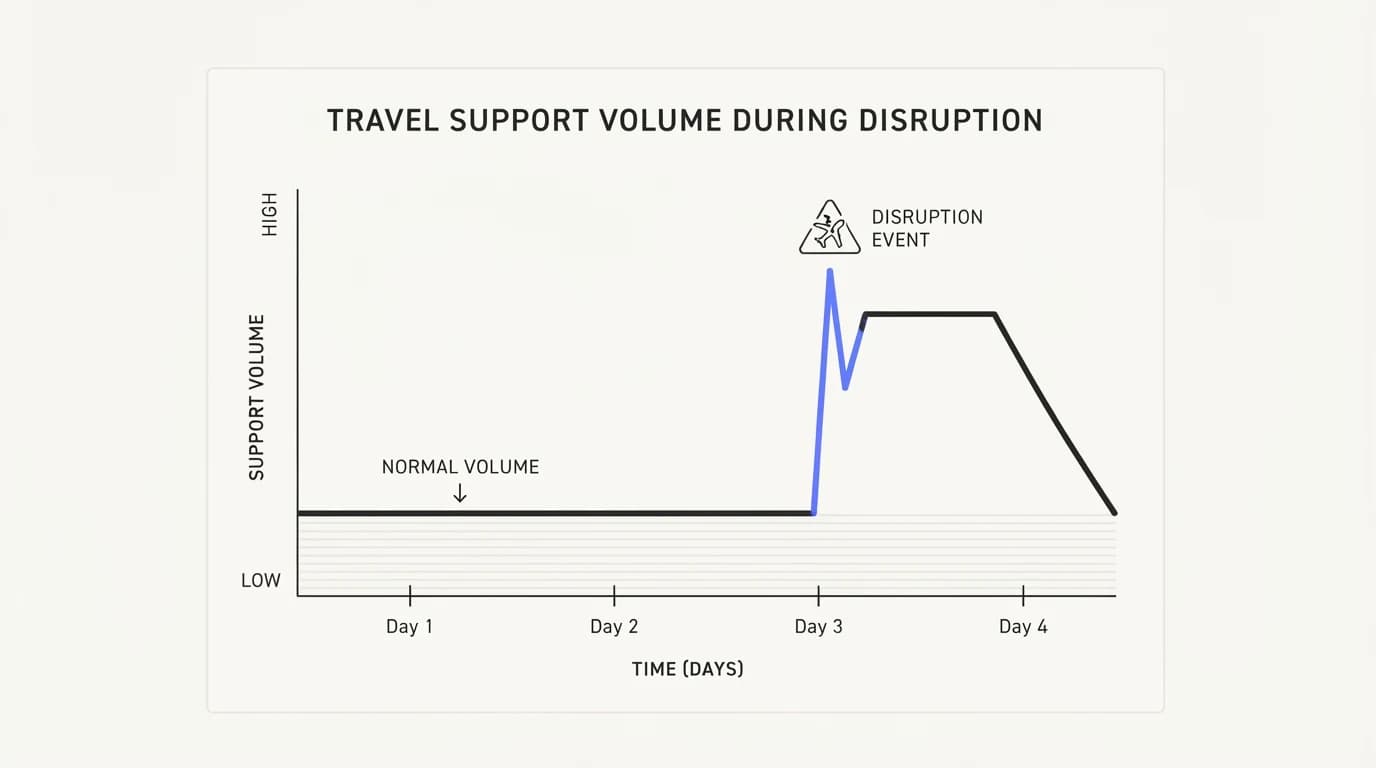
Most support tooling gets sized against a rolling average: tickets per day, average handle time, typical response time. Travel breaks that model, because the distribution of contact volume is not smooth. A normal Tuesday might generate a manageable, predictable trickle, and a single weather system or mechanical issue can multiply that trickle many times over within an hour.
This is the core design flaw in most travel support planning. Teams staff and configure for the average, then get overwhelmed on the day that actually matters, which is the day a customer is stranded, missing a connection, or trying to reach a rebooking desk before the last seats on alternate flights disappear. A customer support automation strategy built only for steady-state volume is solving the wrong problem for this industry.
The fix is to design for the disruption hour explicitly, as its own scenario, rather than hoping average-day tooling stretches to cover it. That means asking what happens to response time, accuracy, and escalation capacity specifically during a spike, not just what the dashboard shows on a quiet week. A tool that looks fine at typical volume can fail exactly when it matters most.
Staffing follows the same trap. A support roster sized for the average week is, almost by definition, undersized for the week that includes a major weather event, because humans cannot be hired and trained fast enough to appear the moment a disruption starts. That gap between average staffing and peak need is exactly where a grounded AI agent does its most valuable work, absorbing the repetitive first wave while your human team scales its attention toward the harder cases a spike also produces.
Modeling the disruption hour instead of the average day
 Communicate.so
Modeling the disruption hour starts with naming your actual trigger events. For an airline, that is weather holds, mechanical delays, and crew scheduling breaks. For a hotel group, it is booking system outages and overbooked properties.
For a booking platform, it is a partner airline's own disruption cascading into your support queue even though you did not cause it.
Once you know the triggers, estimate the volume multiple honestly rather than assuming linear growth. A canceled bank of connecting flights does not add a proportional number of extra contacts, it can multiply the queue by many times over within the hour the news spreads, because every affected passenger tries to reach support at roughly the same moment through every channel available to them.
An AI agent's real value case in travel is absorbing that first wave of repetitive, policy-answerable questions, so human agents can spend their attention on genuinely complex rebookings. Deflection numbers from other industries give a useful floor for what to expect: enterprise deflection benchmarks reported by Lorikeet put a median around 41.2% at maturity, with vendor-marketed claims running higher, and a similar range is realistic for the repetitive share of a travel disruption queue: what is the rebooking policy, can I get a refund, where do I check my new flight status.
What an agent should not attempt during a disruption is anything that requires real-time, account-specific data it does not have: this exact passenger's rebooked flight, this specific refund's processing status, whether this particular route still has open seats. Those questions need a live system connection or a human with access to one, and guessing at them during the highest-stakes hour of the week is where travel support AI causes the most damage.
The Air Canada chatbot ruling and what it actually decided
In February 2024, the British Columbia Civil Resolution Tribunal ruled on Moffatt v. Air Canada, and the decision is worth understanding precisely rather than by headline. A passenger named Jake Moffatt asked Air Canada's website chatbot about bereavement fares after a family death, and the chatbot described a retroactive refund process that did not match the airline's actual policy.
Air Canada argued the chatbot was a separate entity responsible for its own output. The tribunal, in the published decision Moffatt v. Air Canada, 2024 BCCRT 149, rejected that argument, finding Air Canada owed a duty of care to chatbot users and had not taken reasonable care to ensure the chatbot's information was accurate, which amounted to negligent misrepresentation.
The tribunal ordered Air Canada to cover the fare difference the passenger was misled about.
| Claim about the ruling | Accurate | Why |
|---|---|---|
| A company is responsible for what its chatbot tells customers | ✓ | The tribunal held Air Canada accountable for the chatbot's statement the same as a static web page |
| The chatbot itself was found liable as a separate entity | ✗ | The tribunal rejected the argument that the bot bore its own responsibility |
| This was a criminal or regulatory penalty | ✗ | It was a civil small-claims-style tribunal decision awarding damages for negligent misrepresentation |
| The case set a binding rule for every jurisdiction | ✗ | It is a British Columbia tribunal decision; treat it as a strong cautionary precedent, not universal law |
The lesson every travel support team should take is not a legal technicality, it is an operational one: your chatbot's statements are your company's statements. The American Bar Association summarized the ruling as confirming companies remain liable for information their AI chatbot provides, and CBC News covered the case as it unfolded. Treat this as background context, not legal advice, and confirm how it applies to your business with your own counsel.
Scoping a travel agent: policy answers vs binding promises
 Communicate.so
The Air Canada case turned on a chatbot stating something as policy that was not true. The direct fix is not avoiding AI in travel support, it is making sure the agent's policy answers are grounded in your actual, current, published policy rather than a generalized or outdated version the model happened to produce.
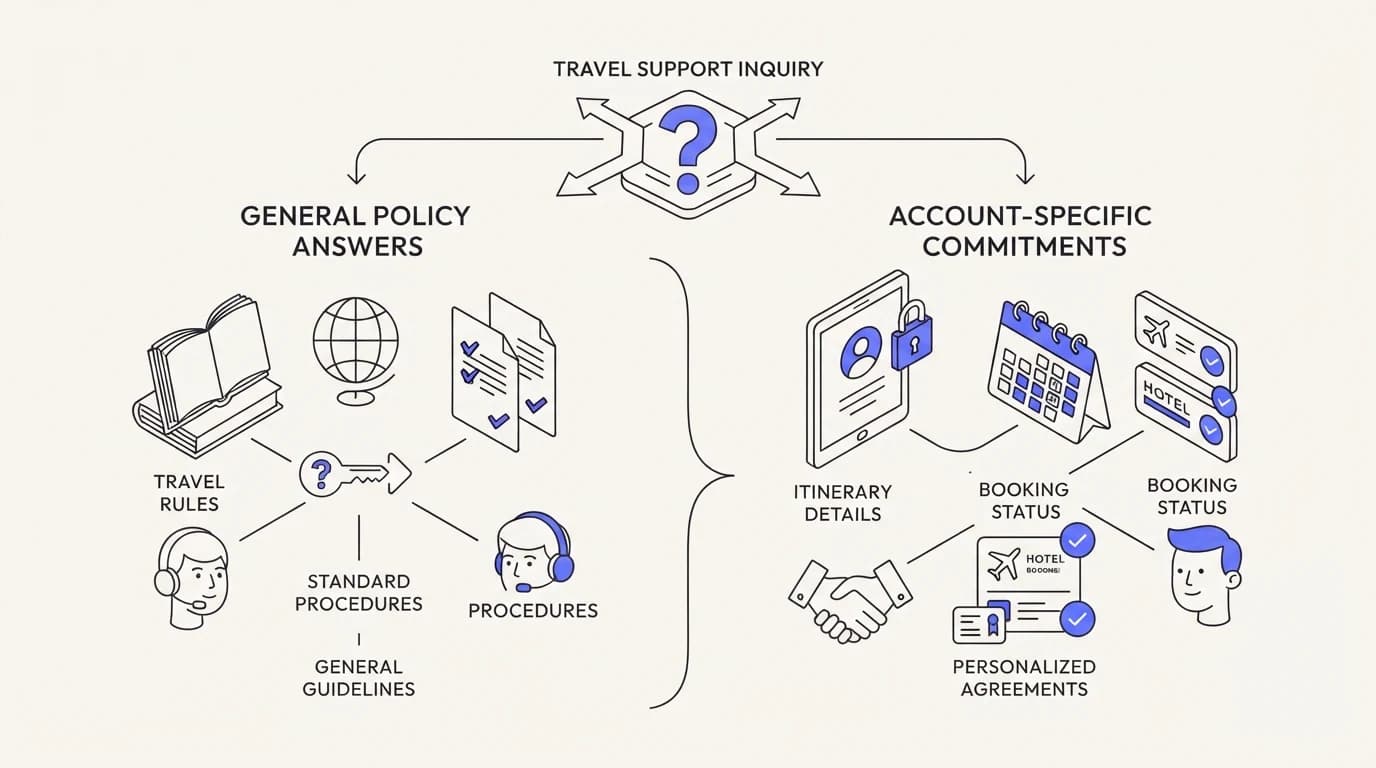
Split the agent's job the same way the ruling implicitly does. General policy questions, what the standard baggage allowance is, what the change fee structure looks like, what the bereavement fare policy actually says, are answerable from documented content and should be answered precisely from that content, not from a paraphrase the model invents.
Anything that would function as a binding promise to a specific traveler, a guaranteed rebooking, a confirmed refund amount, a waived fee for this particular case, needs either a live system check or a human decision, not a chatbot's best guess. Bounding what the agent is allowed to assert, the discipline covered in AI agent guardrails, is the practical version of the duty of care the tribunal described.
Keep policy content current deliberately, with an owner responsible for updating it the same day a policy changes. The Air Canada chatbot was not malicious, it was working from stale or poorly structured information, and that gap between what is published and what the agent knows is exactly where liability risk concentrates.
Grounding: keeping the agent inside real, current policy
Grounding a travel agent means connecting it to your actual policy documents, fare rules, and FAQ content rather than letting it answer from general training knowledge about how airlines or hotels typically operate. Two airlines can have materially different bereavement fare policies, and a model's general sense of the industry is not a substitute for your specific, current terms.
This matters because the failure mode documented across the industry is consistent. CMSWire found the share of organizations reporting a negative consequence from generative AI rose from 44% in 2024 to 51% in 2025, and Twig lists hallucinated answers among the most common complaints about AI support tools. A travel chatbot inventing a fare rule is the exact shape of that failure.
The stronger practice is retrieval grounded strictly in your current published content, with the agent explicitly permitted to say it does not know rather than fill a gap with a confident guess. A traveler asking about an edge-case fare rule deserves an honest handoff to a person, not a plausible-sounding answer assembled from general pattern matching.
Version control on policy content is worth taking seriously in travel specifically, because fare rules and disruption procedures change more often than a typical FAQ, sometimes within the same week a new schedule takes effect. Keep a single source of truth that both your human agents and your AI agent read from, so the two never quietly diverge and start giving travelers two different answers to the same question.
Escalation during an irregular operations event
 Communicate.so
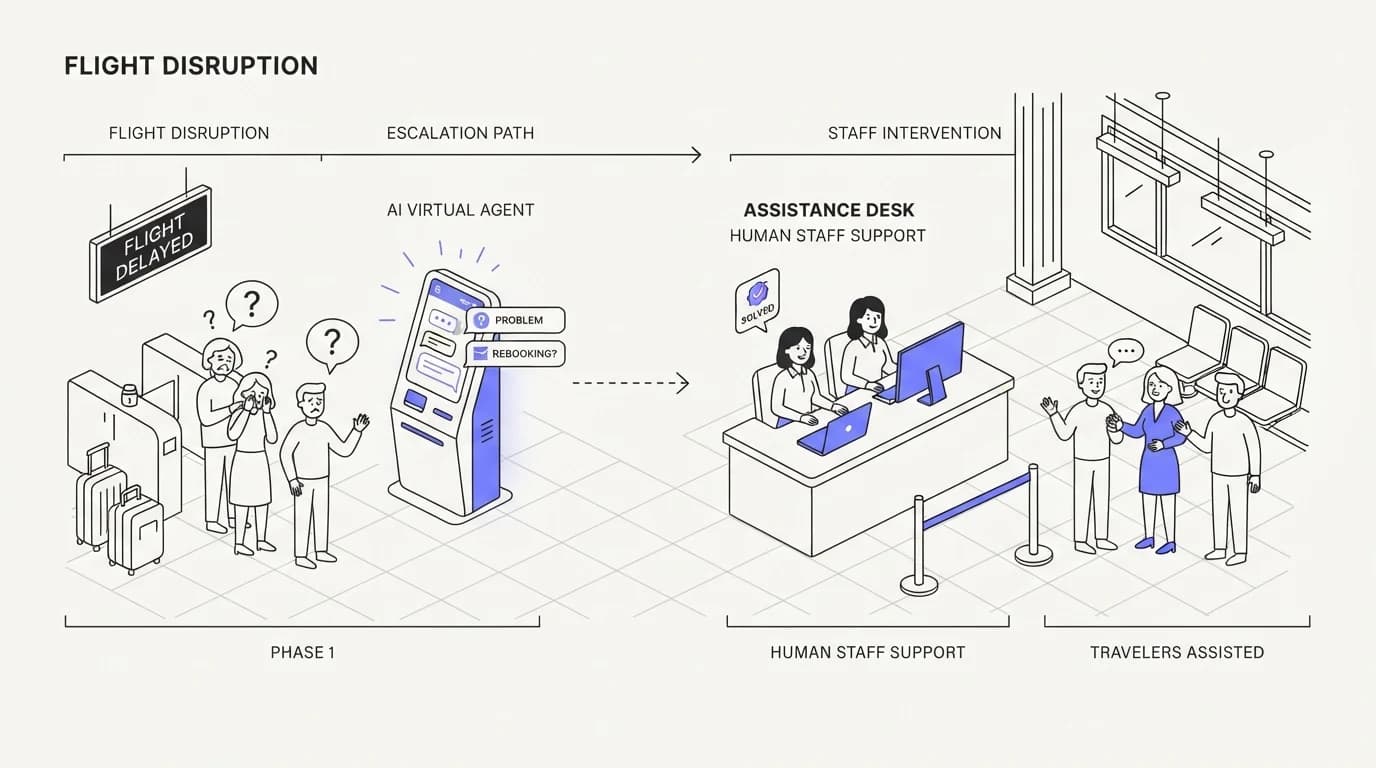
Escalation design matters most exactly when volume is highest, which is the opposite of when most teams test it. During a disruption, the agent should absorb the repetitive policy questions fast and route anything account-specific or emotionally charged to a human immediately, without adding friction to an already stressful moment.
Losing context at handoff is worse in travel than almost anywhere else, because a stranded traveler retelling their entire situation to a second agent, after already explaining it to a chatbot, reads as the company not caring rather than a system limitation. The handoff has to carry the full conversation forward.
A shared surface where the AI and human staff work the same queue supports this directly, the model described in AI to human handoff. During a real disruption, that clean pass is what determines whether the agent reduces load on your team or just adds a frustrating extra step before a human finally helps.
Channels and the 24/7 expectation in travel
 Communicate.so
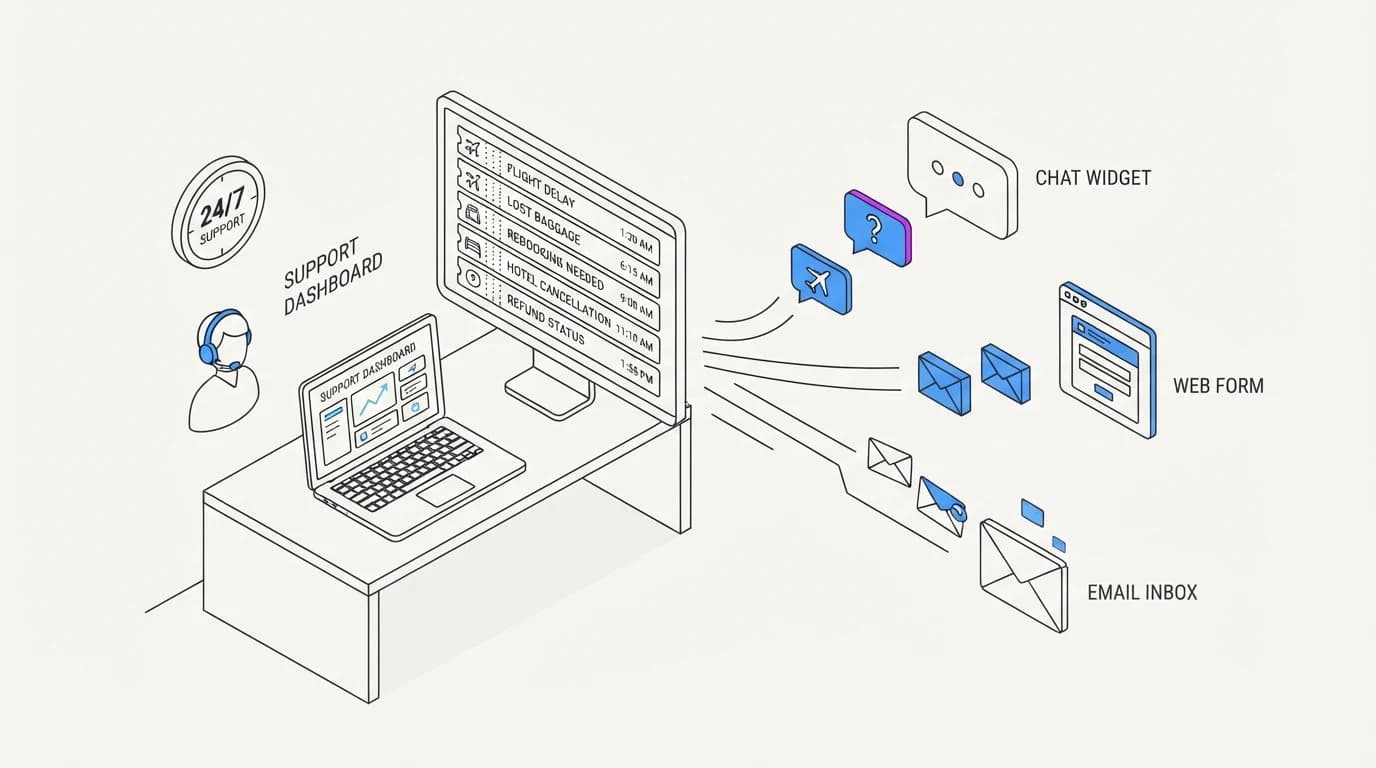
Travel disruptions do not respect business hours, and neither do the travelers affected by them. A flight cancellation at 11 p.m. generates real contact volume at 11 p.m., and a 24/7 AI agent covering policy questions overnight is often the difference between a traveler getting an immediate, accurate answer and sitting on hold until a call center opens.
Multilingual coverage matters more in travel than in most industries, because travelers cross language boundaries constantly and a disruption abroad hits people far from home in a language that may not be the support team's default. Handling that well, the way multilingual customer support approaches it, keeps the same grounded, policy-accurate answers available regardless of the traveler's language.
Track first response time separately during disruption events versus normal operations, because the same target that looks comfortable on an average day can quietly slip during exactly the hour customers need it most. Watching that gap is how you catch a tool that only performs well when nobody is testing it.
Channel consistency matters as much as channel coverage. A traveler who starts a conversation in the app, switches to email from an airport gate with a dying phone, then picks up chat again from a hotel lobby should not have to repeat the disruption they are dealing with at every step. Keeping the AI agent and human escalation on one shared surface across channels is what makes that continuity possible instead of accidental.
Average handle time is worth watching alongside first response time, because a disruption event tends to push both in the wrong direction at once if the agent is not absorbing enough of the repetitive load. Benchmarking your own average handle time during a real spike, not just a demo scenario, tells you whether the tool is actually earning its place in your disruption playbook or just adding a layer between the traveler and the answer.
Where Communicate fits, honestly
Communicate is a grounded AI agent that answers from content you connect and hands off cleanly when a question needs a person or a live system it cannot reach. For a travel business, that means training it on your current fare rules, baggage policy, and disruption procedures, and treating any account-specific rebooking as an automatic escalation.
Here is what it does without embellishment. It runs a web widget, live chat, and email through one shared inbox and one knowledge base, with analytics on response times and escalation rates from the same surface. It does not connect to live flight, reservation, or inventory systems, so any question requiring a real-time booking check routes to your team, not to a guess.
On pricing, entry is a one-time $1 activation with 100 test credits, then usage-based credits, detailed on the pricing page. Run those test credits against your actual disruption-day policy questions, including your bereavement, cancellation, and rebooking rules, before trusting the agent with a live spike.
Key takeaways
- Travel support has to be designed for the disruption hour, not the average day, because a single event can multiply contact volume within minutes.
- Moffatt v. Air Canada, 2024 BCCRT 149, confirmed a company is responsible for what its chatbot tells customers, the same as any other official statement.
- Split agent scope into policy answers, which are safe to automate from grounded content, and binding account-specific promises, which need a human or live system.
- Grounding in current, correct policy content and an honest "I do not know" response are the direct fix to the failure mode the Air Canada case illustrates.
- Escalation has to hold up at peak volume, since a clean handoff during a disruption is what actually protects both the traveler and the business.
Ready to scope an AI agent for the days your travel support actually gets tested? Start with a one-dollar account activation that includes 100 test credits, connect your current fare and policy documents, and test it against your worst disruption scenario before it goes live.
Frequently asked questions
Is a company liable for what its AI chatbot tells customers?
Based on the Moffatt v. Air Canada tribunal decision, yes, at least under the negligent misrepresentation reasoning that court applied. The tribunal held Air Canada responsible for its chatbot's inaccurate statement the same way it would be responsible for a static web page, in Moffatt v.
Air Canada, 2024 BCCRT 149. Confirm how this applies in your jurisdiction with your own counsel.
What happened in the Air Canada chatbot case?
A passenger asked Air Canada's website chatbot about bereavement fares after a family death, and the chatbot described a retroactive refund process that did not match the airline's actual policy. When the passenger tried to claim it, Air Canada said the chatbot's statement was not binding. A tribunal disagreed and ordered the airline to cover the fare difference.
Did the tribunal rule the chatbot itself was liable?
No. The tribunal rejected Air Canada's argument that the chatbot was a separate entity responsible for its own output, and held the company accountable instead. See the full decision at CanLII for the tribunal's reasoning.
Why is travel support volume so spiky compared to other industries?
Travel disruptions cluster around discrete triggers, weather, mechanical issues, crew scheduling, and system outages, that affect many travelers at once and prompt them to contact support within the same narrow window. Unlike steady product-usage questions in other industries, travel contact volume tracks external events rather than a rolling average.
How should I design support capacity for a disruption instead of an average day?
Model your specific trigger events and estimate the realistic volume multiple during each one, then design escalation and AI coverage around that peak rather than your typical daily volume. An agent that comfortably handles average-day traffic can still fail during a real spike if it was never tested against one, which is why 24/7 coverage and clean escalation matter more here than raw average-day metrics.
Can an AI agent process a refund during a flight cancellation?
Only if it has a live, authorized connection to your reservation and payment systems, and even then the decision to automate a refund versus route it to a human is a policy call your team should make deliberately. A general support agent without that live connection should explain refund policy and route the actual processing to a person or system with account access.
What should an AI agent never promise during a travel disruption?
Anything account-specific it cannot verify in real time: a guaranteed seat on a specific alternate flight, a confirmed refund amount, or a waived fee for one particular case. Those require live data or human authority, and a confident guess in that territory is exactly the failure the Air Canada ruling illustrates.
How accurate does a travel support AI need to be on policy questions?
As accurate as your published policy, every time, because the ruling in Moffatt v. Air Canada established that an inaccurate chatbot statement carries the same weight as an inaccurate statement anywhere else on your site. Grounding the agent in current documents rather than general model knowledge is the direct way to hold that bar, a discipline covered in reducing AI hallucinations in support.
Does a chatbot need to disclose that it is AI to travelers?
Clear disclosure is good practice regardless of jurisdiction-specific legal requirements, since a traveler deserves to know they are talking to an automated system rather than a person, especially during a stressful disruption. Label the agent plainly at the start of the conversation and make it easy to reach a human.
How do I keep bereavement and disruption policy content accurate for an AI agent?
Assign an explicit owner responsible for updating the agent's source documents the same day a policy changes, and treat that update as part of the policy change process itself, not an afterthought. The Air Canada chatbot's failure traced back to outdated or poorly structured information, not a fundamentally broken concept.
Should a travel AI agent handle multiple languages?
Yes, since travelers cross language boundaries constantly and a disruption often strands people far from a region where the support team's default language is spoken. Grounded multilingual customer support keeps the same accurate, policy-grounded answers available regardless of the traveler's language.
What is the safest first travel support use case for AI?
General, stable policy questions: baggage allowance, standard change fee structure, check-in windows, and cancellation policy basics. These have documented, consistent answers and let you validate a grounded AI agent on lower-stakes territory before extending it toward disruption-specific scenarios.
How does deflection during a travel disruption compare to normal support benchmarks?
Enterprise deflection benchmarks reported by Lorikeet put a median around 41.2% at maturity across industries, and the repetitive share of a disruption queue, rebooking policy and refund process questions specifically, is a reasonable target for a similar deflection rate once the agent is properly grounded.
Can AI reduce hold times during a flight cancellation event?
It can reduce hold times for the policy-answerable share of contacts by resolving them immediately through chat rather than a phone queue, freeing human agents to focus on account-specific rebooking that requires their access and judgment. It does not eliminate the need for humans during a major disruption, it changes what they spend their time on.
What escalation signal should trigger an automatic handoff in travel support?
Any request that is account-specific, requires a live system check, or involves a promise the agent cannot verify, such as a guaranteed rebooking or a specific refund amount. The handoff should carry the full conversation, the pattern covered in AI to human handoff, so the traveler does not have to restate their situation to a second person.
Does the Air Canada ruling apply outside Canada?
It is a British Columbia Civil Resolution Tribunal decision, so it is directly binding only within that jurisdiction, but legal commentary from the American Bar Association and others has treated it as a widely cited cautionary precedent internationally. Confirm the law that applies to your specific business and jurisdiction with counsel.
How often should travel policy content be re-synced to an AI agent?
As close to real time as your update process allows, and at minimum immediately whenever a fare rule, fee structure, or disruption procedure changes. Stale policy content grounding an AI agent creates exactly the gap between what is published and what the agent says that caused the Air Canada case.
What made the Air Canada chatbot answer wrong in the first place?
Public reporting on the case does not describe the chatbot as malicious or unusually broken, it described a retroactive bereavement fare process that did not match the airline's actual policy. The most likely operational cause, consistent with failures documented across the industry, is a gap between the chatbot's grounding content and the airline's current, correct policy.
Is it worth using AI support for a small travel business with irregular disruption events?
Yes, and arguably more so than for a business with steady volume, because a small team has the least slack to absorb a sudden spike. A grounded agent that resolves the repetitive policy share of a disruption queue, paired with clean human escalation for the rest, is one of the more direct ways customer support automation pays off for a business whose volume is inherently uneven.
How do I measure whether a travel AI agent is actually working during a disruption?
Track deflection rate, first response time, and escalation accuracy specifically during disruption windows, not just as a blended average across the month. A tool that performs well on quiet days but slows down or starts guessing during a spike will hide that weakness in a monthly average, which is why disruption-specific analytics matter more than a single headline number for a travel support operation.