
AI agent fallback design: build the "I do not know" path first
 Communicate.so
Chatbot fallback design for AI support agents: how to design the escalation path before the happy path, and why the fallback is the actual product.
TL;DR: Most AI support projects design the happy path first: the agent answers well, the demo looks good, and the team ships. The fallback path, what happens when the agent does not know the answer, gets designed last or not at all, and it is the path a frustrated, confused, or high-stakes customer actually experiences most often. This guide argues the fallback is the real product, since it is what determines whether a customer trusts the system after it fails once. It covers how to detect when the agent should stop answering, how to hand off without losing context, what a good refusal sounds like, and the failure modes of a fallback design built as an afterthought.
Ask a support lead to describe their AI agent and you get a description of what it answers well. Ask what it does when it does not know, and the answer is often vague, or worse, silence, because the fallback path was never designed with the same care as the happy path. That gap is where trust breaks, and it breaks in a way a good happy path cannot repair after the fact.
This guide is written for the person building or reviewing an AI agent for support, and it treats the fallback, the escalation, the handoff, the honest refusal, as the primary design object, not the exception case. It draws on the escalation workflow and human handoff patterns already proven in production support systems, applied specifically to the moment an agent decides it should stop.
Why the fallback is the actual product
A customer who gets a correct answer from an AI agent barely notices the AI part. The interaction feels like support working as expected, and the agent's presence is invisible in the best sense. A customer who hits the fallback path notices everything: whether the handoff is fast, whether the human picking up already has context, and whether the agent admitted uncertainty honestly or bluffed.
This is why fallback quality drives trust more than average answer quality. Support tools accumulate a reputation from their worst interactions, not their best ones, and a Twig review of common AI support complaints lists no escalation path as one of the most frequent grievances customers raise (Twig), right alongside hallucinated answers. Both complaints point at the same root failure: an agent that does not know when to stop.
Designing the fallback first, before the happy path is even fully built, forces a useful discipline. It makes a team define what confidence actually means for their agent, rather than treating every generated answer as equally trustworthy by default.
This discipline compounds with the pressure most teams are already under. 91% of CX leaders report executive pressure to deploy AI faster than their team can validate it (DigitalApplied), and that pressure pushes teams toward polishing the visible happy path rather than the harder, less demo-friendly work of defining exactly when the agent should stop. A fallback built under that same time pressure, as an afterthought once the happy path already works, tends to inherit all of the shortcuts the happy path took.
What triggers a fallback: detecting the boundary of what the agent knows
 Communicate.so
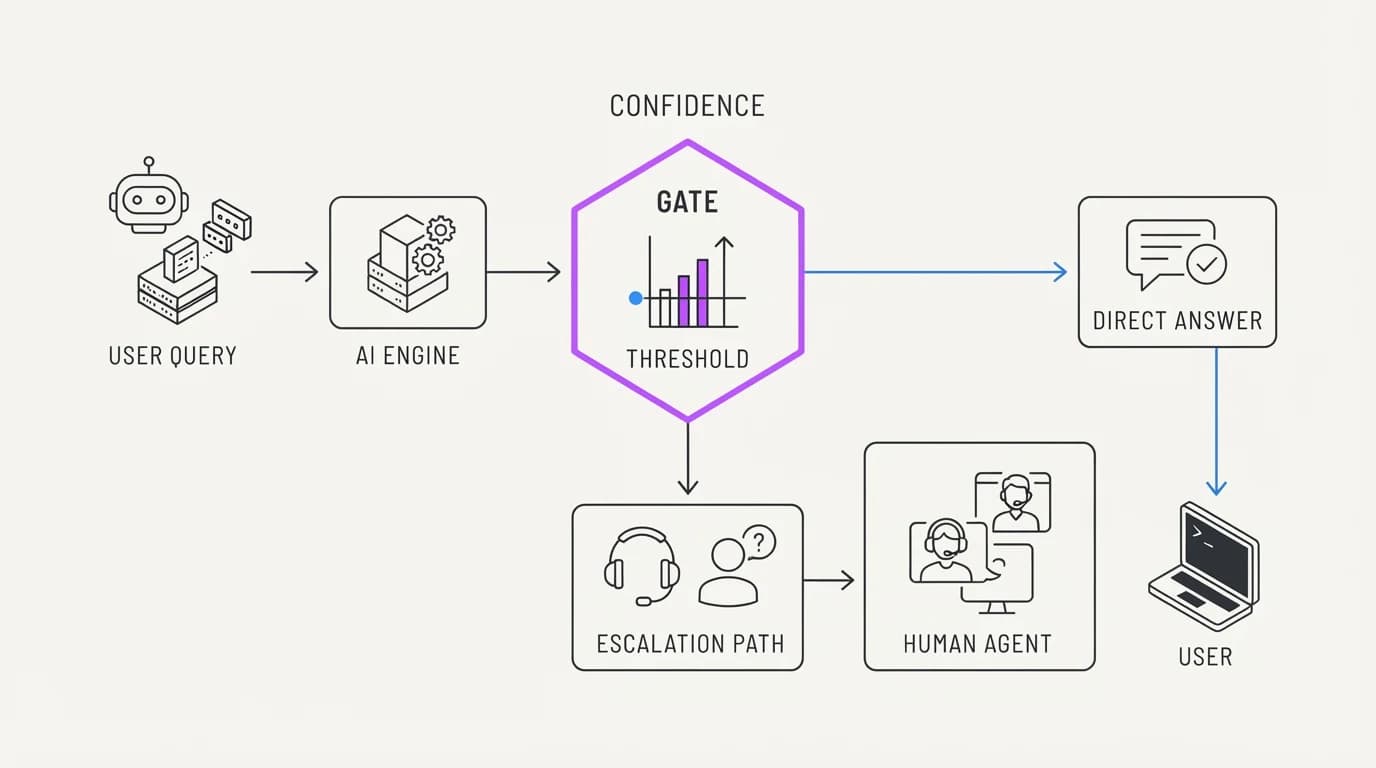
A fallback needs a trigger, and the trigger is rarely a single clean signal. Four conditions reliably indicate an agent has reached the edge of what it can safely answer: no retrieved passage matches the question closely enough, the question requires an account-specific fact the agent cannot access, the customer signals frustration or explicitly asks for a human, and the topic falls into a category flagged as high-risk regardless of confidence, such as legal, medical, or financial commitments.
Retrieval confidence is the most measurable of the four. When the top-ranked passage from the knowledge base falls below a similarity threshold, the honest response is not a best-effort guess stitched from weak matches, it is a direct statement that the agent does not have a confident answer. Teams building this threshold should read the companion guide on reducing hallucinations, since a poorly calibrated confidence threshold is the single largest cause of an agent answering when it should have escalated.
Sentiment and explicit requests are easier to detect but easy to under-weight. A customer who types "just get me a person" should never be met with another round of clarifying questions from the agent. Treat an explicit request for a human as an immediate, unconditional trigger, not one signal among several to be weighed against the agent's own confidence.
The account-specific trigger deserves its own attention because it sits at the boundary between two systems. An agent that cannot verify a customer's order status because the CRM integration has no live connection, or because the specific field it needs was never scoped into the read path, is not missing knowledge, it is missing access. That distinction matters for how the fallback message reads: telling a customer their information is not currently accessible is different from telling them the question is outside what the agent can answer at all, and conflating the two produces a confusing refusal.
What a good refusal sounds like
A bad refusal is vague, generic, and offers no path forward: "I am unable to help with that." A good refusal names what the agent does not know, confirms what it does know, and states the next step clearly.
Compare the two directly. A weak fallback says the request cannot be processed. A strong fallback says the specific account detail needed is not available to it, confirms it has flagged the ticket to a specialist, and states roughly when the customer should expect a reply.
The second version costs almost nothing extra to generate and changes the entire experience of being told no. This is the same discipline covered in the guide to AI agent guardrails, where refusal language is treated as a first-class part of the system prompt, not an edge case appended at the end.
The tone of a refusal matters as much as its content. An apologetic, over-hedged refusal reads as evasive even when the underlying reasoning is sound. State the limitation plainly, once, and move directly to the next step rather than repeating an apology.
Write the refusal language the same way a support team would write a canned response for a human agent to send, reviewed and edited by someone who actually talks to customers, rather than generated fresh by the model every time. A small, fixed library of well-written refusal templates, selected by the trigger category, is more consistent and easier to audit than letting the model improvise a new refusal on every call.
Handoff without losing context
 Communicate.so
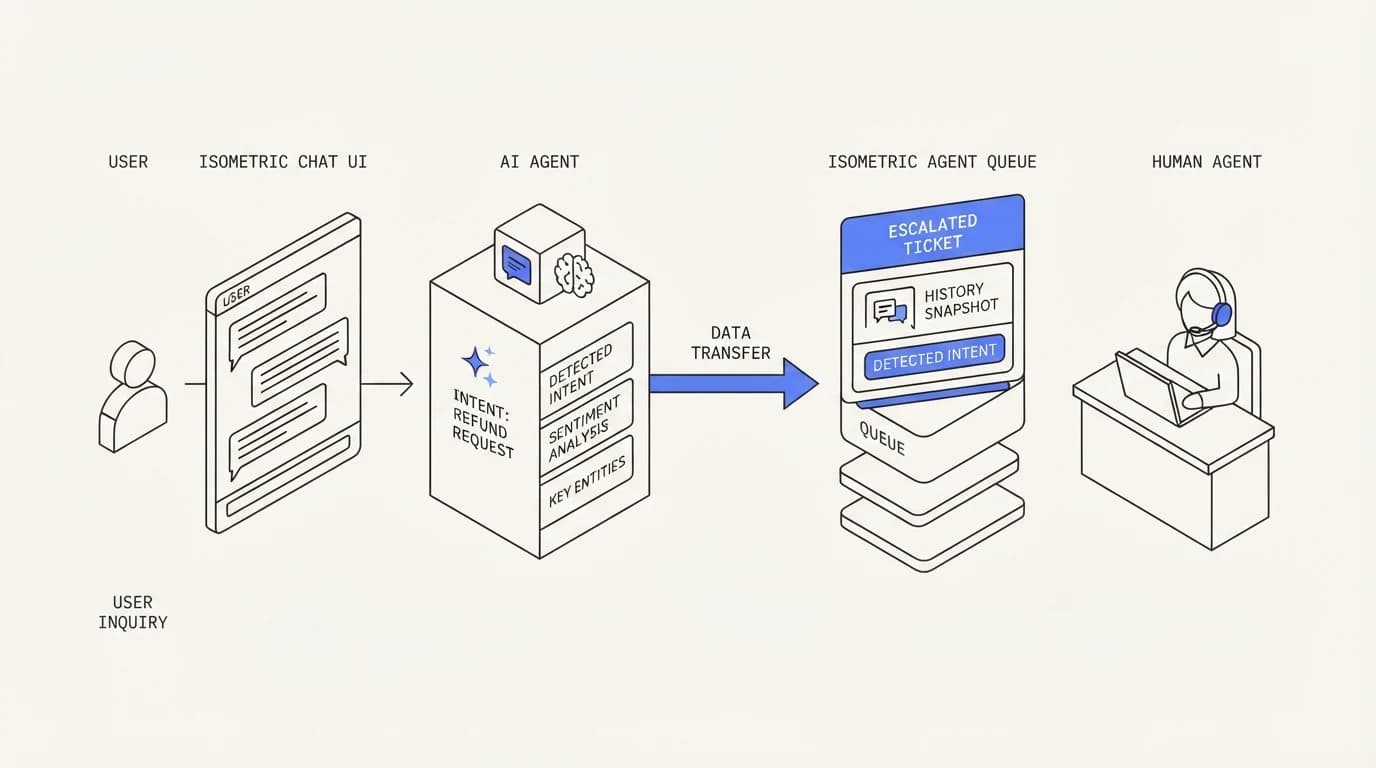
The most common way a fallback fails is not a bad refusal message, it is a handoff that drops everything the AI agent already learned. A customer who spent five minutes explaining a problem to the agent should never have to repeat it to the human who picks up next.
A well-built handoff passes the full conversation transcript, any account context the agent already pulled, and a short structured summary of what the customer needs, into the human agent's queue before the human opens the ticket. This is the mechanism described in shared inbox with AI and humans, where the AI agent and human agents work the same queue rather than two disconnected systems bridged by a copy-pasted transcript.
Priority matters as much as context. A handoff triggered by explicit customer frustration should route to the front of the queue, not the back, since the customer has already spent effort getting this far and a long wait after that effort compounds the original frustration.
Consider what the human agent sees the moment they open the ticket. A raw transcript dump forces them to read the whole conversation before responding. A structured summary at the top, the customer's actual need in one or two sentences, followed by the full transcript for reference, lets the human agent start responding within seconds rather than minutes.
This small formatting choice has an outsized effect on how fast a handoff actually resolves, independent of anything the AI agent itself did well or poorly.
Fallback design patterns compared
Not every fallback needs to be a full human handoff. The right pattern depends on how confident the agent is and how urgent the request is, and treating every uncertain moment as an identical escalation wastes both the agent's partial knowledge and the human queue's capacity.
| Pattern | When to use it | Loses context | Good default |
|---|---|---|---|
| Clarifying question | Ambiguous but answerable question | ✗ | ✓ for low-confidence but recoverable cases |
| Partial answer plus offer to escalate | Agent knows part of the answer, not all | ✗ | ✓ for mixed-confidence questions |
| Immediate human handoff with context | High-risk topic or explicit customer request | ✗ | ✓ for frustration and high-stakes cases |
| Generic refusal with no next step | Never | ✓ | ✗ |
The pattern in the last row is the one most agents default to without meaning to, because it requires the least design work. It is also the pattern most responsible for the no-escalation-path complaint that shows up repeatedly in customer feedback about AI support tools.
Escalation routing: who gets the ticket and how fast
 Communicate.so
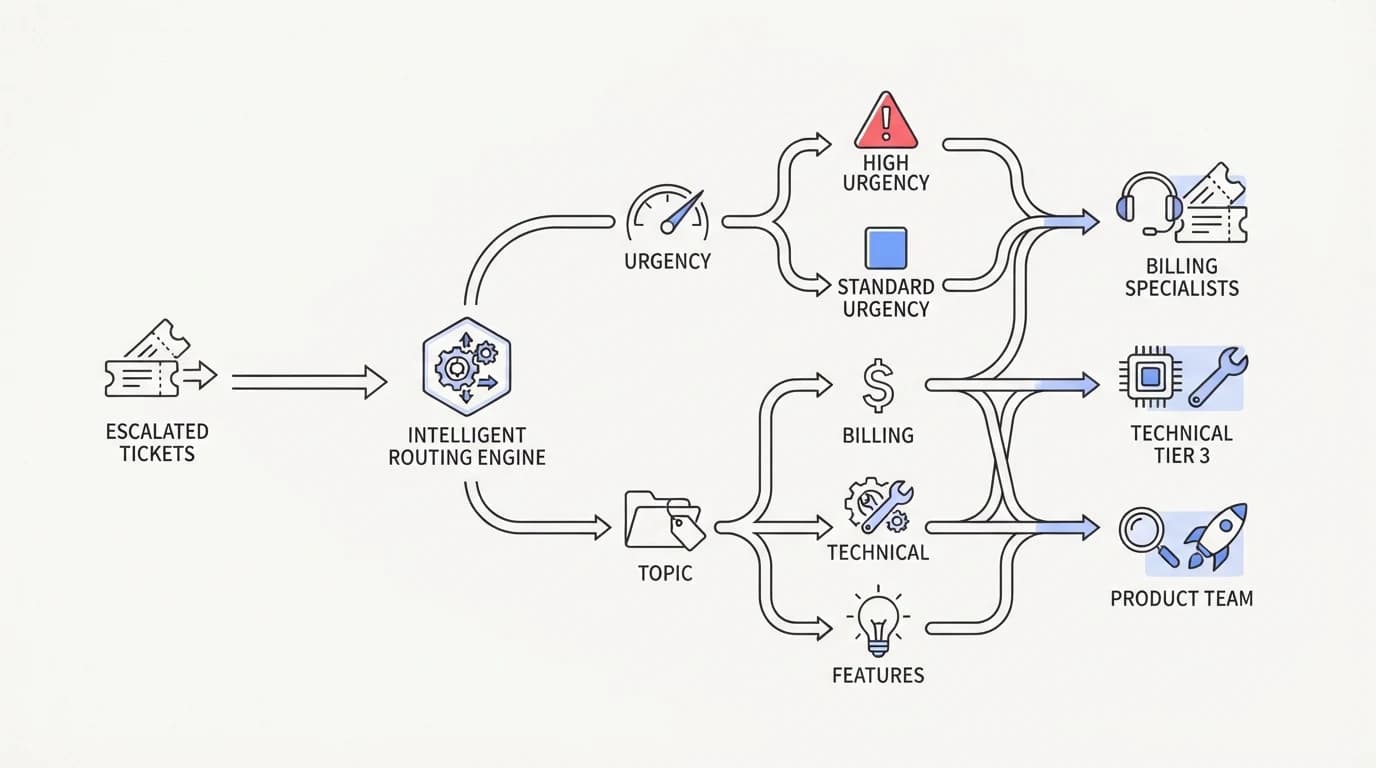
A fallback that hands every escalated ticket to a single generic queue solves the immediate handoff problem but creates a new bottleneck downstream. Route by the same signals that triggered the fallback: a billing question goes to billing, a high-frustration signal jumps the queue regardless of topic, and a topic the agent flagged as high-risk goes to whichever team is authorized to make that judgment call. This routing logic is the same discipline covered in support escalation workflow design, applied specifically to AI-originated escalations rather than customer-initiated ones.
Track how long an escalated ticket waits after handoff, not just how long the AI portion of the conversation took. A fast, honest fallback followed by a long wait in a human queue still produces an unhappy customer, and measuring only the AI portion of the timeline hides that.
Staffing for the fallback queue is a separate planning exercise from staffing for total ticket volume. A team that reduces headcount purely on the strength of a high deflection rate can end up understaffed for the specific, harder tickets that reach the human queue, since those tickets take longer to resolve than the average ticket the deflection rate is calculated against. Plan human capacity against the fallback queue's own volume and complexity, not against total ticket volume minus deflected tickets.
Testing the fallback path before launch
Most AI agent testing focuses on whether the happy path answers correctly. Testing the fallback path deserves equal weight: run a fixed set of scenarios designed to fail, an out-of-scope question, an account-specific question with no CRM access, an explicit request for a human, and a high-risk topic, and verify the agent escalates rather than guesses in every case. This mirrors the golden-set discipline used to evaluate the happy path, applied to the boundary instead of the center.
A fallback test set should be revisited every time the agent's knowledge base or prompt changes, since a change that improves happy-path accuracy can inadvertently raise the agent's confidence threshold too high, causing it to answer questions it previously and correctly escalated.
Include at least one scenario in the test set where the customer's tone shifts mid-conversation, starting calm and turning frustrated after a clarifying question. This tests whether the fallback trigger reacts to the current state of the conversation or only to the opening message, and a surprising number of fallback systems only evaluate the first message for sentiment, missing a shift that happens three turns in.
Where fallback design goes wrong
The most common mistake is designing the fallback once, at launch, and never revisiting it as ticket patterns shift. A fallback trigger tuned for one product's ticket mix drifts out of calibration as the product changes, new features introduce new categories of question the original threshold never accounted for. The second common mistake is over-triggering the fallback out of caution, which defeats the purpose of the agent entirely if every remotely ambiguous question routes to a human regardless of whether the agent actually knew the answer.
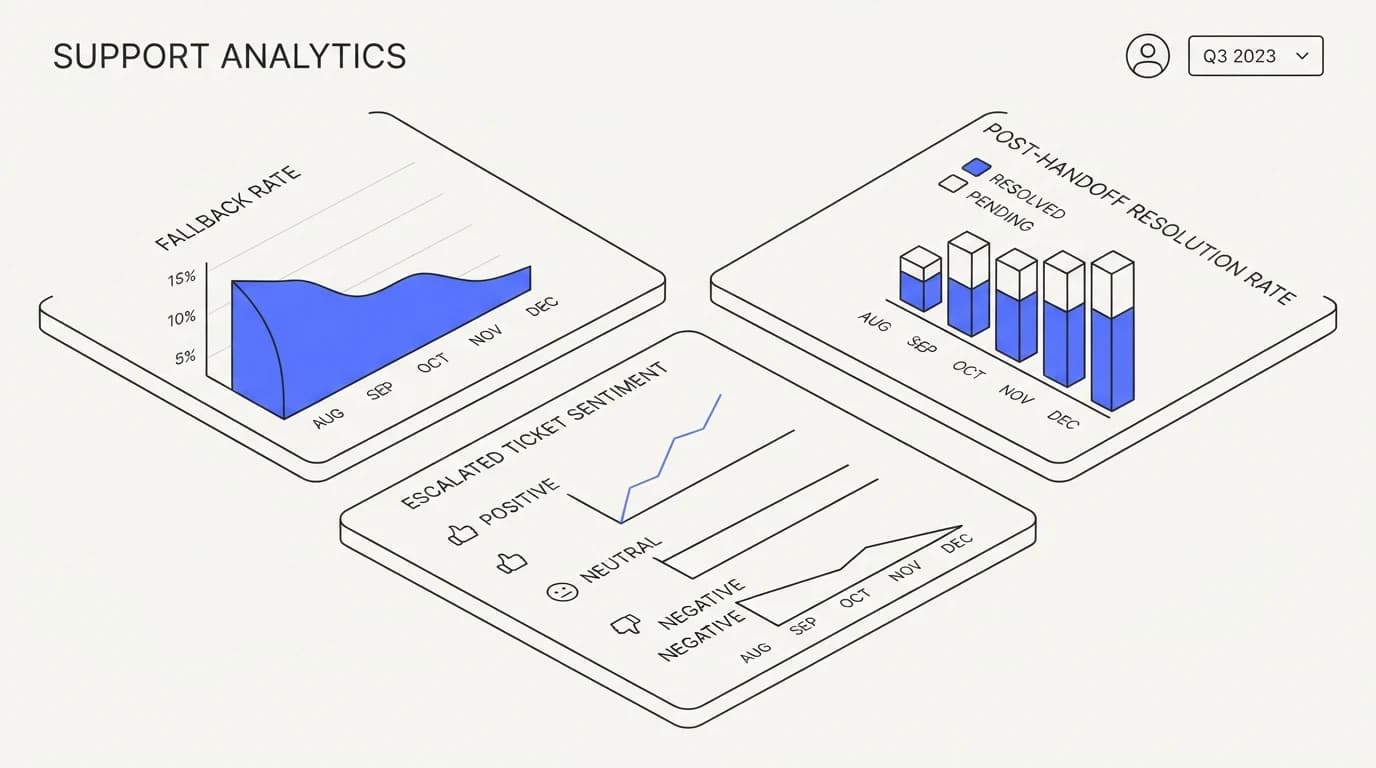
The balance is not a one-time setting. It is a metric to track continuously: fallback rate, resolution rate after fallback, and customer sentiment on escalated tickets, reviewed with the same regularity as the agent's core answer accuracy.
Assign explicit ownership for this review rather than leaving it as a shared responsibility nobody actually checks. A named owner who reviews fallback metrics on a fixed schedule, weekly during the first quarter after launch and monthly after that, is what turns this from a one-time design exercise into a maintained part of the support operation.
Measuring fallback health over time
 Communicate.so
A fallback system is not a one-time build, it is an ongoing measurement loop. Track fallback rate alongside the deflection numbers already covered in support ticket deflection rate: a healthy agent resolves the majority of routine volume directly and escalates the minority that genuinely needs a human, and a shift in either direction, a falling deflection rate or a rising fallback rate, is worth investigating before it shows up as a customer complaint. Neither number is meaningful in isolation, since a low fallback rate paired with a low deflection rate usually means tickets are quietly going unresolved rather than being escalated correctly.
Review a sample of escalated transcripts monthly, not just the aggregate metrics. A dashboard can show a stable fallback rate while the underlying reasons for escalation quietly shift, for example a new product feature generating a new category of question the agent was never trained to recognize as out of scope. Reading real transcripts catches that shift long before the aggregate numbers move enough to trigger an alert.
Frequently asked questions
What is the difference between a fallback and a refusal
A refusal is one specific response, telling the customer the agent cannot answer. A fallback is the entire system around that moment: the trigger that detects the boundary, the message the customer receives, and the handoff that follows. A well-designed fallback usually includes a refusal as one component, not as the whole response.
Should every low-confidence answer trigger a full human handoff
No. A low-confidence answer on an otherwise answerable, low-stakes question is often better served by a clarifying question that lets the agent recover, rather than an immediate escalation that adds wait time for something the agent could have resolved with one more turn. Reserve immediate handoff for genuinely high-risk or explicitly requested cases.
How is a confidence threshold actually set
Start from a fixed test set of real tickets labeled by whether a human would consider the retrieved context sufficient to answer confidently. Tune the threshold against that labeled set rather than a single arbitrary number, and re-tune it whenever the knowledge base or prompt changes meaningfully.
Expect to set the threshold slightly more conservative than feels optimal on the first pass. Teams consistently find that a threshold tuned to minimize unnecessary escalations on a test set ends up letting through more borderline live answers than expected, because real customer phrasing is messier than the test set's cleaner examples.
What happens if a customer explicitly asks for a human but the queue is full
The agent should acknowledge the request immediately and set an honest expectation for wait time, rather than continuing to attempt an AI-generated answer while the customer waits. A delayed but honest handoff preserves more trust than a fast but unwanted continued AI response.
Does a good fallback need a different tone than the rest of the agent's responses
The tone should stay consistent, but the content changes. A fallback message that suddenly turns robotic or overly formal after a natural-sounding happy path reads as jarring and can feel like the system giving up rather than handing off carefully. Keep the same voice, change only what is being communicated.
Should the agent tell the customer explicitly that it is an AI when it escalates
Clarity here builds trust rather than undermining it. Telling a customer their conversation is moving to a human teammate, and naming that the AI could not fully resolve the specific question, is more honest and generally better received than a vague transition that leaves the customer unsure what actually happened.
How much conversation history should transfer during a handoff
The full transcript, plus any structured account context the agent already pulled, plus a short summary of the unresolved need. Transferring only a summary risks losing detail the customer already provided. Transferring only the raw transcript without a summary makes the human agent do the synthesis work the AI agent already did.
Can fallback design reduce overall support costs
Yes, indirectly. A well-tuned fallback keeps genuinely resolvable tickets in the AI path instead of over-escalating them, and it keeps genuinely unresolvable tickets from bouncing through multiple failed AI attempts before reaching a human. Both effects reduce wasted work, even though the fallback path itself is not where the cost savings visibly show up.
The token cost of a fast, clean escalation is also smaller than the cost of several retry attempts, a topic covered in more depth in reducing LLM costs.
What is the risk of an agent that almost never triggers a fallback
An agent that rarely escalates is either genuinely excellent or dangerously overconfident, and the difference matters. Audit a sample of its high-confidence answers on ambiguous or account-specific questions specifically, since an agent that never admits uncertainty is often one whose confidence signal is broken rather than one that is always right.
A near-zero fallback rate is worth treating as a warning sign on its own, independent of any customer complaint. It usually means the confidence threshold is set too permissively, letting genuinely uncertain answers through as if they were confident ones, which is a quieter and more dangerous failure than an over-cautious agent that escalates too often.
How does fallback design interact with multilingual support
Confidence signals and retrieval quality can behave differently across languages, particularly if the knowledge base is stronger in one language than another. A fallback threshold tuned on English-language tickets may under-trigger or over-trigger on other languages, so teams running multilingual customer support should validate the fallback trigger separately per language rather than assuming one threshold transfers cleanly.
Should a fallback ever offer the customer a choice between waiting for a human and continuing with the AI
Yes, for lower-stakes cases where either path is reasonable. Giving the customer the choice respects that some people prefer to keep trying with the AI while others want a human immediately, and offering the choice explicitly is often better received than the system silently deciding for them.
What metrics track fallback health over time
Fallback rate, resolution rate after fallback, average wait time post-handoff, and customer sentiment specifically on escalated tickets. Tracking fallback rate alone is misleading, since a rising rate could mean the agent is getting more cautious and honest, or it could mean the knowledge base has gone stale. The other metrics disambiguate which one is happening.
Does a fallback design change based on channel, such as chat versus email
The underlying triggers stay the same, but the handoff mechanics differ. A live chat handoff can move a customer into a queue in real time with visible status. An email-based fallback needs to set an explicit expectation for reply time, since the customer has no live indication that anything is happening after the AI response lands.
Is it ever appropriate for the agent to guess rather than escalate
No, not when the guess could be wrong in a way that matters to the customer. A wrong guess dressed as a confident answer causes more damage to trust than an honest escalation, even though escalation feels like a less impressive product outcome in a demo. The fallback exists precisely to prevent this trade from being made silently.
How does fallback design relate to first response time
A fast fallback that hands off cleanly protects first response time even when the AI cannot resolve the ticket itself, because the customer receives an immediate, honest acknowledgment rather than a delayed non-answer. Measuring first response time without accounting for fallback quality can hide a real problem: a fast initial reply that turns out to be a dead end.
What is the biggest single improvement most teams can make to their fallback
Passing full context on handoff. Most fallback systems already detect the right trigger and say a reasonable refusal, but drop the conversation history and account context at the handoff boundary, forcing the customer to repeat themselves. Fixing the context transfer usually improves perceived quality more than tuning the confidence threshold further.
This fix is also the cheapest one on this list to ship, since it is usually an engineering change to what data accompanies a handoff event rather than a change to the model, the prompt, or the confidence logic. Teams looking for a fast first win on an existing agent should start here before touching anything else.
Should fallback design be reviewed alongside every prompt change
Yes. A prompt change aimed at improving happy-path answers can shift the agent's effective confidence in either direction without anyone intending it to, and the fallback test set described earlier in this guide is the fastest way to catch that shift before it reaches customers rather than after a complaint surfaces.
How does a well-designed fallback change customer perception of the AI agent overall
Customers who experience one honest, well-handled fallback tend to trust the agent more on future interactions, not less, because the failure demonstrated the system knows its own limits. This is the core argument for treating the fallback as the actual product: it is the interaction that proves the system is trustworthy, not the one that proves it is capable.
Should a team build the fallback path before the happy path is finished
Design it first, even if the happy path ships first in practice. Deciding what counts as low confidence, what an honest refusal sounds like, and how handoff context transfers are decisions that shape the rest of the system, and making them after the happy path is built usually means retrofitting logic into a prompt and pipeline that were never structured for it. Teams following a staged rollout, such as the one in launch your first AI agent, should treat the fallback design as part of the first milestone, not a later one.
Can a fallback message include a partial answer alongside the escalation
Yes, and this is often the best version of a fallback. If the agent is confident about part of a multi-part question and uncertain about the rest, stating the confident part directly and escalating only the uncertain part respects the customer's time more than discarding everything the agent already knew. This requires the agent's confidence scoring to work at the sub-answer level rather than only at the level of the whole response.
Building this well takes more engineering effort than a single whole-response confidence score, since it means decomposing a question into parts and scoring each independently. Teams starting out should ship the simpler whole-response version first and add sub-answer scoring once the basic fallback loop is proven and measured, once real transcript volume shows how often multi-part questions actually occur.