
AI support tone of voice: a QA rubric, not a personality
 Communicate.so
AI support tone of voice guide: why robotic tone is a prompt problem, and the QA rubric that fixes it without changing models.
TL;DR: Robotic tone is one of the top complaints customers raise about AI support, alongside hallucinated answers, no escalation path, no context awareness, and poor integration, according to Twig's research. Most teams treat tone as a personality setting they configure once and forget. That framing does not hold up, because tone drifts as prompts get edited and content changes, and nobody notices until a customer complains. This guide treats tone as a QA rubric with graded criteria you check against real transcripts, the same discipline applied to accuracy or response time. It covers what tone actually is in a support context, how to write a rubric, how to build example exchanges that teach the model your voice, and how to keep tone from drifting after launch. None of this requires a different model. It requires writing down what good sounds like and checking against it.
Ask a support lead what is wrong with their AI agent and accuracy rarely tops the list. Tone does. The bot answers correctly and still leaves people cold, because it sounds like a form letter reading a policy document out loud rather than a person trying to help.
Robotic tone sits alongside hallucinated answers, no escalation path, no context awareness, and poor integration as one of the recurring complaints customers raise about AI support tools, according to research from Twig. If you want the full breakdown of all five complaints and what causes each one, the guide to why customers hate chatbots covers it. This guide stays on the one that is hardest to describe and easiest to get wrong: tone.
The claim this guide defends is specific. Tone is not a personality you pick from a dropdown, and it is not a one-time setting you configure at launch. Tone is a quality standard you write down, test against real transcripts, and re-check the way you would check response time or resolution rate, a discipline closer to live chat versus AI agent channel decisions than to branding work.
Why AI support tone goes wrong by default
A language model with no tone instruction defaults to a cautious, hedging, over-formal register, because that pattern is common in the generic training text it draws from. It is not rude. It is not warm either, and it reads as corporate rather than human, which is the exact texture customers describe when they say a bot feels robotic.
The default gets worse under a generic system prompt copied from a template, the same failure named in the chatbot complaints guide as the root cause of robotic tone. Nobody described the brand's actual voice, so the model has nothing to imitate and falls back to its safest, blandest register.
Tone problems compound with the other complaints, too. A bot that hedges every sentence sounds less trustworthy even when it is right, and a customer who already distrusts the tone is quicker to distrust an answer, which raises the odds they escalate or complain regardless of accuracy. Fixing tone is not cosmetic work sitting apart from reducing hallucinations.
It changes how much benefit of the doubt a customer extends to everything else the agent says.
Tone is a specification, not a vibe
 Communicate.so
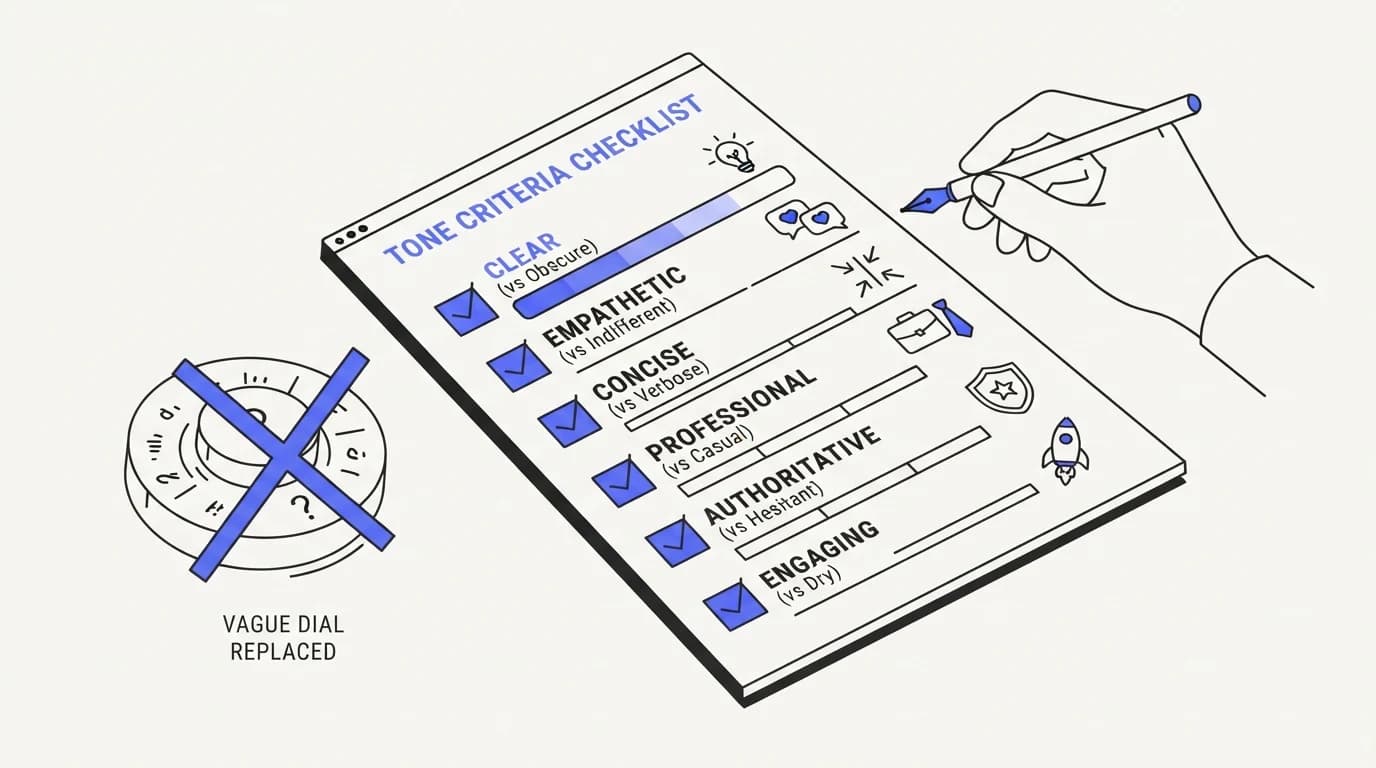
Treating tone as a vibe is where most teams go wrong. A vibe cannot be tested, cannot be checked by a second person, and cannot be defended when someone asks why an answer sounds a certain way. A specification can do all three.
A usable tone specification names what the brand sounds like in concrete terms: direct or gentle, formal or casual, how much explanation is normal before an answer, and which words are off-limits. It also names the failure modes to avoid, like burying an answer under three sentences of preamble, or hedging with qualifiers when the agent actually knows the answer.
Write the specification as a short document, not a single line in a prompt. Include two or three real example exchanges that show the tone in action, because examples teach a model faster and more reliably than adjectives do. Communicate's AI agent configuration accepts custom instructions and example conversations for exactly this reason, since tone quality tracks what you feed the prompt, not which model sits underneath it.
Building a QA rubric for tone
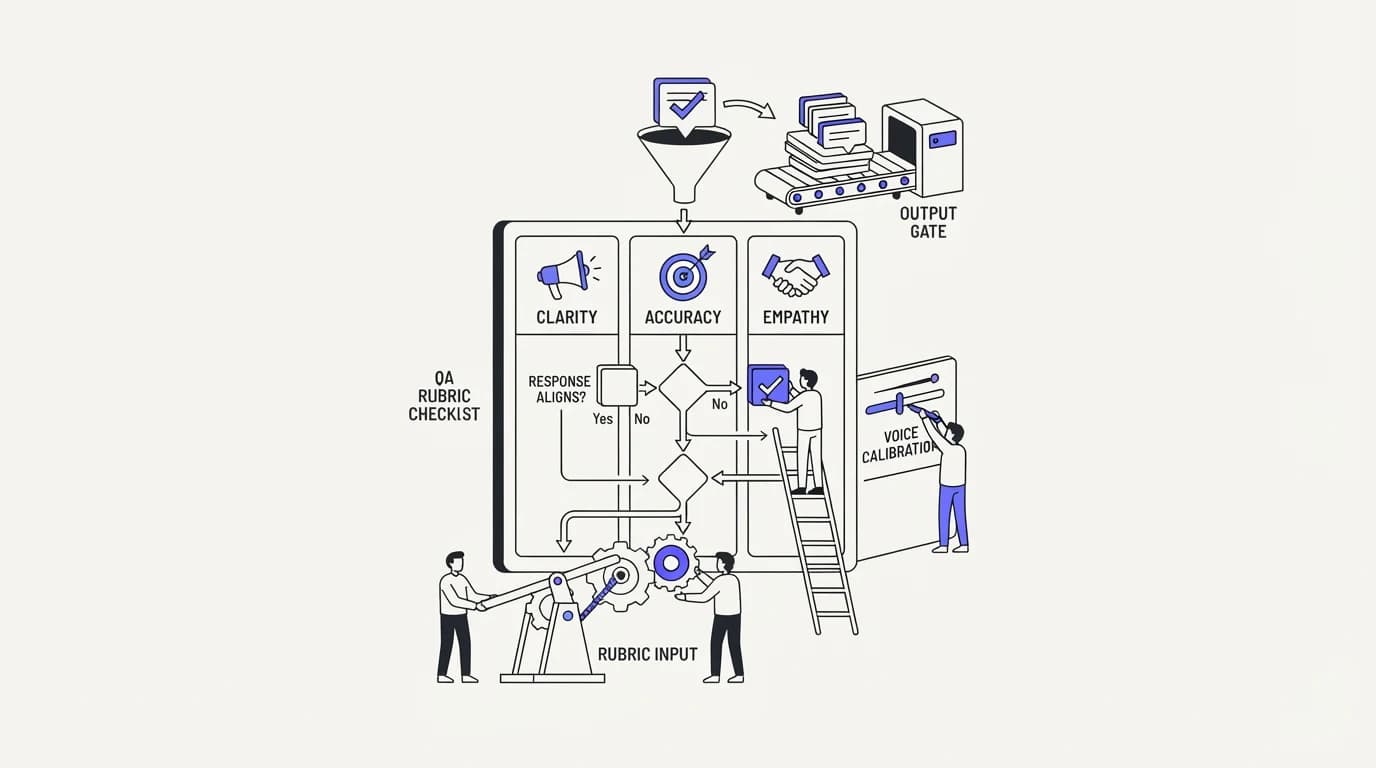
A rubric turns tone from an opinion into a checklist. Score real transcripts against a small number of concrete criteria, the same way you would score accuracy or resolution time, and tone stops being a matter of taste argued in a meeting.
Good rubric criteria are binary or near-binary, answerable by reading a transcript without debate. Does the answer come in the first sentence, or is it buried under a preamble. Does the agent use words from the banned list.
Does the agent hedge with a qualifier when it actually has a confident, grounded answer. Does the reply match the length the question deserves, rather than padding a short answer or truncating a complex one.
| Tone criterion | What good looks like | What robotic looks like |
|---|---|---|
| Answer placement | Direct answer in the first sentence | Answer buried after a preamble |
| Hedging | States what it knows plainly | Qualifies confident answers unnecessarily |
| Word choice | Matches the brand word list | Uses generic corporate phrasing |
| Length match | Reply length fits the question | Same length reply regardless of question |
| Empathy on frustration | Acknowledges the issue before solving it | Jumps straight to policy language |
Run the rubric against ten to twenty real transcripts before launch, and again on a schedule after launch, because tone drifts as content changes and prompts get edited for other reasons. This is the same discipline the AI support onboarding checklist recommends for accuracy testing, applied to a different quality dimension.
Score each transcript against every criterion independently rather than assigning one overall gut-feel number, because a single blended score hides which specific criterion is failing. A transcript that scores well on word choice but poorly on answer placement points at a different fix than one that scores poorly on hedging, and a blended score would treat both the same.
Two reviewers scoring the same batch of transcripts and comparing results is worth the extra time in the first round, because it surfaces where the rubric itself is ambiguous. If two people reading the same transcript disagree on whether it passes the empathy criterion, the criterion needs a sharper definition, not a tie-breaker vote, before you trust the rubric to run unattended against future analytics sampling.
Writing example exchanges that actually teach tone
 Communicate.so
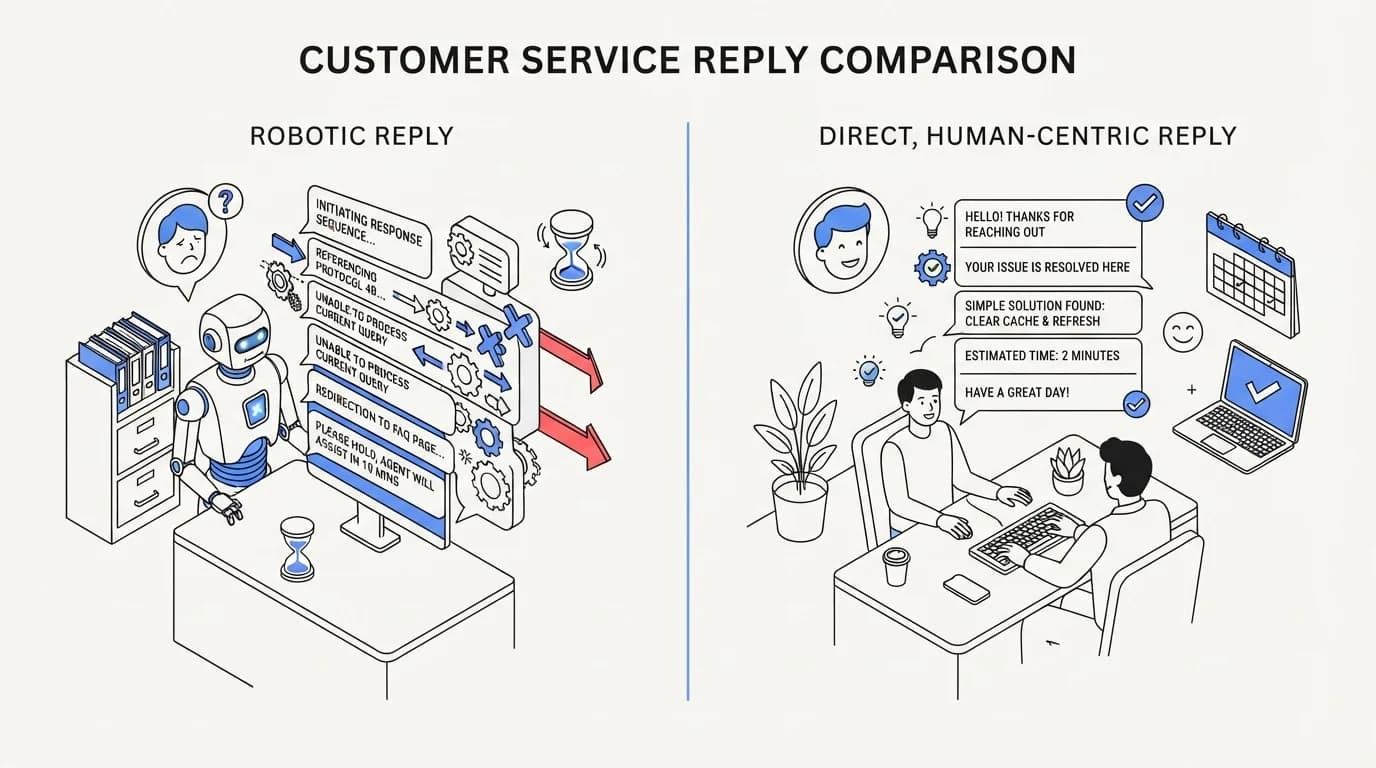
A tone rubric tells you what good looks like. Example exchanges show the model how to get there. Pick three or four real customer questions, the kind that come up weekly, and write both the actual robotic answer your bot gave and the version that fits your voice.
Keep examples short and varied in situation: a straightforward factual question, a frustrated customer, a question the agent should decline because it is outside scope. Showing the model how tone should shift with the situation, calm and factual for the easy question, acknowledging frustration first for the upset customer, teaches nuance that a single generic instruction cannot.
Refresh examples periodically instead of writing them once and forgetting them. As your product changes and new question types show up, old examples stop covering the cases customers actually raise, and tone quietly regresses even though nobody touched the prompt. Pair this with guardrails so the agent both sounds right and stays within the topics it is allowed to answer.
Tone and empathy for frustrated customers
Tone matters most when a customer is already upset, and it is the situation most generic prompts handle worst. A frustrated customer who gets a flat, policy-first answer reads the bot as indifferent, even when the answer itself is correct and fast.
The fix is a short, explicit instruction: acknowledge the issue in one sentence before moving to the solution, and skip that sentence for neutral, low-stakes questions where it would feel performative. This single rule, applied conditionally rather than to every message, is the difference between an agent that sounds attentive and one that sounds like it is reading from the same script regardless of who is on the other end.
Handoff design connects directly to this. An agent that senses frustration but has no clean path to a person will keep trying to resolve the issue itself, which often makes the tone problem worse. The AI to human handoff guide covers building that trigger, and a shared inbox that keeps the AI and the human on one conversation thread means the tone shift from bot to person does not feel like starting over.
Watch for a subtler failure too: an agent that over-apologizes. A rule meant to acknowledge frustration can drift into reflexive apologizing on every message, including neutral ones, and that pattern reads as insincere just as fast as no acknowledgment at all. The rubric criterion should score both the absence of empathy on a genuinely frustrated message and the presence of unnecessary apology on a neutral one, since both are tone failures in opposite directions.
Tone across channels: chat, email, and widget replies
Tone is not one setting that applies identically everywhere the agent shows up. A reply in a live chat window, a reply sent as an email, and a short answer inside an embedded widget carry different reading conventions, and a rubric built for one can feel wrong in another.
Chat conventions favor short, direct sentences and a conversational rhythm, because the customer is reading in real time and expects a quick back and forth. Email conventions tolerate more structure and a slightly more formal opening and closing, because the format itself signals a slower exchange. A widget answer embedded in a product page often needs to be shorter still, since the customer is mid-task and did not open a dedicated support channel.
Write the rubric with channel in mind, or write channel-specific variants of the same core voice, rather than assuming one set of examples covers live chat, email, and an embedded widget equally well. The brand voice underneath should stay consistent, direct, warm, honest about limits, while the surface conventions flex to match where the customer is actually reading the reply.
Multilingual tone: the rubric does not translate itself
 Communicate.so
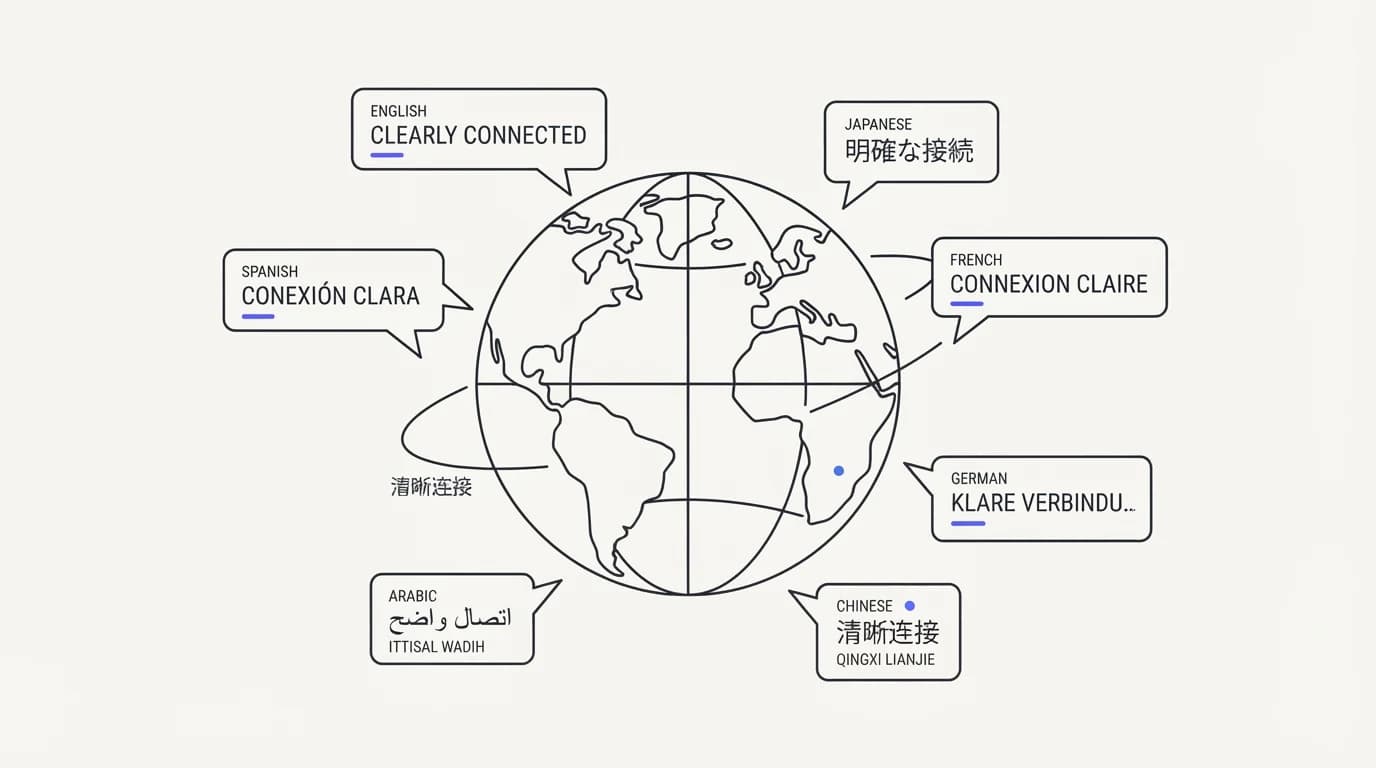
A tone rubric written in one language does not automatically hold in another. Directness, formality, and how much a support reply should hedge vary by language and culture, and a rubric that reads as warm in English can read as blunt or overly casual translated literally.
Teams supporting customers across languages need tone examples in each language, not a single English rubric machine-translated at run time. The multilingual customer support guide covers the broader set of decisions this raises, and tone consistency is one of the harder ones to get right, because a rubric that feels natural in one language can feel stiff in another even when the underlying words are accurate.
A practical starting point is a native or fluent speaker reviewing the first batch of transcripts in each supported language, rather than relying on the team that wrote the English rubric to judge translated output. Tone judgments made by someone who does not speak the language natively tend to miss exactly the register mismatches that make a translated reply feel stiff, since those errors are often invisible to a machine translation check and only obvious to a native ear.
Prioritize languages by actual conversation volume rather than trying to build a full rubric for every supported language on day one. A rubric with real examples for your top two or three languages by volume, expanded over time as volume in other languages grows, gets more of your customers a well-tuned tone sooner than a thin, generic pass across every language at once.
Keeping tone from drifting after launch
 Communicate.so
Tone is not a launch-day task you finish. It drifts. Prompts get edited to fix an unrelated accuracy issue and tone shifts as a side effect.
New content gets connected and the agent starts pulling phrasing from a source document that does not match your voice. Nobody notices until a customer complains.
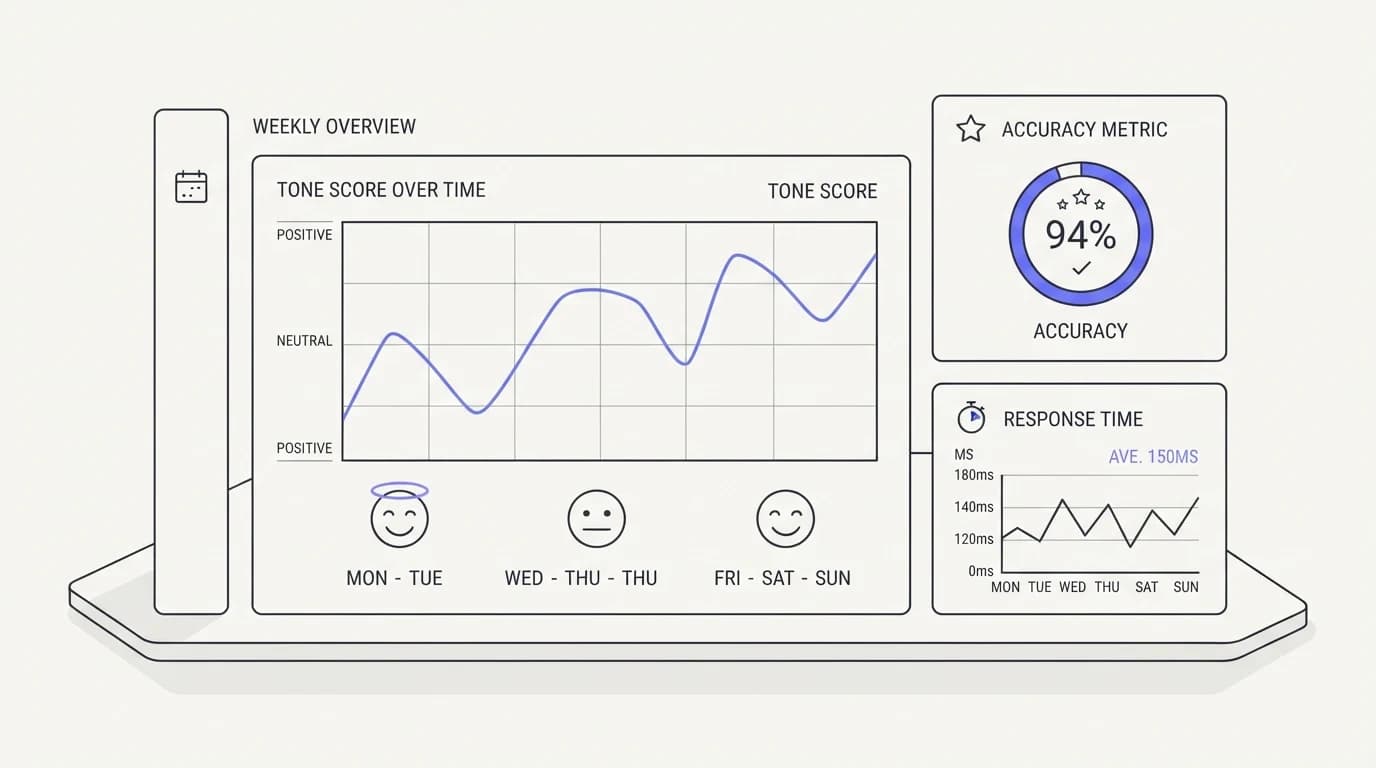
The fix is treating tone score as a metric you watch, the same way you watch resolution rate or first response time. Sample transcripts on a schedule, score them against the rubric, and track the score over time in the same place you track other quality signals through analytics. A tone score that drops after a content update tells you exactly when and why the drift happened, instead of leaving you to guess weeks later from complaint volume.
Assign ownership. Tone drift is the kind of quiet failure that nobody's job description covers, which is why it survives longer than accuracy bugs that trigger an obvious complaint. Naming one person responsible for the rubric and the periodic review is a small process change that prevents most of the drift before it reaches a customer.
Tie the tone review to whatever cadence you already run for other quality checks, rather than inventing a new standalone calendar event nobody remembers to attend. Teams that already run a periodic pass through the onboarding checklist items or a regular accuracy spot check can add the tone rubric to that same session at low added cost, instead of treating tone as a separate initiative competing for attention.
A short written log of what changed and why, whenever a prompt edit or a content update visibly moves the tone score, turns tone maintenance into an institutional habit rather than tribal knowledge held by one person. The next time a score drops, that log is the first place to check, and it often shortens the investigation from hours to minutes.
Key takeaways
- Robotic tone is one of the top complaints about AI support, alongside hallucination, no escalation, no context, and poor integration.
- A language model defaults to a hedging, over-formal register unless it is given a specific tone specification and real examples.
- A tone rubric with concrete, checkable criteria turns tone from a debate into a QA process you can run against real transcripts.
- Frustrated customers need a conditional empathy rule, not a blanket one, and a clean escalation path when the agent cannot resolve the issue.
- Tone drifts after launch as prompts and content change, so treat the tone score as a metric you track, not a setting you configure once.
Frequently asked questions
Why does my AI support agent sound robotic?
It almost always comes down to a generic system prompt with no brand voice examples and no tone rubric. The model defaults to a cautious, over-formal register when nobody has described how the brand actually talks, and that default reads as robotic even when every answer is accurate.
The same default shows up regardless of vendor or underlying model, which is the tell that it is a prompt gap rather than a technology ceiling. Two companies running the same base model can produce very different tone outcomes purely based on whether one of them wrote real examples into the system prompt and the other did not.
Can I fix tone without switching AI models?
Yes, in nearly every case. Tone comes from the system prompt, the examples you give the agent, and an explicit rubric for what good sounds like, not from the underlying model. Communicate's AI agent configuration accepts custom instructions and examples for this exact reason.
What is a tone rubric?
A short list of concrete, checkable criteria, like answer placement, hedging, word choice, reply length, and empathy on frustration, scored against real transcripts. It replaces a vague sense of whether tone feels right with a checklist a second person can apply the same way you did.
A good rubric fits on one page and stays specific enough that two different reviewers reading the same transcript reach the same verdict. If a criterion produces disagreement between reviewers, it needs a sharper definition before it earns a place in the recurring review, not a footnote explaining the ambiguity away.
How many example exchanges do I need to fix tone?
Three or four well-chosen examples covering a straightforward question, a frustrated customer, and a question the agent should decline usually teaches more than a dozen generic ones. Variety in situation matters more than volume, because examples teach the model how tone should shift with context, not just what words to use.
Does tone matter if the answer is accurate?
Yes. A correct answer delivered in a flat, robotic tone still reads as indifferent, especially to a frustrated customer, and it erodes the trust a customer extends to future answers from the same agent. Tone and accuracy are separate quality dimensions that both need testing.
Treating accuracy as the only metric that matters is a common blind spot, because an accuracy dashboard can look perfectly healthy while complaint volume about tone quietly climbs. Score both dimensions independently and review them together, since a team that only measures accuracy will not see a tone problem until it shows up as a drop in satisfaction scores or a spike in escalation requests.
How often should I re-check tone quality?
On a regular schedule, not just at launch. Prompts get edited for accuracy reasons and quietly shift tone, and new content sources can introduce phrasing that does not match your voice. Track a tone score over time in analytics the same way you track response time or resolution rate.
Should a support agent always apologize to frustrated customers?
No, and doing it reflexively reads as scripted. Acknowledge the issue in one plain sentence for a genuinely frustrated customer, then move to the solution, and skip that step entirely for neutral, low-stakes questions where it would feel performative rather than sincere.
Does tone need to be different across languages?
Yes. Directness, formality, and how much a reply should hedge vary by language and culture, so a rubric written for one language does not automatically hold when translated. The multilingual customer support guide covers building tone examples per language rather than machine-translating a single rubric.
Is a formal or casual tone better for AI support?
Neither is universally better. The right register depends on the brand and the customer base, and the mistake is not picking formal over casual, it is never picking deliberately at all. Write down which one fits your brand and give the agent examples that show it, rather than letting the model default to a generic corporate register.
Can tone problems cause more escalations?
Indirectly, yes. A customer who reads the agent's tone as indifferent or robotic is quicker to distrust the answer itself, even when it is correct, which raises the chance they escalate or complain. The support escalation workflow guide covers designing clean handoff triggers that catch this before it becomes a bad experience.
What should a tone specification include?
Concrete descriptors, direct or gentle, formal or casual, how much explanation is normal, plus a short list of words the brand does and does not use, and two or three real example exchanges. A single adjective like friendly is not enough for a model to act on consistently.
Why does tone drift after launch even if nobody changed the prompt?
New content sources can introduce phrasing that does not match your voice, and the agent may start pulling that phrasing into replies even without a prompt edit. This is why tone needs periodic re-checking against the rubric, not a one-time review at launch.
Does a shorter reply always sound better?
Not automatically. A reply padded with unnecessary preamble sounds robotic, but a reply cut too short for a genuinely complex question sounds dismissive. The right target is matching reply length to what the question actually needs, which is one of the criteria a good tone rubric should score directly.
How do I know if my tone rubric is actually working?
Score the same batch of transcripts before and after applying the rubric and prompt changes, and look for measurable movement on each criterion, not just a general sense of improvement. If scores do not move, the rubric criteria are probably too vague to act on and need to be made more specific.
Can guardrails and tone rubrics work together?
Yes, and they should. Guardrails scope what the agent is allowed to answer and act on, while a tone rubric governs how it answers within that scope. An agent can pass every guardrail check and still fail the tone rubric, which is why both need separate review.
Who should own tone quality on a support team?
One named person, not a shared responsibility that quietly belongs to nobody. Tone drift is a quiet failure that does not trigger an obvious alert the way an accuracy bug does, so it needs an owner responsible for the periodic rubric review, not an assumption that someone will notice.
Does empathy in tone slow down response time?
A single acknowledging sentence adds negligible length and, done well, reduces the odds a frustrated customer escalates unnecessarily, which saves time overall. The goal covered in cutting first response time is a fast correct answer delivered well, not the fastest possible answer regardless of how it lands.
Can I test tone before launching an AI agent?
Yes, and you should. Write the rubric and examples first, then run a batch of real or simulated questions through the agent and score the transcripts before any customer sees it. The AI support onboarding checklist covers building this pre-launch test into the rollout process.
Does tone matter more for a chatbot or a fully autonomous AI agent?
It matters more as autonomy increases, because a fully autonomous AI agent handles more of a conversation without a human reviewing the reply first. A scripted chatbot with narrow, reviewed responses has less room for tone drift than an agent generating open-ended replies across a wide range of questions.
This is also why the rubric review needs to scale with autonomy rather than staying fixed at whatever cadence felt sufficient at launch. An agent given more scope to answer without review over time should get a proportionally more frequent tone check, not the same quarterly glance it received when it handled a narrower set of questions.
Customers do not evaluate accuracy and tone as separate signals in the moment they read a reply. A reply that sounds evasive or scripted primes suspicion, and a suspicious customer is more likely to double-check, escalate, or dismiss an answer that was actually correct, which turns a pure tone problem into a measurable trust and resolution problem.
What is the single highest-impact tone fix a team can make this week?
Write three real example exchanges showing the tone you actually want, covering a routine question, a frustrated customer, and a question the agent should decline, and add them to the prompt. Examples move tone faster and more reliably than any amount of adjective-based instruction.
Pair that change with a quick before-and-after read of ten real transcripts so the improvement is visible rather than merely assumed to have worked. A team that can point to specific transcripts and say this is what changed has a much easier time getting buy-in for the fuller rubric work described earlier in this guide, because the improvement is concrete rather than a claim.