
Customer support quality assurance: what changes when AI reviews every ticket
 Communicate.so
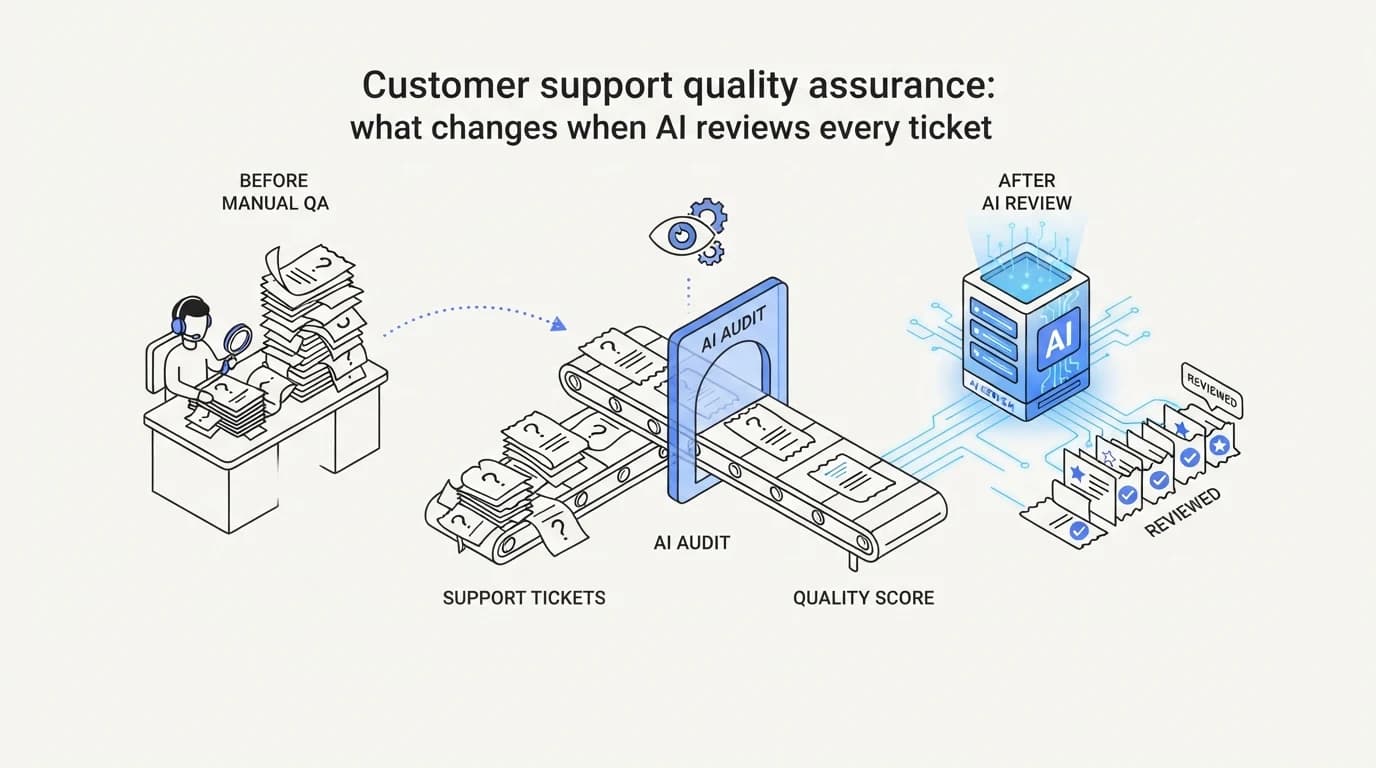
Manual QA scores 1 to 3 percent of tickets. AI can score all of them. Here is a rubric, a rollout plan, and the failure modes to watch.
TL;DR: Customer support quality assurance was built around a hard constraint: a human reviewer can only read so many transcripts in a day, so most teams score 1 to 3 percent of tickets and treat the rest as unreviewed. AI removes that constraint by reading every conversation, which sounds like a straightforward upgrade until you realize the old rubric was written for a small sample, not full coverage. This guide covers what a QA rubric needs to score humans and an AI agent on the same terms, where automated QA introduces failure modes a spreadsheet never had, and how to roll it out without turning coaching into a number on a dashboard. It includes a rubric table you can adapt directly. The goal is not more reporting. It is catching the wrong answer before a customer has to point it out.
What customer support quality assurance actually measures
Customer support quality assurance is the practice of reviewing past conversations against a fixed rubric to check whether an agent, human or AI, handled the interaction correctly. It sits apart from customer satisfaction scores and first response time targets because it looks at process, not just outcome. A ticket can close with a five-star rating and still fail QA if the agent guessed at a policy or skipped a required disclosure.
A typical QA rubric scores five or six dimensions per ticket: factual accuracy, policy compliance, tone, resolution completeness, and whether the agent escalated at the right moment. Each dimension gets a pass, fail, or partial score, and the scores roll up into a team-level quality percentage that leadership tracks over time.
The rubric exists because CSAT and NPS answer a different question. A customer can rate an interaction highly because the agent was friendly, even if the underlying answer was wrong and will cause a repeat contact next week. QA catches the gap between how an interaction felt and whether it was actually correct, which matters more once you are trying to cut average handle time without cutting corners.
Most QA programs also track a rolling pass rate at the team level, reported weekly or monthly to a support manager or director. That number is the one leadership usually sees first, and it hides more than it reveals, because a team pass rate calculated from a tiny sample can move several points on nothing more than which tickets happened to get pulled that week.
A useful rubric distinguishes between a hard fail, a partial fail, and a coaching note. A hard fail is a wrong answer or a broken policy step that needs immediate correction. A partial fail is something like a slightly off tone that a reviewer flags for training without treating as a compliance breach, and collapsing that distinction into a single pass or fail number loses information a coach actually needs.
Why manual QA sampling caps out at a sliver of your tickets
The constraint on manual QA is staffing math, not ambition. A QA analyst who reviews transcripts carefully can get through roughly 20 to 30 tickets in a working day once you account for scoring, notes, and calibration meetings.
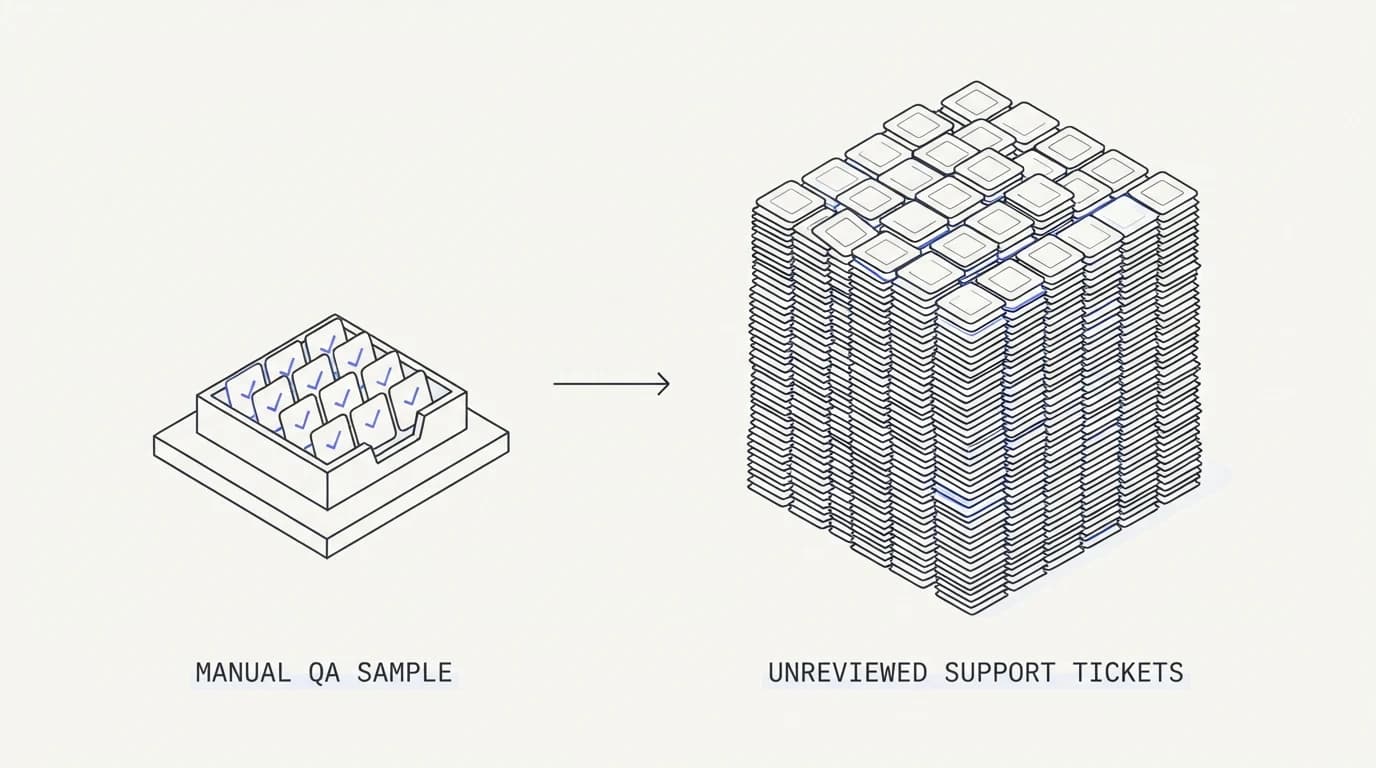
Stack that against a support queue running a few hundred tickets a day and the coverage math falls apart fast. Industry research on QA programs in 2026 puts typical manual coverage at 1 to 3 percent of total ticket volume, according to StealthAgents, which means the other 97 to 99 percent of conversations never get a second look.
The consequence is a blind spot that is invisible by design. A team can hit a 95 percent QA pass rate on its sample and still have a systemic problem in the 98 percent of tickets nobody read, because the sample is usually pulled at random or from flagged tickets, not from the categories most likely to be wrong.
That blind spot grows with volume. As a queue scales past what a small QA team can sample meaningfully, the gap between reviewed quality and actual quality widens, which is part of why ticket deflection programs so often report a rising resolution rate while individual customers report the opposite experience.
Sampling bias compounds the coverage problem. Most programs pull QA tickets from whatever surfaces easily, either a random export or the tickets a supervisor happened to notice, and neither method is built to find the rare but damaging failure. A wrong refund policy answer that shows up once a week can run for months before a 2 percent sample happens to catch it.
 Communicate.so
What changes when AI reviews 100 percent of conversations
An AI reviewer model can apply a fixed rubric to every closed conversation, not just a sample, because scoring a transcript against a checklist is a narrower and more mechanical task than answering the customer in the first place.
Vendors selling this capability describe it as full-coverage QA, and the pitch is direct: instead of sampling 2 percent and hoping it represents the other 98, you score everything, according to Lorikeet, which tracks tools built specifically for that use case.
Full coverage changes what QA is good at catching. Rare ticket types, edge-case questions, and the first few tickets on a newly launched product all get scored the same way as your most common request, instead of being statistically unlikely to land in a 2 percent sample.
It also changes what a low pass rate means. When 2 percent of tickets are reviewed, a quality dip could be sampling noise. When 100 percent are reviewed, a quality dip is a real signal about a specific rubric dimension, a specific ticket category, or a specific week.
Full coverage also removes a specific kind of gaming that small samples enable. An agent, human or AI, that learns roughly which tickets tend to get pulled for review can perform differently on those tickets than on the ones it assumes nobody will read. A reviewer that scores everything closes that gap entirely, because there is no unreviewed category left to relax into.
Building a QA rubric that works for both humans and AI
A rubric written for a human agent assumes the agent might not know an answer and will say so. A rubric applied to an AI agent needs an extra dimension: did the answer match the source document, or did the model state something confident and wrong. Reviewing an AI agent for hallucinated answers is not optional, it is the single highest-value check in the rubric.
Grounding is the mechanism that makes this checkable at all. If an agent answers from a defined set of connected documents through retrieval, a QA reviewer, human or AI, can trace the claim back to a specific passage and mark it correct or fabricated. An ungrounded model gives you nothing to trace, only a plausible-sounding sentence.
Escalation correctness is the second dimension that matters more for AI than for a seasoned human agent. A human agent who is unsure usually says so or asks a colleague. An ungoverned model will often answer anyway, so the rubric needs a specific check for whether the agent handed off at the right confidence threshold instead of guessing.
Tone, policy compliance, and resolution completeness carry over from human QA mostly unchanged, though resolution completeness deserves a sharper definition for AI-handled tickets: did the conversation actually solve the customer's problem, or did it end because the customer gave up asking.
Write each rubric dimension as a question a reviewer, human or AI, can answer with evidence from the transcript, not a subjective impression. A dimension like helpful is nearly impossible to score consistently across reviewers. A dimension like cited the correct refund window from the connected policy document is checkable, repeatable, and disagreement-resistant, which is what makes full coverage worth trusting.
| Scoring dimension | What it checks | Manual QA (small sample) | AI QA (full coverage) |
|---|---|---|---|
| Factual accuracy | Does the answer match the source document instead of sounding confident | ✓ on sampled tickets | ✓ on every ticket |
| Escalation correctness | Did the agent hand off at the right point instead of guessing | ✓ on sampled tickets | ✓ on every ticket |
| Tone and empathy | Does the reply match brand voice with a frustrated customer | ✓ on sampled tickets | ✗ still needs human judgment |
| Policy compliance | Did the reply follow refund, security, or legal policy exactly | ✓ on sampled tickets | ✓ on every ticket |
| Resolution completeness | Did the ticket close the customer's actual problem, not just get a reply | ✗ rarely tracked at scale | ✓ on every ticket |
| Reviewer consistency | Do two reviewers score the same ticket the same way | ✗ reviewer drift is common | ✓ same rubric applied every time |
Where AI QA breaks down and how to guard against it
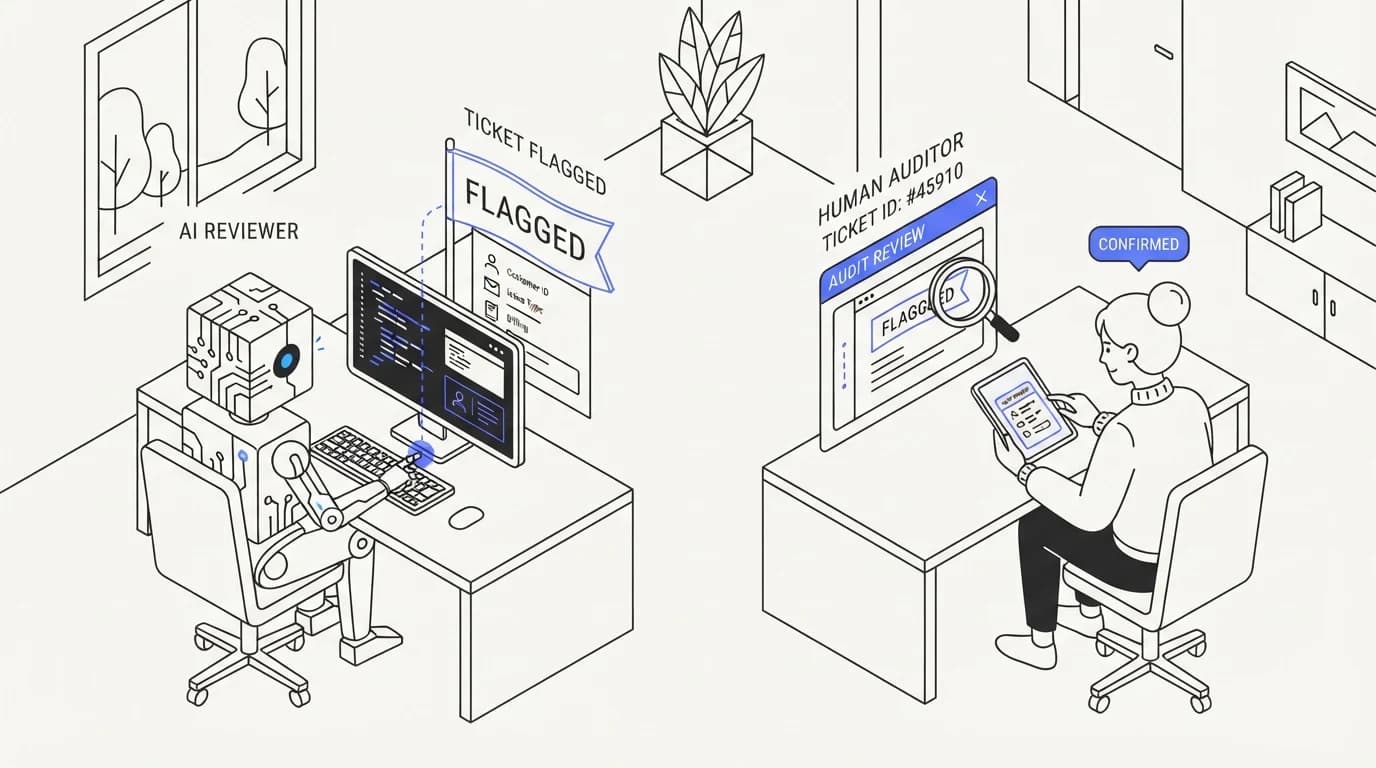
An AI reviewer can be wrong about a ticket the same way an AI agent can be wrong about an answer. A reviewer model can mark a fabricated answer as accurate if the fabrication reads fluently, which is why the rubric needs to include guardrails on the reviewer itself, not just on the agent it is scoring.
The second failure mode is rubric gaming in slow motion. If a scoring model rewards short, confident replies, an agent tuned against that score can start favoring short, confident replies over correct but longer ones, and nobody notices until customers start repeating the same question.
The third failure mode is over-indexing on tone at the expense of correctness. Tone is easy for a model to score consistently, accuracy against a source document is harder, and a team that watches the aggregate quality number without breaking it out by dimension can end up optimizing for pleasant wrong answers.
The fix for all three is the same: keep a small human audit layer on top of the AI reviewer, spot-checking a sample of its scores the same way QA once spot-checked agents. The audit is smaller than the old manual program, but it never goes to zero.
A fourth, quieter failure mode is scope creep in the rubric itself. Once full coverage makes every dimension cheap to check, teams tend to add dimensions until the rubric measures twenty things instead of six, and a twenty-item rubric produces so much noise that nobody can tell which dimension actually predicts a repeat contact or a churned customer. Keep the rubric short and revisit it on a schedule instead of letting it grow by accretion.
 Communicate.so
Rolling out AI QA without alienating your team
The rollout that works starts with shadow scoring. Run the AI reviewer alongside your existing manual QA process for a few weeks, compare the two sets of scores on the same tickets, and calibrate the rubric before you let the AI score run unaccompanied. Teams that skip this step tend to launch an AI agent and a full-coverage reviewer in the same week, which makes it impossible to tell which system is causing a given complaint.
Agents notice when a number replaces a conversation. A QA score that shows up in a dashboard without a coaching conversation attached reads as surveillance, not development, and teams that make that mistake see QA compliance drop even as the underlying quality improves.
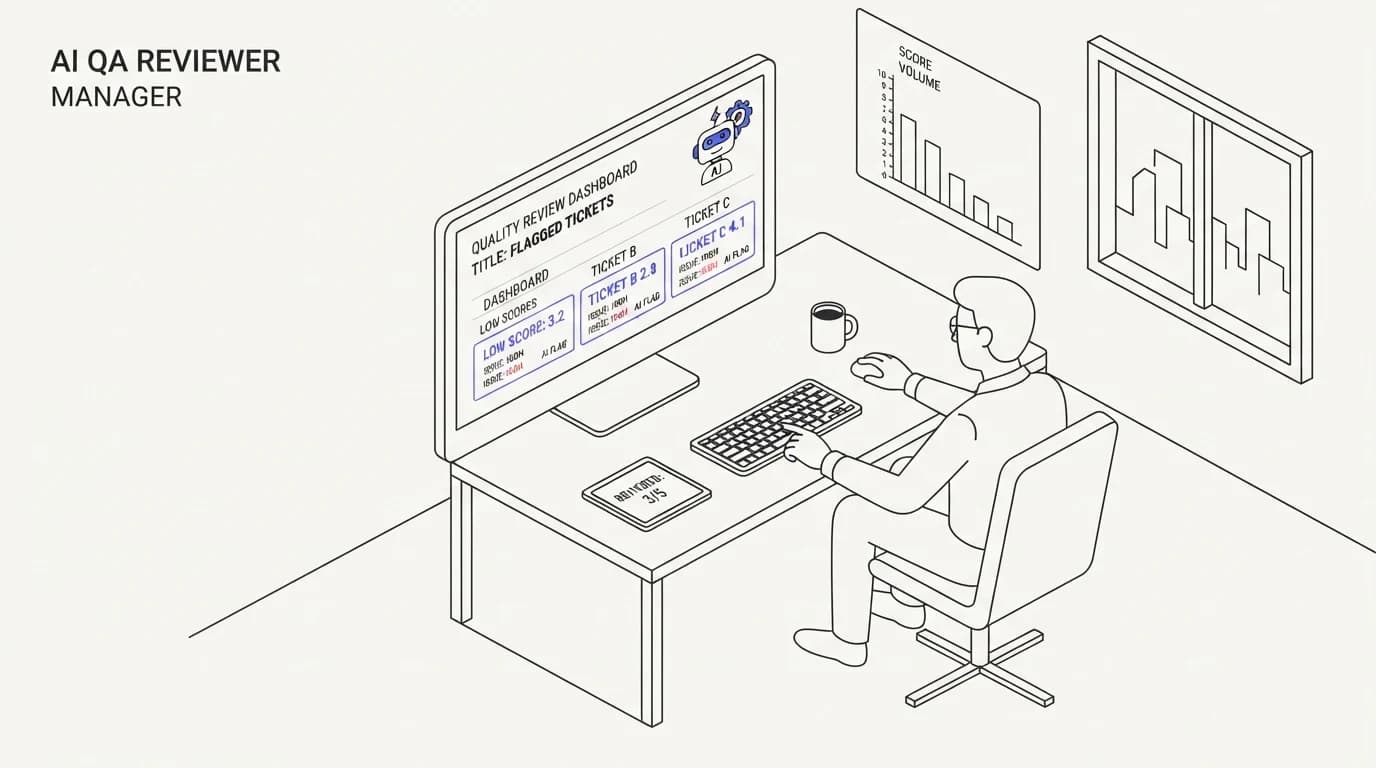
The better pattern treats full coverage as raising the floor for what a coach can see, not as a replacement for coaching. A manager who used to review three random tickets per agent per week can now review the three lowest-scoring tickets, which is a materially better use of the same hour, a shift the AI support onboarding checklist covers in more depth for teams standing up an agent for the first time.
Sequence the rollout in phases rather than turning full coverage on for the whole queue at once. Start with a single ticket category, run shadow mode against it, publish the rubric, and only expand to the next category once agents in the first group have seen a full coaching cycle built on the new score. A phased rollout also gives you a smaller, more diagnosable set of disagreements to resolve before the scope grows.
Publish the rubric itself to the team before you publish any scores. Agents who can read the exact checklist a reviewer is applying trust the resulting score far more than agents handed a number with no visible standard behind it, and a published rubric also gives a human agent something concrete to appeal against if a score looks wrong.
 Communicate.so
Turning QA scores into coaching and product feedback
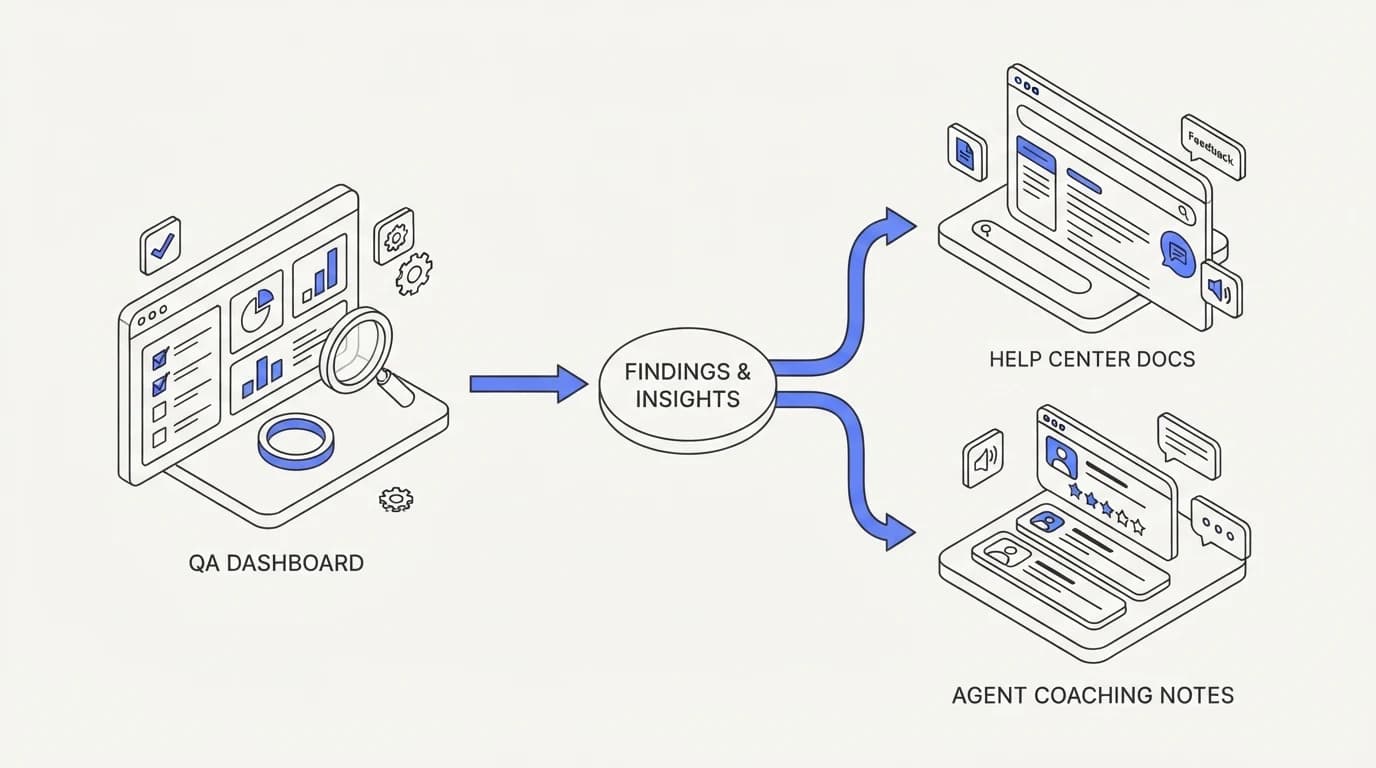
A QA program that only produces a score is half finished. The other half routes the finding back to whatever caused it: a coaching note for a human agent, or a content gap for an AI agent trained on your connected data sources. If the AI keeps failing the same rubric dimension on billing questions, the fix usually lives in the billing documentation, not in the model.
This is where full coverage earns its keep over a sample. A 2 percent sample might surface a content gap after weeks of intermittent failures. Full coverage surfaces the same gap after the first cluster of tickets, because every instance of the failure gets scored instead of a random handful, which is the same logic behind keeping your help center current when you train an AI agent on it.
Feed the lowest-scoring rubric dimension, not the overall pass rate, into your weekly review. A team stuck at 91 percent overall quality with a single dimension consistently failing has a specific, fixable problem. A team stuck at 91 percent with failures spread evenly across every dimension has a training problem, which needs a different fix entirely.
Set a review cadence and stick to it, even if it is short. A fifteen-minute weekly pass through the lowest-scoring rubric dimension across the whole queue catches a documentation gap while it is still new. The same gap left for a monthly review has already generated a month of repeat questions before anyone acts on it.
 Communicate.so
What full-coverage QA costs and what it saves
The adoption pressure behind this shift is real. Service organizations running AI agents in production rose to 66 percent in 2026, up from 39 percent in 2025 according to Salesforce data reported by DigitalApplied, and 91 percent of CX leaders report executive pressure from Gartner to deploy AI, per the same report. QA coverage has not kept pace with that adoption curve in most organizations.
The cost of not closing that gap shows up as complaints, not incidents. The most common complaints about AI support tools are hallucinated answers, no escalation path, a robotic tone, and no awareness of prior context, according to Twig, and every one of those is a rubric dimension a QA program can catch before a customer files the complaint.
The trend line is not encouraging on its own. Organizations reporting a negative consequence from generative AI rose from 44 percent in 2024 to 51 percent in 2025, according to CMSWire. Full-coverage QA is one of the few controls that scales with the deployment instead of lagging behind it.
The cost side is smaller than most teams expect once a rubric-scoring model exists, because scoring a closed transcript is cheaper than generating a live reply. The savings show up on the other side of the ledger: fewer repeat contacts from an uncorrected content gap, fewer escalations mishandled at the wrong confidence level, and a shorter path from a customer complaint to the fix that prevents the next one.
How communicate.so approaches quality assurance
Communicate grounds every AI agent reply in your connected content through retrieval, which is what makes post-hoc QA possible in the first place: a reviewer can trace a claim back to the source document instead of judging tone alone. The analytics view surfaces the conversations where the agent handed off, where it answered with lower confidence, and where a topic keeps recurring, so a QA pass starts from the tickets most likely to need one instead of a random sample.
Every account also runs under documented security controls, since a QA program that scores policy compliance needs the underlying data handling to be auditable too. None of this replaces a human reviewer. It gives that reviewer a shorter, better-targeted list to look at.
Pricing runs on usage rather than seats, which matters for a QA use case specifically because scoring every ticket is a usage-scaling task, not a headcount-scaling one. Details are on the pricing page, and a team that wants to see how the AI agent and its own answers score under a rubric can test both against real historical tickets before committing to a full rollout.
Frequently asked questions
What is customer support quality assurance
Customer support quality assurance is the practice of reviewing closed conversations against a fixed rubric to check accuracy, policy compliance, tone, and resolution, separate from whether the customer rated the interaction highly.
It exists because a satisfied customer and a correct answer are not the same thing, and QA is the process that checks the second one against a defined standard rather than a first response time clock or a satisfaction survey.
Why does manual QA only review a small percentage of tickets
A QA analyst can review roughly 20 to 30 transcripts carefully in a working day, which caps manual coverage at 1 to 3 percent of total volume for most support teams, per StealthAgents. Coverage does not scale with ticket volume the way review capacity would need to.
Can AI actually review 100 percent of support conversations
Yes. Scoring a transcript against a fixed rubric is a narrower task than answering the customer, and reviewer models built for this purpose can apply the same checklist to every closed ticket instead of a sample.
Tools built specifically for this exist in the market today, according to Lorikeet, and the shift from sampling to full coverage is the core value proposition, not a marginal improvement.
What rubric dimensions matter most for AI-answered tickets
Factual accuracy against the source document matters most, since an ungrounded model can produce a fluent, wrong answer. Escalation correctness is second: did the agent hand off at the right confidence level instead of guessing, a check covered in more depth in reducing AI hallucinations in support.
How is QA different from CSAT or NPS
CSAT and NPS measure how the customer felt about the interaction. QA measures whether the agent followed process and gave a correct answer, which can diverge sharply from how the interaction felt in the moment.
A friendly, confident, wrong answer can score well on CSAT and fail QA outright, which is exactly the gap a rubric is built to catch.
Does full-coverage AI QA replace human reviewers
No. It replaces the sampling constraint, not the judgment. A small human audit layer should still spot-check the AI reviewer's own scores, the same way QA once spot-checked human agents, because a reviewer model can be wrong in a fluent way too.
The human role shifts from reading a random sample to auditing the auditor, which is a smaller job but not a disposable one. Teams that remove the human layer entirely tend to discover the gap only after a scoring error has been running unnoticed for weeks.
What is the biggest risk of switching to AI-driven QA
Rubric gaming and tone over-indexing are the two biggest risks. A scoring model that rewards short, confident replies can push an agent toward pleasant wrong answers over correct but longer ones if a team only watches the aggregate score, which is why guardrails on the reviewer itself matter as much as guardrails on the agent.
How do I calibrate an AI QA reviewer before trusting it
Run it in shadow mode alongside your existing manual QA process for a few weeks. Compare scores on the same set of tickets, adjust the rubric where the two disagree, and only let the AI reviewer run unaccompanied once the gap closes.
Track disagreement by rubric dimension rather than as one aggregate percentage. A reviewer that agrees with your human QA team on tone but disagrees on escalation timing needs a narrower fix than a blanket recalibration of the whole rubric.
How should managers use QA scores in coaching
Route the lowest-scoring rubric dimension into the coaching conversation, not the overall pass rate. A manager reviewing the three lowest-scoring tickets per agent per week gets more coaching value than reviewing three random tickets, a shift the AI support onboarding checklist walks through for teams standing up a new program.
What happens if a QA score is only shown as a dashboard number
Agents read an unexplained score as surveillance rather than development, and QA compliance can drop even while underlying quality improves, because the number carries no context about what to fix.
How does QA data help improve an AI agent's answers
A rubric dimension that keeps failing on a specific topic almost always traces back to a content gap. Fixing the source material an agent draws from, through training it on your help center, closes the gap faster than adjusting the model.
Does 100 percent QA coverage mean 100 percent accuracy
No. Full coverage means every ticket gets scored, not that every ticket passes. It surfaces problems faster because a failure pattern shows up after the first cluster of tickets instead of after weeks of an intermittent, under-sampled signal.
How often should a QA rubric be updated
Whenever a new failure mode shows up repeatedly that the current rubric does not check for, or whenever a new product surface or channel goes live. A rubric written a year ago rarely still matches what the support queue actually contains.
Should QA scores factor into agent compensation
Carefully, if at all. A rubric tied directly to pay creates pressure to game the specific dimensions being measured, which is the same rubric-gaming risk that applies to AI reviewers, just with a human incentive attached instead of a training signal.
What is grounding and why does it matter for QA
Grounding means an AI agent answers from a defined set of connected documents through retrieval instead of generating an answer from general knowledge. It matters for QA because a grounded claim can be traced back to a source passage and checked, while an ungrounded claim cannot be verified at all.
How does QA relate to first response time and handle time
QA and speed metrics measure different things and can pull in opposite directions if watched alone. A team chasing a lower average handle time can hit the target by rushing replies, which a QA rubric that checks resolution completeness will catch even when the speed number looks good.
Can small support teams afford a QA program at all
Manual QA scaled to team size has always been expensive relative to a small team's headcount, which is why most small teams skip it entirely. Full-coverage AI QA removes the headcount constraint, since the reviewer scales with ticket volume rather than with analyst hours.
How do I know if my current QA sample is representative
Compare the failure rate in your sample against the failure rate a full-coverage pass finds on the same period, if you can run both briefly. Most teams that make this comparison find their sample understated the real failure rate, sometimes significantly.
What is the single most valuable QA check for an AI support agent
Factual accuracy against the source document. An agent that hallucinates a policy or a price is the failure mode most likely to cause a real customer harm, the kind documented in incidents like a cloud storage chatbot citing a policy that did not exist, which a grounding-focused rubric check is built specifically to catch.
How long does it take to stand up a full-coverage QA program
Most teams can run a shadow-mode calibration in two to four weeks, then move to unaccompanied AI scoring with a human audit layer. The bigger time cost is usually building the rubric itself, since it needs to be specific enough to catch AI-specific failures like hallucination and escalation timing, not just carried over unchanged from a legacy human-only checklist covered in ai-agent guardrails.