
AI support audit trail: what to log so you can explain any answer
 Communicate.so
The audit trail fields, retention windows, and access controls that let you answer why an AI agent said what it said, months later.
TL;DR: An AI support audit trail is the record that lets you reconstruct exactly why an AI agent gave a specific answer to a specific customer, long after the conversation ended. The minimum useful trail logs five things together as one linked record: the customer's exact input, the source documents the agent retrieved, the model and prompt version active at that moment, the generated reply, and any human review or override that followed. Most teams log the conversation transcript and stop there, which answers what was said but not why, and why is the question that actually matters when a customer disputes an answer or a regulator asks for evidence. Retention windows vary by framework: SOC 2 engagements commonly expect at least a year of retained logs, HIPAA-covered workloads run to six years, and the EU AI Act's logging obligations for in-scope systems set their own floor. Building the trail in from the first integration is far cheaper than retrofitting it after an incident forces the question.
Every support team eventually gets some version of the same request: a customer, a manager, or a regulator asks why the AI agent said what it said, and the person answering has to reconstruct a conversation that happened months earlier. Teams that logged only the chat transcript can often produce the words but not the reasoning behind them, no source document, no model version, no sense of whether the answer was reviewed. That gap is what an audit trail closes, and it sits next to the harder governance questions covered in AI agent guardrails, which is about preventing bad answers, while this piece is about proving what happened after one slipped through.
This guide lays out the fields worth logging, the retention windows different compliance frameworks expect, who should have access to the trail, and what a real incident looks like when the trail does not exist. It assumes you already have an AI agent live in production and are deciding what to capture next, not choosing whether to have one.
What an audit trail actually is, and what it is not
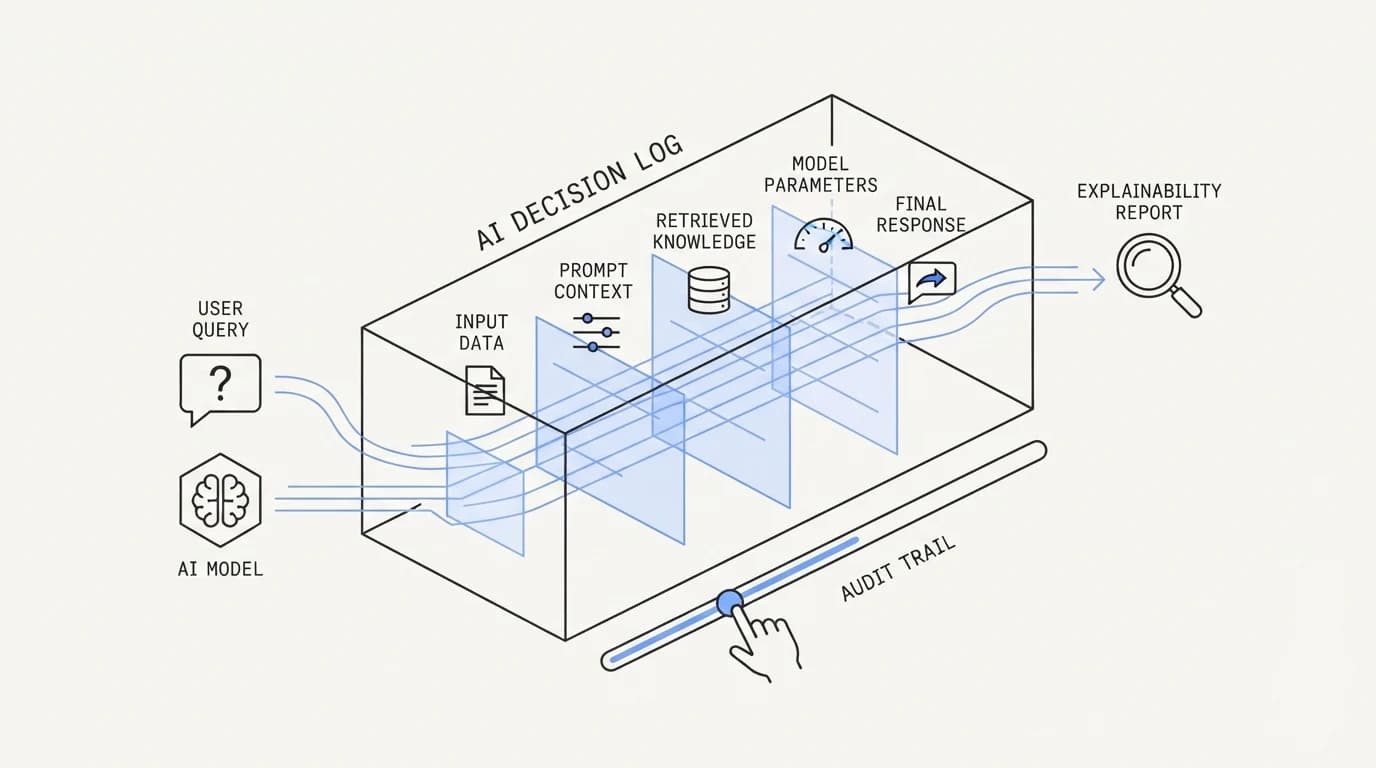
An audit trail is a linked record connecting a customer's question to everything that produced the answer: the retrieved context, the model configuration, the generated response, and any human action taken on it afterward. A chat transcript alone is not an audit trail, because a transcript shows the conversation but not the machinery behind any single reply.
The difference shows up the moment something goes wrong. A transcript tells you the agent said a customer could get a refund after 90 days. An audit trail tells you which document the agent pulled that number from, whether that document was current, which model generated the sentence, and whether a person reviewed it before it sent.
Only the second version lets you fix the actual cause instead of guessing, a distinction that matters as much for reducing AI hallucinations as it does for defending a specific answer after the fact.
Why "why did the agent say that" is the hardest question to answer later
 Communicate.so
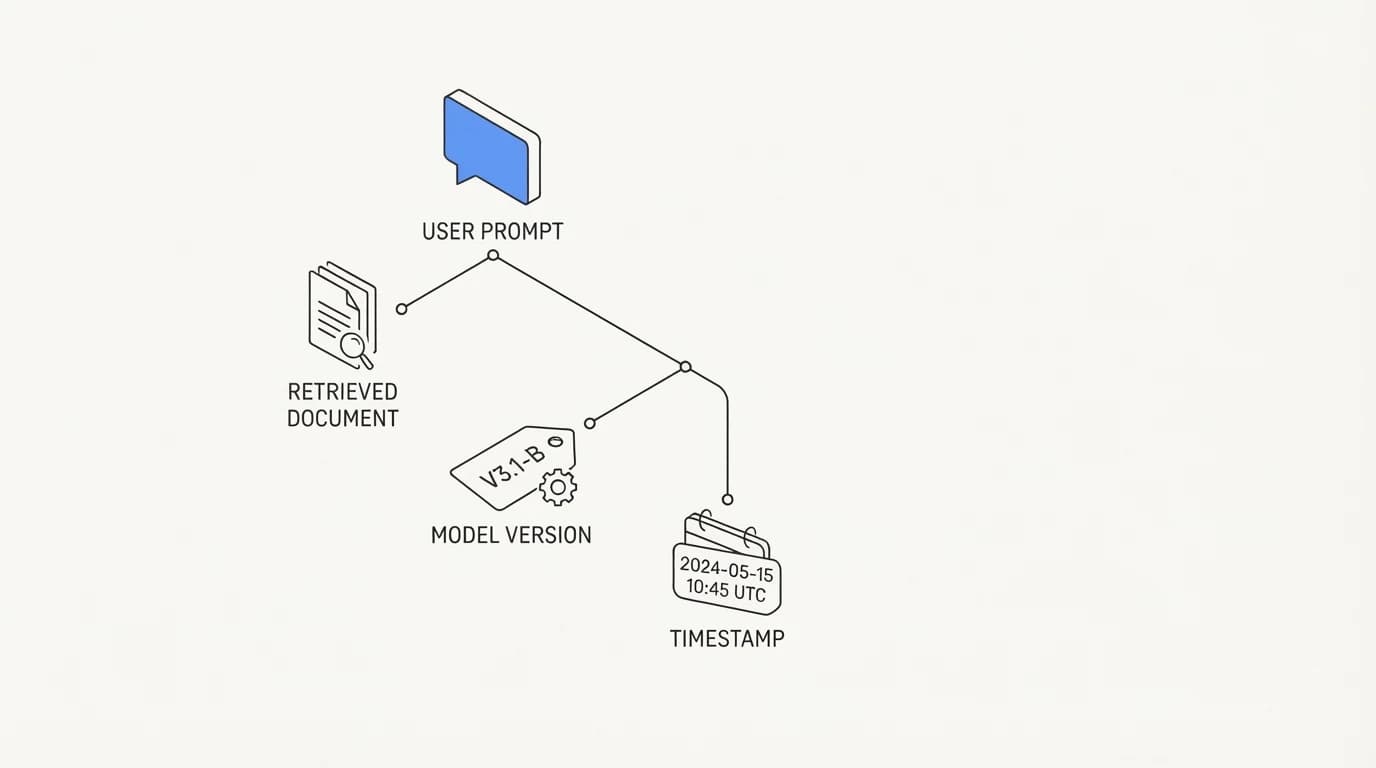
Memory fades and systems change faster than most teams track. A model gets swapped, a prompt gets tweaked, a knowledge base article gets edited, all in the six months between an answer and the question about it, and none of that history matters unless the state at the moment of the reply was captured. CMSWire reports that the share of organizations reporting a negative consequence from generative AI rose from 44 percent in 2024 to 51 percent in 2025, and a growing share of those incidents surface well after the original conversation, when someone escalates a complaint or a legal question arrives.
A support lead without a trail is left reconstructing intent from memory or from whoever happened to be on shift that day. A support lead with a trail pulls the exact record: the input, the retrieval, the model, the output, and the review status, in the order they actually happened. The second version takes minutes.
The first can take days and still land on a guess.
The minimum fields every log entry needs
A defensible audit entry needs, at minimum, the customer's exact input, the documents or data sources the agent retrieved to answer it, the specific reply generated, a timestamp, and a unique identifier tying the entry to the full conversation. Industry guidance summarized by Superblocks also recommends capturing the user identity and authorization level active at the time, since who was asking sometimes changes what the correct answer should have been.
Skip any of these and the trail has a gap that surfaces at the worst possible time. Logging the reply without the retrieval means you cannot tell whether the agent invented a fact or reported one accurately from a stale source. Logging the retrieval without the model version means you cannot tell whether a later model upgrade changed how the same source got interpreted.
| Field | Answers | Commonly skipped |
|---|---|---|
| Customer input, verbatim | What was actually asked | ✗ usually captured |
| Retrieved source documents | Where the answer came from | ✓ frequently missing |
| Model and prompt version | What generated the reply | ✓ frequently missing |
| Generated reply, verbatim | What the customer received | ✗ usually captured |
| Human review or override event | Whether a person checked it | ✓ frequently missing |
Logging the retrieval layer, not just the final reply
 Communicate.so
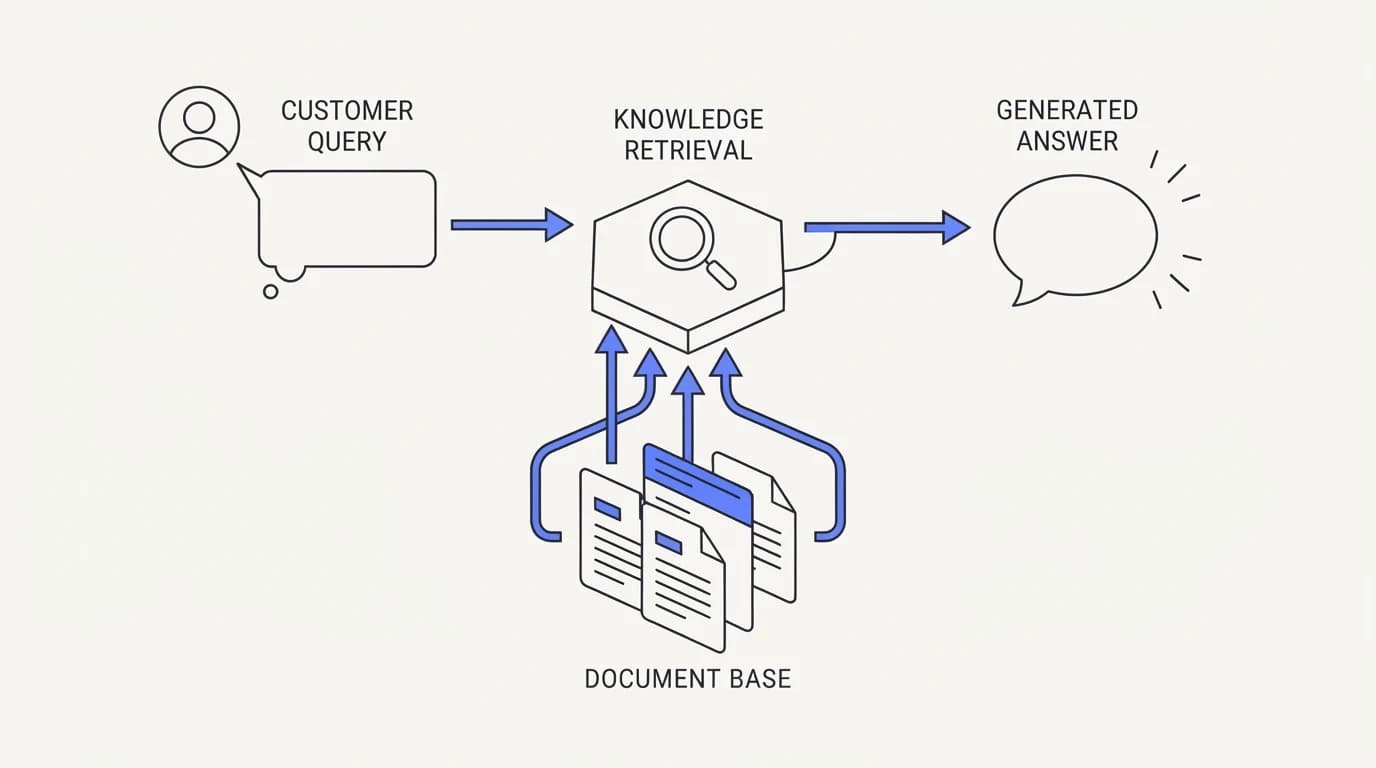
The retrieval step is where most audit trails fall apart, because it is the least visible part of the pipeline to the team building it. A RAG for customer support setup pulls specific passages from a knowledge base before generating a reply, and if those passages are not logged alongside the reply, there is no way to tell later whether the source was accurate, current, or even relevant to the question.
Log the passage identifiers, not just a summary of what was retrieved, and log them even when the answer looks obviously correct, because the incidents worth investigating are rarely the ones anyone flagged at the time. Teams that train an AI on their help center often assume the source documents are the ground truth and stop verifying that the retrieval matched them, which is exactly the assumption an audit trail is built to test.
Logging model, prompt version, and configuration at the moment of the reply
Models and prompts change more often than most teams realize, sometimes through a routine vendor update rather than a deliberate internal decision. If the version active at the time of a specific reply is not recorded, a later review has no way to determine whether the behavior in question still exists in the current configuration or was fixed weeks ago.
This matters most for disputed answers involving policy, pricing, or eligibility, where the underlying prompt instructions determine the boundaries of what the agent is allowed to say. A support ticket deflection rate that looks strong on a dashboard can hide a prompt change that quietly widened what the agent claims to be able to do, and the only way to catch that after the fact is a version-tagged log.
Human handoff and override events belong in the same trail
An audit trail that stops at the AI-generated reply misses half the story whenever a human enters the conversation. If a support agent overrides, edits, or approves an AI-drafted answer, that action needs its own entry, tied to the same conversation record, with the person's identity and the exact change made. The shared inbox for AI and humans model already tracks who touched a conversation and when; extending that tracking into the permanent audit record is a smaller lift than building it from scratch.
This is also where escalation timing belongs. Logging when a conversation moved from AI to human, and how long the customer waited between the two, turns the audit trail into a source for both compliance answers and operational ones, since the same timestamp that proves due diligence also feeds a real average handle time calculation.
Retention: how long to keep the trail and why
Retention requirements vary by framework and there is no single number that satisfies all of them. SOC 2 engagements commonly expect logs retained for at least a year, a baseline described in Konfirmity's summary of SOC 2 logging pipelines, while HIPAA-covered workloads run substantially longer at six years, per the retention guidance summarized by TechJack Solutions. Neither of those figures is a legal opinion for your specific business; check them against your own compliance scope before setting a policy.
A practical default is to retain audit logs at least as long as the longest retention window your compliance obligations require, and no shorter than the window a customer dispute could plausibly reopen. Deleting logs too early to save storage cost is the kind of decision that looks fine until the exact record you deleted is the one someone asks for.
Storage cost is rarely the real constraint once teams look at the numbers. Text logs, even at high conversation volume, are small compared to almost any other data a support stack already stores, and the marginal cost of keeping a year or more of structured, append-only records is a fraction of what a single unresolved dispute or failed audit costs in staff time. Weigh the retention window against that asymmetry rather than against the storage line item alone, and set the policy once in writing so nobody has to improvise a retention decision under pressure during an actual ai support agent implementation review.
Access control: who can read the trail and how it gets reviewed
 Communicate.so
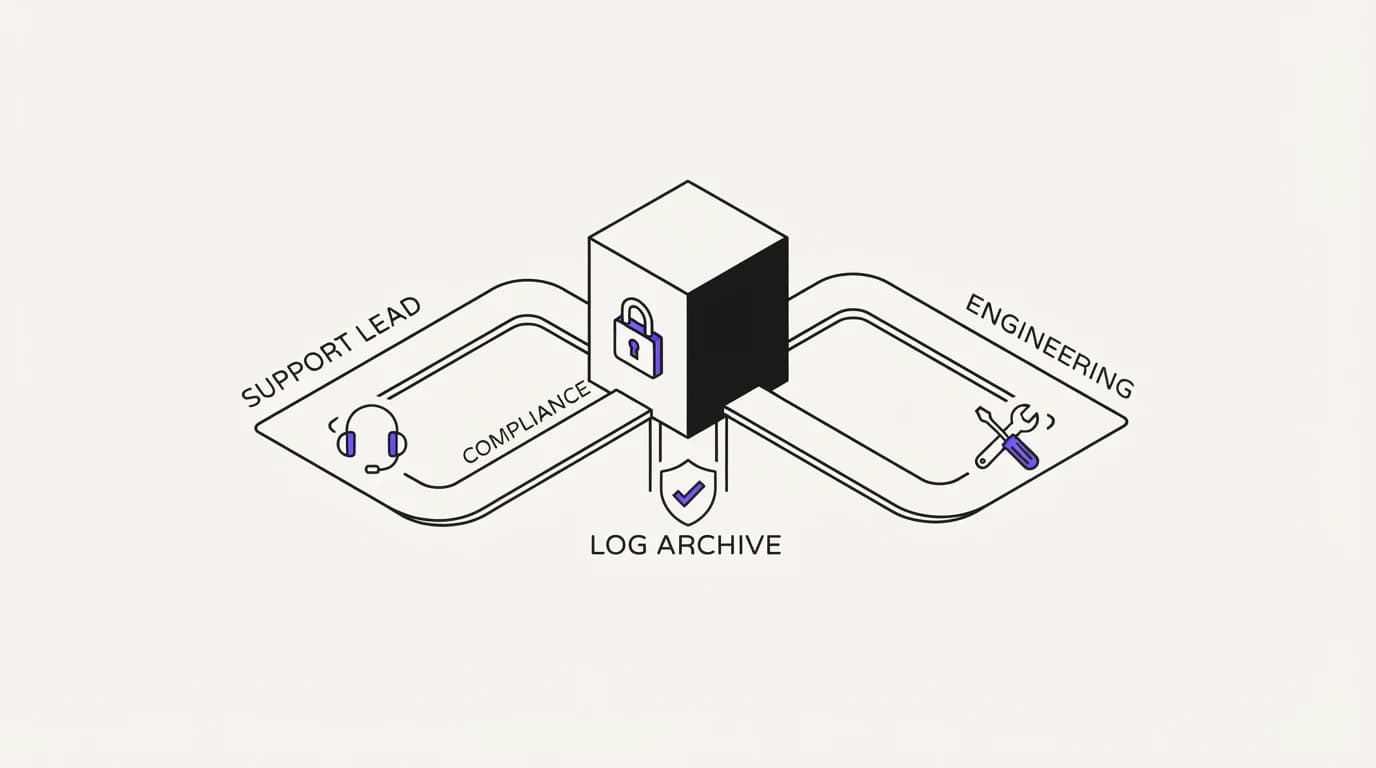
An audit trail that anyone can read is a liability, and an audit trail nobody reviews is a formality. Access should follow role: support leads need read access to investigate disputed answers, compliance needs export access for external audits, and engineering needs enough visibility to debug retrieval or model issues without exposing raw customer data more broadly than necessary. Security policy should name these roles explicitly rather than leaving log access as an unstated default everyone with database credentials happens to have.
Best practice from log-integrity guidance, summarized by TrackAI, favors append-only storage that the writer cannot later modify, which protects the trail's evidentiary value if it is ever needed to demonstrate what actually happened rather than what someone wishes had happened. Regular review, even a lightweight monthly sample, catches gaps in the logging pipeline before an incident exposes them.
Building the trail into the stack from day one
Retrofitting an audit trail after a system has been live for a year means every conversation before the retrofit has a permanent gap. Building it in from the first integration costs comparatively little, because the retrieval, model call, and reply are already passing through the same pipeline; the only addition is writing each step to a durable, append-only store instead of discarding it once the reply is sent. Analytics dashboards that already track resolution and deflection can pull from the same underlying log, so the audit trail and the performance reporting share one source of truth instead of drifting apart.
Teams onboarding an AI agent for the first time tend to treat logging as a later phase, something to add once the agent proves itself. That ordering is backward for exactly the reason this guide exists: the incidents that create the need for an audit trail are, by definition, the ones nobody anticipated, and they do not wait for phase two.
The engineering cost of building the trail correctly the first time is also lower than most teams assume, because the data already exists in the pipeline for a few milliseconds before it is normally discarded. The retrieval call already returns the source passages. The model call already returns a version identifier.
The only new work is writing those values to a durable store instead of letting them fall out of scope once the reply renders, which is closer to a logging-configuration change than a new subsystem, a detail worth raising early in any AI support agent implementation project rather than after launch.
A new channel is the most common place this discipline breaks down. Adding a WhatsApp integration to an AI agent that already logs website chat correctly does not automatically inherit that instrumentation unless someone deliberately wires it in, since the new integration is its own code path with its own request and response shapes. Treat every new channel as a checklist item for the full field set, not an assumed extension of what already works elsewhere.
What an incident looks like without an audit trail
 Communicate.so
In February 2026, a cloud storage company's chatbot cited a downgrade policy that did not exist, according to SocialIntents's account of the incident. Without a retrieval-level log, a company in that position has no fast way to determine whether the agent invented the policy outright or misread a real document, and the difference changes the fix entirely: one is a prompting problem, the other is a stale-content problem.
Cursor faced a comparable moment when its cofounder acknowledged, according to Fortune, an incorrect response from a front-line AI support bot. Companies that can point to a full trail, retrieval included, turn an incident like that into a fast, specific correction. Companies that cannot are left issuing a general apology and hoping the same failure mode does not repeat, because they never actually found it.
Turning the audit trail into a routine review, not a fire drill
An audit trail that only gets opened during an incident is doing half its job. The same record that answers a regulator's question or a customer's complaint is also the fastest way to catch a slow drift before it becomes either of those things, such as a source document going stale, a prompt change quietly widening what the agent claims, or a model update shifting tone on sensitive topics. Treating the trail as a routine input to weekly quality review, alongside the deflection and escalation numbers already tracked in analytics, surfaces those drifts while they are still small and boring rather than after they have become a headline.
A useful routine review does not need to read every conversation. Sampling a handful of conversations per week, weighted toward topics with legal, financial, or policy exposure, catches most of the drift that matters without turning the review into a full-time job. The point of the sample is not exhaustive coverage; it is regular enough contact with the raw record that nobody on the team is surprised by what the trail contains when an actual dispute forces a full read.
The same review habit also protects the logging pipeline itself. Fields go missing quietly: an integration gets swapped, a new channel launches without the same instrumentation as the original one, a vendor changes an API response shape and a field silently stops populating. None of those failures announce themselves, and the only way to catch them before a dispute exposes the gap is to actually look at the trail on a schedule, the same discipline that keeps a support escalation workflow honest instead of aspirational.
Frequently asked questions
Is a chat transcript the same thing as an audit trail
No. A transcript records what was said. An audit trail records what was said plus the retrieved sources, the model and prompt version active at the time, and any human review, linked together as one record.
A transcript alone cannot answer why an agent gave a specific answer, only what that answer was.
How long should AI support audit logs be retained
It depends on which compliance framework applies to your business. SOC 2 engagements commonly expect at least a year of retained logs, and HIPAA-covered workloads run to six years under the retention guidance summarized by TechJack Solutions. Check your specific obligations rather than assuming either figure applies by default.
Do we need to log every conversation or only escalated ones
Log every conversation. Escalated conversations are the ones you already suspect need review, but the incidents that matter most are frequently the ones nobody flagged at the time, discovered only when a customer disputes an answer weeks or months later. Selective logging guarantees a gap exactly where you will eventually need the record.
What is the difference between logging for compliance and logging for debugging
Compliance logging proves what happened and who was accountable for it. Debugging logging helps engineers understand why a system behaved a certain way so they can fix it. A well-built audit trail serves both purposes from the same underlying record, which is why building it once, correctly, beats maintaining two separate logging systems that can drift out of sync, a risk covered further in AI support onboarding checklist.
Should the audit trail include the customer's personal data
Some of it necessarily will, since the customer's question and any account details referenced are part of what needs to be reconstructed. Apply the same data protection controls to the audit trail that you apply to the rest of your customer data, including access restrictions and retention limits, rather than treating the log as a separate system exempt from those policies.
Who inside a small support team should have access to the audit trail
At minimum, the support lead investigating disputed answers and whoever owns compliance or security responsibilities. Engineering needs enough access to debug retrieval and model issues, but broad, unrestricted access for every team member increases risk without adding investigative value most small teams actually use.
Does the audit trail need to capture failed or abandoned conversations
Yes. A conversation where the customer left before the agent finished, or where the agent failed to retrieve anything relevant, is often more informative than a successful one, since it shows exactly where the system broke down. Logging only completed, successful exchanges biases the record toward looking better than the real performance.
How does an audit trail help with average handle time reporting
The timestamps that prove when a conversation moved from AI to human, and how long a customer waited, are the same timestamps that feed an accurate average handle time reduction calculation. Building the audit trail and the operational reporting on the same underlying log means the two numbers never contradict each other.
What happens if a regulator asks for six-month-old conversation records
If the retention policy and the logging pipeline covered the period in question, you produce the linked record: input, retrieval, model version, reply, and any human review. If the trail was incomplete or logs were deleted before the retention window closed, you are left explaining a gap, which is a materially worse position than producing an imperfect but complete record.
Should audit logs be stored in the same database as the live conversation data
Not ideally. Append-only, separately access-controlled storage protects the trail from accidental or deliberate modification by anyone with write access to the live system. A log a writer can quietly edit after the fact has much weaker evidentiary value than one stored where even the original writer cannot alter it.
Does every AI vendor provide this level of logging by default
No, and this varies significantly by vendor and by plan tier. Before committing to a support AI platform, ask specifically whether retrieval-level logging, model version tagging, and human-override tracking are included, rather than assuming a vendor's general claim to be fully auditable covers all three. The full evaluation checklist for this question is covered in AI vendor security questions.
Can audit trail data double as training data for improving the AI agent
It can, with care. Disputed or corrected answers in the trail are valuable signal for identifying where retrieval or prompting needs fixing, but reusing raw customer conversations for training introduces its own data protection questions that should be reviewed separately from the audit trail's primary compliance purpose.
Does logging the model version matter if we only use one AI vendor
Yes, because vendors update models on their own schedule, sometimes without a corresponding announcement that changes anything visible in the product. A single-vendor setup can still see behavior shift between two otherwise identical-looking conversations weeks apart, and only a logged version tag lets you confirm that a model change, not a fluke, caused the difference.
How granular should the retrieved-document logging be
Log the specific passage or chunk identifier the agent actually used, not just the name of the source document. A source document can be hundreds of pages; knowing which paragraph the agent pulled from is what actually lets you verify whether the retrieval was accurate, current, and relevant to the question asked.
What is the fastest way to check whether our current logging is adequate
Pick a recent conversation at random and try to answer, using only the stored logs, why the agent said what it said. If you cannot identify the retrieved source, the model version, and whether a human reviewed the reply within a few minutes, the logging pipeline has a gap worth fixing before an actual dispute forces the question.
Do audit trail requirements differ for voice support versus chat
The underlying principle is identical: log the input, the retrieval, the model and configuration, the output, and any human review, regardless of channel. Voice adds a transcription step, and that transcript itself should be logged and versioned, since a transcription error can be the actual root cause of a disputed answer rather than the model or retrieval.
Does audit logging slow down response time for the customer
Not meaningfully, if it is implemented as an asynchronous write rather than a step the customer's reply waits on. The values being logged, the retrieved passages, the model version, the generated text, already exist in memory by the time the reply is ready to send, so writing them to storage can happen in parallel without adding latency the customer would notice.
Should audit logs be reviewed even when nothing has gone wrong
Yes. A lightweight periodic review, even a small random sample each month, catches gaps in the logging pipeline itself before an incident depends on a record that turns out to be incomplete. Pairing that review with routine analytics checks on deflection and escalation rates turns the audit trail from a purely defensive artifact into an ongoing quality signal.
Does an audit trail help defend against a claim that the AI agent gave legal or medical advice
It helps establish exactly what was said and on what basis, which is the necessary first step in any such dispute, though it does not substitute for a properly scoped agent that avoids giving advice outside its intended domain in the first place. The trail documents the incident; it does not prevent it.
What is the single most common logging gap teams discover during a review
Missing retrieval-level detail. Most teams reliably log the customer's question and the agent's reply, since those are the visible parts of the conversation, but skip logging exactly which source passages the agent pulled from to generate that reply. That gap is precisely what makes a disputed answer impossible to fully explain later, and closing it is usually the highest-value fix covered in this guide's field list, alongside a properly configured AI agent retrieval pipeline.