
Customer effort score: what it measures and why AI moves it both ways
 Communicate.so
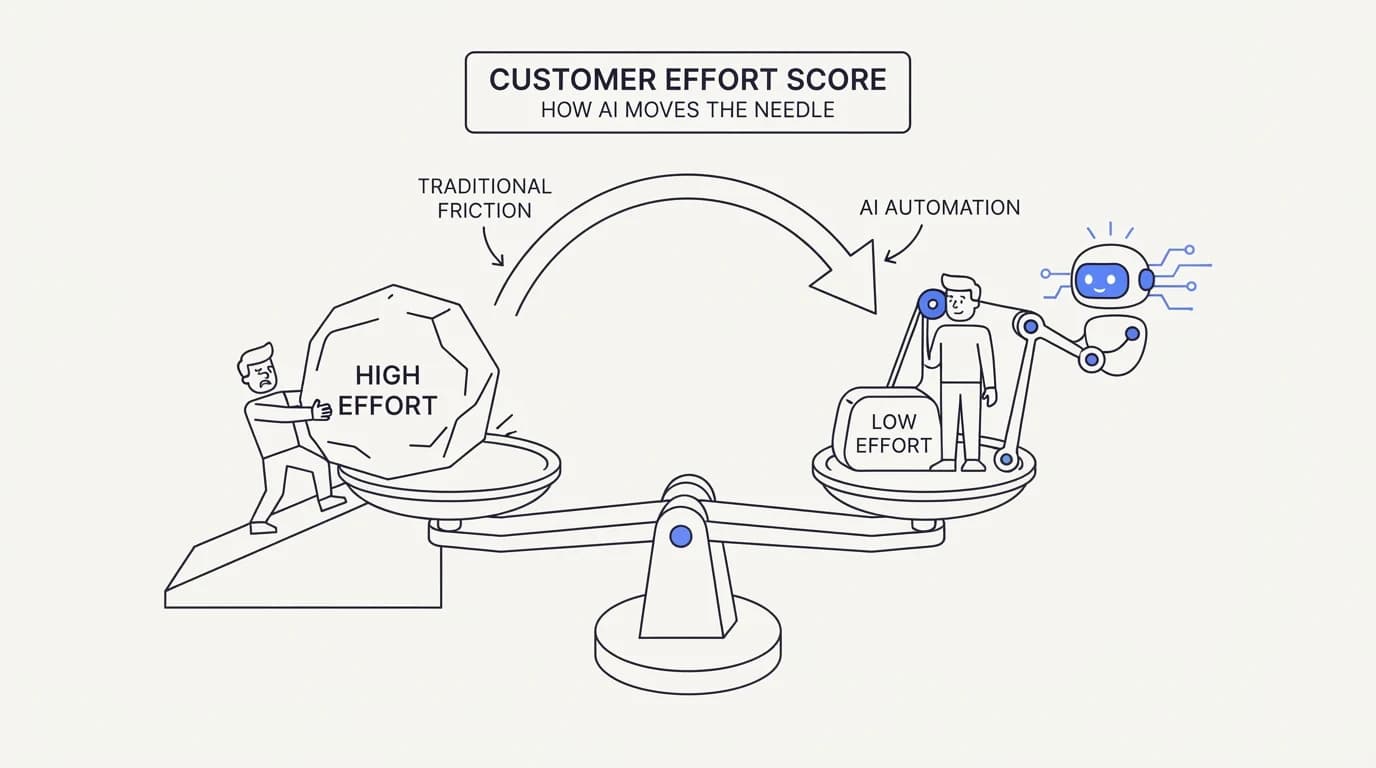
CES predicts repurchase and churn better than CSAT for support interactions. Here is how to measure it, and where AI lowers or raises it.
TL;DR: Customer effort score asks a single question after a support interaction: how much work did it take to get your problem solved. It was introduced in a 2010 Harvard Business Review study of more than 75,000 interactions, and low-effort experiences correlated with repurchase intent far more strongly than satisfaction did. This guide covers where CES came from, how to measure it correctly, and why it predicts churn earlier than CSAT for support specifically. It also covers the part most CES guides skip: an AI agent can push the score in either direction depending entirely on how the handoff to a human is built, not on whether AI is present at all. The rest walks through a comparison table, a program design that catches the failure mode, and how a grounded agent is meant to lower effort rather than just answer faster.
What customer effort score actually measures
Customer effort score, usually shortened to CES, asks a customer to rate how much effort it took to get their issue resolved, typically on a five or seven-point scale after a support interaction closes. It is deliberately narrow. Where CSAT asks how satisfied a customer felt and NPS asks how likely they are to recommend the company, CES asks only about the work the customer had to do to get an answer.
The standard wording asks something close to: the company made it easy for me to handle my issue. Customers respond on a scale from strongly disagree to strongly agree, and the resulting average becomes the CES for that period, channel, or agent.
Effort in this context covers more than time. A customer who waits three minutes but gets a complete answer on the first try reports lower effort than a customer who waits thirty seconds but has to repeat their account details to three different people before anyone can help.
Effort also has a cognitive component that a stopwatch cannot see. A customer reading three different, slightly conflicting instructions across a chat and two follow-up emails has done real work interpreting and reconciling them, even though the total elapsed time might look identical to a single clean reply.
A support team that only measures speed can hit every response-time target while effort quietly climbs, because speed and effort are correlated but not identical. CES exists precisely to catch the gap between the two.
Where CES came from and why it displaced satisfaction scores
CES was introduced in a 2010 Harvard Business Review article titled Stop Trying to Delight Your Customers, written by Matthew Dixon, Karen Freeman, and Nick Toman at the Corporate Executive Board, now part of Gartner. Their study analyzed more than 75,000 customer service interactions and found that reducing effort predicted loyalty far better than exceeding expectations did.
The numbers from that study are still the ones most CES programs cite. Of customers who reported a low-effort experience, 94 percent said they intended to repurchase and 88 percent said they intended to increase their spending, according to the same HBR study. Among customers who had a high-effort experience, 81 percent said they intended to spread negative word of mouth.
The finding upended a decade of service strategy built around delight. Delivering a surprise upgrade or a handwritten note felt good to deliver and tested well in isolated surveys, but it did almost nothing for retention compared to simply removing friction from the ordinary path to an answer.
The study's broader argument was that most customers do not want to be delighted. They want their problem solved with as little disruption to their day as possible, and a service strategy built around surprising them treats a rare, expensive gesture as more valuable than the ordinary, repeatable act of not wasting their time.
How to calculate and survey for CES
Send the CES survey immediately after the interaction closes, not days later, because effort is a fresh, specific memory and degrades fast into a vaguer overall impression of the company. A delayed survey measures brand sentiment more than it measures the interaction you actually want feedback on.
Score responses on a numeric scale and average them per channel, per agent, and per ticket category, the same slicing you would apply to a first response time metric. A blended company-wide CES hides the category actually driving churn, usually a specific workflow like billing disputes or account recovery.
Pair every CES response below a set threshold with the transcript it came from. A low score with no context tells you effort was high somewhere. The transcript tells you whether the customer had to repeat information, wait on a transfer, or read a confusing set of instructions, and only the transcript makes the finding actionable.
Keep the survey to one question. Adding follow-up fields to a CES survey drops response rates fast, and a two-question survey with a 20 percent response rate is less useful than a one-question survey with a 60 percent response rate, even though the second question feels like it should add insight.
Why CES predicts loyalty better than CSAT for support interactions
CSAT measures how a customer felt in the moment, which a polite tone and a fast reply can inflate even when the underlying problem was not actually solved. CES measures whether the work got done with minimal friction, which correlates more directly with whether the customer has to come back, a distinction covered from the escalation side in support escalation workflow design.
A customer who has to contact support three times for the same issue can still rate each individual interaction highly on CSAT, because each agent was pleasant and each reply was fast. CES catches what CSAT misses here because a repeat contact is itself a high-effort signal, whether or not any single interaction felt unpleasant.
This is also why CES tends to move first when a support operation is degrading. A rising average handle time or a growing backlog shows up in CES before it shows up in CSAT, because customers register the extra effort of a slower or more repetitive process well before they consciously downgrade their satisfaction rating.
Treat CES as a leading indicator and CSAT as a lagging one. A support leader watching only CSAT for early warning is reading a metric that moves after the damage is already done, while CES tends to move while the problem is still small enough to fix quickly.
| Metric | What it asks | Predicts repurchase intent | Catches a repeat-contact problem | Easy to inflate with a friendly tone |
|---|---|---|---|---|
| Customer effort score | How much work it took to get the issue resolved | ✓ strongest signal per the 2010 HBR study | ✓ repeat contact reads as high effort | ✗ tied to a concrete friction point |
| CSAT | How satisfied the customer felt with this interaction | ✗ weak alone | ✗ each visit can score well individually | ✓ tone alone can move the score |
| Net promoter score | How likely the customer is to recommend the company | ✗ measures brand, not the interaction | ✗ measured too infrequently | ✓ reflects overall brand feeling |
How AI lowers customer effort when it works
An AI agent lowers effort the same way a good human agent does: it answers on the first attempt without making the customer repeat themselves or wait for a transfer. A grounded agent answering from connected documentation through retrieval can resolve a routine question in the time it takes to type it, which is the lowest-effort path a support interaction can take.
Availability is a second, quieter effort reduction. A customer who gets an answer at 11pm instead of waiting until morning support hours reopen has done less total work to get resolved, even if the interaction itself takes the same amount of time, a point covered in 24/7 customer support coverage.
Service organizations running AI agents in production reached 66 percent in 2026, up from 39 percent in 2025 per Salesforce data reported by DigitalApplied, which means CES is increasingly a metric measured across a mixed AI and human queue, not a purely human one. The effort reduction only holds when the agent actually resolves the question instead of producing a confident, wrong answer that generates a second contact.
Consistency is a third, less obvious effort reduction. A human queue can give the same question two slightly different answers depending on which agent picks it up, and a customer who compares notes with a colleague and gets two different explanations has to do extra work reconciling them. An agent answering from the same grounded source every time removes that variance.
None of this means speed alone is the goal. A fast, wrong answer generates more total effort than a slightly slower, correct one, because the customer has to notice the error, come back, and re-explain the issue, which is the same trap covered from the accuracy side in reducing AI hallucinations in support.
How AI raises customer effort when handoff breaks down
The most common complaints about AI support tools are hallucinated answers, no escalation path, a robotic tone, and no awareness of prior context, according to Twig. Every one of those complaints is, functionally, an effort complaint: the customer had to do more work than they should have to get resolved.
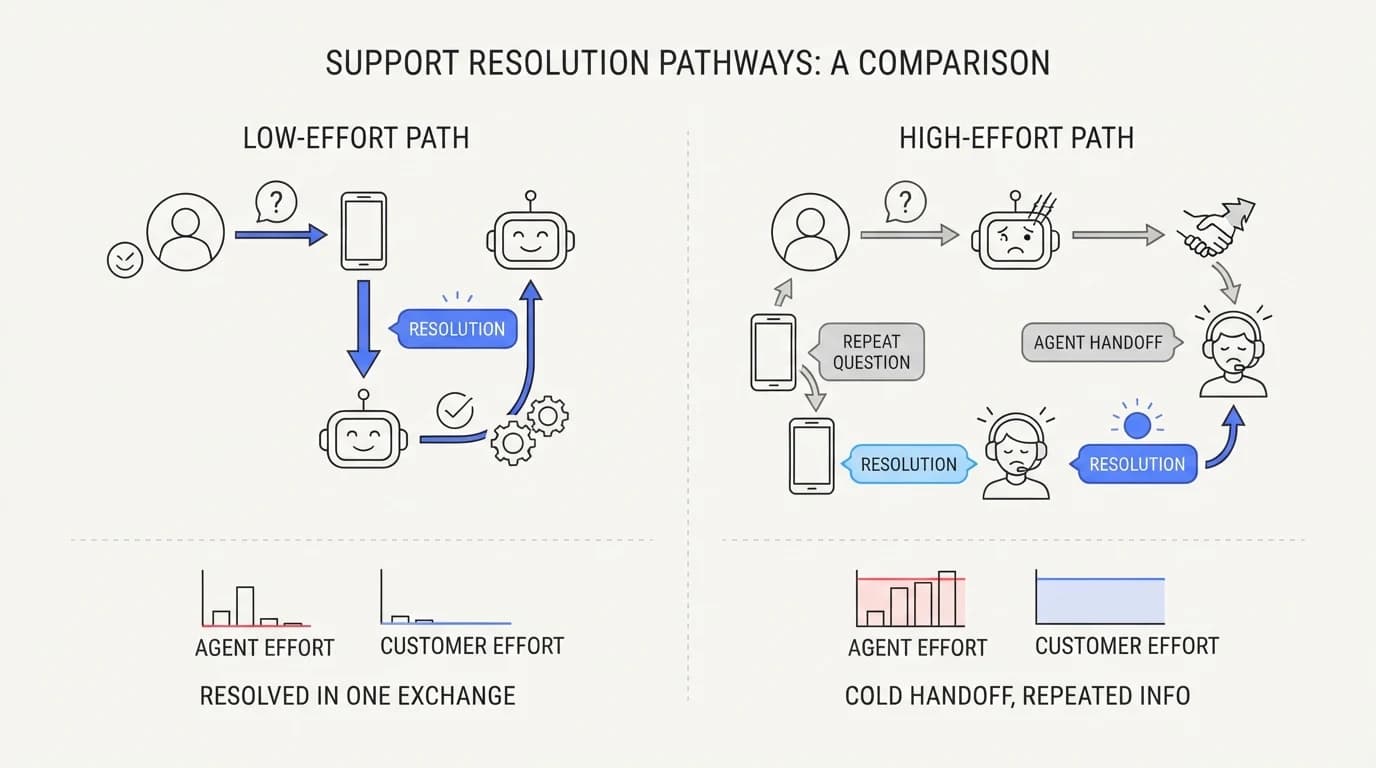
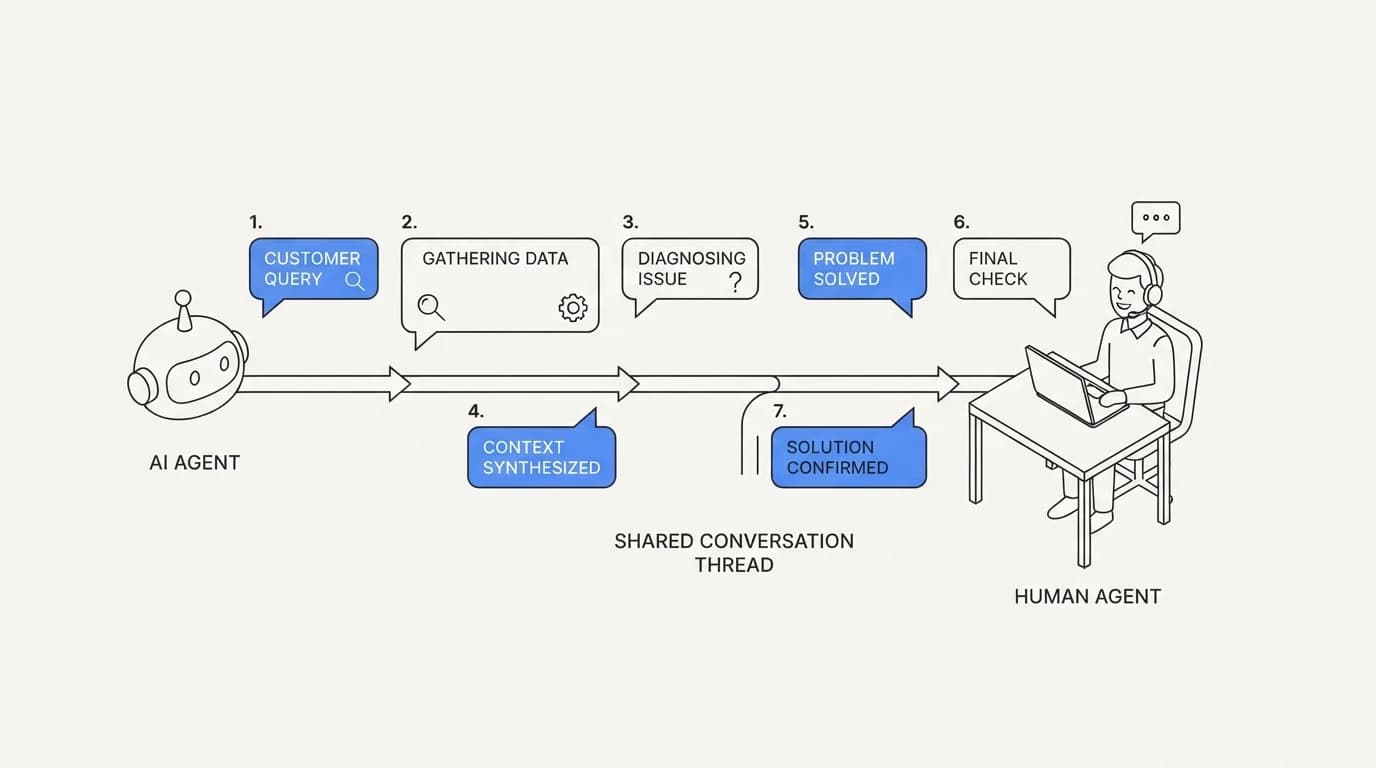
A cold handoff is the sharpest effort spike in a mixed AI and human queue. A customer who explains their issue to an agent, gets escalated, and then has to explain the same issue again to a human has done double the work for one resolution, the exact failure the AI to human handoff design is meant to prevent by carrying the full conversation across the transfer.
Organizations reporting a negative consequence from generative AI rose from 44 percent in 2024 to 51 percent in 2025, per CMSWire. A rising CES alongside rising AI adoption is usually a handoff design problem rather than a reason to remove the agent, and treating it as the latter throws away the effort savings from the cases the agent handles cleanly.
A robotic tone adds a smaller but real effort cost too. A reply that reads as generic or unresponsive to the specific words the customer used forces them to re-read and re-explain in different terms, hoping the next reply lands closer to their actual question, which is itself extra work even before a human ever gets involved.
 Communicate.so
Building a CES program that catches the AI failure modes
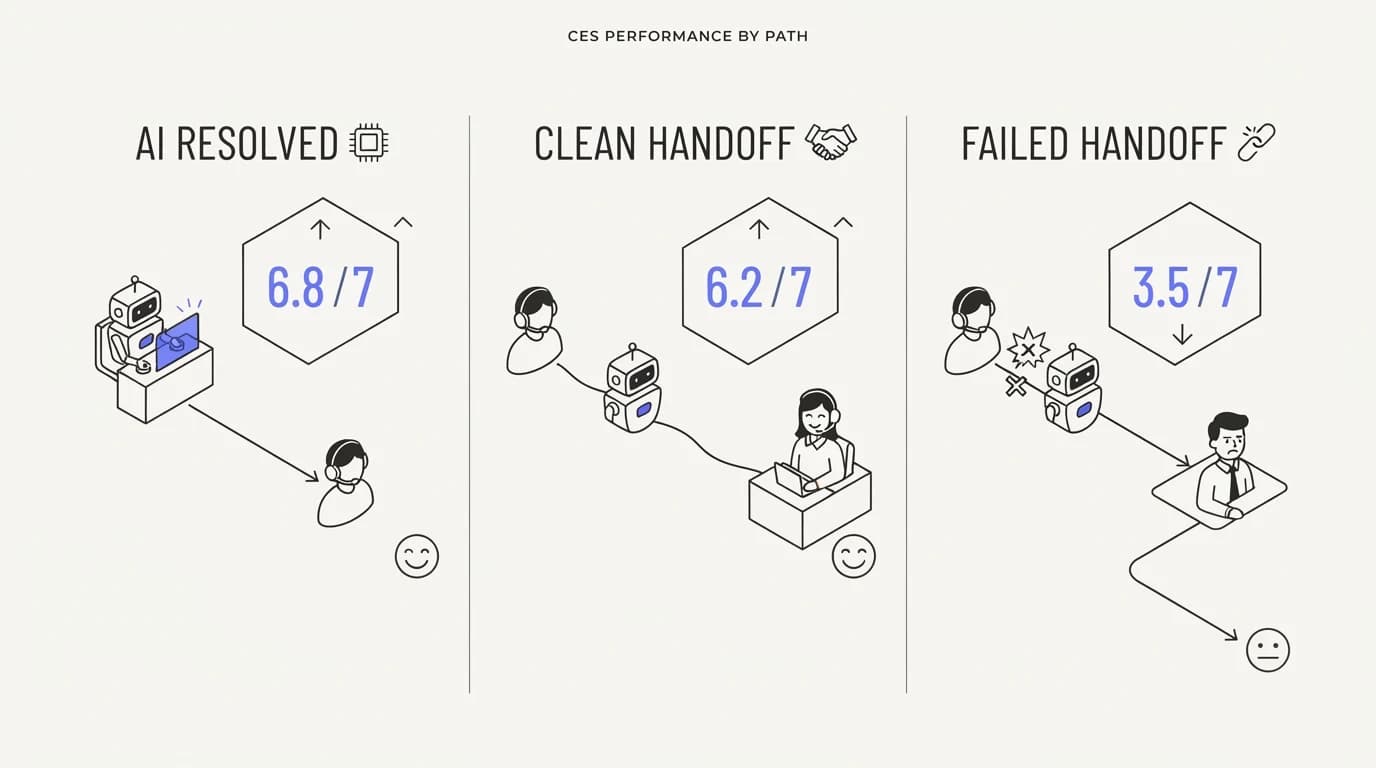
Split CES by resolution path, not just by channel. A ticket the AI agent resolved alone, a ticket the AI escalated cleanly, and a ticket the AI escalated after a failed attempt are three different effort profiles, and averaging them into one number hides which one is actually dragging the score down, a split worth pairing with analytics on where escalations originate.
Watch the escalation-after-failed-attempt category specifically, since it is the one most likely to combine two effort costs: the customer's own failed attempt with the AI, plus a fresh explanation to a human. A queue where that category has a materially worse CES than a direct-to-human escalation is telling you the handoff, not the AI's accuracy, is the actual problem, a distinction ai-agent guardrails design should be built around.
Set a CES floor for automated resolution, not just an aggregate target. If the score on AI-resolved tickets drops below the score on human-resolved tickets for the same category, that is a signal to tighten grounding or narrow what the agent is allowed to answer alone, before the gap becomes a churn problem.
Review the failed-attempt category on a fixed cadence rather than waiting for it to show up as a broader trend. A weekly pass through the transcripts in that category usually surfaces one or two specific question types the agent keeps mishandling, which is a narrower and faster fix than a general retraining pass across the whole rubric.
 Communicate.so
What a low CES actually costs you
The repurchase numbers from the original CEB study still hold as the baseline case for taking CES seriously: 94 percent repurchase intent on low effort against 81 percent negative word of mouth on high effort, per HBR. A support operation that treats CES as a secondary metric behind CSAT is optimizing for the wrong side of that gap.
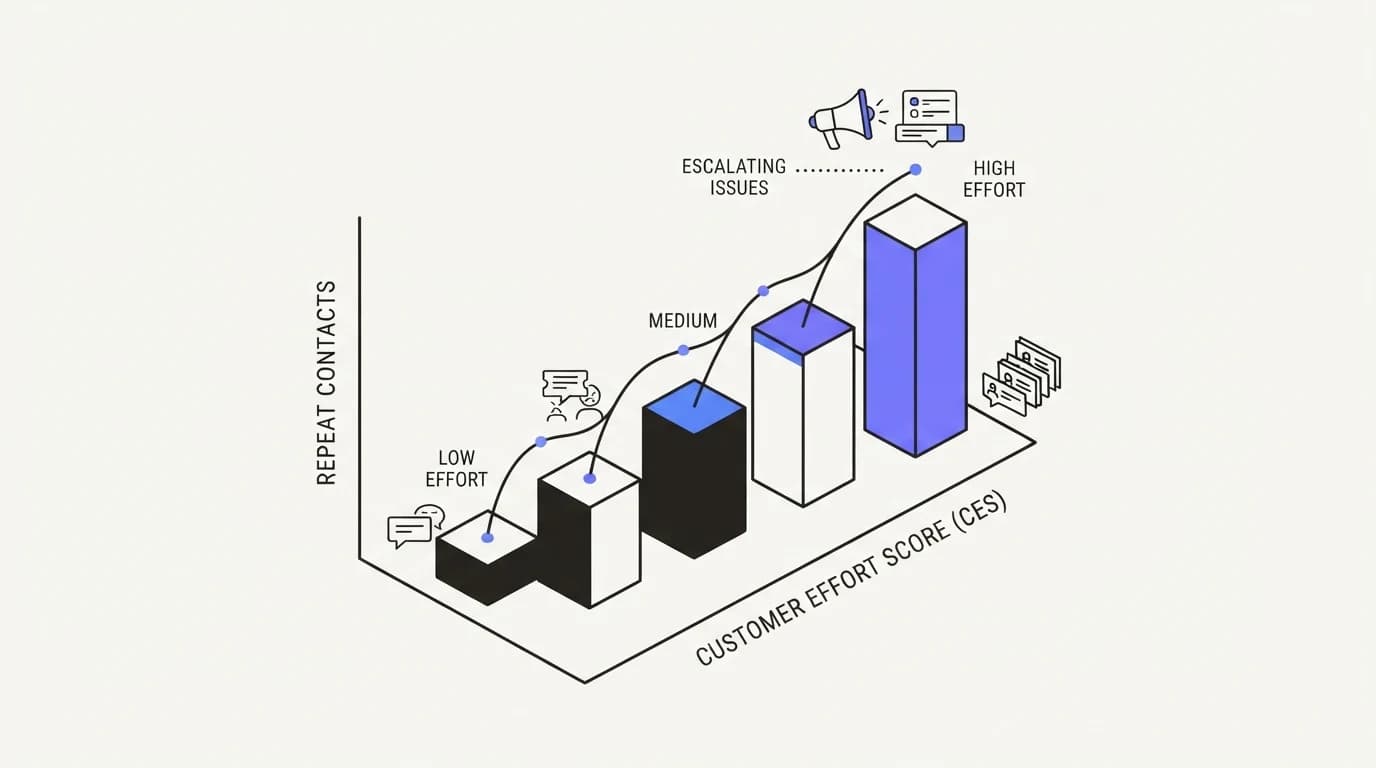
The cost also compounds through repeat contact volume. Every high-effort interaction that ends without resolution generates a second ticket, which raises average handle time across the queue and lowers the effective deflection rate a team reports, even when the underlying issue was simple.
There is a staffing cost hiding in that same repeat contact volume. A queue where a fifth of tickets are actually a second or third attempt at the same issue is carrying headcount to handle repeat work that a lower-effort first interaction would have removed entirely, which shows up as a budget line long before anyone traces it back to CES.
 Communicate.so
How communicate.so is built to lower effort, not just deflect tickets
Communicate grounds every reply in your connected content through retrieval so the first answer is more likely to be right, which is the single biggest lever on effort: a correct first answer removes the need for a second contact entirely. The shared inbox keeps the AI and a human on the same conversation thread, so a handoff carries full context instead of forcing the customer to explain themselves twice.
The human handoff uses presence-based takeover with a per-turn backstop, so a person can step in mid-conversation without restarting it. That single design choice is what keeps an escalation from becoming the highest-effort path in the queue instead of a clean continuation of the same thread.
On the model side, Communicate runs a single model, gpt-4o-mini through OpenRouter, with response and prompt caching to hold cost and latency down, since a slow first reply is itself an effort cost even before the content of the answer is judged. The security posture matters here too, since a customer asked to re-verify their identity because of a broken session is absorbing effort a well-built handoff should never create.
 Communicate.so
Frequently asked questions
What is customer effort score
Customer effort score is a single-question metric, usually asked right after a support interaction closes, measuring how much work it took the customer to get their issue resolved. It comes from a 2010 HBR study and is scored on a five or seven-point agreement scale.
Who created customer effort score
Matthew Dixon, Karen Freeman, and Nick Toman at the Corporate Executive Board, now part of Gartner, introduced CES in the July 2010 Harvard Business Review article Stop Trying to Delight Your Customers, based on an analysis of more than 75,000 customer interactions.
What is a good customer effort score
There is no universal good score, since the scale and wording vary between programs. The number that matters is the trend within your own queue, split by resolution path and ticket category, compared against your own baseline rather than an external benchmark.
A score that holds steady while ticket volume grows is a better sign than a single high absolute number measured on a small sample, since the second can move sharply on a handful of responses in either direction.
How is CES different from CSAT
CSAT measures how satisfied a customer felt with an interaction. CES measures how much work the interaction took. A customer can rate an interaction highly on CSAT because the agent was pleasant, while still reporting high effort because they had to repeat information or wait on a transfer, a gap covered in cutting first response time.
How is CES different from NPS
NPS asks whether a customer would recommend the company overall, which reflects brand sentiment built up over many interactions. CES asks about one specific interaction and is measured immediately after it closes, making it more diagnostic for a support team trying to fix a specific workflow.
NPS is typically collected quarterly across the whole customer base, while CES is collected after every interaction that closes. The two serve different owners: NPS informs company-level strategy, CES informs day-to-day support operations.
Why does CES predict repurchase better than satisfaction
The original 2010 study found that 94 percent of customers reporting a low-effort experience intended to repurchase and 88 percent intended to increase spending, against 81 percent of high-effort customers intending to spread negative word of mouth, per HBR. Effort correlates with whether a customer sticks around more directly than a moment-in-time satisfaction rating does.
When should a CES survey be sent
Immediately after the interaction closes. Effort is a specific, fresh memory that fades into a vaguer overall impression within a day or two, so a delayed survey measures general sentiment rather than the interaction you actually want feedback on.
For a chat or in-app interaction, send it in the same session, before the customer navigates away. A follow-up email survey sent hours later will always collect a smaller, less representative response set.
Does AI automatically improve customer effort score
No. AI lowers effort when it resolves a question correctly on the first attempt and raises it when a customer has to repeat themselves after a failed AI attempt or a cold handoff, one of the most common complaints about AI support tools according to Twig.
What is a cold handoff and why does it hurt CES
A cold handoff is a transfer from an AI agent to a human that loses the conversation context, forcing the customer to explain their issue again. It is one of the sharpest effort spikes a support queue can produce, and the AI to human handoff design exists specifically to prevent it by carrying context across the transfer.
How should CES be segmented to catch AI-specific problems
Split by resolution path: tickets the AI resolved alone, tickets it escalated cleanly, and tickets it escalated after a failed attempt. The failed-attempt-then-handoff category usually carries the worst effort score and is the clearest sign the handoff, not the AI's accuracy, needs attention, a split worth pairing with analytics.
Can a high CES coexist with a high CSAT
Yes, and it is a common pattern. An agent can be pleasant and fast while the process still forces a customer to repeat information or contact support multiple times, which CSAT will not catch but CES will.
A team that only watches CSAT can spend a quarter believing its support is strong while the CES trend, unwatched, is already flagging a growing repeat-contact problem underneath a friendly surface.
How does repeat contact volume relate to CES
A high-effort interaction that does not resolve on the first attempt generates a second ticket, which raises average handle time across the queue and understates the deflection rate a team reports, even for a simple underlying issue.
A channel that requires the customer to switch context partway through, such as being told to call a phone number after starting in chat, adds effort on its own too, independent of how well the eventual answer resolves the issue, and often shows up in the same repeat-contact data.
What ticket categories usually drive the worst CES
Billing disputes, account recovery, and any workflow requiring identity verification across multiple steps tend to score worst, because each step adds real work for the customer regardless of how quickly or pleasantly it is handled.
These categories are also the ones most likely to route through several systems or several people, and every additional handoff inside that path is another opportunity for the customer to repeat information they already gave once.
How often should a support team review CES
Weekly at minimum for a team running meaningful ticket volume, since a degrading process shows up in CES before it shows up in CSAT. A monthly-only review lets a friction point compound for weeks before anyone notices the trend.
A smaller team with lower volume can review biweekly without losing much, as long as the review still splits by resolution path rather than reading one blended number, since a blended number moves slowly enough that biweekly review can still catch it in time.
Does adding more self-service options lower CES
Only if the self-service option actually resolves the question. A help center article the customer cannot find, or an AI agent that answers from stale content, adds effort rather than removing it, which is why keeping the source material current matters as much as training the agent on it in the first place.
More options without better findability can raise effort too, since a customer now has to choose between a help article, a chat widget, and an email form before they even start solving the problem. Fewer, well-signposted paths usually beat a wide menu of self-service choices.
What is the single biggest lever for improving CES
A correct first answer. Every other effort reduction, faster response, better tone, cleaner handoff, matters less than whether the customer got a resolution without having to contact support a second time for the same issue.
Teams that chase CES through tone training or faster response times without first fixing accuracy tend to see the score stall, because the biggest single source of effort, having to come back and ask again, never goes away.
How does CES relate to churn
CES tends to move ahead of both CSAT and NPS when service quality degrades, since customers register the extra work of a slower or more repetitive process before they consciously lower a satisfaction rating. A support team watching CES alongside escalation workflow health catches a churn risk earlier than a team watching CSAT alone.
Can CES be gamed the way CSAT sometimes is
It is harder to game, since it is tied to a concrete, verifiable friction point rather than a general impression a friendly tone can shift. A customer who had to repeat their account number three times will report high effort regardless of how polite the final agent was.
The closest thing to gaming CES is suppressing the survey itself, only sending it after a smooth interaction and skipping it after a rough one. That inflates the reported number while leaving the underlying friction untouched, which shows up later as a churn number the survey never predicted.
What survey scale should a CES program use
A five or seven-point agreement scale against a statement like the company made it easy for me to handle my issue is standard and matches the original research. Consistency across periods matters more than which specific scale you pick.
Switching scales midway through a program breaks the historical trend line, since a five-point average and a seven-point average are not directly comparable. Pick one early and keep it fixed even as the program matures.
Should CES scores affect agent or AI agent evaluation
Yes, alongside accuracy and escalation correctness, the same dimensions a QA rubric should already be scoring. A low CES tied to a specific agent or a specific AI resolution path points directly at where to focus a fix.
Treat CES as one input among several rather than the sole evaluation criterion, since a small sample of responses for a single agent can swing on a handful of scores. Pair it with the transcript-level QA finding before drawing a conclusion about any one agent's performance.